
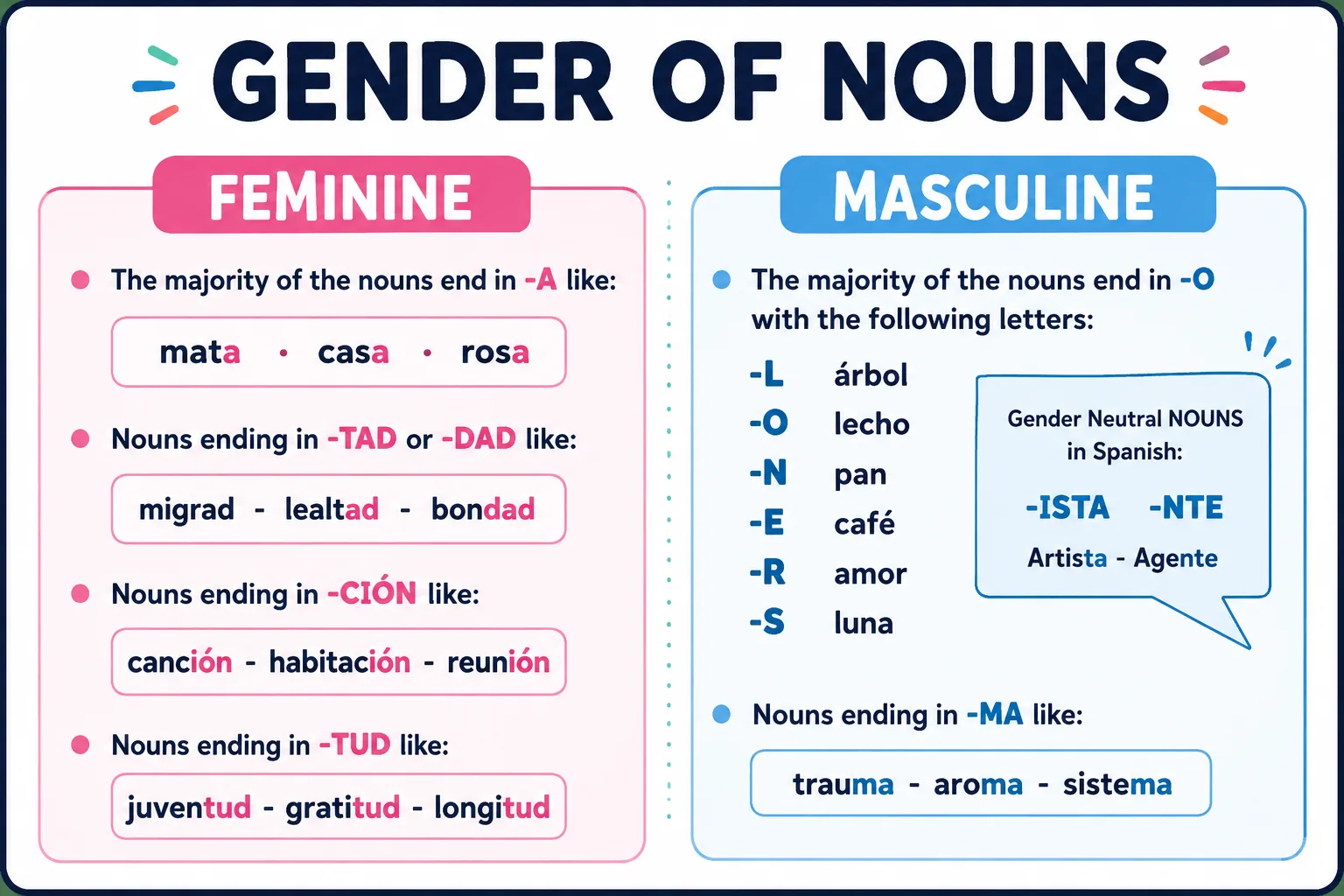
Every Spanish noun has a grammatical gender - masculine or feminine - and the gender affects the articles, adjectives, and pronouns that surround it. Unlike English, which marks gender only on a small set of personal pronouns, Spanish carries gender through nearly every noun phrase. Fortunately, Spanish gender is far more predictable than French or German. The ending of a noun almost always points to its gender, and the exceptions are a manageable list rather than an unbounded minefield.
This reference lays out the core rules, the most important exception classes, the gender behavior of common noun types, and the agreement patterns for articles and adjectives. For how gender interacts with verbs and pronouns, see the Spanish pronouns reference. For how to pronounce these endings correctly, see the Spanish alphabet pronunciation guide. For the broader grammar foundations, see the Spanish grammar rules guide for beginners.
The Primary Rules
Rule 1. Nouns ending in -o are usually masculine.
- el libro (the book), el perro (the dog), el dinero (the money).
Rule 2. Nouns ending in -a are usually feminine.
- la casa (the house), la mesa (the table), la puerta (the door).
Rule 3. Nouns ending in -ion, -dad, -tad, -tud, -umbre are feminine.
- la nacion (nation), la ciudad (city), la libertad (freedom), la virtud (virtue), la costumbre (custom).
Rule 4. Nouns ending in -or, -aje, -ma (from Greek) are usually masculine.
- el amor, el viaje, el programa, el tema, el idioma, el problema, el sistema.
Rule 5. Days of the week, months, points of the compass, languages, rivers, mountains, seas are masculine.
- el lunes, el enero (but often just "enero"), el norte, el espanol, el Amazonas.
Rule 6. Letters of the alphabet are feminine, numbers are masculine.
- la a, la b (as letter names); el uno, el dos.
Memory aid: "The o brings the boy, the a brings the girl" covers the base case but fails for half a dozen important classes. Learn the -cion, -dad, -or patterns as drilled rules, not exceptions.
Systematic Exceptions
Table 1. Common masculine nouns ending in -a.
| Noun | Meaning | Source |
|---|---|---|
| el dia | day | irregular Latin |
| el mapa | map | shortened from maapa |
| el planeta | planet | Greek origin |
| el problema | problem | Greek -ma |
| el sistema | system | Greek -ma |
| el tema | theme, topic | Greek -ma |
| el programa | program | Greek -ma |
| el clima | climate | Greek -ma |
| el idioma | language | Greek -ma |
| el drama | drama | Greek -ma |
| el poema | poem | Greek -ma |
| el sofa | sofa | Arabic |
Table 2. Common feminine nouns ending in -o.
| Noun | Meaning | Source |
|---|---|---|
| la mano | hand | Latin manus (f) |
| la foto | photograph | short for la fotografia |
| la moto | motorcycle | short for la motocicleta |
| la radio | radio | variable; masc in some regions |
| la libido | libido | Latin |
Endings That Reliably Signal Gender
Table 3. Predictive endings for gender.
| Ending | Usual gender | Examples |
|---|---|---|
| -o | masculine | el libro, el vaso |
| -a | feminine | la casa, la mesa |
| -cion | feminine | la cancion, la nacion |
| -sion | feminine | la profesion |
| -dad | feminine | la ciudad |
| -tad | feminine | la amistad |
| -tud | feminine | la actitud |
| -umbre | feminine | la costumbre |
| -ez | feminine | la vejez |
| -ie | feminine | la especie, la serie |
| -or | masculine | el amor, el calor (but la flor, la labor) |
| -aje | masculine | el viaje, el coraje |
| -ma (Greek) | masculine | el problema, el tema |
| -ante | often masculine (agent nouns) | el estudiante |
| -l, -n, -r, -s, -z | can be either | el papel (m), la piel (f) |
Nouns with Two Genders
Some nouns have both forms, differing by meaning:
Table 4. Gender-differentiated pairs.
| Masculine | Meaning | Feminine | Meaning |
|---|---|---|---|
| el capital | capital (money) | la capital | capital (city) |
| el cura | priest | la cura | cure |
| el papa | pope | la papa | potato (Latin America) |
| el frente | front (battle) | la frente | forehead |
| el guia | male guide | la guia | female guide, guidebook |
| el orden | order (sequence) | la orden | order (command) |
| el policia | policeman | la policia | police force / policewoman |
| el coma | coma | la coma | comma |
| el corte | cut | la corte | court |
Context tells you which is meant. Memorizing the full list pays off.
Masculine Article with Feminine Nouns
A quirk of Spanish: feminine singular nouns that begin with a stressed a- or ha- take the masculine article el (and un) in the singular to avoid the awkward double-a:
- el agua fria (the cold water) - but plural las aguas frias.
- el hacha afilada (the sharp axe) - but plural las hachas.
- el alma (the soul) - but las almas.
- el hambre (hunger).
The noun is still feminine: adjectives agree with feminine (fria, afilada, not *frio, *afilado). Only the article is masculine in the singular. This rule does not apply when the a- is unstressed: la avenida (the avenue), la amiga (the friend).
Gender of People and Animals
Most nouns for people switch ending to mark natural gender:
- el chico / la chica (boy / girl)
- el medico / la medica (male doctor / female doctor) - though usage varies
- el profesor / la profesora (teacher)
Some nouns ending in -ante, -ista, -iente use a single form for both, with article distinguishing:
- el / la estudiante, el / la periodista, el / la presidente (though la presidenta is now common).
Some traditional professions have accepted feminine forms only recently: la jueza (female judge), la ingeniera (female engineer).
For animals, many have a single gender form that covers both sexes (el ratón = mouse of either sex; la rana = frog of either sex). For clarity: "el raton macho" (male mouse), "la rana hembra" (female frog).
Adjective Agreement
Adjectives agree with their noun in gender and number. An adjective ending in -o has four forms:
Table 5. Adjective agreement for rojo (red).
| Masculine | Feminine | |
|---|---|---|
| Singular | rojo | roja |
| Plural | rojos | rojas |
An adjective ending in -e has only two forms (singular, plural): grande, grandes. Adjectives ending in a consonant typically add -es for plural: azul/azules.
Some adjectives of nationality add -a for feminine even when the masculine doesn't end in -o: espanol / espanola, frances / francesa, aleman / alemana.
Articles
Table 6. The full article system.
| Masculine singular | Feminine singular | Masculine plural | Feminine plural | |
|---|---|---|---|---|
| Definite | el | la | los | las |
| Indefinite | un | una | unos | unas |
Contractions: a + el = al, de + el = del (but not with proper nouns: a El Salvador, not al Salvador).
Lo is the neuter article, used with adjectives to form abstract nouns: lo bueno (the good thing), lo importante (what's important). It never modifies a noun.
Gender of Abstract and Collective Nouns
Abstract nouns ending in:
- -idad, -cion, -ez: feminine (la felicidad, la libertad, la rapidez)
- -ismo, -aje, -or: masculine (el romanticismo, el aprendizaje, el amor)
Collective nouns follow regular rules based on their endings.
Common Mistakes Learners Make
- Assuming -a = feminine always. Greek-origin -ma nouns are masculine (el problema, el sistema).
- Mismatching adjective gender after el agua. El agua frio is wrong; the noun is still feminine - el agua fria.
- Forgetting to change the adjective when the noun is feminine. El coche rojo vs la casa roja, not la casa rojo.
- Overusing the personal a. Required before specific animate direct objects, not indefinite ones (see the Spanish pronouns reference).
- Failing to pluralize adjectives. Los libros rojos, not los libros rojo.
- Using la dia. Day is masculine: el dia.
- Treating mano as masculine. La mano - one of the most common feminine -o nouns.
- Using "al" before feminine el. a + el agua = al agua is actually correct because el agua formally takes el. This is fine.
Quick Reference
Default rules:
- -o = masculine; -a = feminine.
- -cion/-sion/-dad/-tad/-tud/-umbre/-ez = feminine.
- Greek -ma = masculine.
- -or, -aje = masculine.
- Days, months, languages, rivers, mountains, numbers = masculine.
- Letters = feminine.
Always memorize by article: when you learn a new noun, memorize it with its article: "el arbol, la flor." Never learn "arbol" alone.
Special article rule: feminine nouns beginning with stressed a-/ha- take el/un in the singular.
FAQ
Why is "el agua" masculine if water is feminine?
The article is masculine to avoid a clash of two a-sounds (la agua). The noun remains grammatically feminine - adjectives agree with feminine, and the plural is las aguas.
Why does "mano" end in -o but take la?
It inherited from Latin "manus," which was feminine. A handful of Spanish nouns preserve this Latin-origin gender against their ending's normal signal.
How do I know if a new noun is masculine or feminine?
Check the ending using the rules above. For ambiguous endings (-e, -l, -n, -r, -s, -z), consult a dictionary and memorize with the article.
Do foreign words take a specific gender?
Usually masculine by default: el pizza (incorrect - la pizza is standard), el email, el software. But pizza is feminine, as is chocolate in some regions historically. Exceptions exist; dictionaries help.
Is "el problema" really masculine?
Yes. All Greek-origin -ma nouns (problema, sistema, tema, clima, idioma, programa, poema, drama, telegrama) are masculine.
Can I say "la presidente"?
Yes. In current usage "la presidenta" is also widely accepted, especially in Latin America. Both are considered correct.
Why isn't there a neuter gender?
There is, vestigially: the article lo is neuter but cannot modify nouns - only adjectives to form abstract nominals (lo bueno).
See Also
- Spanish grammar rules complete beginners guide
- Spanish alphabet pronunciation guide
- Spanish verb conjugation system -AR -ER -IR reference
- Spanish pronouns: direct, indirect, reflexive
- Ser vs estar complete guide
- Spanish subjunctive mood reference
- Spanish past tense: preterite vs imperfect
- Spanish por vs para reference
Frequently Asked Questions
Why is 'el agua' masculine if water is feminine?
The article is masculine to avoid two a-sounds clashing (la agua). The noun agua is still grammatically feminine, so adjectives use feminine forms and the plural is las aguas.
Why does 'mano' end in -o but take la?
It inherited its gender from Latin ‘manus,’ which was feminine. A handful of Spanish nouns preserve their Latin gender despite their ending.
How do I know the gender of a new noun?
Check the ending against the main rules: -o = m, -a = f, -cion/-dad/-tad/-tud/-umbre = f, Greek -ma = m, -or/-aje = m. For ambiguous endings, consult a dictionary and always memorize with the article.
Do foreign words take a specific gender?
They are usually assigned masculine by default (el email, el software), but some have a settled feminine gender (la pizza). Dictionaries confirm.
Is 'el problema' really masculine?
Yes. All Greek-origin -ma nouns are masculine: problema, sistema, tema, clima, idioma, programa, poema, drama, telegrama.
Can I say la presidenta?
Yes. Both la presidente and la presidenta are accepted; la presidenta is widely used, especially in Latin America.
Is there a neuter gender in Spanish?
Vestigially. The neuter article ‘lo’ exists but modifies adjectives only, forming abstract nouns (lo bueno).