
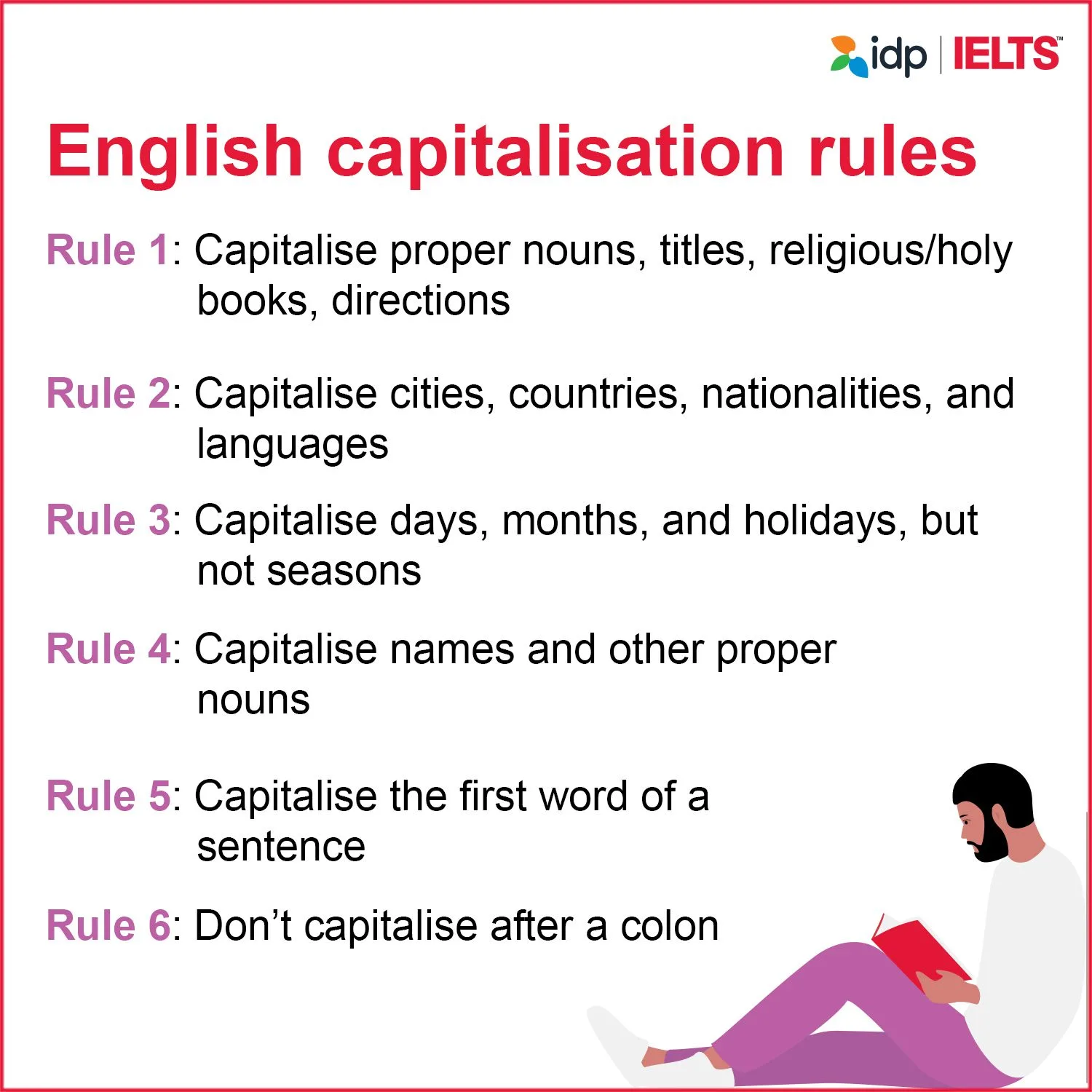
Capitalization in English follows a set of rules that seem straightforward until you encounter the exceptions. You know to capitalize the first word of a sentence and proper nouns like names of people and places. But what about job titles? Seasons? Directions? The word after a colon? These gray areas trip up even experienced writers and create inconsistencies in professional documents, academic papers, and business communications.
This guide covers every capitalization rule in English, from the basics you already know to the nuanced cases that cause the most confusion. Each rule includes clear examples so you can apply it immediately in your writing.
Rule 1 - First Word of a Sentence
Always capitalize the first word of a sentence. This is the most basic capitalization rule and applies universally.
- The meeting starts at nine.
- After reviewing the data, the team made its recommendation.
- Running is excellent cardiovascular exercise.
After a Colon
Whether to capitalize the first word after a colon depends on what follows.
Capitalize when a complete sentence follows the colon:
- The CEO made one thing clear: The company would not compromise on quality.
- The data reveals an important trend: Customer retention rates have improved every quarter.
Do not capitalize when a fragment, list, or explanation follows the colon:
- She brought three items: a notebook, a pen, and a calculator.
- The answer was simple: better communication.
- The recipe calls for one key ingredient: fresh basil.
Note: Style guides differ on this point. APA and Chicago styles capitalize after a colon when a complete sentence follows. AP style capitalizes only when the colon introduces more than one sentence. Choose a convention and apply it consistently.
After a Semicolon
Never capitalize the first word after a semicolon (unless it is a proper noun).
- The report was thorough; however, it missed several key metrics.
- Sales increased in Q3; the trend continued through Q4.
Rule 2 - Proper Nouns
Proper nouns name specific people, places, organizations, and things. They are always capitalized. Common nouns name general categories and are not capitalized.
People
- Albert Einstein developed the theory of relativity.
- The team is led by Sarah Chen and Marcus Williams.
- We invited Professor Rodriguez to speak at the event.
Places and Geographic Names
Capitalize the names of specific places: continents, countries, states, cities, streets, buildings, parks, bodies of water, mountains, and regions when they refer to recognized geographic areas.
| Category | Capitalized | Not Capitalized |
|---|---|---|
| Continents | Africa, Asia, Europe | the continent, overseas |
| Countries | Japan, Brazil, France | the country, abroad |
| States/Provinces | California, Ontario, Bavaria | the state, the province |
| Cities | London, Tokyo, New York | the city, downtown |
| Streets | Main Street, Fifth Avenue | the street, the avenue |
| Buildings | the Empire State Building | the office building |
| Parks | Yellowstone National Park | the park, the national park |
| Bodies of water | the Pacific Ocean, Lake Michigan | the ocean, the lake |
| Mountains | Mount Everest, the Rocky Mountains | the mountain, the peak |
| Regions | the Midwest, the South, the Middle East | head south, drive west |
The Direction Rule
Capitalize compass directions when they refer to recognized geographic regions. Do not capitalize them when they indicate a simple direction of movement.
Capitalized (regions):
- She grew up in the South.
- The West Coast has a mild climate.
- Tensions between the East and the West defined the Cold War era.
- Northern Ireland is part of the United Kingdom.
- The culture of the Midwest is often described as friendly and unpretentious.
Not capitalized (directions):
- Drive south for three miles, then turn east.
- The office is on the north side of the building.
- The wind blew from the west.
- They moved to southern California. (but: they moved to South Carolina - a proper name)
Rule 3 - Days, Months, and Holidays
Capitalize the names of days of the week, months, and holidays. Do not capitalize seasons.
Days and Months
- The deadline is Monday, March 15.
- We schedule reviews every Wednesday in October.
- January and February are the coldest months.
Holidays and Special Events
- The office is closed on Christmas Day and New Year's Day.
- We celebrate Independence Day on July 4th.
- The team organized an event for Earth Day.
- Thanksgiving falls on a Thursday every year.
- Veterans Day honors those who served.
Seasons - Do Not Capitalize
Seasons are common nouns and are not capitalized in standard writing.
- We are planning a summer vacation.
- The winter weather was particularly harsh this year.
- Applications are due by spring.
- The fall semester begins in August.
Exceptions - capitalize seasons when:
- They are part of a proper noun or formal title: Winter Olympics, Spring Semester 2025, Fall Festival
- They are personified in literary writing: Old Man Winter arrived early.
- They appear in a title using title case: "Spring Cleaning Tips for Your Home"
Rule 4 - Titles Before Names
Capitalize a title when it appears directly before a person's name and functions as part of the name. Do not capitalize a title when it follows a name, stands alone as a general reference, or is used descriptively.
Capitalized - Title Before a Name
- President Lincoln delivered the Gettysburg Address.
- Dr. Martinez will see you at three o'clock.
- Professor Hawking published his findings in 1988.
- Captain Reynolds led the rescue operation.
- Senator Warren introduced the legislation.
- Queen Elizabeth reigned for over seventy years.
- Coach Thompson announced the starting lineup.
- Detective Garcia reviewed the evidence.
Not Capitalized - Title After or Without a Name
- Abraham Lincoln served as president during the Civil War.
- The professor assigned three chapters of reading.
- She consulted her doctor about the symptoms.
- The captain ordered the crew to prepare for departure.
- A senator from Massachusetts introduced the bill.
- The queen addressed the crowd from the balcony.
- The coach called a timeout with two minutes remaining.
Special Cases for High-Ranking Titles
Some style guides capitalize certain very high-ranking titles even when they stand alone, particularly when referring to a specific, identifiable holder of the office.
- The President will address the nation tonight. (referring specifically to the current president)
- The Pope arrived in Rome. (referring to the specific current Pope)
However, many modern style guides, including AP, prefer lowercase even in these cases unless the title directly precedes the name. The safest approach is to capitalize only when the title precedes a name.
Job Titles in Business Writing
In business contexts, job titles follow the same general rule, but practice varies.
Standard rule:
- Director Smith will lead the session. (title before name - capitalize)
- Sarah Smith, the marketing director, will lead the session. (title after name - lowercase)
- The director will lead the session. (title alone - lowercase)
Common business deviation: Some companies capitalize all job titles in internal documents as a matter of style. If your organization follows this convention, be consistent throughout all documents.
Rule 5 - Title Case vs. Sentence Case
When writing headings, titles of works, or subject lines, you need to choose between title case and sentence case.
Title Case Rules
In title case, capitalize the first letter of all major words. Lowercase minor words unless they are the first or last word of the title.
Words to capitalize:
- Nouns (report, strategy, market)
- Verbs (is, are, run, write, has)
- Adjectives (new, effective, global)
- Adverbs (quickly, effectively, very)
- Pronouns (he, she, it, they, who)
- Subordinating conjunctions with 4+ letters (because, although, unless)
Words to lowercase (unless first or last):
- Articles (a, an, the)
- Short prepositions (in, on, at, to, for, of, by, with)
- Coordinating conjunctions (and, but, or, nor, for, yet, so)
Title case examples:
- The Art of Writing Better Emails
- How to Build a Successful Marketing Strategy
- Ten Rules for Effective Communication in the Workplace
- What You Need to Know Before Your First Interview
- A Comprehensive Guide to Financial Planning
Sentence Case Rules
In sentence case, capitalize only the first word and any proper nouns. Everything else is lowercase.
Sentence case examples:
- The art of writing better emails
- How to build a successful marketing strategy
- Ten rules for effective communication in the workplace
- What you need to know before your first interview
- A comprehensive guide to financial planning
When to Use Each
| Context | Common Convention |
|---|---|
| Book titles | Title case |
| Article headlines | Varies (AP uses title case, many digital outlets use sentence case) |
| Academic paper titles (APA) | Title case for headings, sentence case for reference list titles |
| Blog post titles | Either (be consistent across the site) |
| Email subject lines | Either (sentence case is more common in modern professional email) |
| PowerPoint slides | Title case is traditional, sentence case is increasingly popular |
| Chapter headings | Usually title case |
| Section headings | Varies by style guide |
Rule 6 - Historical Events, Periods, and Documents
Capitalize the names of specific historical events, periods, and documents. Do not capitalize general references to types of events or eras.
Capitalized:
- The Industrial Revolution transformed manufacturing.
- The Renaissance produced extraordinary art and science.
- The Great Depression devastated the global economy.
- World War II ended in 1945.
- The Declaration of Independence was signed in 1776.
- The Civil Rights Movement achieved landmark legislation.
- The Treaty of Versailles formally ended World War I.
- The Reformation reshaped European religion and politics.
- The Cold War lasted from roughly 1947 to 1991.
- The Bill of Rights protects fundamental freedoms.
Not capitalized:
- The country has experienced several revolutions throughout its history.
- The depression of the 1870s preceded the more famous one of the 1930s. (but capitalize if referring specifically to the Great Depression)
- They studied medieval history.
- The treaty was ratified by all parties.
- The war lasted four years.
Rule 7 - Organizations, Institutions, and Brand Names
Capitalize the official names of organizations, institutions, government bodies, and brand names. Do not capitalize generic references.
Organizations and Institutions
- She graduated from Harvard University.
- The United Nations was founded in 1945.
- He works at the Federal Bureau of Investigation.
- The American Red Cross provides disaster relief.
- She applied to the Massachusetts Institute of Technology.
When using a shortened or generic reference later in the same document, style guides vary:
- The University announced new enrollment figures. (some style guides allow capitalization for a specific, previously named institution)
- The university announced new enrollment figures. (others prefer lowercase)
Brand Names
Always capitalize brand names as the company styles them.
- She ordered a coffee at Starbucks.
- The presentation was created in PowerPoint.
- The files are stored in Google Drive.
- He checked his schedule on his iPhone.
Important: Some brand names have unconventional capitalization (iPhone, eBay, LinkedIn). Respect the company's styling.
Do not capitalize generic product names:
- She searched the internet for reviews. (generic - but some style guides still capitalize Internet)
- He made a photocopy of the document. (not Xerox, unless referring to the brand)
- She used a tissue to clean the screen. (not Kleenex, unless referring to the brand)
Rule 8 - Academic Subjects, Courses, and Degrees
Academic Subjects
Do not capitalize general academic subjects. Capitalize them only when they are the name of a specific course, a language, or contain a proper noun.
Not capitalized (general subjects):
- She is studying biology and chemistry.
- He majored in history and political science.
- The mathematics requirement must be fulfilled by sophomore year.
- She is interested in economics and philosophy.
Capitalized (specific courses, languages, proper nouns):
- She is enrolled in Biology 101 and Advanced Chemistry.
- He is taking American History this semester. (proper noun: American)
- She studies English, French, and Mandarin. (languages are always capitalized)
- The course is called Introduction to Macroeconomics.
Academic Degrees
Do not capitalize general references to degrees. Capitalize when using the full formal name.
- She earned a bachelor's degree in engineering.
- He holds a master's degree in business administration.
- She received her doctorate in clinical psychology.
- He earned a Bachelor of Science in Computer Engineering from MIT.
- She holds a Master of Business Administration from Stanford.
Rule 9 - Titles of Works
Capitalize titles of books, movies, TV shows, songs, articles, poems, and other creative works according to title case conventions.
Books:
- To Kill a Mockingbird by Harper Lee
- The Great Gatsby by F. Scott Fitzgerald
- A Brief History of Time by Stephen Hawking
Movies and TV Shows:
- The Shawshank Redemption
- Breaking Bad
- No Country for Old Men
Songs:
- "Bohemian Rhapsody" by Queen
- "Bridge over Troubled Water" by Simon and Garfunkel
Articles:
- "How to Write an Effective Cover Letter"
- "The Future of Artificial Intelligence in Healthcare"
Note on articles and prepositions in titles: Short articles (a, an, the) and prepositions (in, on, at, to, for, of) are lowercase in title case unless they are the first or last word of the title.
- The Catcher in the Rye (first "The" capitalized because it starts the title; second "the" lowercase)
- Of Mice and Men ("Of" capitalized because it starts the title)
Rule 10 - Email Subject Lines
Email subject lines can follow either title case or sentence case. Modern professional email trends toward sentence case because it feels less formal and more personal.
Title case:
- Meeting Rescheduled to Friday at 2 PM
- Q3 Budget Review - Action Items Required
- Follow-Up on Last Week's Discussion
Sentence case:
- Meeting rescheduled to Friday at 2 PM
- Q3 budget review - action items required
- Follow-up on last week's discussion
Best practice: Match the formality of your email. Use title case for formal announcements and communications with executives or clients. Use sentence case for internal emails and casual professional correspondence.
Rule 11 - Abbreviations and Acronyms
Capitalize all letters in most abbreviations and acronyms.
- NASA (National Aeronautics and Space Administration)
- FBI (Federal Bureau of Investigation)
- CEO (Chief Executive Officer)
- HTML (Hypertext Markup Language)
- ASAP (As Soon As Possible)
- FAQ (Frequently Asked Questions)
- HR (Human Resources)
Some longer acronyms that are pronounced as words are sometimes written with only the first letter capitalized:
- Nato or NATO
- Unicef or UNICEF
- Scuba (originally an acronym, now treated as a common word)
- Radar (originally an acronym, now treated as a common word)
Rule 12 - Nationalities, Ethnicities, and Languages
Always capitalize nationalities, ethnicities, and languages because they derive from proper nouns.
- She speaks fluent Japanese and conversational Portuguese.
- The French delegation arrived on Tuesday.
- Italian cuisine is popular worldwide.
- The study focused on African American literature.
- Spanish is the second most spoken language in the United States.
- The Chinese economy has grown rapidly over the past three decades.
- He studied Latin and Greek in college.
Rule 13 - Religious Terms
Capitalize the names of religions, religious followers, religious texts, and deities.
- She practices Buddhism.
- The Bible, the Quran, and the Torah are sacred texts.
- Christians, Muslims, Jews, Hindus, and Buddhists represent major world religions.
- The Dalai Lama is a spiritual leader in Tibetan Buddhism.
- Many Catholic traditions date back centuries.
Capitalize pronouns referring to deities when the style guide or religious convention calls for it, though this practice varies:
- Some writers capitalize: "God revealed His plan."
- Others do not: "God revealed his plan."
Common Capitalization Errors in Professional Writing
Error 1 - Capitalizing Job Titles That Stand Alone
Wrong: The Marketing Director approved the campaign.
Right: The marketing director approved the campaign.
Right: Marketing Director Sarah Chen approved the campaign.
Error 2 - Capitalizing Seasons
Wrong: The report is due by Spring.
Right: The report is due by spring.
Error 3 - Capitalizing Common Nouns for Emphasis
Wrong: The Company will implement a new Policy regarding Employee Benefits.
Right: The company will implement a new policy regarding employee benefits.
Capitalizing common nouns for emphasis is a common corporate habit, but it is grammatically incorrect and creates visual clutter. Use bold or italics for emphasis instead.
Error 4 - Capitalizing After a Semicolon
Wrong: The first quarter exceeded targets; However, the second quarter fell short.
Right: The first quarter exceeded targets; however, the second quarter fell short.
Error 5 - Inconsistent Capitalization in Lists
Wrong:
- Review the proposal
- Submit feedback
- Schedule a Follow-Up Meeting
Right (consistent sentence case):
- Review the proposal
- Submit feedback
- Schedule a follow-up meeting
Also right (consistent title case):
- Review the Proposal
- Submit Feedback
- Schedule a Follow-Up Meeting
Error 6 - Capitalizing Directions When Not Referring to Regions
Wrong: The office is on the North side of the building.
Right: The office is on the north side of the building.
Error 7 - Capitalizing Generic References to Institutions
Wrong: She is attending University next fall.
Right: She is attending university next fall.
Right: She is attending the University of Michigan next fall.
Error 8 - Capitalizing After a Comma in a Quotation
Wrong: "The results are clear," She said.
Right: "The results are clear," she said.
When the sentence continues after a quotation, do not capitalize the word following the closing quotation mark (unless it is a proper noun).
Quick Reference Chart
| Capitalize | Do Not Capitalize |
|---|---|
| Proper nouns (Sarah, London) | Common nouns (woman, city) |
| Days and months (Monday, March) | Seasons (spring, winter) |
| Title before a name (President Lincoln) | Title after/without a name (the president) |
| Specific courses (Biology 101) | General subjects (biology) |
| Languages (English, Spanish) | Academic fields (linguistics) |
| Geographic regions (the South) | Directions (drive south) |
| Historical events (World War II) | General events (the war) |
| Brand names (Google, Apple) | Generic products (search engine) |
| First word after a colon (if a full sentence follows) | First word after a semicolon |
| Holidays (Christmas, Thanksgiving) | General celebrations (the holiday) |
| Religions (Buddhism, Christianity) | General beliefs (the religion) |
| Official document names (the Constitution) | General references (the constitution of the club) |
Practice Exercises
Exercise 1 - Correct the Capitalization
Fix the capitalization errors in each sentence.
- The Vice President of marketing will present the report on wednesday.
- She studied History and french at the university of oxford.
- The office is located on the North side of elm street.
- We celebrate independence day every Summer.
- The Company's new Policy takes effect in the Fall.
- professor Williams teaches introduction to psychology every Spring Semester.
- They traveled to the Middle east last Winter.
- The ceo announced that the Organization would expand to asia.
Corrected versions:
- The vice president of marketing will present the report on Wednesday.
- She studied history and French at the University of Oxford.
- The office is located on the north side of Elm Street.
- We celebrate Independence Day every summer.
- The company's new policy takes effect in the fall.
- Professor Williams teaches Introduction to Psychology every spring semester (or Spring Semester if it is the formal name of a specific term).
- They traveled to the Middle East last winter.
- The CEO announced that the organization would expand to Asia.
Exercise 2 - Title Case Practice
Convert each title to proper title case.
- the complete guide to writing better emails
- how to succeed in business without really trying
- a tale of two cities
- the art of the deal
- what to expect when you're expecting
Title case versions:
- The Complete Guide to Writing Better Emails
- How to Succeed in Business Without Really Trying
- A Tale of Two Cities
- The Art of the Deal
- What to Expect When You're Expecting
Final Advice on Capitalization
Capitalization errors are subtle but cumulative. A single mistake is easy to overlook, but a document with inconsistent capitalization looks careless and unprofessional. The most effective strategy is to learn the rules, choose a style guide for gray areas, and apply your choices consistently.
When in doubt, default to lowercase. Overcapitalization is the more common error, and it clutters your text with unnecessary visual emphasis. Save capital letters for the words that genuinely require them: proper nouns, the first word of a sentence, titles before names, and the specific cases covered in this guide.
Read your work with fresh eyes during the editing phase, paying specific attention to capitalization. Look for the common errors outlined above - job titles standing alone, seasons, directions, and common nouns capitalized for emphasis. Correcting these patterns will immediately elevate the professionalism of your writing.
Frequently Asked Questions
Do you capitalize job titles in a sentence?
Job titles follow a specific capitalization rule that depends on their position relative to a name. Capitalize a job title when it appears directly before a person’s name as part of their title, such as President Lincoln, Director Smith, or Professor Johnson. Do not capitalize a job title when it appears after a name or stands alone as a general reference.
Write Sarah is the marketing director, not Sarah is the Marketing Director. Similarly, write the president addressed the nation when not naming a specific person. An exception exists for very high-ranking titles like President of the United States, which some style guides capitalize even when standing alone. When in doubt, lowercase the title unless it directly precedes a name.
Should seasons be capitalized in English?
Seasons are not capitalized in standard English writing. Write spring, summer, autumn or fall, and winter in lowercase when using them in ordinary sentences. For example, we are planning a summer vacation and the winter weather was harsh are both correct. However, capitalize a season when it is part of a proper noun, a formal title, or the name of a specific event.
Examples include the Winter Olympics, Spring Semester 2025, and Fall Festival. Also capitalize seasons when they are personified in literary writing, as in Old Man Winter arrived early. Many writers mistakenly capitalize seasons because months and days of the week are capitalized, but seasons are general time references, not proper nouns, and follow different rules.
What is the difference between title case and sentence case?
Title case capitalizes the first letter of all major words in a heading or title. Major words include nouns, verbs, adjectives, adverbs, and pronouns. Minor words like articles, short prepositions, and coordinating conjunctions are lowercase unless they are the first or last word. For example, The Art of Writing Better Emails uses title case.
Sentence case capitalizes only the first word and any proper nouns, treating the heading like a normal sentence.
The same title in sentence case would be The art of writing better emails. Style guides differ on which approach to use. APA style prefers title case for headings. Many digital publications and tech companies prefer sentence case for a cleaner, more modern appearance.