
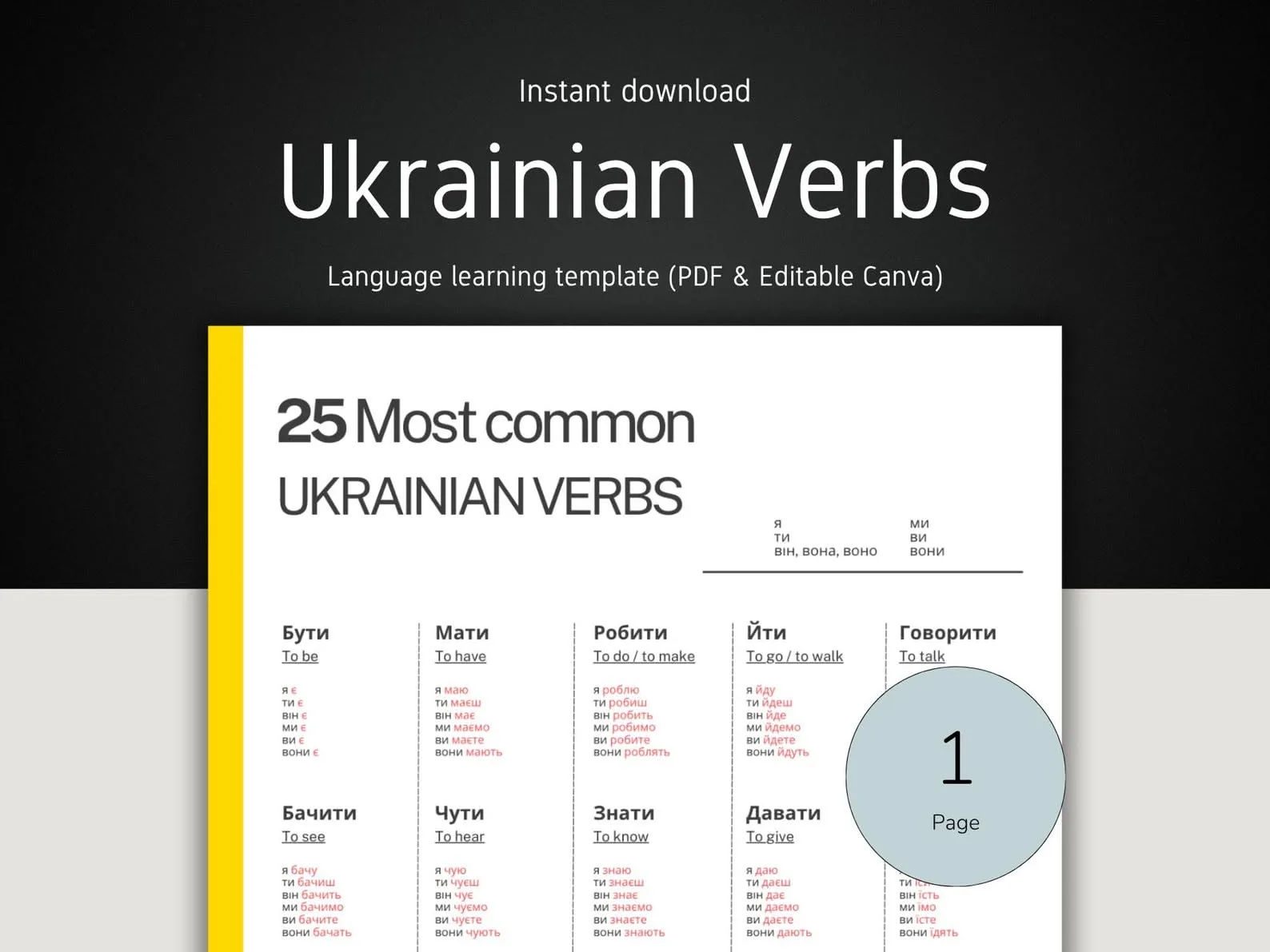
Verbs are the engine of Ukrainian grammar, and learning the most frequent ones quickly is the single highest-yield investment a beginner can make. A learner who knows the conjugation of бути (to be), мати (to have), робити (to do), говорити (to speak), and йти (to go) can construct most of the basic sentences of daily life.
Add another ninety-five high-frequency verbs and the learner has the spine of a usable conversational vocabulary. This reference assembles those verbs in tabular form, paired with their aspect partners and English glosses.
Ukrainian verbs come in two aspects, недоконаний вид (imperfective) and доконаний вид (perfective). Most verbs exist as paired roots: робити / зробити (to do / to do completely), писати / написати (to write / to write through), читати / прочитати (to read / to read through).
The imperfective describes ongoing or repeated action; the perfective describes a completed, bounded action. Choosing the right aspect is one of the fundamental difficulties of Slavic grammar, and the entries below mark each pair so the learner can begin using both members.
This article also flags verbs that differ between Ukrainian and Russian. Where Russian uses знать for "to know," Ukrainian uses знати, with similar meaning but different conjugation endings. Where Russian says видеть, Ukrainian uses бачити. These are not false friends but quiet divergences that mark a speaker's command of Ukrainian as an independent language. The full list below is grouped by semantic field for easier learning, with a final alphabetical index for reference.
The Core Five Verbs
These five verbs appear in roughly half of all Ukrainian sentences. Master their present, past, and infinitive forms first.
Table 1: The five most essential verbs
| Imperfective | Perfective | English | Sample form |
|---|---|---|---|
| бути | побути | to be | я є / я був / я буду |
| мати | - | to have | я маю / я мав / я матиму |
| робити | зробити | to do, make | я роблю / я зроблю |
| говорити | сказати | to speak / to say | я говорю / я скажу |
| йти / іти | піти | to go (on foot) | я йду / я піду |
Бути (to be) is largely omitted in the present tense in Ukrainian: "I am a student" is Я студент, not Я є студент. The form є appears in formal, emphatic, or existential contexts: У мене є книга (I have a book; literally "at me there is a book"). The past був / була / було / були and future буду / будеш / буде are fully obligatory.
Мати (to have) is paired with the optional pattern у мене є ("at me there is"), which is more colloquial and parallels Russian. Мати itself is more formal in Ukrainian: Я маю питання (I have a question), У мене є питання (I have a question, more conversational). Both are correct.
Aspect pair note: not every verb has a clean perfective partner. Мати is normally only imperfective; perfective senses are expressed with other roots like отримати (to receive). For a deep dive, see the Ukrainian verb conjugation aspect system reference.
Examples:
- Я студент. (Ya student.) = I am a student.
- У мене є машина. (U mene ye mashyna.) = I have a car.
- Він робить уроки. (Vin robyt uroky.) = He is doing his homework.
- Вона добре говорить англійською. (Vona dobre hovoryt anhliiskoiu.) = She speaks English well.
- Ми йдемо до парку. (My ydemo do parku.) = We are going to the park.
Verbs of Motion
Motion verbs are a separate sub-system in Slavic. Ukrainian distinguishes determinate (one specific trip) from indeterminate (general or repeated movement) motion. For full coverage, see the Ukrainian verbs of motion reference.
Table 2: Common verbs of motion
| Imperfective (det.) | Imperfective (indet.) | Perfective | English |
|---|---|---|---|
| йти / іти | ходити | піти | to go (on foot) |
| їхати | їздити | поїхати | to go (by vehicle) |
| летіти | літати | полетіти | to fly |
| пливти | плавати | попливти | to swim, sail |
| бігти | бігати | побігти | to run |
| нести | носити | принести | to carry |
| везти | возити | привезти | to transport |
| вести | водити | повести | to lead |
| приходити | - | прийти | to arrive (foot) |
| приїжджати | - | приїхати | to arrive (vehicle) |
| виходити | - | вийти | to leave, exit |
| входити | - | увійти | to enter |
The choice between йти (one specific trip happening now) and ходити (general or repeated walking) is fundamental. Я йду в магазин = "I am going to the store" (right now). Я ходжу в магазин кожного дня = "I go to the store every day."
Examples:
- Я ходжу в спортзал. (Ya khodzhu v sportzal.) = I go to the gym (regularly).
- Сьогодні я йду в кіно. (Sohodni ya ydu v kino.) = Today I am going to the cinema.
- Він приїхав з Києва. (Vin pryyikhav z Kyieva.) = He arrived from Kyiv.
- Літак летить високо. (Litak letyt vysoko.) = The plane is flying high.
Verbs of Speech and Thought
Table 3: Speech and cognition verbs
| Imperfective | Perfective | English |
|---|---|---|
| говорити | сказати | to speak / to say |
| розмовляти | поговорити | to converse, talk |
| розповідати | розповісти | to tell, recount |
| слухати | послухати | to listen |
| чути | почути | to hear |
| думати | подумати | to think |
| вважати | - | to consider, deem |
| знати | дізнатися | to know / to find out |
| розуміти | зрозуміти | to understand |
| забувати | забути | to forget |
| пам'ятати | - | to remember |
| вивчати | вивчити | to study, learn |
| вчити | навчити | to teach |
| вчитися | навчитися | to learn (oneself) |
| пояснювати | пояснити | to explain |
| запитувати / питати | запитати / спитати | to ask |
| відповідати | відповісти | to answer |
| читати | прочитати | to read |
| писати | написати | to write |
The pair говорити / сказати is irregular in that the perfective uses a different root (сказати from say-root, while говорити is from a different root). Many high-frequency verbs have such suppletive perfective partners. Брати / взяти (to take) is similar.
The distinction between знати and розуміти is important. Знати is to have knowledge of facts; розуміти is to understand or grasp meaning. Я знаю українську мову (I know Ukrainian) presumes mastery; Я розумію українську мову (I understand Ukrainian) is more about comprehension when listening or reading.
Examples:
- Я знаю українську мову. (Ya znaiu ukrainsku movu.) = I know the Ukrainian language.
- Він не розуміє цього. (Vin ne rozumiie tsoho.) = He does not understand this.
- Розкажи мені історію. (Rozkazhy meni istoriiu.) = Tell me a story.
- Я забув твоє ім'я. (Ya zabuv tvoie imya.) = I forgot your name.
Verbs of Daily Activity
Table 4: Everyday action verbs
| Imperfective | Perfective | English |
|---|---|---|
| робити | зробити | to do, make |
| працювати | попрацювати | to work |
| відпочивати | відпочити | to rest |
| спати | поспати | to sleep |
| прокидатися | прокинутися | to wake up |
| вставати | встати | to get up |
| їсти | з'їсти | to eat |
| пити | випити | to drink |
| готувати | приготувати | to cook, prepare |
| мити | помити | to wash (objects) |
| митися | помитися | to wash (oneself) |
| одягатися | одягнутися | to get dressed |
| взувати(ся) | взути(ся) | to put on shoes |
| виходити | вийти | to leave, go out |
| повертатися | повернутися | to return |
| зустрічати | зустріти | to meet |
| зустрічатися | зустрітися | to meet up (each other) |
| дзвонити | подзвонити | to call (phone) |
| писати | написати | to write |
Examples:
- Я прокидаюся о сьомій годині. (Ya prokydaiusia o somii hodyni.) = I wake up at seven o'clock.
- Вона готує вечерю. (Vona hotuie vecheriu.) = She is cooking dinner.
- Подзвони мені пізніше. (Podzvony meni pizniishe.) = Call me later.
- Ми зустрілися в кафе. (My zustrilysia v kafe.) = We met up at the cafe.
Verbs of Emotion and State
Table 5: Emotion and state verbs
| Imperfective | Perfective | English |
|---|---|---|
| любити | полюбити | to love |
| подобатися | сподобатися | to please, like |
| ненавидіти | - | to hate |
| хотіти | захотіти | to want |
| бажати | побажати | to wish |
| боятися | - | to be afraid |
| сумувати | засумувати | to be sad, miss |
| радіти | зрадіти | to rejoice |
| сердитися | розсердитися | to get angry |
| дивуватися | здивуватися | to be surprised |
| соромитися | засоромитися | to be embarrassed |
| стомлюватися | стомитися | to get tired |
| хворіти | захворіти | to be ill / to fall ill |
| жити | пожити | to live |
| вмирати | вмерти | to die |
| народжуватися | народитися | to be born |
The pair любити / подобатися is a frequent confusion. Любити is "to love" (intense, often romantic or for activities one is passionate about). Подобатися is "to please" and is used for "to like" with the dative subject pattern: Мені подобається ця книга = "This book is pleasing to me" = "I like this book." Use любити for stronger feelings: Я люблю свою сім'ю (I love my family).
Examples:
- Я тебе люблю. (Ya tebe liubliu.) = I love you.
- Мені подобається ця пісня. (Meni podobaietsia tsia pisnia.) = I like this song.
- Він боїться собак. (Vin boyitsia sobak.) = He is afraid of dogs.
- Вона хоче кави. (Vona khoche kavy.) = She wants coffee.
Verbs Distinct from Russian
Table 6: Ukrainian verbs that differ from Russian equivalents
| Ukrainian | Russian | English |
|---|---|---|
| бачити | видеть | to see |
| дивитися | смотреть | to watch, look |
| чекати | ждать | to wait |
| гукати | звать | to call (out to) |
| шукати | искать | to look for, search |
| розуміти | понимать | to understand |
| розповідати | рассказывать | to tell |
| тримати | держать | to hold |
| жартувати | шутить | to joke |
| мріяти | мечтать | to dream |
| робити | делать | to do |
| ходити | идти | to walk (general) |
| їсти | кушать / есть | to eat |
| пити | пить | to drink |
These are not false friends in the strict sense (the meanings overlap) but each is a distinctly Ukrainian word with its own conjugation. A learner who treats Ukrainian as Russian-with-spelling-changes will produce odd sentences. For a fuller treatment of vocabulary differences, see the Ukrainian vs Russian false friends reference.
The verb бачити (to see) is one of the most striking Ukrainian-Russian differences. Russian видеть is more transparent for English speakers; Ukrainian бачити comes from a different root entirely. Both languages also have a separate verb for "to watch" (дивитися / смотреть), and the distinction between seeing and watching is preserved in both.
Verbs of Buying, Selling, and Possession
Table 7: Commerce verbs
| Imperfective | Perfective | English |
|---|---|---|
| купувати | купити | to buy |
| продавати | продати | to sell |
| платити | заплатити | to pay |
| заробляти | заробити | to earn |
| витрачати | витратити | to spend |
| коштувати | - | to cost |
| отримувати | отримати | to receive |
| давати | дати | to give |
| брати | взяти | to take |
| повертати | повернути | to return (something) |
| позичати | позичити | to borrow / to lend |
| міняти | поміняти | to change, exchange |
Examples:
- Скільки це коштує? (Skilky tse koshtuie?) = How much does this cost?
- Я купив новий телефон. (Ya kupyv novyi telefon.) = I bought a new phone.
- Дайте, будь ласка, чек. (Daite, bud laska, chek.) = Please give me the receipt.
Common Mistakes
- Mixing aspect. Beginners often use the imperfective when the perfective is required, especially in past tense. Я писав листа (I was writing the letter) describes the process; Я написав листа (I wrote / finished the letter) describes the completed event. Both are grammatical but mean different things.
- Using есть instead of є. Є is the Ukrainian present of "to be"; есть is Russian. Even bilingual speakers sometimes default to the Russian form.
- Russian root substitution. Saying смотреть instead of дивитися, искать instead of шукати, etc. The Ukrainian forms are required in Ukrainian-language contexts.
- Wrong case after verbs. Many verbs require specific cases: боятися + genitive (боюся темряви), допомагати + dative (допомагаю мамі), користуватися + instrumental (користуюся словником). Mismatching the case is a common error.
- Reflexive -ся. Ukrainian -ся attaches to the verb (одягаюся, не одягаю себе). Treating it as a separate word is wrong.
- Past tense gender. Ukrainian past tense agrees in gender: Я був (I was, m), Я була (I was, f). English speakers often forget this, producing "Я був" when speaking as a woman.
Quick Reference
- Top five: бути, мати, робити, говорити, йти.
- Motion: йти / ходити, їхати / їздити, летіти / літати.
- Speech: говорити / сказати, розповідати / розповісти, питати / запитати.
- Daily: працювати, спати, їсти, пити, готувати.
- Emotion: любити, подобатися, хотіти, боятися.
- Commerce: купувати / купити, продавати / продати, платити / заплатити.
- Aspect rule: imperfective for process / habit; perfective for completed result.
- -ся attaches: одягаюся, не одягаю + ся separately.
FAQ
How do I memorize aspect pairs efficiently? Learn them as units, like English "go / went." Flashcards with both forms on one side and English on the other beat learning each form in isolation. Within a few hundred verbs the patterns become intuitive: most perfectives are formed by adding по-, на-, з-, про- prefixes or by stem changes.
Is есть ever correct in Ukrainian? No, not in standard Ukrainian. The present tense form is є. Есть is Russian. Some surzhyk (mixed Russian-Ukrainian speech) uses it, but it is not standard.
Why does Ukrainian have two verbs for "to like"? Любити (to love) and подобатися (to please / to like) cover different intensities and grammatical patterns. Любити takes accusative direct object; подобатися takes dative subject. They are not interchangeable. Я люблю каву (I love coffee, strong) vs Мені подобається кава (Coffee is pleasing to me, milder).
How does the perfective express future? Perfective verbs in Ukrainian have only past and future forms (no present, since the action is bounded). Я зроблю is "I will do (and finish)." Я роблю is imperfective present "I am doing / I do." Я буду робити is imperfective future ("I will be doing").
What about the verb to be in the present? Generally omitted: Я українець = "I am Ukrainian" (no copula). The form є appears emphatically: Він є кращим студентом (He is the best student). And in existential phrases: Тут є проблема (There is a problem here).
How do I form negative commands? Не + imperfective imperative: Не біжи! (Don't run!), Не їж! (Don't eat!). The perfective imperative is used for affirmative commands; the imperfective for negative.
Are there irregular verbs? Yes, but fewer than in Romance languages. Бути (to be), їсти (to eat), дати (to give), їхати (to ride), and a small set of others have irregular forms worth memorizing as units.
See Also
- Ukrainian verb conjugation aspect system reference
- Ukrainian verbs of motion going walking riding reference
- Ukrainian seven cases complete declension reference
- Ukrainian pronouns personal possessive reflexive reference
- Ukrainian vs Russian vocabulary false friends reference
- Ukrainian common phrases daily conversation reference
- Ukrainian alphabet and Cyrillic differences from Russian
Author: Kalenux Team
Frequently Asked Questions
How do I memorize aspect pairs efficiently?
Learn them as units like English go/went. Flashcards with both forms beat learning each in isolation. Most perfectives form via по-, на-, з-, про- prefixes or stem changes.
Is есть ever correct in Ukrainian?
No, not in standard Ukrainian. The present tense form is є. Есть is Russian. Some surzhyk (mixed speech) uses it, but it is not standard.
Why does Ukrainian have two verbs for 'to like'?
Любити (to love) takes accusative; подобатися (to please) takes dative subject. Я люблю каву is strong; Мені подобається кава is milder. They are not interchangeable.
How does the perfective express future?
Perfective verbs have only past and future forms. Я зроблю is ‘I will do (and finish).’ Я буду робити is imperfective future (‘I will be doing’).
Is the verb 'to be' used in the Ukrainian present tense?
Generally omitted: Я українець means ‘I am Ukrainian.’ The form є appears emphatically or in existential phrases: Тут є проблема (there is a problem here).
How do I form negative commands in Ukrainian?
Не + imperfective imperative: Не біжи! (Don’t run!), Не їж! (Don’t eat!). Perfective imperative is used for affirmative commands; imperfective for negative.
Are there irregular verbs in Ukrainian?
Yes, but fewer than in Romance languages. Бути (to be), їсти (to eat), дати (to give), їхати (to ride) have irregular forms worth memorizing as units.