
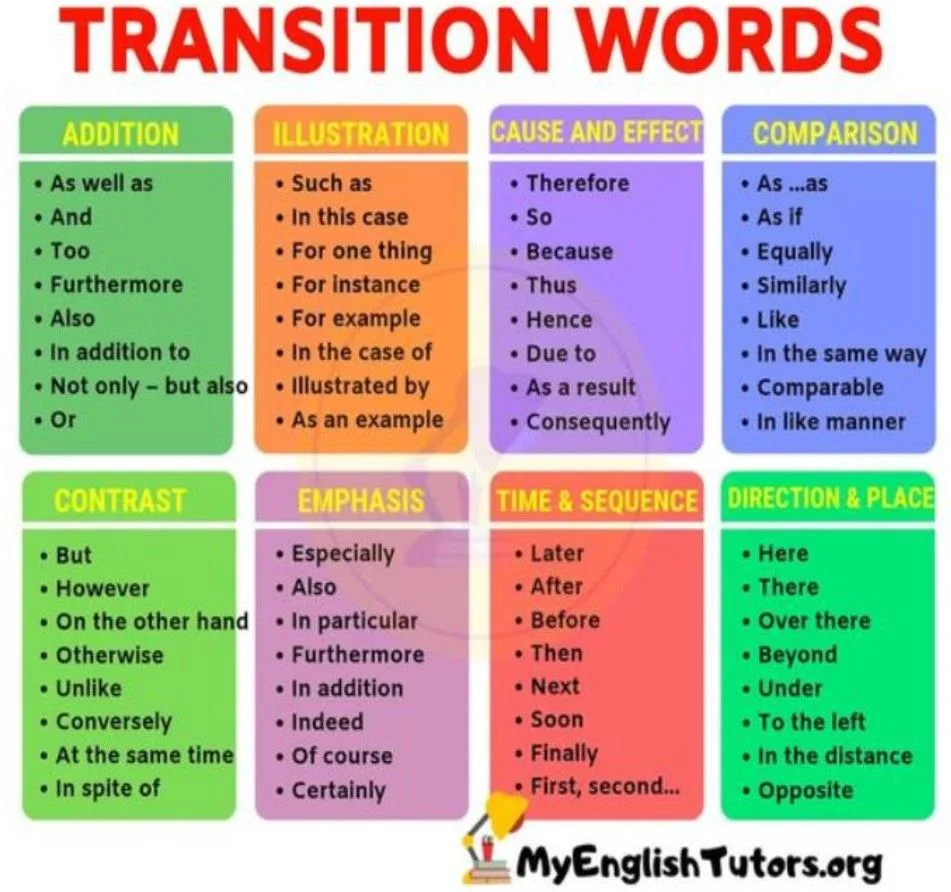
Strong writing flows from one idea to the next without jarring stops or confusing leaps. Transition words and phrases are the connective tissue that holds your paragraphs together, guiding readers through your logic and signaling how each point relates to the one before it. Without transitions, even well-researched writing reads like a disjointed list of facts. With the right transitions, your arguments build momentum and your prose feels polished.
This guide provides a comprehensive reference of over 200 transition words and phrases organized by their purpose. Whether you are writing an academic essay, a business report, or a blog post, you will find the exact connector you need along with examples showing how to use it effectively.
What Are Transition Words?
Transition words are words and phrases that connect ideas between sentences, paragraphs, or sections of a text. They serve as signals to the reader, indicating the relationship between the thought you just expressed and the one coming next. Transition words answer the implicit question every reader asks: "How does this connect to what I just read?"
Consider these two versions of the same passage:
Without transitions: The company invested heavily in employee training. Productivity increased by 15 percent. Customer satisfaction scores rose. The board approved additional funding for the program.
With transitions: The company invested heavily in employee training. As a result, productivity increased by 15 percent. Furthermore, customer satisfaction scores rose. Consequently, the board approved additional funding for the program.
The second version reads smoothly because each transition word clarifies the logical connection between sentences. The reader understands that the productivity increase resulted from the training, that the satisfaction scores were an additional benefit, and that the funding decision followed logically from these outcomes.
Transition Words for Addition
Addition transitions introduce supplementary information, reinforcing or expanding on a point you have already made. Use these when you want to add another piece of evidence, another example, or another argument that supports your main idea.
| Transition Word/Phrase | Usage Level |
|---|---|
| additionally | Formal |
| also | Neutral |
| and | Neutral |
| as well as | Neutral |
| besides | Neutral |
| coupled with | Formal |
| equally | Formal |
| equally important | Formal |
| first, second, third | Neutral |
| further | Formal |
| furthermore | Formal |
| in addition | Formal |
| in addition to | Formal |
| in the same way | Neutral |
| likewise | Formal |
| moreover | Formal |
| not only... but also | Neutral |
| not to mention | Informal |
| on top of that | Informal |
| similarly | Formal |
| together with | Neutral |
| too | Informal |
| what is more | Formal |
Examples of Addition Transitions in Sentences
- The new software reduces processing time by 40 percent. Additionally, it eliminates the need for manual data entry.
- Regular exercise strengthens the cardiovascular system. Moreover, it improves mental health and cognitive function.
- The hotel offers complimentary breakfast. In addition, guests receive free access to the fitness center and pool.
- She speaks fluent French. She also speaks conversational Mandarin.
- The proposal addresses budget concerns. Furthermore, it outlines a realistic timeline for implementation.
- The study confirmed the original hypothesis. Equally important, it revealed several unexpected variables worth investigating.
- The restaurant serves locally sourced ingredients. Not only does this support local farmers, but it also ensures fresher meals for diners.
- The candidate has ten years of management experience. Besides her professional qualifications, she holds a doctorate in organizational psychology.
Transition Words for Contrast and Opposition
Contrast transitions signal a shift in direction. They tell the reader that the upcoming idea contradicts, qualifies, or differs from the previous one. These transitions are essential for presenting counterarguments, acknowledging limitations, or highlighting differences.
| Transition Word/Phrase | Usage Level |
|---|---|
| although | Neutral |
| but | Neutral |
| by contrast | Formal |
| conversely | Formal |
| despite | Neutral |
| despite this | Formal |
| even so | Neutral |
| even though | Neutral |
| however | Formal |
| in contrast | Formal |
| in spite of | Neutral |
| instead | Neutral |
| nevertheless | Formal |
| nonetheless | Formal |
| notwithstanding | Formal |
| on the contrary | Formal |
| on the other hand | Neutral |
| rather | Neutral |
| regardless | Neutral |
| still | Neutral |
| that said | Neutral |
| though | Neutral |
| whereas | Formal |
| while | Neutral |
| yet | Neutral |
Examples of Contrast Transitions in Sentences
- The experiment produced positive results in the lab. However, field trials revealed significant complications.
- Many employees prefer remote work for its flexibility. On the other hand, some find that working from home increases feelings of isolation.
- The project came in under budget. Nevertheless, the client expressed dissatisfaction with the timeline.
- Although the evidence supports the theory, further research is needed before drawing definitive conclusions.
- Sales increased in the European market. Conversely, the Asian market experienced a notable decline.
- The medication effectively treats symptoms. Despite this, it carries a risk of serious side effects that patients should consider.
- The first approach prioritizes speed. In contrast, the second approach prioritizes accuracy.
- She did not receive formal training in design. Nonetheless, her portfolio demonstrates exceptional skill and creativity.
Transition Words for Cause and Effect
Cause-and-effect transitions explain why something happened or what resulted from a particular action or event. They are fundamental in analytical, scientific, and argumentative writing where establishing causal relationships is central to your purpose.
| Transition Word/Phrase | Usage Level |
|---|---|
| accordingly | Formal |
| as a consequence | Formal |
| as a result | Formal |
| because | Neutral |
| because of this | Neutral |
| consequently | Formal |
| due to | Neutral |
| for this reason | Neutral |
| hence | Formal |
| in effect | Formal |
| in that case | Neutral |
| it follows that | Formal |
| leading to | Neutral |
| owing to | Formal |
| since | Neutral |
| so | Informal |
| so that | Neutral |
| that is why | Neutral |
| therefore | Formal |
| thereby | Formal |
| thus | Formal |
| under those circumstances | Formal |
Examples of Cause-and-Effect Transitions in Sentences
- The company failed to adapt to changing consumer preferences. As a result, it lost 30 percent of its market share within two years.
- Rainfall exceeded historical averages for three consecutive months. Consequently, several rivers breached their flood barriers.
- The patient did not follow the prescribed medication schedule. Therefore, the infection returned more aggressively.
- Because the bridge was structurally compromised, officials closed it to all vehicle traffic.
- The research team discovered a flaw in the original methodology. Accordingly, they redesigned the study and repeated the experiments.
- Production costs rose sharply during the quarter. Hence, the company was forced to raise consumer prices.
- The new policy simplified the approval process, thereby reducing average wait times from ten days to three.
- The region experienced prolonged drought. Due to the water shortage, agricultural output dropped by nearly half.
Transition Words for Sequence and Time
Sequence transitions organize ideas chronologically or in order of importance. They guide readers through steps in a process, stages in a timeline, or the logical progression of an argument.
| Transition Word/Phrase | Usage Level |
|---|---|
| after | Neutral |
| after that | Neutral |
| afterward | Neutral |
| at first | Neutral |
| at last | Neutral |
| at the same time | Neutral |
| before | Neutral |
| concurrently | Formal |
| currently | Neutral |
| during | Neutral |
| eventually | Neutral |
| finally | Neutral |
| first, second, third | Neutral |
| following | Neutral |
| formerly | Formal |
| gradually | Neutral |
| immediately | Neutral |
| in the first place | Neutral |
| in the meantime | Neutral |
| last | Neutral |
| later | Neutral |
| meanwhile | Neutral |
| next | Neutral |
| once | Neutral |
| previously | Formal |
| prior to | Formal |
| simultaneously | Formal |
| since then | Neutral |
| soon | Neutral |
| subsequently | Formal |
| then | Neutral |
| thereafter | Formal |
| to begin with | Neutral |
| ultimately | Formal |
| when | Neutral |
| while | Neutral |
Examples of Sequence Transitions in Sentences
- First, preheat the oven to 350 degrees. Next, combine the dry ingredients in a large bowl. Then, add the wet ingredients and mix until smooth.
- Initially, the team focused on gathering data. Subsequently, they analyzed the results and drafted their findings.
- Before submitting the application, review all fields for accuracy.
- The company launched in 2015. Since then, it has expanded to twelve countries across three continents.
- Meanwhile, the engineering department was developing a prototype for the next product iteration.
- The negotiations stalled for several weeks. Eventually, both parties agreed to a compromise.
- Prior to the merger, each company operated independently with separate management structures.
- The software update will deploy on Friday. In the meantime, users should save all open projects to avoid data loss.
Transition Words for Emphasis
Emphasis transitions draw attention to a particularly important point. They tell the reader that the information following is significant and deserves special consideration.
| Transition Word/Phrase | Usage Level |
|---|---|
| above all | Formal |
| certainly | Neutral |
| clearly | Neutral |
| especially | Neutral |
| essentially | Neutral |
| in any case | Neutral |
| in fact | Neutral |
| indeed | Formal |
| it should be noted | Formal |
| most importantly | Formal |
| naturally | Neutral |
| notably | Formal |
| of course | Neutral |
| obviously | Neutral |
| particularly | Formal |
| significantly | Formal |
| specifically | Neutral |
| surprisingly | Neutral |
| to emphasize | Formal |
| undeniably | Formal |
| undoubtedly | Formal |
| without a doubt | Neutral |
Examples of Emphasis Transitions in Sentences
- The proposal has several advantages. Most importantly, it reduces operational costs by 25 percent without sacrificing quality.
- Customer retention drives long-term profitability. Indeed, it is widely claimed that retaining existing customers costs less than acquiring new ones.
- The policy changes affect all departments. In particular, the finance and operations teams will see the most significant adjustments.
- Certainly, the risks should not be ignored, but the potential rewards justify moving forward with the plan.
- The experiment produced unexpected results. Notably, the control group outperformed the experimental group in three of the five measured categories.
- The evidence supports a single conclusion. Without a doubt, the current system requires immediate reform.
Transition Words for Examples and Illustration
These transitions introduce specific cases, evidence, or illustrations that support a general claim. They are essential in persuasive and expository writing where abstract claims need concrete backing.
| Transition Word/Phrase | Usage Level |
|---|---|
| as an example | Neutral |
| as demonstrated by | Formal |
| as illustrated by | Formal |
| as shown by | Neutral |
| consider | Neutral |
| for example | Neutral |
| for instance | Neutral |
| in other words | Neutral |
| in particular | Formal |
| including | Neutral |
| namely | Formal |
| one example is | Neutral |
| specifically | Neutral |
| such as | Neutral |
| that is | Neutral |
| that is to say | Formal |
| to clarify | Neutral |
| to demonstrate | Formal |
| to illustrate | Formal |
| to put it another way | Neutral |
Examples of Illustration Transitions in Sentences
- Several factors contributed to the company's growth. For example, its early investment in digital marketing generated brand awareness that competitors lacked.
- Some cities have implemented innovative transportation solutions. For instance, Copenhagen built an extensive cycling infrastructure that now handles roughly half of commutes to work and school.
- The word "set" has many meanings. To illustrate, it can function as a noun, verb, or adjective with entirely different definitions in each role.
- The regulation affects multiple industries, including healthcare, finance, and telecommunications.
- Specifically, the study found that participants who slept fewer than six hours performed noticeably worse on memory tests.
- The results varied across demographics. In particular, respondents aged 18 to 24 showed markedly different preferences from all other age groups.
Transition Words for Comparison and Similarity
Comparison transitions highlight similarities between ideas, situations, or arguments. They help readers see parallel structures and draw connections between related concepts.
| Transition Word/Phrase | Usage Level |
|---|---|
| along the same lines | Neutral |
| as with | Neutral |
| by the same token | Formal |
| comparable to | Formal |
| equally | Formal |
| in a similar fashion | Formal |
| in comparison | Formal |
| in like manner | Formal |
| in the same way | Neutral |
| just as | Neutral |
| like | Informal |
| likewise | Formal |
| much like | Neutral |
| paralleling | Formal |
| similar to | Neutral |
| similarly | Formal |
Examples of Comparison Transitions in Sentences
- The brain processes visual information faster than text. Similarly, audiences retain more information from video presentations than from written reports.
- Just as a foundation determines the stability of a building, a thesis statement determines the strength of an essay.
- Japanese manufacturing revolutionized quality control in the 1980s. In the same way, Silicon Valley redefined how the world approaches innovation and entrepreneurship.
- Likewise, the second study confirmed the correlation between sleep quality and academic performance.
- The European economy faces challenges from an aging population. By the same token, several Asian economies are beginning to experience the same demographic pressures.
- The new employee onboarding process mirrors the approach used by leading technology companies. In a similar fashion, the performance review system draws from well-established best practices in organizational psychology.
Transition Words for Summary and Conclusion
Summary and conclusion transitions signal that you are wrapping up your argument, restating your thesis, or drawing final conclusions. They tell the reader that the discussion is moving toward its end.
| Transition Word/Phrase | Usage Level |
|---|---|
| after all | Neutral |
| all in all | Neutral |
| all things considered | Neutral |
| altogether | Neutral |
| as a final point | Formal |
| as has been shown | Formal |
| briefly | Neutral |
| by and large | Neutral |
| finally | Neutral |
| in a word | Neutral |
| in brief | Formal |
| in closing | Formal |
| in conclusion | Formal |
| in essence | Formal |
| in short | Neutral |
| in summary | Formal |
| in the end | Neutral |
| in the final analysis | Formal |
| on balance | Formal |
| on the whole | Neutral |
| overall | Neutral |
| to conclude | Formal |
| to put it briefly | Neutral |
| to sum up | Neutral |
| to summarize | Formal |
| ultimately | Formal |
Examples of Summary Transitions in Sentences
- In conclusion, the evidence strongly supports increasing the minimum wage to reflect current living costs.
- To summarize, three factors drive customer loyalty: product quality, responsive service, and consistent brand experience.
- All things considered, the benefits of the proposed merger outweigh its risks.
- Ultimately, the success of any organization depends on the quality and commitment of its people.
- On balance, renewable energy sources offer a more sustainable path forward despite their current limitations.
- In short, effective communication is not a natural talent but a skill that can be developed through deliberate practice.
Transition Words for Condition
Conditional transitions introduce hypothetical situations, stipulations, or circumstances that must be met for something else to follow. They are common in analytical and persuasive writing.
| Transition Word/Phrase | Usage Level |
|---|---|
| as long as | Neutral |
| assuming that | Neutral |
| even if | Neutral |
| given that | Formal |
| if | Neutral |
| if so | Neutral |
| in case | Neutral |
| in the event that | Formal |
| on the condition that | Formal |
| only if | Neutral |
| provided that | Formal |
| supposing | Neutral |
| unless | Neutral |
| whether or not | Neutral |
Examples of Conditional Transitions in Sentences
- Provided that the team meets its quarterly targets, the company will proceed with the expansion plan.
- The outdoor event will continue as scheduled unless severe weather forces a cancellation.
- Given that the current data is incomplete, the committee should delay its decision until the full report is available.
- Even if the initial costs are high, the long-term savings justify the investment.
- The software can handle enterprise-level workloads, as long as the server infrastructure meets the minimum specifications.
- In the event that the primary supplier cannot deliver on time, the backup supplier will fulfill the order.
Transition Words for Concession
Concession transitions acknowledge an opposing point or a limitation before reinforcing your own position. They demonstrate intellectual honesty and strengthen your argument by showing that you have considered multiple perspectives.
| Transition Word/Phrase | Usage Level |
|---|---|
| admittedly | Formal |
| although it is true that | Formal |
| be that as it may | Formal |
| despite | Neutral |
| even so | Neutral |
| granted | Neutral |
| I concede that | Formal |
| it may appear that | Formal |
| naturally | Neutral |
| of course | Neutral |
| this may be true | Neutral |
| to be sure | Formal |
| while it is true that | Formal |
Examples of Concession Transitions in Sentences
- Admittedly, the sample size was smaller than ideal. However, the consistency of the results across all subgroups strengthens the study's conclusions.
- Granted, remote work presents challenges for team cohesion. Nevertheless, its benefits in productivity and employee satisfaction are well documented.
- Of course, no single policy can solve every aspect of the housing crisis. Still, the proposed reforms address the most urgent barriers to affordable housing.
- While it is true that automation eliminates some jobs, it also creates new roles that demand higher-level skills and offer better compensation.
- To be sure, the transition will require significant upfront investment. The projected return, however, makes the expenditure worthwhile within three years.
How to Use Transition Words Effectively
Knowing the words is only half the challenge. Using them well requires understanding several principles that separate polished writing from mechanical, formulaic prose.
Match the Transition to the Actual Relationship
The most common mistake writers make is using a transition that does not accurately reflect the relationship between ideas. If you write "The company raised prices. Furthermore, sales declined," you have used an addition transition where a cause-and-effect or contrast transition is needed. The correct version is "The company raised prices. As a result, sales declined" or "The company raised prices. However, sales declined."
Before inserting a transition, ask yourself: What is the actual relationship between these two ideas? Are they cause and effect? Are they in opposition? Is the second idea an example of the first? Choose the transition category that matches that relationship.
Vary Your Transitions
Using the same transition repeatedly makes your writing monotonous. If every paragraph begins with "However," your reader will notice the pattern and disengage. Draw from the full range of options within each category.
Repetitive: The first trial was successful. However, the second trial failed. However, the third trial produced mixed results.
Varied: The first trial was successful. The second trial, by contrast, failed entirely. The third trial, meanwhile, produced mixed results that required further analysis.
Do Not Overuse Transitions
Not every sentence needs a transition word. When the logical relationship between sentences is obvious, a transition can feel redundant and patronizing. Trust your reader to follow straightforward connections.
Overloaded: She arrived at the airport. Then, she checked in at the counter. Next, she went through security. After that, she walked to the gate. Finally, she boarded the plane.
Better: She arrived at the airport, checked in at the counter, and cleared security. At the gate, she reviewed her boarding pass before joining the line to board.
Place Transitions Strategically
Transitions work in three positions: at the beginning of a sentence, in the middle, or at the end. Varying the position creates rhythmic variety and prevents your transitions from sounding formulaic.
- Beginning: However, the results did not match our predictions.
- Middle: The results, however, did not match our predictions.
- End: The results did not match our predictions, however.
Each position creates a slightly different emphasis. Beginning placement signals the shift immediately. Middle placement integrates the transition into the sentence flow. End placement creates a softer, more reflective shift.
Transitions in Academic Writing
Academic writing demands precise, formal transitions that clarify the logical structure of an argument. Readers of academic texts expect explicit signaling of how evidence supports claims and how different sections of a paper relate to one another.
Transitions Between Paragraphs
Each body paragraph should begin with a transition that connects it to the previous paragraph. This does not always require a single transition word. Sometimes, an entire transitional sentence works better.
Weak: Another factor is funding. The government provides grants to support renewable energy research.
Strong: While technological innovation drives progress, it cannot advance without adequate financial support. Government grants play a critical role in funding renewable energy research at every stage.
Transitions Between Sections
When moving between major sections of a paper, use a brief transitional paragraph that summarizes what was covered and previews what comes next.
Example: The preceding analysis demonstrates that urban sprawl contributes significantly to carbon emissions through increased vehicle dependency. The following section examines policy interventions that several cities have implemented to reverse these trends and promote sustainable development.
Common Academic Transition Phrases by Section
| Paper Section | Useful Transitions |
|---|---|
| Introduction | This paper examines, The purpose of this study is, This analysis explores |
| Literature Review | Previous research indicates, Several scholars have noted, Building on this work |
| Methodology | To investigate this question, The study employed, Data was collected through |
| Results | The analysis revealed, The data indicates, A significant finding was |
| Discussion | These findings suggest, This result aligns with, One possible explanation is |
| Conclusion | In summary, This study demonstrates, Future research should |
Transitions in Business Writing
Business writing favors concise, direct transitions that move the reader efficiently through reports, emails, and proposals. While academic writing may elaborate on connections, business writing demands brevity and clarity.
Transitions in Reports
- To introduce findings: The analysis reveals, The data shows, Key findings include
- To present recommendations: Based on these findings, We recommend, The following steps should be taken
- To compare options: Option A offers, By comparison, On the other hand
- To address concerns: While there are risks, To mitigate this, One potential challenge is
Transitions in Emails
Professional emails benefit from short, direct transitions that guide the reader through your message without adding unnecessary length.
- To shift topics: Regarding, On another note, Turning to
- To request action: Please, I would appreciate it if, Could you
- To follow up: As discussed, Following up on, As mentioned in our meeting
Transitions in Proposals
Proposals require persuasive transitions that build a logical case for your recommendation.
- To identify the problem: Currently, The challenge is, At present
- To present the solution: To address this, The proposed solution, We recommend
- To outline benefits: This approach will, As a result, The expected outcome is
- To address objections: While some may argue, It is worth noting, To address this concern
Common Transition Mistakes to Avoid
Using "However" as a Conjunction
"However" is not a conjunction and cannot join two independent clauses with only a comma. This error creates a comma splice.
Incorrect: The experiment succeeded, however the results were inconclusive.
Correct: The experiment succeeded; however, the results were inconclusive.
Also correct: The experiment succeeded. However, the results were inconclusive.
Confusing "Therefore" and "However"
These two transitions signal opposite relationships. "Therefore" indicates that the second idea follows logically from the first. "However" indicates that the second idea contradicts or qualifies the first. Swapping them reverses your meaning.
Starting Every Sentence with a Transition
When every sentence begins with a transition word, the pattern becomes distracting. Use transitions selectively at points where the reader needs guidance about how ideas connect.
Using Informal Transitions in Formal Writing
Transitions like "plus," "on top of that," and "so" are appropriate in casual writing and conversation but not in academic papers, legal documents, or formal business reports. Match the formality of your transitions to the formality of your document.
Quick Reference - Transition Words by Relationship
| Relationship | Top Transitions |
|---|---|
| Addition | furthermore, moreover, in addition, additionally, also |
| Contrast | however, on the other hand, nevertheless, conversely, although |
| Cause/Effect | therefore, consequently, as a result, thus, accordingly |
| Sequence | first, next, then, subsequently, finally |
| Emphasis | indeed, in fact, most importantly, notably, certainly |
| Example | for example, for instance, specifically, such as, to illustrate |
| Comparison | similarly, likewise, in the same way, just as, comparable to |
| Summary | in conclusion, to summarize, overall, in short, ultimately |
| Condition | if, provided that, unless, given that, as long as |
| Concession | admittedly, granted, although, despite, even so |
Practice Exercises
Exercise 1 - Choose the Correct Transition
Select the transition that best fits each blank.
- The new highway reduced commute times. ______, it increased noise pollution in nearby neighborhoods. (However / Therefore / Moreover)
- The company exceeded its sales targets. ______, the board approved year-end bonuses for all employees. (Nevertheless / As a result / On the other hand)
- ______ the weather forecast predicted rain, the outdoor event proceeded as planned. (Because / Although / Therefore)
- The first quarter showed strong growth. ______, the second quarter maintained this positive trajectory. (However / Similarly / Despite)
- The medication is effective for most patients. ______, some individuals may experience mild side effects. (Therefore / Furthermore / However)
Answers: 1. However, 2. As a result, 3. Although, 4. Similarly, 5. However
Exercise 2 - Improve the Paragraph
Rewrite the following paragraph by adding appropriate transitions between each sentence.
"The company launched a new product line. Sales exceeded expectations. The marketing team expanded its campaign. International markets showed strong interest. The board increased the production budget."
Sample revision: The company launched a new product line, and sales exceeded expectations from the first week. Encouraged by this response, the marketing team expanded its campaign to reach broader audiences. Meanwhile, international markets showed strong interest in the product. As a result, the board increased the production budget to meet growing demand.
Final Thoughts on Transition Words
Transition words are not decorative additions to your writing. They are functional tools that clarify relationships between ideas and guide your reader through your argument. The best writers use transitions purposefully, choosing each one to accurately signal the connection between thoughts.
Build your transition vocabulary gradually. Start by mastering the most common words in each category - however, furthermore, therefore, for example - and expand from there as you encounter new situations that require more precise connectors. Read your work aloud to test whether your transitions sound natural.
If a transition feels forced, it probably is. Writers who frequently need to express cause-and-effect relationships will find a dedicated resource in the guide on cause and effect transitions, which covers therefore, consequently, as a result, and their relatives in full detail.
The goal is not to use as many transition words as possible but to use the right transition in the right place. When you achieve that balance, your writing will flow naturally from one idea to the next, carrying your reader along with confidence and clarity.
Frequently Asked Questions
How many transition words should I use in an essay?
There is no fixed number of transition words per essay, but a useful guideline is to include at least one transition per paragraph shift and whenever you change direction within a paragraph. For a standard five-paragraph essay, you might use eight to twelve transitions naturally throughout the piece. The key is balance.
Too few transitions make your writing feel choppy and disconnected, forcing readers to guess how your ideas relate.
Too many transitions clutter your prose and make it feel mechanical or overly formal. Read your draft aloud and add a transition wherever you stumble between ideas. Remove any transition that feels redundant or forced. Quality placement matters far more than quantity.
What is the difference between transition words and conjunctions?
Conjunctions and transition words both connect ideas, but they work differently in sentence structure. Coordinating conjunctions like and, but, and or join words, phrases, or independent clauses within a single sentence.
Subordinating conjunctions like because, although, and while create dependent clauses attached to main clauses. Transition words and phrases like however, furthermore, and as a result typically connect separate sentences or paragraphs.
They signal logical relationships between complete thoughts rather than grammatically linking clauses.
Transition words are usually followed by a comma when they begin a sentence. Understanding this distinction helps you punctuate correctly and choose the right connector for each situation in your writing.
Can I start a sentence with a transition word?
Yes, starting a sentence with a transition word is perfectly acceptable and often the most effective placement. Words like however, moreover, consequently, and furthermore commonly appear at the beginning of sentences, followed by a comma. This position clearly signals to the reader how the upcoming sentence relates to the previous one.
You can also place transition words in the middle of a sentence, set off by commas, for variety.
For example, the results were, therefore, inconclusive. Varying the position of your transitions prevents your writing from becoming monotonous. Just ensure that every transition you use accurately reflects the logical relationship between your ideas, regardless of where you place it in the sentence.