
Swahili verbs are agglutinative. Rather than conjugating through separate words like English ("I have been reading") or through complex inflectional endings like Latin or Spanish, Swahili builds tense, aspect, person, number, and even pronouns directly onto the verb stem as a neat sequence of prefixes and suffixes. A single Swahili verb can carry what would require an entire English phrase to express, and the parts always appear in the same fixed order.
The structure of a typical Swahili finite verb is:
Subject prefix + Tense marker + (Object infix) + Verb root + Final vowel
For example, "ninakipenda" breaks down as ni- (I) + na- (present tense) + ki- (it, referring to a class 7 object) + pend (the root for love) + a (the default final vowel). That one word means "I love it" where "it" refers to, say, a book.
Once you internalize this template, conjugating any verb becomes a matter of slotting the correct pieces into the correct positions. There are no irregular verbs in the sense of English "go / went / gone" - Swahili has a small number of short, monosyllabic stems that retain the infinitive ku- in some tenses, but even those follow predictable rules.
This reference covers the full set of subject prefixes, the main tense markers (-na-, -li-, -ta-, -me-, -ki-, -sha-, -a-, -hu-), negation, object infixes, and the special behavior of monosyllabic stems. Tables give complete conjugations of sample verbs across the major tenses, and commentary addresses the places where English speakers most often get confused.
The Verb Template
Every finite Swahili verb follows this template, with slots that may or may not be filled:
| Slot | Name | Purpose | Example (in ninakipenda) |
|---|---|---|---|
| 1 | Subject prefix | Who does it | ni- (I) |
| 2 | Tense / aspect marker | When / how | -na- (present continuous) |
| 3 | Object infix (optional) | Pronoun / noun-class object | -ki- (it, class 7) |
| 4 | Verb root | Core meaning | -pend- (love) |
| 5 | Final vowel | Usually -a | -a |
Negation, the relative, and certain moods require modifications to this template. For the vast majority of sentences, however, these five slots are all you need.
Subject Prefixes
Every finite verb starts with a subject prefix. The prefixes for human subjects (class 1 and class 2) are the most used:
| Pronoun | English | Subject Prefix | Example |
|---|---|---|---|
| mimi | I | ni- | ninasoma (I am reading) |
| wewe | you (sg.) | u- | unasoma (you are reading) |
| yeye | he/she | a- | anasoma (he/she is reading) |
| sisi | we | tu- | tunasoma (we are reading) |
| ninyi | you (pl.) | m- | mnasoma (you are reading) |
| wao | they | wa- | wanasoma (they are reading) |
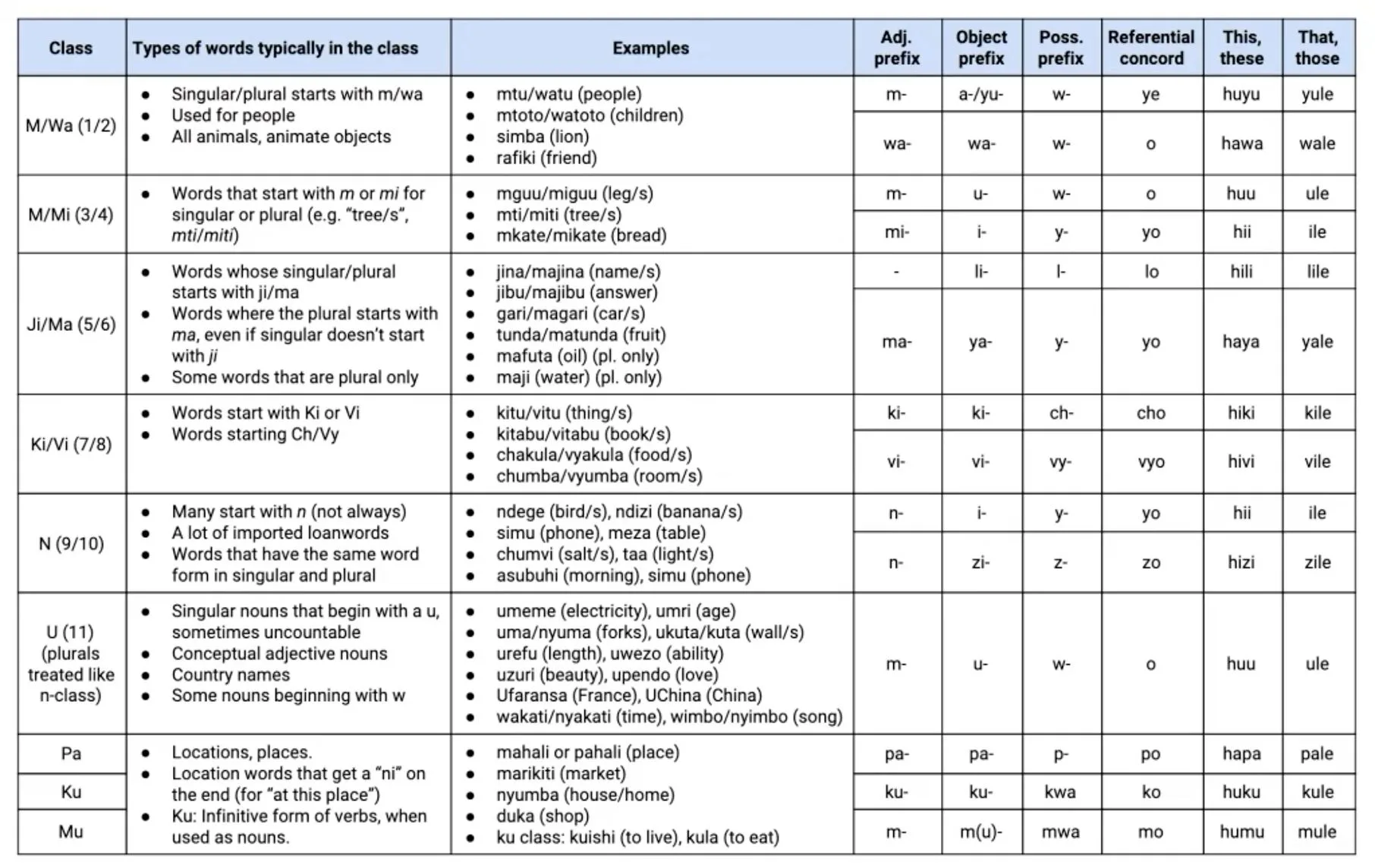
For non-human subjects, the subject prefix matches the noun class of the subject. See the noun classes table for the full set.
The Main Tense Markers
Tense markers come immediately after the subject prefix. Swahili distinguishes tense more than English does in some places (separate perfect vs. simple past) and less in others (no distinction between simple and continuous present).
-na- Present Continuous / Habitual Present
The default present tense marker. Used for actions happening right now or habitual actions.
- Ninasoma kitabu. (I am reading a book / I read books.)
- Anacheza nje. (He/she is playing outside.)
- Tunakula chakula. (We are eating food.)
-li- Simple Past
Completed actions in the past.
- Nilisoma kitabu. (I read a book.)
- Alienda sokoni. (He/she went to the market.)
- Tuliongea kwa muda mrefu. (We talked for a long time.)
-ta- Future
All future actions - there is no distinction between "will" and "going to" as in English.
- Nitasoma kesho. (I will read tomorrow.)
- Watakuja Jumamosi. (They will come on Saturday.)
- Utafanya nini? (What will you do?)
-me- Perfect
Completed action with present relevance. Similar to English "have done" but often used where English uses simple past.
- Nimesoma kitabu. (I have read the book.)
- Ameondoka. (He/she has left.)
- Tumemaliza. (We have finished.)
A crucial subtlety: -me- on a stative verb often describes a current state, not a past event. "Amechoka" literally is "he/she has tired" but is translated "he/she is tired." "Amefurahi" (he/she is happy) uses -me- even though English uses the simple present.
-ki- Conditional / Simultaneous
Usually translated "if" or "when" or "-ing" depending on context.
- Nikisoma, ninafahamu. (If/when I read, I understand.)
- Alimwona akicheza. (He saw him playing.)
- Tukienda sasa, tutafika mapema. (If we go now, we will arrive early.)
-sha- / -mesha- Already
Expresses that something has already been done, often attached to or combined with -me-.
- Nimesha-la. (I have already eaten.)
- Wameshaondoka. (They have already left.)
The -sha- comes from the verb kumaliza (to finish) and is sometimes written as a separate clitic.
-a- General Truth / Habitual
Expresses general truth or habitual action, though in modern Swahili -na- has largely replaced this. Still common in writing and formal speech.
- Maji huvuja. (Water leaks / water tends to leak.) Note: with the special marker hu- (habitual).
- Twaenda. (We are going.) Older style.
hu- Habitual / Gnomic
Expresses habitual or general truths. Uniquely, this prefix replaces the subject prefix - it does not combine with one. It therefore does not show person, but context usually makes the subject clear.
- Wanafunzi husoma asubuhi. (Students read in the morning / students habitually read in the morning.)
- Jua huchomoza mashariki. (The sun rises in the east.)
Full Conjugation of kusoma (to read)
| Tense | 1sg | 2sg | 3sg | 1pl | 2pl | 3pl |
|---|---|---|---|---|---|---|
| Present -na- | ninasoma | unasoma | anasoma | tunasoma | mnasoma | wanasoma |
| Past -li- | nilisoma | ulisoma | alisoma | tulisoma | mlisoma | walisoma |
| Future -ta- | nitasoma | utasoma | atasoma | tutasoma | mtasoma | watasoma |
| Perfect -me- | nimesoma | umesoma | amesoma | tumesoma | mmesoma | wamesoma |
| Conditional -ki- | nikisoma | ukisoma | akisoma | tukisoma | mkisoma | wakisoma |
Negation
Negation in Swahili uses a different system from the affirmative. There is no separate word like English "not." Instead, a negative prefix is added and, in some tenses, the final vowel or tense marker changes.
Present Negative
The affirmative present takes -na-, but the negative uses a different subject prefix and changes the final -a to -i.
| Person | Affirmative | Negative |
|---|---|---|
| 1sg | ninasoma | sisomi |
| 2sg | unasoma | husomi |
| 3sg | anasoma | hasomi |
| 1pl | tunasoma | hatusomi |
| 2pl | mnasoma | hamsomi |
| 3pl | wanasoma | hawasomi |
The negative subject prefixes are: si-, hu-, ha-, hatu-, ham-, hawa-. Note that the tense marker -na- disappears, and the final vowel changes from -a to -i.
Past Negative
Uses -ku- instead of -li-.
- Sikusoma. (I did not read.)
- Hakuenda. (He/she did not go.)
- Hatukula. (We did not eat.)
Future Negative
Uses -ta- like the affirmative but with negative subject prefixes.
- Sitasoma. (I will not read.)
- Hatutaenda. (We will not go.)
Perfect Negative
Uses -ja- instead of -me-.
- Sijasoma. (I have not read.)
- Hajafika. (He/she has not arrived.)
Object Infixes
Object pronouns in Swahili are not separate words; they are infixes that slot between the tense marker and the verb root.
| Object | Infix | Example |
|---|---|---|
| me | -ni- | Unaniona. (You see me.) |
| you (sg.) | -ku- | Ninakuona. (I see you.) |
| him/her | -m- / -mw- | Ninamwona. (I see him/her.) |
| us | -tu- | Anatuona. (He/she sees us.) |
| you (pl.) | -wa- ... -ni | Anawaoneni. (He/she sees you pl.) |
| them | -wa- | Ninawaona. (I see them.) |
For non-human objects, the infix is the object prefix of the noun class. For example, ki- (class 7 object): "Nimekisoma" (I have read it, referring to a book - kitabu).
Object infixes are typically used when the object is definite and known ("Ninasoma kitabu" = I am reading a book; "Ninakisoma" = I am reading it; "Ninakisoma kitabu" = I am reading the book).
Monosyllabic Verbs and the Retained ku-
A small but very common group of verb roots has only one syllable: -la (eat), -nywa (drink), -ja (come), -fa (die), -pa (give), -wa (be). These monosyllabic verbs retain the infinitive marker ku- in certain tenses because the tense markers need something to attach to.
- ninakula (I am eating) - the ku- from kula is retained
- nilikula (I ate)
- nitakula (I will eat)
- nimekula (I have eaten) - here many speakers drop the ku-: "nimekula" or "nimela"
In the -me- perfect, the ku- is often dropped. In the -na-, -li-, -ta-, -ki-, tenses, the ku- is retained.
Imperative and Subjunctive
The imperative (command) is simple: the verb stem with no prefix.
- Soma! (Read!)
- Njoo! (Come!)
- Kaa! (Sit!)
For plural commands (addressing multiple people), add -ni:
- Someni! (Read, you all!)
- Njooni! (Come, you all!)
The subjunctive is used for polite requests, wishes, and after certain verbs like "want." It uses the regular subject prefix, no tense marker, and changes the final -a to -e.
- Nisome? (Shall I read?)
- Tule. (Let us eat.)
- Anataka nisome. (He/she wants me to read.)
Common Mistakes English Speakers Make
1. Forgetting that -me- often means a current state, not a past event. "Amechoka" is "he is tired" now, not "he tired" in the past. The same pattern applies to -mejaa (is full), -mefurahi (is happy), -mekasirika (is angry).
2. Trying to use separate words for pronouns. "I see you" is one word in Swahili: "ninakuona" - not "mimi ninaona wewe." While the independent pronouns exist (mimi, wewe), they are used for emphasis, not as grammatical requirements.
3. Using -na- for general truths. "The sun rises in the east" is best expressed with hu-: "Jua huchomoza mashariki." Using -na- makes it sound like the sun is currently in the act of rising.
4. Dropping the subject prefix on monosyllabic verbs. "Kula!" means "eat!" (command), but if you mean "I am eating" you must say "ninakula" - the ku- is part of the stem that gets retained, not a substitute for the subject prefix.
5. Using affirmative morphology in the negative. "Sinasoma" is wrong. The negative drops -na- entirely: "sisomi" (I am not reading). Remember that negative tenses have their own patterns.
Quick Reference
| Element | Examples |
|---|---|
| Subject prefixes | ni- u- a- tu- m- wa- |
| Negative subject prefixes | si- hu- ha- hatu- ham- hawa- |
| Tense markers (affirmative) | -na- (pres), -li- (past), -ta- (fut), -me- (perf), -ki- (cond), -hu- (habitual) |
| Tense markers (negative) | no -na-, -ku- (past), -ta- (fut), -ja- (perf) |
| Object infix position | between tense marker and root |
| Final vowel | -a (most), changes to -i in negative present, -e in subjunctive |
| Imperative | stem alone (sg.), stem + -ni (pl.) |
FAQ
Are there irregular verbs in Swahili?
Not in the English sense. Every verb follows the same template. The monosyllabic verbs (kula, kunywa, kuja, kufa, kupa, kuwa) are irregular only in that they retain the infinitive ku- in some tenses. Otherwise, Swahili conjugation is almost perfectly regular.
How do I know which tense marker to use?
Think about whether the action is ongoing (-na-), completed in the past (-li-), completed with current relevance (-me-), future (-ta-), or conditional (-ki-). The match to English is not perfect - especially -me-, which sometimes corresponds to English simple present ("amechoka" = is tired).
What is the difference between -li- and -me-?
-li- is simple past: the action happened and is now complete. -me- is perfect: the action happened and has present relevance or has created a current state. "Nilisoma" (I read - simple narrative) vs. "Nimesoma" (I have read - and the result is that I now know the content).
Do I have to use object infixes?
Not always. If the object is a full noun, you can often skip the infix: "Ninasoma kitabu" (I am reading a book). If the object is a pronoun or already known, the infix is used: "Ninakisoma" (I am reading it). Using both is grammatical and emphasizes definiteness: "Ninakisoma kitabu" (I am reading the book).
How is the infinitive formed?
Every infinitive starts with ku-: kusoma (to read), kuimba (to sing), kuwa (to be). Before a vowel, ku- becomes kw-: kwenda (to go), kwisha (to finish).
Can tense markers combine?
A few can. -me- plus -ki- gives the perfect participle: "nimekwisha kusoma" (I have finished reading). -ki- can chain with itself to mark simultaneous actions. But most tense marker slots hold only one marker at a time.
Why is "jambo" used as a greeting but it ends in -o?
"Jambo" is a noun (matter, thing) not a verb. The full greeting is "hujambo" (you have no problems) or "sijambo" (I have no problems). The -jambo part is a noun and remains invariable; only the negative subject prefix changes.
See Also
- Swahili Noun Classes
- Swahili Pronouns: Subject, Object, Possessive
- Swahili Alphabet and Pronunciation
- Swahili Adjectives and Agreement
- Swahili Greetings and Daily Phrases
- Verb Tense Systems Compared Across Languages
- Language Difficulty for English Speakers
- Arabic Verb Conjugation
Frequently Asked Questions
Are there irregular verbs in Swahili?
Not in the English sense. Every verb follows the same template. The monosyllabic verbs (kula, kunywa, kuja, kufa, kupa, kuwa) are irregular only in retaining the infinitive ku- in some tenses. Otherwise Swahili conjugation is almost perfectly regular.
What is the difference between -li- and -me-?
-li- is simple past: the action happened and is complete. -me- is perfect: the action happened and has present relevance or produced a current state. Nilisoma (I read - narrative) vs. Nimesoma (I have read - and now know it).
Do I have to use object infixes?
Not always. With a full noun object the infix is often optional: Ninasoma kitabu (I am reading a book). When the object is a pronoun or already definite, the infix is used: Ninakisoma (I am reading it). Using both emphasizes definiteness.
How is the infinitive formed?
Every infinitive starts with ku-: kusoma (to read), kuimba (to sing), kuwa (to be). Before a vowel, ku- becomes kw-: kwenda (to go), kwisha (to finish).
Can tense markers combine?
A few can. -me- with -ki- can form a perfect participle, and -sha- can combine with -me- for ‘already.’ Most tense marker slots, however, hold only one marker at a time.
Why does -me- sometimes correspond to English present tense?
With stative verbs, -me- describes a resulting state rather than a past event. Amechoka literally is ‘he has tired,’ translated as ‘he is tired.’ Amefurahi means ‘he is happy.’ This is one of the most distinctive features of Swahili tense usage.
How do I negate a Swahili verb?
Negation uses different subject prefixes (si-, hu-, ha-, hatu-, ham-, hawa-) and different tense markers. In the present, the -na- disappears and the final -a becomes -i (sisomi = I am not reading). In the past -ku- replaces -li-. In the perfect -ja- replaces -me-.