
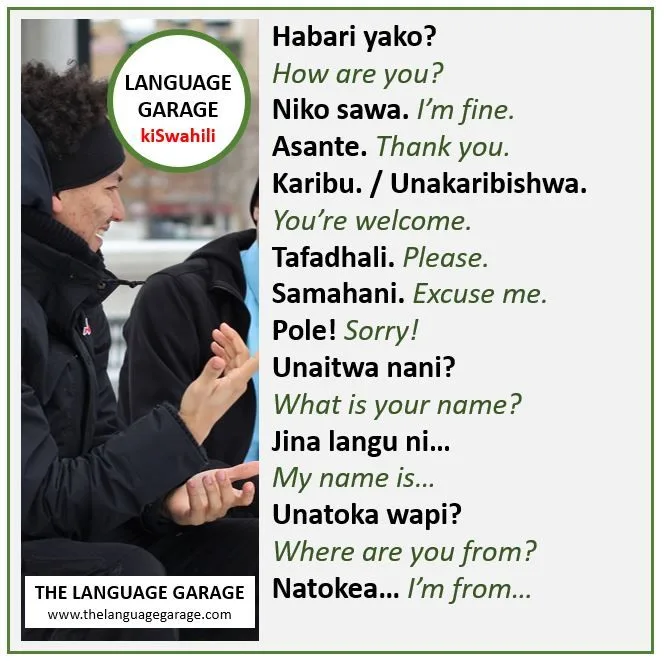
Swahili, known to its speakers as Kiswahili, is the working language of more than 150 million people across East and Central Africa. It is an official language of Kenya, Tanzania, Uganda, Rwanda, and the Democratic Republic of the Congo, and it is understood as a lingua franca from Mozambique to southern Somalia.
For the traveler, the student, or the expatriate, a practical phrasebook is not a luxury but the fastest path to the warm reception that East Africans reliably extend to anyone who makes an honest effort in their language.
This reference page collects more than one hundred everyday Swahili phrases and organizes them by the situations in which visitors and residents actually use them. You will find the essential greetings and polite expressions, introductions, phrases for the market and shopping, phrases for travel and transport, phrases for restaurants and food, phrases for emergencies, phrases for asking directions, and phrases for goodbyes.
Each entry appears in Swahili with a literal gloss where useful and a natural English equivalent. Where usage differs between Tanzania and Kenya, both variants are noted; where a phrase belongs to the coastal Islamic register or to urban slang, that context is marked too.
The philosophy of Swahili conversation is different from the efficient, transactional habits of English speakers. Greetings take time. Pleasantries are expected. A direct question without a preceding greeting is considered abrupt, and in rural settings even rude. A little patience at the start of an exchange returns tenfold in goodwill, prices, and information.
Core Greetings and Acknowledgments
The most useful ten words in Swahili are the ones that open and close a conversation. Master these first; the rest follows naturally.
| Swahili | Literal | Natural English |
|---|---|---|
| Jambo. | Matter / hello. | Hello (to tourists). |
| Hujambo? | Don't you have a problem? | How are you? |
| Sijambo. | I don't have a problem. | I am fine. |
| Habari? | News? | How are things? |
| Nzuri. | Good. | Fine. |
| Shikamoo. | I touch your feet. | Respectful hello to elders. |
| Marahaba. | Greetings accepted. | Response to Shikamoo. |
| Karibu. | Come near. | Welcome. |
| Asante. | Thank you. | Thanks. |
| Kwaheri. | Goodbye. | Farewell. |
Asante sana (thank you very much) and Karibu sana (you are very welcome) are reinforced forms. Asanteni thanks more than one person; Karibuni welcomes more than one. The plural suffix -ni is worth memorizing because it appears on almost every imperative.
Cultural note: An East African greeting is a small ritual, not a warm-up. A proper exchange often runs Habari? - Nzuri, habari yako? - Nzuri, habari ya nyumbani? - Salama. Skipping steps marks the visitor as hurried and foreign.
Kenyan Versus Tanzanian Register
Both countries teach the same Standard Swahili, but the street languages differ. Tanzania is considered the cradle of proper Kiswahili and speakers there tend toward a more formal register. Kenya mixes English freely and has produced Sheng, a youth variety of Swahili that borrows from English and Kikuyu. Learners are advised to begin with standard forms; both countries understand and respect them.
| Meaning | Tanzanian (standard) | Kenyan (urban) |
|---|---|---|
| How are you? | Habari yako? | Niaje? / Sasa? |
| Fine. | Nzuri. | Poa. / Freshi. |
| Money. | Pesa. | Doh. / Cheddah. |
| Friend. | Rafiki. | Buda. / Msee. |
| Yes. | Ndiyo. | Ndio. / Yap. |
| No. | Hapana. | La. |
Linguists treat Sheng as a separate code rather than bad Swahili. Visitors do not need to learn it, but should expect to hear it in Nairobi matatus, Mombasa markets, and on Kenyan television comedy.
Polite Expressions and Courtesies
Beyond the basic thank-you, Swahili has a small but essential set of courtesies that lubricate every exchange. For a deeper treatment of opening moves, see the Swahili greetings and daily conversation reference.
| Swahili | English |
|---|---|
| Tafadhali. | Please. |
| Asante (sana). | Thank you (very much). |
| Karibu. | You are welcome. |
| Samahani. | Excuse me / I am sorry. |
| Naomba radhi. | I beg your pardon. |
| Pole. | Sorry (sympathy). |
| Pole sana. | I am very sorry (for your trouble). |
| Hakuna shida. | No problem. |
| Hakuna tatizo. | No issue. |
| Haidhuru. | Never mind. |
| Sawa. | Okay. |
| Sawa sawa. | Fine, agreed. |
Pole is the word travelers most often misuse. It is sympathy, not apology. When a porter drops your bag, you say Pole, meaning I feel for you. When you step on someone's foot, you say Samahani, meaning I am sorry for what I did.
Introductions and Small Talk
| Swahili | English |
|---|---|
| Jina lako nani? | What is your name? |
| Jina langu ni Sara. | My name is Sara. |
| Ninaitwa John. | I am called John. |
| Unatoka wapi? | Where are you from? |
| Ninatoka Marekani. | I am from America. |
| Ninatoka Uingereza. | I am from England. |
| Unafanya kazi gani? | What work do you do? |
| Mimi ni mwalimu. | I am a teacher. |
| Mimi ni mwanafunzi. | I am a student. |
| Ninakaa wapi? - Ninakaa Arusha. | Where do I stay? - I stay in Arusha. |
| Nimefika jana. | I arrived yesterday. |
| Nitakaa wiki moja. | I will stay one week. |
| Furaha kukutana nawe. | Pleased to meet you. |
The subject prefix ni- (I), u- (you), and a- (he/she) attaches to every verb. Ninatoka (I come from), unatoka (you come from), anatoka (he/she comes from). This pattern generalizes to hundreds of verbs; see the Swahili pronouns reference for the full system.
Numbers, Money, and Shopping
Shopping in a market, a duka (small shop), or a soko (open market) is a core traveler experience. Prices are usually negotiable outside supermarkets and hotels.
| Swahili | English |
|---|---|
| Hii ni ngapi? | How much is this? |
| Bei gani? | What price? |
| Bei ya mwisho? | Last price? |
| Ni ghali sana. | It is very expensive. |
| Punguza bei, tafadhali. | Reduce the price, please. |
| Nitachukua. | I will take it. |
| Sitaki. | I do not want it. |
| Nina shilingi elfu mbili tu. | I have only two thousand shillings. |
| Una chenji? | Do you have change? |
| Lipa wapi? | Where do I pay? |
| Naomba risiti. | May I have a receipt. |
| Unakubali kadi? | Do you accept cards? |
The Kenyan shilling (shilingi) is worth roughly one-hundredth of a US dollar at most times; the Tanzanian shilling is worth less. For the numbers themselves, consult the Swahili numbers and counting reference.
Bargaining Etiquette
- State a counter-offer of roughly half to two-thirds of the asked price.
- Walk away politely if the price is too high. The seller will often call you back.
- A smile and a few Swahili words reduce the mzungu (foreigner) price significantly.
- Food staples at market (fruit, vegetables, bread) are rarely bargained.
- Crafts, fabrics, and carvings are always bargained.
Practical tip: If you carry only large notes, expect to be told Hakuna chenji (no change) in small shops. Break large notes at a supermarket or petrol station.
Food and Restaurants
Eating out in East Africa ranges from fine-dining hotels in Nairobi and Dar es Salaam to roadside mamas serving nyama choma (grilled meat) and ugali. The following phrases cover both extremes.
| Swahili | English |
|---|---|
| Nina njaa. | I am hungry. |
| Nina kiu. | I am thirsty. |
| Menyu, tafadhali. | Menu, please. |
| Mna chakula cha mboga? | Do you have vegetarian food? |
| Sili nyama. | I do not eat meat. |
| Naomba maji. | May I have water. |
| Maji ya chupa. | Bottled water. |
| Chai bila sukari. | Tea without sugar. |
| Chakula ni kitamu sana. | The food is very delicious. |
| Kimeiva vizuri. | It is cooked well. |
| Pilipili kidogo. | A little chili. |
| Hakuna pilipili. | No chili. |
| Bili tafadhali. | The bill, please. |
| Hesabu tafadhali. | The bill, please (alternate). |
| Naomba kulipa. | I would like to pay. |
For a fuller treatment of food vocabulary, see our companion reference on East African cuisine and cooking.
Travel and Transport
Public transport in East Africa runs on the daladala (Tanzanian minibus) and the matatu (Kenyan minibus). Private taxis, motorbike taxis called boda-boda or piki-piki, and ride apps like Uber and Bolt are all widely used.
| Swahili | English |
|---|---|
| Naenda Arusha. | I am going to Arusha. |
| Gari lako linaenda wapi? | Where is your vehicle going? |
| Nauli ni ngapi? | What is the fare? |
| Simama hapa, tafadhali. | Stop here, please. |
| Naomba kushuka. | I would like to get off. |
| Wapi kituo cha mabasi? | Where is the bus station? |
| Nataka teksi. | I want a taxi. |
| Tafadhali, nipeleke kwenye hoteli. | Please, take me to the hotel. |
| Tafadhali, endesha polepole. | Please, drive slowly. |
| Gari lina petroli? | Does the car have petrol? |
| Tiketi mbili za basi. | Two bus tickets. |
A fuller treatment of travel phrases, airports, safari parks, and minibus vocabulary appears in the companion travel reference.
Directions
| Swahili | English |
|---|---|
| Samahani, wapi...? | Excuse me, where is...? |
| Naenda wapi? | Where do I go? |
| Kushoto. | Left. |
| Kulia. | Right. |
| Moja kwa moja. | Straight ahead. |
| Karibu. | Near. |
| Mbali. | Far. |
| Hapa. | Here. |
| Pale. | There. |
| Mtaa huu. | This street. |
| Kona. | Corner. |
| Kilometa mbili. | Two kilometers. |
| Meta mia moja. | One hundred meters. |
Prepositions of place are covered in the Swahili prepositions reference.
Accommodation
| Swahili | English |
|---|---|
| Nina booking. | I have a booking. |
| Nahitaji chumba kimoja. | I need one room. |
| Chumba cha mtu mmoja. | Single room. |
| Chumba cha watu wawili. | Double room. |
| Bei ya usiku mmoja? | Price for one night? |
| Breakfast inakuja? | Is breakfast included? |
| Maji ya moto yapo? | Is there hot water? |
| Wi-Fi iko? | Is there Wi-Fi? |
| Nitaondoka kesho. | I will leave tomorrow. |
Emergencies
Phrases you hope not to use but must know. Write the Swahili forms on a card kept with your passport.
| Swahili | English |
|---|---|
| Saidia! | Help! |
| Polisi! | Police! |
| Mwizi! | Thief! |
| Moto! | Fire! |
| Ajali! | Accident! |
| Ninaumwa. | I am sick. |
| Nahitaji daktari. | I need a doctor. |
| Piga simu gari la wagonjwa. | Call an ambulance. |
| Wapi hospitali ya karibu? | Where is the nearest hospital? |
| Nimepoteza pasipoti. | I have lost my passport. |
| Mkoba wangu umeibwa. | My bag has been stolen. |
| Sijiskii vizuri. | I do not feel well. |
| Nimeumia. | I am hurt. |
Safety tip: The Kenyan emergency number is 999 or 112. The Tanzanian emergency number is 112. Save the number of your country's embassy and your hotel in your phone.
Time Expressions in Conversation
Swahili uses an unusual daily time system in which the day starts at 6 AM. Saa moja (literally hour one) means 7 AM, not 1 AM. This trips up every new learner; see the companion reference on days, months, and time for the full system.
| Swahili | English |
|---|---|
| Sasa. | Now. |
| Baadaye. | Later. |
| Leo. | Today. |
| Kesho. | Tomorrow. |
| Jana. | Yesterday. |
| Asubuhi. | In the morning. |
| Mchana. | In the afternoon. |
| Jioni. | In the evening. |
| Usiku. | At night. |
| Saa ngapi? | What time is it? |
| Saa tatu asubuhi. | Nine o'clock in the morning. |
Feelings and States
| Swahili | English |
|---|---|
| Nina furaha. | I am happy. |
| Nina huzuni. | I am sad. |
| Nimechoka. | I am tired. |
| Nina njaa. | I am hungry. |
| Nina kiu. | I am thirsty. |
| Nina baridi. | I am cold. |
| Nina joto. | I am hot. |
| Ninapenda. | I like / I love. |
| Sipendi. | I do not like. |
| Ninaelewa. | I understand. |
| Sielewi. | I do not understand. |
| Ninaogopa. | I am afraid. |
Telephone and Internet
| Swahili | English |
|---|---|
| Unaweza kunipigia simu? | Can you call me? |
| Nambari yako ya simu? | Your phone number? |
| Nitatuma ujumbe. | I will send a message. |
| Simu haishiki mtandao. | The phone has no signal. |
| Wi-Fi ya bure ipo? | Is there free Wi-Fi? |
| Password ni nini? | What is the password? |
| Ninahitaji simu kuchaji. | I need to charge my phone. |
Common Mistakes
Learners at every level make the same small set of errors. Knowing them in advance saves embarrassment.
- Confusing Pole (sympathy) with Samahani (apology). A child falls down: Pole. You bump into someone: Samahani.
- Using Jambo with locals. Jambo is the tourist greeting; with Swahili speakers, use Habari.
- Mistranslating Hakuna matata. It exists but is mostly a tourist phrase. Everyday speakers say Hakuna shida or Hakuna tatizo.
- Forgetting Shikamoo with elders. In Tanzania, failing to offer Shikamoo to an older stranger is a social error.
- Assuming saa tano means five o'clock. It means 11 AM or 11 PM in the Swahili clock (offset by six hours).
- Dropping the noun class agreement. Matunda matamu (sweet fruit, M/MI class) versus chakula kitamu (sweet food, KI/VI class). Adjectives agree; see the Swahili adjectives reference.
- Overusing English. Even a few Swahili words transform your interactions.
Quick Reference Card
The phrases on this card cover 80 percent of ordinary interactions. Print it, fold it into your passport, and consult it until these phrases are automatic.
- Jambo / Habari - Hello / How are you?
- Nzuri - Fine.
- Asante (sana) - Thank you (very much).
- Karibu - Welcome / You are welcome.
- Samahani - Excuse me / I am sorry.
- Tafadhali - Please.
- Ndiyo / Hapana - Yes / No.
- Sielewi - I do not understand.
- Unasema Kiingereza? - Do you speak English?
- Hii ni bei gani? - What is the price?
- Naenda... - I am going to...
- Saidia! - Help!
- Kwaheri - Goodbye.
Frequently Asked Questions
See the FAQ section in the JSON file for a curated set of common learner questions.
See Also
- Swahili greetings and daily conversation reference
- Swahili numbers and counting 1 to 1000 reference
- Swahili pronouns reference
- Swahili prepositions reference
- Swahili dialects and regional variations reference
- Swahili Arabic loanwords reference
- Language difficulty for English speakers reference
Author: Kalenux Team
Frequently Asked Questions
How many Swahili phrases do I need to function in East Africa?
A functional traveler vocabulary is about 50 phrases: 8 greetings, 10 shopping and money phrases, 10 direction and transport phrases, 10 food and restaurant phrases, 6 emergency phrases, and 6 polite expressions. This covers 90 percent of tourist interactions and most daily transactions.
Are Tanzanian and Kenyan Swahili very different?
The core grammar and vocabulary are identical because both countries use Standard Swahili in schools and media. The differences are mostly register and slang. Tanzanian Swahili is more formal and closer to the standard. Kenyan Swahili uses more English loanwords and has a street variety called Sheng. Tanzanians will tell you they speak the real Swahili.
Is Pole a greeting or an apology?
Pole means sorry in the sense of sympathy, not guilt. If someone trips, is tired, or has lost a relative, you say Pole. It does not mean I apologize for what I did. For that, use Samahani or Naomba radhi. Pole sana is a stronger form of sympathy.
What does Karibu mean exactly?
Karibu literally means near or come near and functions as welcome, come in, you are welcome after thanks, and please start eating when food is served. It is one of the most useful words in Swahili. Karibuni is the plural. Karibu tena means welcome back or come again.
Do I tip in East Africa, and how do I ask for the bill?
Tipping 5 to 10 percent is standard in restaurants in Kenya and Tanzania. To ask for the bill, say Bili tafadhali or Hesabu tafadhali. Naomba kulipa means I would like to pay. Credit cards are accepted in hotels and larger restaurants; small places are cash only.
What should I say in a medical emergency?
Saidia! means Help! Ninaumwa means I am sick. Nahitaji daktari means I need a doctor. Piga simu polisi means call the police. Wapi hospitali ya karibu? means Where is the nearest hospital? Memorize these and keep a card with your accommodation address in Swahili.
Why do people keep saying Pole pole to me?
Pole pole means slowly slowly and is a cultural value as much as an instruction. It is said to climbers on Kilimanjaro, to impatient tourists, and to anyone rushing. The Swahili proverb Haraka haraka haina baraka (hurry hurry has no blessing) captures the same idea.