
The semicolon is one of the most underused and misunderstood punctuation marks in English. Many writers avoid it entirely, either because they are unsure of the rules or because they believe it makes writing feel overly formal. This guide covers semicolon usage in plain terms: the two jobs the mark actually does, the mistakes that make writers avoid it, and how to tell a semicolon from a comma or a colon.
In reality, the semicolon is a powerful tool that fills a specific gap between the comma and the period, and learning to use it correctly can make your writing noticeably sharper and more sophisticated.
This guide covers every standard use of the semicolon, with clear rules, dozens of examples, comparisons with other punctuation marks, common mistakes to avoid, and guidance on using semicolons effectively in professional writing.
What a Semicolon Does
A semicolon sits between a comma and a period in terms of the pause it creates and the relationship it signals between ideas:
| Mark | Strength | Purpose |
|---|---|---|
| Comma (,) | Lightest pause | Separates elements within a sentence |
| Semicolon (;) | Medium pause | Connects closely related independent clauses |
| Period (.) | Full stop | Ends a sentence completely |
The semicolon tells the reader: "These two ideas are complete thoughts, but they are so closely connected that separating them with a period would weaken the relationship between them."
Think of it as a bridge between two sentences that belong together. A period puts them in separate rooms. A semicolon keeps them in the same room, standing side by side.
Rule 1 - Connecting Two Independent Clauses
The primary use of the semicolon is to join two independent clauses (complete sentences) that are closely related in meaning, without using a coordinating conjunction (and, but, or, nor, for, so, yet).
The Requirements
For a semicolon to work in this way, three conditions must be met:
- Both sides must be independent clauses - each one could stand alone as a complete sentence.
- The two clauses must be closely related - they should share a topic, develop a connected idea, or present a comparison/contrast.
- No coordinating conjunction should appear between them. If you use and, but, or, etc., use a comma instead.
Examples
- The project deadline is Friday; the team is working overtime to finish.
- Revenue increased by 15 percent; expenses remained flat.
- She excels at strategic planning; he is strongest in execution.
- The data supports the hypothesis; further testing will confirm the results.
- The first quarter exceeded expectations; the second quarter fell short.
- Remote work improved employee satisfaction; it also reduced overhead costs.
- The software update is ready; deployment begins Monday morning.
- Training is mandatory for all new hires; current employees may attend voluntarily.
- The interview went well; I expect to hear back by Thursday.
- Customer complaints declined steadily; Net Promoter Scores reached an all-time high.
- The proposal was thorough; it addressed every concern the board had raised.
- She finished the analysis ahead of schedule; the quality was exceptional.
- The old system was unreliable; the new one has had zero downtime.
- Sales targets were met in every region; the national goal was exceeded by 8 percent.
- The conference attracted over 500 attendees; last year's event drew only 200.
Why Not Just Use a Period?
You could replace every semicolon in the examples above with a period and be grammatically correct. The difference is stylistic and structural. A semicolon emphasizes the connection between the two ideas, while a period treats them as separate thoughts.
| With Semicolon | With Period |
|---|---|
| The market is volatile; investors are cautious. | The market is volatile. Investors are cautious. |
| She studied for months; the exam was easy. | She studied for months. The exam was easy. |
| The plan is ambitious; the resources are limited. | The plan is ambitious. The resources are limited. |
The semicolon version signals that the two statements are directly linked - cause and effect, comparison, contrast, or logical continuation. The period version presents them as independent observations that the reader must connect on their own.
When to choose the period over the semicolon:
- When the clauses are not particularly closely related
- When you want a sharper, more emphatic break between ideas
- When the paragraph already contains a semicolon (avoid clustering them)
- When the reader might benefit from a full stop to process the first idea before moving to the second
Why Not Just Use a Comma?
Using only a comma to join two independent clauses creates a comma splice, which is a grammatical error in standard written English.
| Comma Splice (Wrong) | Semicolon (Correct) | Comma + Conjunction (Also Correct) |
|---|---|---|
| The market is volatile, investors are cautious. | The market is volatile; investors are cautious. | The market is volatile, and investors are cautious. |
| The report is done, I will send it now. | The report is done; I will send it now. | The report is done, so I will send it now. |
| She finished early, he needed more time. | She finished early; he needed more time. | She finished early, but he needed more time. |
| Sales grew in Q1, costs also increased. | Sales grew in Q1; costs also increased. | Sales grew in Q1, but costs also increased. |
Rule 2 - Before Conjunctive Adverbs and Transitional Phrases
When a conjunctive adverb or transitional phrase connects two independent clauses, place a semicolon before it and a comma after it. This structure signals that the second clause relates to the first in a specific way (contrast, result, addition, etc.).
Common Conjunctive Adverbs and Their Functions
| Word | Function | Example |
|---|---|---|
| however | contrast | The plan is solid; however, the timeline is unrealistic. |
| therefore | result | The data is clear; therefore, we should proceed. |
| moreover | addition | The candidate is qualified; moreover, she has industry experience. |
| furthermore | addition | The product is innovative; furthermore, it is affordable. |
| nevertheless | contrast | The launch was delayed; nevertheless, the product was successful. |
| consequently | result | The budget was cut; consequently, two positions were eliminated. |
| meanwhile | time | The CEO was traveling; meanwhile, the board convened. |
| otherwise | alternative | Submit the report by Friday; otherwise, the review will be delayed. |
| similarly | comparison | Revenue grew in North America; similarly, European sales increased. |
| likewise | comparison | The marketing team exceeded targets; likewise, sales outperformed. |
| instead | substitution | We did not cancel the event; instead, we moved it online. |
| accordingly | result | The test results were positive; accordingly, the trial was expanded. |
| indeed | emphasis | The findings were significant; indeed, they challenged existing theory. |
| nonetheless | contrast | The project faced delays; nonetheless, it was completed on time. |
| thus | result | The hypothesis was confirmed; thus, the next phase was approved. |
| hence | result | The market shifted; hence, our strategy must adapt. |
| additionally | addition | The software is fast; additionally, it is easy to use. |
| subsequently | sequence | The proposal was approved; subsequently, funding was allocated. |
| specifically | clarification | Several factors contributed; specifically, turnover and training gaps were the biggest issues. |
More Full Examples
- The initial results were promising; however, the sample size was too small to draw definitive conclusions.
- Sales exceeded projections; therefore, the board approved the expansion into two new markets.
- The software has robust features; moreover, it integrates seamlessly with our existing systems.
- The deadline was missed; consequently, the client requested a discount on the final invoice.
- The first approach failed completely; nevertheless, the team remained optimistic and pivoted quickly.
- Revenue grew in Q1; furthermore, profit margins improved by three percentage points.
- The CEO resigned unexpectedly; meanwhile, the board convened an emergency meeting to discuss succession.
- We must secure funding this quarter; otherwise, the project will be shelved indefinitely.
- The London office exceeded targets; similarly, the Tokyo office reported strong growth in all segments.
- The vendor did not meet specifications; accordingly, we terminated the contract and began searching for alternatives.
The Most Common Mistake with Conjunctive Adverbs
Many writers use a comma before conjunctive adverbs instead of a semicolon, creating a comma splice. This is one of the most frequent punctuation errors in professional writing.
| Wrong (Comma Splice) | Correct (Semicolon) |
|---|---|
| The data was clear, however, the team disagreed. | The data was clear; however, the team disagreed. |
| Costs increased, therefore, we cut the budget. | Costs increased; therefore, we cut the budget. |
| She was qualified, moreover, she had experience. | She was qualified; moreover, she had experience. |
| The report is late, consequently, we missed the window. | The report is late; consequently, we missed the window. |
| Sales declined, nevertheless, annual targets were met. | Sales declined; nevertheless, annual targets were met. |
When the Conjunctive Adverb Appears Mid-Clause
If the conjunctive adverb appears in the middle of a single independent clause (interrupting it rather than connecting two clauses), use commas only - no semicolon.
- The data, however, suggests a different conclusion.
- The team, therefore, decided to change course.
- The results, moreover, were consistent across all test groups.
- The approach, nonetheless, has merit.
- The plan, accordingly, was revised.
In these cases, the adverb interrupts one clause rather than connecting two. The sentence has only one independent clause with the adverb embedded inside it.
How to Tell the Difference
If you remove the conjunctive adverb and the sentence still contains two separate complete thoughts, use a semicolon:
- The data was clear; however, the team disagreed. -> Remove "however": "The data was clear. The team disagreed." Two sentences. Use semicolon.
If you remove the conjunctive adverb and the sentence contains only one complete thought, use commas:
- The data, however, suggests a different conclusion. -> Remove "however": "The data suggests a different conclusion." One sentence. Use commas.
Rule 3 - In Complex Lists (The Super Comma)
Use semicolons to separate items in a list when one or more items already contain commas. The semicolon acts as a higher-level separator to prevent confusion about where one item ends and the next begins.
The Problem Without Semicolons
The conference attendees included Sarah Lee, VP of Marketing, James Chen, Director of Sales, Maria Gonzalez, CFO, and Robert Kim, Head of Engineering.
The problem: Is this a list of four people (each with a title) or eight people? Are "VP of Marketing" and "Director of Sales" names or job titles? The commas create genuine ambiguity.
The Solution With Semicolons
The conference attendees included Sarah Lee, VP of Marketing; James Chen, Director of Sales; Maria Gonzalez, CFO; and Robert Kim, Head of Engineering.
Now it is clear: There are four people, each followed by their title. The semicolons separate the four entries, and the commas within each entry separate the name from the title.
More Examples
The company has offices in New York, New York; Austin, Texas; Portland, Oregon; and Denver, Colorado.
The agenda includes a review of Q3 financials, presented by the CFO; a product roadmap update, led by the VP of Engineering; and a team-building exercise, organized by HR.
Key findings include increased customer retention, up 12 percent from last year; improved response times, averaging under two hours; and higher satisfaction scores, reaching 4.7 out of 5.
The panel features Dr. Anna Park, Stanford University; Prof. Michael Torres, MIT; and Dr. Claire Wu, Johns Hopkins University.
She has worked in healthcare, specializing in hospital administration; finance, focusing on risk management; and technology, leading software development teams.
The award recipients are John Davis, first place; Sarah Kim, second place; and Marcus Brown, third place.
Key milestones include completing the design phase, scheduled for March; beginning development, expected in April; launching the beta, targeted for August; and releasing the final product, planned for October.
The team evaluated three vendors: Acme Corp., based in Chicago, Illinois; Pinnacle Solutions, headquartered in San Francisco, California; and Global Systems, with offices in London, England.
When to Use Semicolons vs Commas in Lists
| List Type | Use | Example |
|---|---|---|
| Simple items with no internal commas | Commas | apples, oranges, and bananas |
| Items with internal commas | Semicolons | New York, NY; Austin, TX; and Portland, OR |
| Items where commas could cause ambiguity | Semicolons | Use judgment based on clarity |
Should You Still Use the Oxford Semicolon?
Yes. Just as the Oxford comma comes before "and" in a regular list, place a semicolon before "and" in the final item of a complex list. This maintains consistency and prevents ambiguity about whether the last two items are separate or connected.
- With: New York, NY; Austin, TX; and Portland, OR.
- Without: New York, NY; Austin, TX; Portland, OR.
Both are acceptable, but the version with the final semicolon before "and" is more common and slightly clearer.
Semicolon vs Comma vs Period - When to Use Each
This comparison helps you choose the right punctuation for connecting clauses. Understanding the distinctions prevents the most common punctuation errors.
| Situation | Punctuation | Example |
|---|---|---|
| Two closely related independent clauses, no conjunction | Semicolon | The plan is solid; execution begins Monday. |
| Two independent clauses with a coordinating conjunction | Comma + conjunction | The plan is solid, and execution begins Monday. |
| Two independent clauses, less closely related | Period | The plan is solid. We will discuss execution next week. |
| Two clauses with a conjunctive adverb between them | Semicolon + adverb + comma | The plan is solid; however, the timeline is tight. |
| Dependent clause + independent clause | Comma | Although the plan is solid, we need more funding. |
| Independent clause + dependent clause | Usually no punctuation | We need more funding because the plan has expanded. |
Decision Flowchart
Step 1: Are both sides complete sentences (independent clauses)?
- No -> Use a comma or no punctuation (depending on the structure). Do not use a semicolon.
- Yes -> Go to Step 2.
Step 2: Are the clauses closely related in meaning?
- No -> Use a period.
- Yes -> Go to Step 3.
Step 3: Is there a coordinating conjunction (and, but, or, nor, for, so, yet)?
- Yes -> Use a comma before the conjunction.
- No -> Go to Step 4.
Step 4: Is there a conjunctive adverb (however, therefore, meanwhile, etc.)?
- Yes -> Use a semicolon before the adverb and a comma after it.
- No -> Use a semicolon alone.
This flowchart covers the vast majority of clause-connection decisions you will encounter.
Semicolon vs Colon - The Key Differences
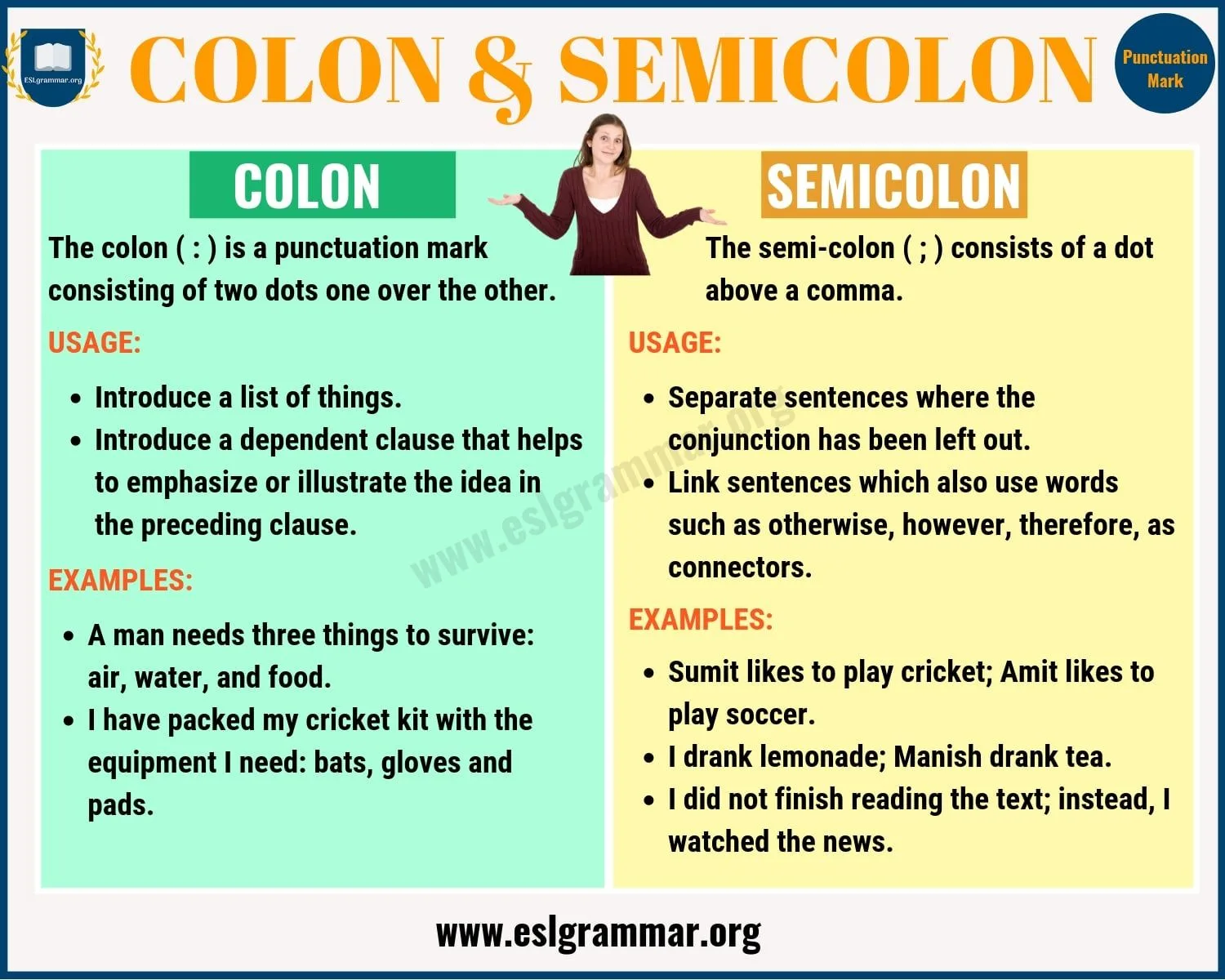
Writers often confuse semicolons and colons because they look similar (one has two dots, the other has a dot and a line). Their functions, however, are quite different. While semicolons link two independent clauses of equal weight, colons for lists and explanations serve a forward-pointing role - they introduce what follows rather than balancing two equivalent ideas.
| Feature | Semicolon (;) | Colon (:) |
|---|---|---|
| Connects | Two independent clauses of equal weight | An independent clause to an explanation, list, or elaboration |
| Relationship | Balanced, parallel, side-by-side | Introductory, explanatory, one-directional |
| Signal to reader | "Here is a related thought of equal importance" | "Here is what I mean" or "Here is what follows" |
| Both sides independent? | Yes, both must be independent clauses | Only the first side must be an independent clause |
| Introduces a list? | Only within a complex list (as separator) | Yes, commonly used to introduce lists |
| Can follow a fragment? | No | No (the part before the colon must be a complete clause) |
Side-by-Side Examples
| Semicolon | Colon |
|---|---|
| She had two priorities; meeting the deadline was the first. | She had two priorities: meeting the deadline and staying on budget. |
| The team worked late; they wanted to finish before the holiday. | The team had one goal: finishing before the holiday. |
| Revenue grew by 10 percent; profit margins also improved. | The numbers tell the story: revenue grew by 10 percent. |
| The software is powerful; it handles complex data efficiently. | The software excels in one area: handling complex data. |
| He trained for a year; she started just three months ago. | He had one advantage: a full year of training. |
Common Error: Using a Semicolon to Introduce a List
Wrong: The kit includes; a hammer, nails, and screws.
Correct: The kit includes: a hammer, nails, and screws.
Wrong: There are three options; red, blue, and green.
Correct: There are three options: red, blue, and green.
Wrong: The committee identified several issues; budget overruns, staffing shortages, and missed deadlines.
Correct: The committee identified several issues: budget overruns, staffing shortages, and missed deadlines.
A colon introduces a list. A semicolon does not (unless it is separating items within a complex list, as covered in Rule 3).
When NOT to Use a Semicolon
Understanding when to avoid the semicolon is as important as knowing when to use it. These are the most common situations where a semicolon is incorrect.
Do Not Connect an Independent Clause with a Dependent Clause
Wrong: Although the data was promising; we need more testing.
Correct: Although the data was promising, we need more testing.
Wrong: Because the budget was cut; the project was delayed.
Correct: Because the budget was cut, the project was delayed.
Wrong: If the client approves the design; we will begin production.
Correct: If the client approves the design, we will begin production.
The clause beginning with although, because, or if is dependent (it cannot stand alone), so a comma is the correct connector.
Do Not Use Before Coordinating Conjunctions
Wrong: The report was thorough; and the recommendations were clear.
Correct: The report was thorough, and the recommendations were clear.
Wrong: She accepted the position; but she negotiated a higher salary.
Correct: She accepted the position, but she negotiated a higher salary.
When using and, but, or, nor, for, so, or yet to connect clauses, use a comma, not a semicolon.
Exception: If the clauses are very long or contain internal commas, a semicolon before the conjunction can improve readability:
- The report covered sales figures for Q1, Q2, and Q3, including regional breakdowns and year-over-year comparisons; and the appendix contained raw data from all 14 regional offices, with separate tabs for each office.
This usage is uncommon but accepted in complex sentences where a comma before the conjunction would create confusion with the existing commas.
Do Not Use to Introduce a Simple List
Wrong: The menu includes; soup, salad, and a main course.
Correct: The menu includes soup, salad, and a main course.
Also correct: The menu includes: soup, salad, and a main course.
Do Not Use After a Fragment
Wrong: Regarding the budget; we need to make cuts.
Correct: Regarding the budget, we need to make cuts.
Wrong: An excellent performer; she was promoted within six months.
Correct: An excellent performer, she was promoted within six months.
"Regarding the budget" and "An excellent performer" are not independent clauses, so they cannot be joined to another clause with a semicolon.
Do Not Overuse Semicolons
Using multiple semicolons in a single paragraph can make writing feel dense, academic, and hard to follow. As a general guideline:
- One semicolon per paragraph is ideal for most writing.
- Two semicolons per paragraph is acceptable when the content calls for it.
- Three or more semicolons per paragraph is almost always too many. Consider whether periods, conjunctions, or restructured sentences would serve the reader better.
The exception is complex lists (Rule 3), where multiple semicolons in a single sentence are necessary and expected.
Semicolons in Professional Writing
Business Emails
Semicolons appear sparingly in emails but can be effective for connecting related points concisely:
- The quarterly numbers look strong; I will prepare a summary for the board.
- The client approved Phase 1; however, they want a revised timeline for Phase 2.
- We have three options: extend the deadline; increase the team size; or reduce the project scope.
- The vendor confirmed availability; pricing details will follow tomorrow.
In email communication, keep semicolons to a minimum. Most email readers prefer shorter sentences and simpler punctuation. One semicolon per email is usually the right frequency.
Reports and Proposals
Semicolons are more common in formal documents where precision and information density matter:
- Productivity increased by 18 percent; absenteeism decreased by 7 percent.
- The solution addresses both cost and efficiency; moreover, it scales with projected growth over the next five years.
- The committee reviewed applications from Atlanta, Georgia; Dallas, Texas; and Seattle, Washington.
- Phase 1 has been completed on time and under budget; Phase 2 is currently on track for the September milestone.
- Customer satisfaction scores improved in all regions; the largest gains were recorded in the Northeast.
Legal and Technical Writing
Semicolons are standard in legal and technical writing, where they clarify complex structures and parallel requirements:
- The licensee shall maintain all records; provide quarterly reports to the licensor; and ensure compliance with all applicable regulations.
- The system supports user authentication via OAuth 2.0; role-based access control, including admin, editor, and viewer roles; and end-to-end encryption for all data in transit.
- The contractor agrees to complete the work by the specified deadline; the client agrees to provide access to all necessary facilities.
- All modifications must be documented; unauthorized changes will void the warranty.
Academic Writing
Semicolons are valued in academic writing for connecting ideas efficiently:
- The study found a significant correlation between variables; however, causation could not be established.
- Participants in Group A showed improvement; participants in Group B showed no change.
- The theory has been widely cited; nevertheless, it has faced substantial criticism in recent years.
- Data was collected through surveys, interviews, and focus groups; analysis was conducted using mixed methods.
Semicolons and Tone
The semicolon carries a subtle tonal quality. It suggests sophistication, control, and deliberateness. A writer who uses semicolons correctly signals that they are making intentional choices about sentence structure rather than defaulting to short, simple sentences.
However, this tonal quality can work against you if overused. Too many semicolons can make writing feel:
- Dense - readers may struggle to process tightly packed information.
- Academic - in contexts where a conversational tone is expected, semicolons can feel stiff.
- Self-conscious - excessive semicolons can suggest the writer is trying too hard to appear sophisticated.
The ideal approach is to use semicolons when they genuinely improve the sentence - when two ideas are so closely linked that a period would weaken the connection - and to use periods, conjunctions, or restructured sentences everywhere else.
Common Semicolon Mistakes
Mistake 1: Comma Splice Instead of Semicolon
Wrong: The meeting ran long, we did not cover the last agenda item.
Correct: The meeting ran long; we did not cover the last agenda item.
This is the most common error that semicolons can fix. When you spot two complete sentences joined only by a comma, a semicolon is one of the standard corrections.
Mistake 2: Semicolon Before Because, Although, If, or While
Wrong: We postponed the launch; because the testing was incomplete.
Correct: We postponed the launch because the testing was incomplete.
Wrong: The team succeeded; although they faced significant obstacles.
Correct: The team succeeded although they faced significant obstacles.
Words like because, although, if, and while create dependent clauses, not independent ones.
Mistake 3: Semicolon Introducing a List
Wrong: The package includes; three books, a workbook, and access to online resources.
Correct: The package includes: three books, a workbook, and access to online resources.
Mistake 4: Fragment on One Side
Wrong: An excellent performer; she was promoted within six months.
Correct: An excellent performer, she was promoted within six months.
"An excellent performer" is not an independent clause. Both sides of a semicolon must be able to stand alone as complete sentences.
Mistake 5: Semicolon with Coordinating Conjunction
Wrong: The design is elegant; but the functionality is limited.
Correct: The design is elegant, but the functionality is limited.
Coordinating conjunctions (and, but, or, nor, for, so, yet) pair with commas, not semicolons, in standard usage.
Mistake 6: Using a Semicolon Where a Colon Belongs
Wrong: He had one goal; to finish the marathon.
Correct: He had one goal: to finish the marathon.
The second part explains or elaborates on the first, which is the colon's job.
Practice Sentences
Decide whether each sentence uses the semicolon correctly. If not, identify the error and provide the corrected version. Answers follow below.
- The presentation was well-received; however, several questions remained unanswered.
- She completed the report on time; and submitted it to the director.
- The team includes Anna Lee, Project Manager; Tom Chen, Lead Developer; and Sara Kim, UX Designer.
- Although the budget was tight; the team delivered excellent results.
- The server is down; we are working on a fix.
- Three departments exceeded targets; marketing, sales, and operations.
- He arrived early; she arrived late.
- The proposal was rejected; because the costs were too high.
- The results were encouraging; therefore, the board approved the next phase.
- The company has offices in London, England; Paris, France; and Tokyo, Japan.
- She is the most qualified candidate; her experience speaks for itself.
- We should proceed with caution; the risks are significant.
- After reviewing the data; the team decided to change course.
- The plan is ambitious; moreover, it is achievable within the current budget.
- There are two options; extend the deadline or reduce the scope.
Answers
Correct. Two independent clauses connected by a semicolon with the conjunctive adverb "however" followed by a comma.
Incorrect. Do not use a semicolon before a coordinating conjunction. Also, "submitted it to the director" lacks its own subject and is not an independent clause.
Corrected: She completed the report on time and submitted it to the director.Correct. Semicolons separate list items that contain internal commas.
Incorrect. "Although the budget was tight" is a dependent clause.
Corrected: Although the budget was tight, the team delivered excellent results.Correct. Two closely related independent clauses.
Incorrect. The semicolon is being used to introduce a list. A colon is needed.
Corrected: Three departments exceeded targets: marketing, sales, and operations.Correct. Two closely related independent clauses with a clear parallel structure.
Incorrect. "Because the costs were too high" is a dependent clause.
Corrected: The proposal was rejected because the costs were too high.Correct. Semicolon before conjunctive adverb "therefore," comma after.
Correct. Semicolons in a complex list with internal commas.
Correct. Two closely related independent clauses. The second supports the first.
Correct. Two related independent clauses where the second explains the first.
Incorrect. "After reviewing the data" is a dependent phrase, not an independent clause.
Corrected: After reviewing the data, the team decided to change course.Correct. Semicolon before "moreover," comma after, connecting two independent clauses.
Incorrect. The semicolon is introducing a list of options. A colon would be better. Additionally, the list needs proper structure.
Corrected: There are two options: extend the deadline or reduce the scope.
Quick-Reference Summary
| Use a Semicolon... | Example |
|---|---|
| Between two related independent clauses (no conjunction) | The plan is ready; implementation starts Monday. |
| Before a conjunctive adverb connecting two clauses | Sales grew; however, costs also increased. |
| Between list items that contain commas | New York, NY; Austin, TX; and Portland, OR. |
| Do NOT Use a Semicolon... | Use Instead |
|---|---|
| Before a coordinating conjunction (and, but, or) | Comma |
| To introduce a list | Colon |
| After a dependent clause or fragment | Comma or no punctuation |
| When the clauses are not closely related | Period |
| Before because, although, if, while, etc. | Comma or no punctuation |
Semicolon Quick Tests
Before placing a semicolon, run these quick checks:
Test 1: The Independence Test Can both sides stand alone as complete sentences? If not, do not use a semicolon.
- "The plan is ready" - complete sentence. Pass.
- "Implementation starts Monday" - complete sentence. Pass.
- "The plan is ready; implementation starts Monday." - Correct.
Test 2: The Relationship Test Are the two clauses closely related? If they discuss completely different topics, use a period instead.
- "Sales grew by 10 percent; the office holiday party is next Friday." - Unrelated. Use a period.
- "Sales grew by 10 percent; profit margins also improved." - Related. Semicolon works.
Test 3: The Conjunction Test Is there a coordinating conjunction (and, but, or, etc.) between the clauses? If yes, use a comma, not a semicolon.
- "The data is clear, and the team agrees." - Comma + conjunction. Correct.
- "The data is clear; and the team agrees." - Semicolon + conjunction. Incorrect.
Final Tips for Semicolon Mastery
Start with Rule 1. The most common and most useful semicolon application is connecting two independent clauses without a conjunction. Master this before worrying about the other uses. It covers the majority of semicolon decisions you will face.
Both sides must be independent clauses (except in complex lists). If either side cannot stand alone as a sentence, a semicolon is almost certainly wrong. This single test catches most semicolon errors.
Use semicolons sparingly. One or two per paragraph is usually the right density. A well-placed semicolon adds elegance. Multiple semicolons in quick succession add density and fatigue.
A period is always a safe alternative. If you are unsure whether a semicolon is appropriate, a period is never wrong. The semicolon adds nuance and shows the connection between ideas, but it is rarely required. You will never be marked wrong for using a period where a semicolon could have gone.
Read your sentence aloud. A semicolon should create a pause slightly longer than a comma but shorter than a period. If the two clauses feel disconnected when read aloud, a period is probably the better choice.
The semicolon is a precision tool, not a decoration. Use it when two ideas genuinely belong together and the connection between them is part of the meaning you want to convey. Do not use it simply to make your writing look more formal or sophisticated.
Learn the conjunctive adverb pattern. The semicolon-adverb-comma construction (clause; however, clause) is extremely common in professional writing and is the source of many comma splices. Once you master this pattern, you will eliminate one of the most frequent punctuation errors.
Practice with complex lists. The "super comma" function of the semicolon is essential for writing that involves locations, people with titles, or items with descriptions. Mastering this use makes your lists clear and professional.
Do not fear the semicolon. Many writers avoid it because they are unsure of the rules. Now that you know the three main uses - connecting independent clauses, preceding conjunctive adverbs, and organizing complex lists - you have everything you need to use it correctly and confidently.
Revise for semicolons during editing, not drafting. During your first draft, focus on getting ideas down. During editing, look for comma splices and closely related sentences that could benefit from a semicolon. Adding semicolons during revision is often more effective than trying to deploy them perfectly in real time.
The semicolon occupies a small but valuable niche in English punctuation. Once you understand its three main uses and the situations where it does not belong, you have everything you need to use it correctly in any writing context - from casual emails to formal reports to published articles.
Frequently Asked Questions
What is the main purpose of a semicolon?
The primary purpose of a semicolon is to connect two independent clauses that are closely related in meaning without using a conjunction. Think of it as stronger than a comma but softer than a period. While a period creates a full stop between ideas, a semicolon signals that the two statements are closely linked and should be read as connected thoughts.
For example, the project deadline is Friday; the team is working overtime to finish. Both clauses could stand alone as sentences, but the semicolon shows they are directly related. This usage accounts for the vast majority of semicolons in professional writing. The semicolon also serves a practical role in complex lists where commas alone would create confusion.
How is a semicolon different from a colon?
Although they look similar, semicolons and colons serve different purposes. A semicolon connects two independent clauses of equal weight, suggesting a balanced relationship between the ideas. A colon introduces something that follows from or explains the preceding clause, such as a list, an explanation, or an elaboration.
Think of a colon as saying here is what I mean or as follows, while a semicolon says and here is a related thought.
For example, she had one goal: finishing the marathon uses a colon because the second part explains the goal. She trained for months; she finished the marathon uses a semicolon because both clauses carry equal weight. Mixing these up is a common error in business and academic writing.
When should I avoid using a semicolon?
Never use a semicolon to connect an independent clause with a dependent clause or a fragment. The sentence although it rained; we went hiking is incorrect because although it rained is not an independent clause. A comma should be used instead. Avoid using semicolons to introduce lists unless the list items themselves contain commas.
Do not place a semicolon before coordinating conjunctions like and, but, or or, as a comma is the correct choice in those constructions. Also avoid overusing semicolons within a single paragraph, as this can make your writing feel dense and difficult to follow. In most professional contexts, one or two semicolons per paragraph is a reasonable maximum.