
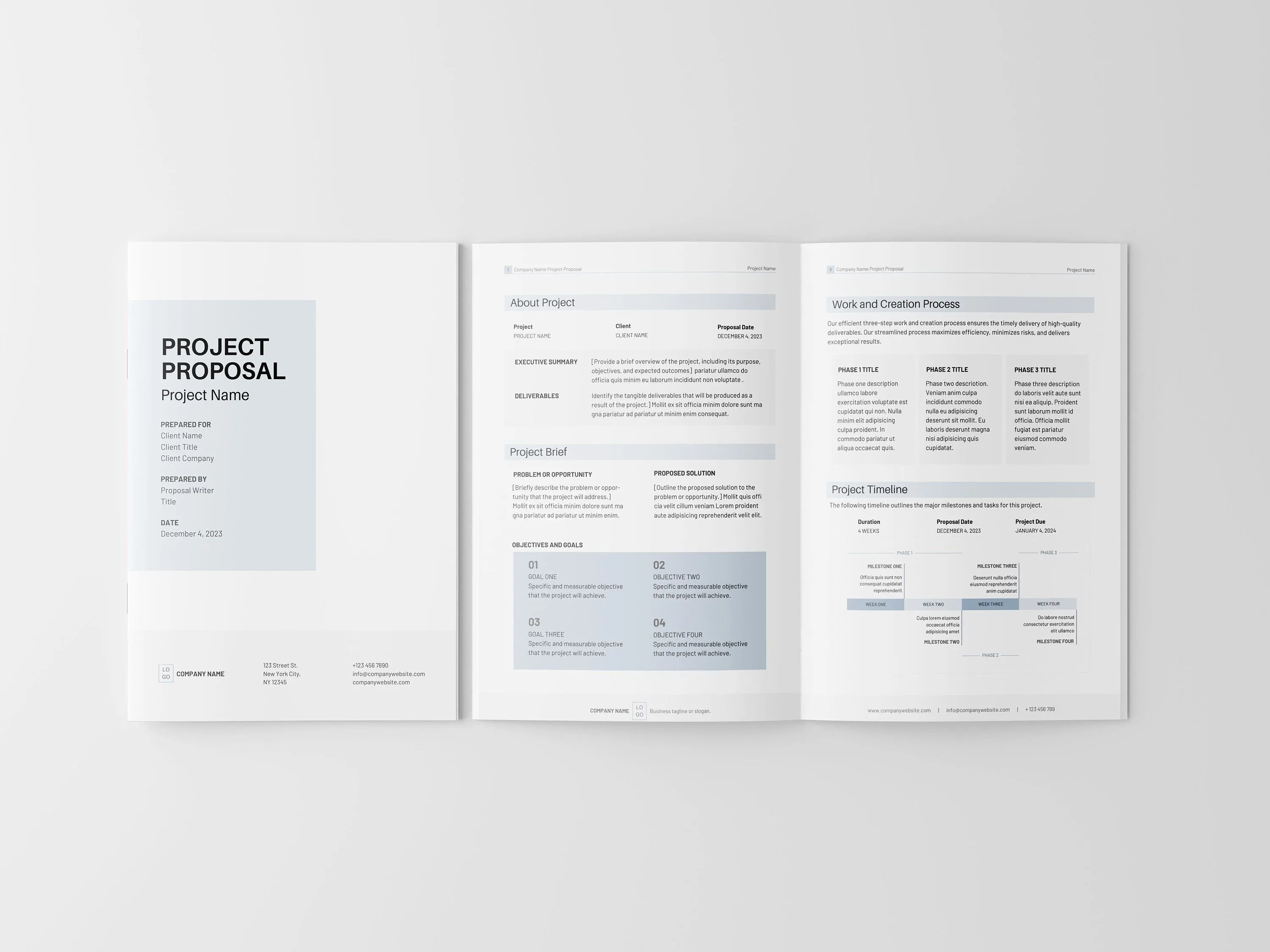
A business proposal is the single most important document in the sales process. It is the bridge between a prospect's problem and a company's solution, and it often determines whether a deal closes or a competitor wins the contract. Yet despite their importance, most business proposals are poorly structured, overly generic, and fail to address what decision-makers actually care about.
This comprehensive guide provides a complete business proposal template, step-by-step writing instructions, industry-specific examples, and the strategic insights that separate winning proposals from the pile of rejected submissions collecting dust in procurement offices around the world.
What a Business Proposal Actually Is
A business proposal is a formal document that outlines a specific solution to a client's problem, the methodology for delivering that solution, the timeline, and the investment required. It is not a brochure, a company overview, or a capabilities statement. The proposal exists to answer one question: why should this client choose this provider for this specific engagement?
Types of Business Proposals
Solicited proposals respond to a formal request from a potential client. These requests come in several forms:
- Request for Proposal (RFP) - A detailed document specifying the client's requirements, evaluation criteria, and submission guidelines
- Request for Quotation (RFQ) - A request focused primarily on pricing for clearly defined deliverables
- Request for Information (RFI) - A preliminary inquiry used to gather information before issuing a formal RFP
Unsolicited proposals are submitted proactively when a company identifies a potential client's problem and presents a solution without being asked. These require more persuasive writing because the reader may not yet acknowledge the problem exists.
Internal proposals are written within an organization to secure budget, resources, or approval for a project. They follow many of the same structural conventions but typically have a different tone and audience.
The Complete Business Proposal Template
The following template provides the standard structure used in professional business proposals. Each section is explained in detail with guidance on what to include and what to avoid.
Cover Page
The cover page creates the first impression. It should include:
- Proposal title that clearly describes the engagement
- Client name and logo (if appropriate and available)
- Your company name and logo
- Date of submission
- Proposal version number (for tracking revisions)
- Contact information for the primary proposal contact
- Confidentiality notice (if the proposal contains proprietary information)
Template:
[Your Company Logo]

PROPOSAL

[Proposal Title: Specific Description of the Engagement]

Prepared for:
[Client Company Name]
[Client Contact Name, Title]

Prepared by:
[Your Company Name]
[Your Name, Title]
[Email Address]
[Phone Number]

Date: [Submission Date]
Version: [1.0]

CONFIDENTIAL - This document contains proprietary information
intended solely for the named recipient.
Table of Contents
For proposals longer than five pages, include a table of contents with page numbers. This allows decision-makers to navigate directly to the sections most relevant to their evaluation criteria.
Executive Summary
The executive summary is the most important section of the proposal. Many decision-makers read only this section before deciding whether the full proposal merits their time. It should be written last, after all other sections are complete, but it appears first in the document.
What to include:
- The client's core problem or opportunity in one to two sentences
- Your proposed solution summarized in two to three sentences
- The key benefits the client will realize
- The investment required (total cost or range)
- The projected timeline
- A compelling reason to act now
What to exclude:
- Company history or background (save for the About Us section)
- Technical jargon that the decision-maker may not understand
- Vague promises without supporting evidence
- Lengthy methodology descriptions
Template:
EXECUTIVE SUMMARY

[Client Name] is facing [specific problem or opportunity]. Without
intervention, [consequence of inaction - lost revenue, competitive
disadvantage, regulatory risk, operational inefficiency].

[Your Company Name] proposes [brief description of solution] to
[primary outcome]. This approach will [key benefit 1], [key benefit 2],
and [key benefit 3].

The proposed engagement requires an investment of [dollar amount] over
[timeline]. Based on [data source or comparable engagement], [Client
Name] can expect [projected ROI, cost savings, or measurable outcome]
within [timeframe].

We recommend beginning the engagement by [proposed start date] to
[reason for urgency - capture seasonal demand, meet regulatory
deadline, maintain competitive position].
Example - IT Consulting Proposal:
EXECUTIVE SUMMARY

Greenfield Manufacturing is experiencing an average of 14 hours of
unplanned downtime per month across its three production facilities,
resulting in an estimated $2.1 million in annual lost revenue. The
current legacy ERP system, implemented in 2014, lacks the integration
capabilities required to support real-time production monitoring and
predictive maintenance.

Apex Technology Solutions proposes a phased migration to a cloud-based
ERP platform with integrated IoT sensor monitoring, reducing unplanned
downtime by an estimated 80 percent within the first 12 months. This
approach will consolidate three disparate systems into a single
platform, provide real-time visibility across all facilities, and
enable predictive maintenance scheduling based on equipment performance
data.

The proposed engagement requires an investment of $485,000 over 9
months. Based on comparable implementations in the manufacturing
sector, Greenfield can expect full ROI within 14 months through
reduced downtime, lower maintenance costs, and improved production
scheduling accuracy.

We recommend beginning the discovery phase by March 15 to complete
the migration before the Q4 production surge.
Problem Statement
This section demonstrates that you understand the client's situation. It should reflect research, not assumptions. Reference specific details from conversations, the RFP, publicly available information, or industry data.
Template:
UNDERSTANDING YOUR CHALLENGE

[Client Name] is currently experiencing [specific problem]. Based on
our [conversations with your team / review of the RFP / analysis of
your current operations], we understand that:

- [Specific pain point 1 with quantifiable impact if available]
- [Specific pain point 2 with quantifiable impact if available]
- [Specific pain point 3 with quantifiable impact if available]

These challenges are [growing / creating risk / limiting growth]
because [root cause analysis]. Without a structured approach to
[addressing the problem], [Client Name] faces [specific consequences].
Writing tips for the problem statement:
- Use the client's language, not yours
- Quantify the problem whenever possible (lost revenue, wasted hours, compliance risk)
- Show that you understand the root cause, not just the symptoms
- Reference specific conversations or documents to demonstrate due diligence
- Avoid making the client feel criticized for their current situation
Proposed Solution
This is where the proposal shifts from problem to answer. Describe your approach clearly, explain why it will work, and differentiate it from alternatives the client may be considering.
Template:
PROPOSED SOLUTION

To address the challenges outlined above, [Your Company Name]
recommends the following approach:

Overview
[Two to three paragraph summary of the proposed solution, written in
plain language that a non-technical decision-maker can understand.]

Key Components

1. [Component 1 Name]
   [Description of what this component involves and what it achieves]

2. [Component 2 Name]
   [Description of what this component involves and what it achieves]

3. [Component 3 Name]
   [Description of what this component involves and what it achieves]

Why This Approach

[Explain the rationale behind the chosen methodology. Reference
industry standards, best practices, lessons learned from similar
engagements, or research that supports the approach.]

What Makes Our Approach Different

- [Differentiator 1 - specific, not generic]
- [Differentiator 2 - specific, not generic]
- [Differentiator 3 - specific, not generic]
Scope of Work
The scope of work defines exactly what is included in the engagement and, equally important, what is not. This section prevents scope creep and sets clear expectations.
Template:
SCOPE OF WORK

In Scope:
- [Deliverable or activity 1]
- [Deliverable or activity 2]
- [Deliverable or activity 3]
- [Deliverable or activity 4]
- [Deliverable or activity 5]

Out of Scope:
- [Item explicitly excluded 1]
- [Item explicitly excluded 2]
- [Item explicitly excluded 3]

Assumptions:
- [Assumption about client resources, access, or cooperation]
- [Assumption about existing infrastructure or data]
- [Assumption about timeline dependencies]

Change Management:
Any changes to the agreed scope will be documented in a written change
order, including the impact on timeline and budget, and must be
approved by both parties before work begins.
Timeline and Milestones
Present the project timeline using phases with clear milestones. Decision-makers want to know when they will see results, not just when the work will be done.
Template:
PROJECT TIMELINE

Phase 1: [Phase Name] - [Duration]
  Start: [Date]
  End: [Date]
  Key Activities:
  - [Activity 1]
  - [Activity 2]
  Milestone: [Deliverable or checkpoint]

Phase 2: [Phase Name] - [Duration]
  Start: [Date]
  End: [Date]
  Key Activities:
  - [Activity 1]
  - [Activity 2]
  Milestone: [Deliverable or checkpoint]

Phase 3: [Phase Name] - [Duration]
  Start: [Date]
  End: [Date]
  Key Activities:
  - [Activity 1]
  - [Activity 2]
  Milestone: [Deliverable or checkpoint]

Total Project Duration: [X weeks/months]
Example - Marketing Campaign Proposal:
PROJECT TIMELINE

Phase 1: Research and Strategy - 3 Weeks
  Start: April 1
  End: April 21
  Key Activities:
  - Competitive analysis and market research
  - Customer persona development
  - Campaign strategy and channel selection
  Milestone: Strategy presentation and approval

Phase 2: Creative Development - 4 Weeks
  Start: April 22
  End: May 19
  Key Activities:
  - Brand messaging and copy development
  - Visual asset creation (ads, landing pages, email templates)
  - A/B test variant preparation
  Milestone: Creative review and approval

Phase 3: Launch and Optimization - 8 Weeks
  Start: May 20
  End: July 14
  Key Activities:
  - Campaign launch across approved channels
  - Weekly performance monitoring and optimization
  - Mid-campaign performance report (Week 4)
  Milestone: Final performance report with recommendations

Total Project Duration: 15 Weeks
Pricing and Investment
Present pricing clearly and transparently. Decision-makers distrust proposals that obscure costs or use confusing fee structures.
Template - Fixed Price:
INVESTMENT

Deliverable                              Investment
-------------------------------------------------
[Deliverable 1]                          $XX,XXX
[Deliverable 2]                          $XX,XXX
[Deliverable 3]                          $XX,XXX
[Deliverable 4]                          $XX,XXX
-------------------------------------------------
Total Project Investment                 $XX,XXX

Payment Schedule:
- 30% upon contract signing              $XX,XXX
- 30% upon completion of [milestone]     $XX,XXX
- 40% upon final delivery and acceptance $XX,XXX

This pricing includes [list what is included: revisions, meetings,
travel, tools, licenses]. Additional work outside the defined scope
will be quoted separately via change order.
Template - Tiered Pricing:
INVESTMENT OPTIONS

                    Essential    Professional   Enterprise
---------------------------------------------------------
[Feature 1]           Yes           Yes            Yes
[Feature 2]           No            Yes            Yes
[Feature 3]           No            No             Yes
[Support Level]     Email only   Email + Phone  Dedicated PM
[Timeline]          12 weeks      10 weeks       8 weeks
---------------------------------------------------------
Investment          $XX,XXX       $XX,XXX        $XX,XXX

Recommended: The Professional tier provides the optimal balance of
scope, timeline, and investment for [Client Name]'s stated objectives.
Template - Time and Materials:
INVESTMENT

Role                    Hourly Rate    Estimated Hours    Estimated Cost
-----------------------------------------------------------------------
[Role 1]                $XXX           XX hours           $XX,XXX
[Role 2]                $XXX           XX hours           $XX,XXX
[Role 3]                $XXX           XX hours           $XX,XXX
-----------------------------------------------------------------------
Estimated Total                                           $XX,XXX

Budget Cap: A not-to-exceed amount of $XX,XXX has been established
for this engagement. Any work that would exceed this cap requires
written approval from [Client Name] before proceeding.

Invoicing: [Monthly / Biweekly] based on actual hours worked,
with detailed time logs provided with each invoice.
Team and Qualifications
Introduce the team members who will work on the engagement. Decision-makers want to know who will actually do the work, not just the company's overall capabilities.
Template:
YOUR PROJECT TEAM

[Name], [Title] - Project Lead
[Two to three sentences covering relevant experience, certifications,
and specific expertise relevant to this engagement.]

[Name], [Title] - [Role]
[Two to three sentences covering relevant experience.]

[Name], [Title] - [Role]
[Two to three sentences covering relevant experience.]
Case Studies and Social Proof
Include two to three brief case studies from comparable engagements. Focus on results, not process.
Template:
RELEVANT EXPERIENCE

[Client Name or Industry] - [Brief Project Description]
Challenge: [One sentence describing the client's problem]
Solution: [One sentence describing what you delivered]
Result: [Quantifiable outcome - revenue increase, cost reduction,
time saved, efficiency gained]

[Client Name or Industry] - [Brief Project Description]
Challenge: [One sentence]
Solution: [One sentence]
Result: [Quantifiable outcome]
Terms and Conditions
Include standard business terms to protect both parties and set clear expectations.
Template:
TERMS AND CONDITIONS

1. Agreement: This proposal becomes a binding agreement upon signature
   by authorized representatives of both parties.

2. Validity: This proposal is valid for [30/60/90] days from the date
   of submission.

3. Payment Terms: Invoices are due within [30] days of receipt.
   Late payments are subject to a [1.5%] monthly finance charge.

4. Intellectual Property: [Specify ownership of deliverables, work
   product, and pre-existing IP used in the engagement.]

5. Confidentiality: Both parties agree to maintain the confidentiality
   of proprietary information shared during the engagement.

6. Termination: Either party may terminate this agreement with [30]
   days written notice. Client is responsible for payment of all work
   completed through the termination date.

7. Limitation of Liability: [Standard limitation clause appropriate
   to your industry and jurisdiction.]

8. Governing Law: This agreement shall be governed by the laws of
   [State/Jurisdiction].
Signature Page
Template:
ACCEPTANCE

By signing below, both parties agree to the terms outlined in this
proposal.

FOR [CLIENT COMPANY NAME]:

Signature: _________________________
Name: _____________________________
Title: ____________________________
Date: _____________________________

FOR [YOUR COMPANY NAME]:

Signature: _________________________
Name: _____________________________
Title: ____________________________
Date: _____________________________
Step-by-Step Proposal Writing Process
Writing a proposal is not a single task but a structured process. Following these steps in order produces stronger results than attempting to write the document from start to finish.
Step 1: Research the Client
Before writing a single word, gather as much information as possible about the client, their industry, their competitors, and their specific situation. Sources include:
- The RFP document (for solicited proposals) - read it multiple times and highlight evaluation criteria
- The client's website - annual reports, press releases, leadership bios, strategic priorities
- Industry publications - trends, challenges, regulatory changes affecting the client's sector
- Previous conversations - notes from sales calls, discovery meetings, and informal discussions
- Public financial data - for publicly traded companies, review quarterly earnings and investor presentations
- Social media and news - recent announcements, executive interviews, organizational changes
The quality of the research directly determines the quality of the problem statement and the relevance of the proposed solution.
Step 2: Outline Before Writing
Create a detailed outline that maps to the RFP requirements (if applicable) or follows the standard template structure. For each section, note the key points to be made and any supporting evidence to include. This step prevents the common problem of discovering gaps or redundancies after the writing is already underway.
Step 3: Write the Problem Statement First
Starting with the problem statement forces the writer to think from the client's perspective. If the problem statement is weak, everything that follows will be unfocused. A strong problem statement demonstrates understanding and builds credibility before the solution is even introduced.
Step 4: Develop the Solution and Scope
With the problem clearly defined, develop the solution in direct response to each pain point identified. Every element of the proposed solution should trace back to a specific problem or need. If a solution component does not address a stated problem, it should be questioned.
Step 5: Build the Timeline and Pricing
Timeline and pricing should be developed together because they are interdependent. A compressed timeline typically increases cost. A phased approach may reduce upfront investment. Present these sections in a way that helps the client understand the relationship between scope, time, and cost.
Step 6: Write the Executive Summary Last
The executive summary should distill the entire proposal into a compelling overview. Writing it last ensures that it accurately reflects the content of the full document. Many proposal writers make the mistake of writing the executive summary first and then discovering that the proposal evolved in a different direction during the writing process.
Step 7: Review, Edit, and Proofread
Every proposal should go through at least three rounds of review:
- Content review - Does the proposal address all client requirements? Is the solution sound? Is the pricing competitive?
- Persuasion review - Does the proposal make a compelling case? Are benefits clearly articulated? Is differentiation evident?
- Quality review - Grammar, spelling, formatting consistency, page numbering, cross-references, and visual presentation
Industry-Specific Proposal Examples
Consulting Proposal Example - Management Consulting
Problem Statement: "Regional Healthcare Partners (RHP) operates 12 outpatient clinics across three states. Over the past 18 months, patient wait times have increased by 34 percent, patient satisfaction scores have declined from 4.2 to 3.6 on a 5-point scale, and three clinics are operating at a net loss.
Internal efforts to address these challenges through hiring and process adjustments have not produced sustainable improvement, suggesting that structural and operational root causes remain undiagnosed."
Proposed Solution: "Meridian Consulting proposes a 14-week operational assessment and improvement program targeting patient flow optimization, staffing model redesign, and revenue cycle enhancement across all 12 clinics. The engagement will begin with a four-week diagnostic phase including on-site observation, staff interviews, and data analysis, followed by a six-week solution design phase, and conclude with a four-week implementation support phase."
IT Services Proposal Example - Software Development
Problem Statement: "Cascade Financial's customer-facing portal, built in 2018, processes an average of 4,200 transactions daily. The platform's monolithic architecture cannot scale to meet projected growth of 40 percent over the next two years without significant performance degradation. Additionally, the current technology stack presents security vulnerabilities that conflict with the updated PCI DSS 4.0 compliance requirements effective March 2025."
Proposed Solution: "StackBridge Development proposes a phased migration from the existing monolithic application to a microservices architecture using containerized deployment on AWS. Phase 1 addresses the highest-risk security vulnerabilities and PCI DSS compliance gaps. Phase 2 decomposes the transaction processing engine into independently scalable microservices. Phase 3 modernizes the customer-facing interface using a React-based frontend with server-side rendering for performance."
Marketing Proposal Example - Digital Marketing Agency
Problem Statement: "Summit Outdoor Gear generates 78 percent of its revenue through wholesale distribution channels. The company's direct-to-consumer e-commerce channel, launched 14 months ago, accounts for only $420,000 in annual revenue against a target of $1.2 million. Current digital marketing efforts are limited to occasional social media posts and a quarterly email newsletter, resulting in a website conversion rate of 0.8 percent compared to the industry average of 2.4 percent."
Proposed Solution: "Forge Digital proposes a 6-month integrated digital marketing program designed to increase Summit Outdoor Gear's direct-to-consumer revenue to $1.2 million annually. The program combines search engine optimization to capture high-intent organic traffic, targeted paid acquisition across Google and Meta platforms, a redesigned email marketing program with automated sequences, and conversion rate optimization of the existing e-commerce experience."
Formatting and Design Best Practices
The visual presentation of a proposal matters more than most writers realize. A well-formatted proposal communicates professionalism and attention to detail before the reader absorbs a single word of content.
Typography and Layout
- Use no more than two fonts - one for headings and one for body text
- Set body text at 11 or 12 point for readability
- Use generous white space - crowded pages signal disorganization
- Maintain consistent margins of at least one inch on all sides
- Left-align body text - fully justified text creates uneven spacing that reduces readability
- Use headers and subheaders to create a clear visual hierarchy
Tables, Charts, and Graphics
- Use tables for pricing, timelines, and comparison data rather than embedding these in paragraph text
- Include charts or graphs when they clarify quantitative information
- Ensure all graphics are high resolution and professionally designed
- Label every table and figure with a descriptive caption
Branding and Consistency
- Use your company's brand colors and logo consistently throughout
- Match the design quality to the size of the engagement - a $500,000 proposal should not look like it was formatted in a basic word processor
- Consider using a professionally designed template for recurring proposal needs
Common Proposal Mistakes and How to Avoid Them
Mistake 1: Writing About Yourself Instead of the Client
The most common proposal mistake is spending too much space on company history, awards, and capabilities rather than addressing the client's specific situation. The client's name should appear more frequently than your company's name throughout the document.
Mistake 2: Vague or Generic Solutions
Proposals that could be sent to any client without modification signal laziness. Every solution section should reference specific details from the client's situation, industry, and stated requirements.
Mistake 3: Burying the Price
Hiding pricing deep in the document or presenting it in confusing formats erodes trust. Decision-makers will find the price eventually. Present it clearly and confidently, tied directly to the value delivered.
Mistake 4: Ignoring the Evaluation Criteria
When responding to an RFP, the evaluation criteria are a scoring rubric. Structure the proposal to make it easy for evaluators to find and score each criterion. Cross-reference specific RFP requirements in your response.
Mistake 5: Submitting a First Draft
Proposals written by one person without review consistently underperform. Build time into the proposal schedule for at least one round of review by someone who was not involved in the writing.
Mistake 6: Missing the Deadline
Late proposals are almost always rejected regardless of quality. Build a proposal calendar that accounts for review cycles, approvals, and printing or upload time.
What Decision-Makers Actually Look For
Understanding the reader's priorities transforms a technically adequate proposal into a winning one. Research across procurement professionals reveals consistent patterns in how proposals are evaluated.
Demonstrated Understanding of the Problem
Decision-makers first assess whether the proposing company truly understands the situation. Generic problem statements that could apply to any company in the industry fail this test. Specific references to the client's data, conversations, and stated priorities pass it.
Clarity and Specificity of the Solution
Vague promises to "leverage best practices" or "drive transformation" do not persuade experienced buyers. They want to see exactly what will be done, by whom, in what sequence, and with what expected outcomes. The more specific the proposal, the more credible it appears.
Realistic Timeline and Pricing
Experienced decision-makers can identify unrealistically low prices and compressed timelines. These signal either a misunderstanding of the project scope or a deliberate strategy to win the contract and negotiate increases later. Neither interpretation builds confidence.
Risk Awareness
Proposals that acknowledge potential risks and present mitigation strategies demonstrate maturity and honesty. Decision-makers know that every project carries risk. They trust providers who name those risks upfront over those who pretend everything will proceed without complications.
Evidence of Relevant Experience
Case studies, references, and team qualifications provide evidence that the proposing company can deliver on its promises. The strongest evidence comes from engagements that closely match the client's industry, size, and challenge.
Professionalism in Presentation
The quality of the document itself is a proxy for the quality of work the client can expect. Typos, inconsistent formatting, and generic content signal carelessness. Clean design, clear writing, and attention to detail signal professionalism.
Proposal Follow-Up Strategy
Submitting the proposal is not the end of the process. A strategic follow-up approach significantly increases win rates.
Immediate Confirmation
Send a brief email confirming that the proposal has been submitted and received. Include the primary contact's direct phone number and email for questions.
Scheduled Check-In
If the client provided an evaluation timeline, schedule a follow-up for one to two days after the expected decision date. If no timeline was provided, follow up one week after submission.
Follow-Up Communication Template
Subject: Following Up - [Proposal Title] for [Client Name]

Dear [Contact Name],

I wanted to follow up on the proposal we submitted on [date] regarding
[brief description of the engagement]. I hope you have had the
opportunity to review the document.

I am available to answer any questions, provide additional information,
or discuss any aspect of the proposal in more detail. If it would be
helpful, I would welcome the opportunity to present the key points to
your evaluation team in a brief call or meeting.

Please do not hesitate to reach out at your convenience.

Best regards,
[Your Name]
[Phone Number]
[Email Address]
Handling Questions and Revisions
When the client asks questions or requests revisions, respond promptly and thoroughly. Treat every interaction during the evaluation period as an extension of the proposal. Speed and quality of response during this phase often influence the final decision as much as the proposal document itself.
Proposal Checklist
Before submitting any business proposal, verify the following:
- Client name is spelled correctly throughout the document
- All RFP requirements are addressed (for solicited proposals)
- Pricing is accurate and all line items total correctly
- Dates in the timeline are realistic and do not conflict
- Team members listed are available for the proposed engagement period
- Contact information is current and accurate
- The document has been proofread by someone other than the primary author
- File format matches submission requirements (PDF, Word, online portal)
- File size is within submission limits if submitting electronically
- All required attachments (certificates, insurance, references) are included
- The proposal is submitted before the deadline with time to spare
Proposal Writing Tools and Software
The tools used to create proposals can significantly affect both efficiency and quality.
Document Creation
- Microsoft Word - The most widely used tool for proposal creation. Offers robust formatting, styles, table features, and track changes for collaboration. Best for proposals that will be submitted as Word documents or converted to PDF
- Google Docs - Ideal for collaborative proposal writing when multiple team members need to contribute simultaneously. Less formatting control than Word but superior real-time collaboration
- Adobe InDesign - For high-stakes proposals where visual design is a competitive differentiator. Requires design skills but produces professional-quality layouts that stand out from Word-based competitors
Proposal Management Platforms
- Proposify - End-to-end proposal management with templates, content libraries, electronic signatures, and analytics that track when recipients view the proposal
- PandaDoc - Document automation with CRM integration, allowing sales teams to generate proposals from deal data. Includes e-signature and payment collection
- Qvidian (now Upland) - Enterprise-level RFP response management designed for organizations that handle high volumes of proposal requests
Content Libraries
Organizations that submit proposals regularly should maintain a content library containing pre-approved sections for company overviews, team biographies, case studies, standard terms, and common methodology descriptions. A well-maintained content library reduces proposal creation time by 40 to 60 percent while ensuring consistency across submissions.
RFP Response Strategy
Responding to a Request for Proposal requires a disciplined approach that differs from writing unsolicited proposals.
The Go/No-Go Decision
Not every RFP deserves a response. Before committing resources, evaluate:
- Alignment - Does the engagement match your capabilities and strategic direction?
- Competitiveness - Do you have a realistic chance of winning? Is the RFP wired for an incumbent?
- Profitability - Can you deliver the required scope at a price that makes business sense?
- Capacity - Do you have the team and resources to both write the proposal and deliver the engagement if you win?
- Relationship - Do you have an existing relationship with the client, or would you be competing blind?
A disciplined go/no-go process prevents teams from wasting resources on proposals they are unlikely to win.
Compliance Matrix
For complex RFPs, create a compliance matrix that maps every requirement in the RFP to a specific section in your proposal. This ensures nothing is missed and makes the evaluator's job easier.
COMPLIANCE MATRIX

RFP Section | Requirement                  | Proposal Section | Page | Status
------------|------------------------------|------------------|------|--------
3.1         | Experience with similar scope | Section 5        | 12   | Complete
3.2         | Project methodology          | Section 4        | 8    | In Review
3.3         | Key personnel qualifications | Section 6        | 15   | Complete
4.1         | Pricing breakdown            | Section 7        | 18   | Draft
4.2         | Payment terms                | Section 8        | 21   | Complete
Evaluation Scoring Strategy
Most RFPs include evaluation criteria with weighted scores. Structure your proposal to maximize points in the highest-weighted categories. If technical approach is worth 40 percent and price is worth 30 percent, invest proportionally more effort in the technical sections. Cross-reference the evaluation criteria throughout the proposal so evaluators can easily find and score the relevant content.
Questions and Clarifications
Most formal RFP processes include a period for questions and clarifications. Use this opportunity strategically:
- Ask questions that demonstrate understanding of the client's situation
- Seek clarification on ambiguous requirements that affect pricing
- Request information that will help you differentiate your proposal
- Note the answers to other bidders' questions, as these often reveal competitive dynamics
Pricing Strategy and Psychology
Pricing is not just about calculating costs and adding margin. How pricing is presented influences the client's perception of value.
Anchoring
Present the highest-value option first. When the client sees a $150,000 enterprise option before a $90,000 professional option, the $90,000 feels more reasonable than it would if presented alone. This anchoring effect is well-documented in decision science and applies directly to proposal pricing.
Bundling vs. Itemizing
Bundled pricing (one total for the engagement) emphasizes simplicity and value. Itemized pricing (individual line items for each deliverable) provides transparency and allows the client to understand cost drivers. The best approach often combines both: present itemized pricing that rolls up to a clear total, with a brief explanation of what drives the major cost components.
The Power of Three Options
Proposals that offer three pricing tiers consistently outperform single-price proposals. Three options give the client a sense of control and make the middle option feel like a balanced choice. Structure the tiers so that the middle option delivers the most value relative to its price increment over the basic option.
Communicating Value, Not Just Cost
Every pricing section should connect costs to outcomes. Rather than simply stating that Phase 2 costs $45,000, explain that Phase 2 delivers the automated reporting system that will reduce the monthly reporting effort from 40 hours to 6 hours, representing an annual labor savings of approximately $85,000 at current fully-loaded rates.
Final Considerations
Writing a business proposal is both a craft and a strategic exercise. The most successful proposal writers approach each document not as a template to fill in but as a persuasive argument tailored to a specific audience.
They invest time in research, structure their arguments around the client's priorities, present pricing with confidence and transparency, and deliver a document that reflects the quality of work the client can expect. The template and guidance provided in this article establish the foundation. The competitive advantage comes from applying these principles with discipline, creativity, and genuine attention to what the client needs.
Frequently Asked Questions
How long should a business proposal be?
The ideal length of a business proposal depends on the project scope and the expectations of the recipient. For small projects under $50,000, a concise proposal of 5 to 10 pages is usually sufficient. Mid-range projects between $50,000 and $500,000 typically require 10 to 25 pages to adequately address scope, methodology, and pricing.
Large-scale enterprise proposals or government contracts may run 30 to 100 pages or more, often with appendices and supporting documentation.
Regardless of length, every page should earn its place. Decision-makers prefer proposals that are thorough but not padded. If a section does not directly support the case for selecting your solution, consider cutting it or moving it to an appendix.
What is the difference between a solicited and unsolicited proposal?
A solicited proposal is written in response to a specific request from a potential client, often in the form of a Request for Proposal (RFP), Request for Quotation (RFQ), or Request for Information (RFI). These proposals follow the structure and requirements outlined by the requesting organization.
An unsolicited proposal, by contrast, is submitted without a formal request.
It identifies a problem the prospective client may not have formally acknowledged and presents a solution proactively.
Unsolicited proposals require more effort in the problem-identification stage because the writer must first convince the reader that the problem exists and merits investment. Both types follow similar structural conventions, but unsolicited proposals demand stronger persuasive writing in the opening sections.
Should I include pricing in a business proposal?
Yes, pricing should be included in nearly every business proposal unless the RFP explicitly states that pricing should be submitted separately. Decision-makers expect to see cost information alongside the proposed solution so they can evaluate the full picture.
Present pricing clearly using tables or line items, and break down costs so the reader understands exactly what each component includes.
Avoid vague language like ‘pricing available upon request,’ which creates friction and may disqualify the proposal.
For complex engagements, consider offering tiered pricing options to give the client flexibility. Always tie pricing back to value by explaining what the client receives at each price point. Transparency in pricing builds trust and accelerates the decision-making process.