
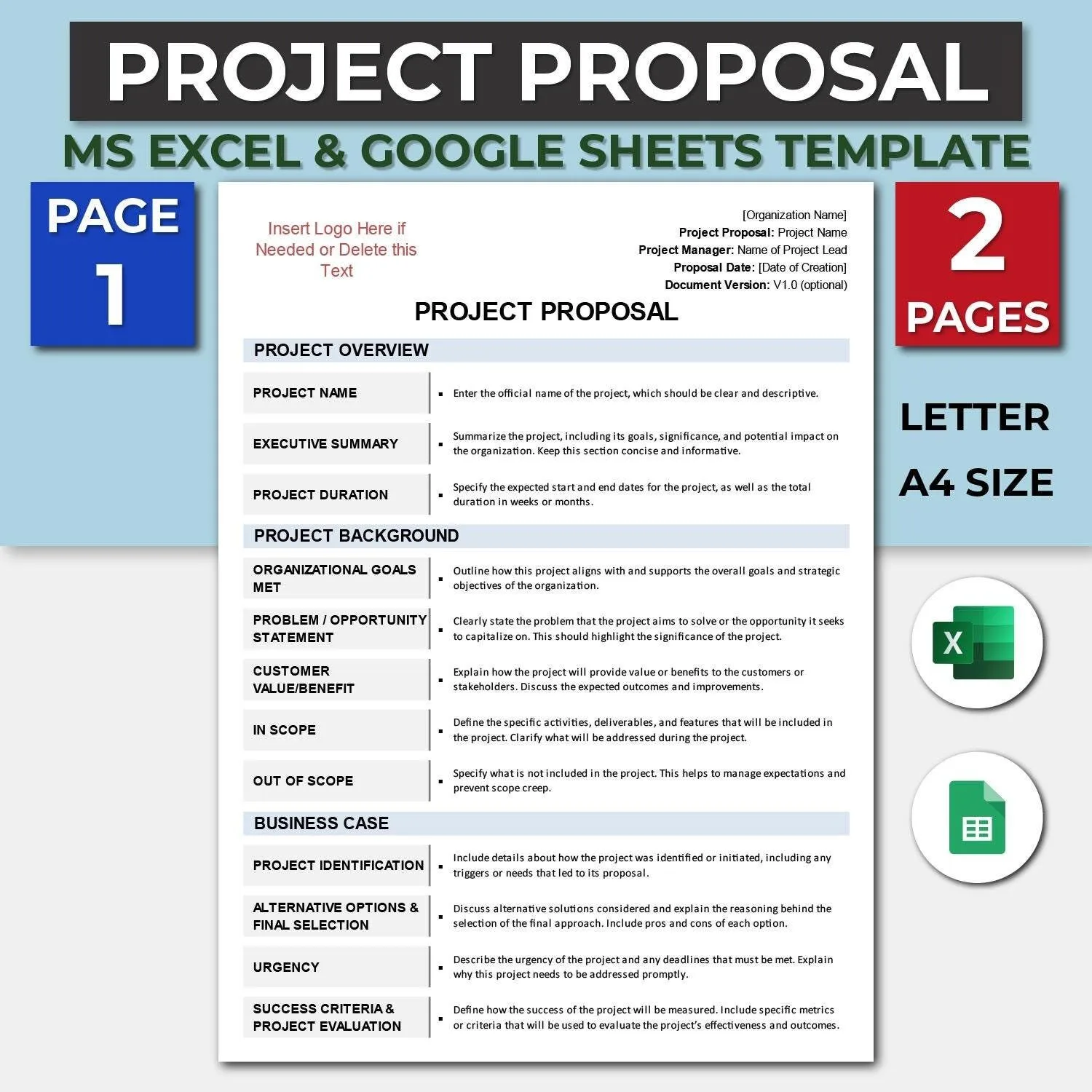
A well-crafted project proposal is the gateway to securing approval, funding, and organizational support for any initiative. Whether the project involves deploying a new enterprise software system, constructing a commercial building, launching a marketing campaign, or conducting academic research, the proposal must convincingly demonstrate that the project is worth pursuing and that the proposing team has the competence to deliver it.
This comprehensive guide provides a complete project proposal template adaptable to any industry, along with detailed examples, budget formatting guidance, timeline visualization techniques, and expert strategies for writing proposals that get approved. Every section includes practical advice that transforms generic templates into persuasive, professional documents.
What Is a Project Proposal
A project proposal is a formal document that outlines a planned initiative, presenting its objectives, methodology, timeline, budget, and expected outcomes to decision-makers who control the resources needed for execution. It serves as both an informational document and a persuasive argument, answering two fundamental questions: why should this project happen, and why should you trust this team to execute it.
Project Proposal vs. Business Proposal
These two document types are frequently confused, but they serve fundamentally different purposes.
Project proposals focus on a specific, bounded initiative with defined deliverables:
- Typically internal documents seeking organizational approval
- Emphasize methodology, milestones, and resource allocation
- Define a clear start date, end date, and scope
- Address a specific problem or opportunity within the organization
- Success is measured against project-specific objectives
Business proposals focus on establishing a commercial relationship:
- Typically external documents targeting prospective clients or partners
- Emphasize value proposition, pricing, and company qualifications
- May propose an ongoing relationship rather than a finite project
- Compete against proposals from other vendors or firms
- Success is measured by winning the contract or partnership
Understanding this distinction ensures that the document's structure, tone, and content align with its actual purpose. A project proposal that reads like a sales pitch, or a business proposal that reads like an internal project plan, will fail to connect with its intended audience.
The Complete Project Proposal Template
The following template covers every essential section of a comprehensive project proposal. Adapt the level of detail to match the project's complexity and the expectations of the approving authority.
1. Title Page
The title page creates the first impression and should convey professionalism and clarity.
Required elements:
- Project title (descriptive and specific)
- Subtitle specifying the proposal type or phase
- Prepared by (name, title, department)
- Prepared for (name, title, or committee name)
- Date of submission
- Organization name and logo
- Version number (for proposals that undergo revision)
- Confidentiality notice (if applicable)
Example:
Enterprise Resource Planning System Implementation Project Proposal for Phase 1 Deployment
Prepared by: Technical Infrastructure Team Project Lead: Marcus Chen, Director of IT Operations
Submitted to: Executive Steering Committee Date: March 15, 2026 Version: 2.1
2. Executive Summary
The executive summary condenses the entire proposal into a self-contained overview of one to two pages. Many decision-makers read only this section before deciding whether to invest time in the full document.
What to cover:
- The problem or opportunity being addressed (two to three sentences)
- The proposed solution (three to four sentences)
- Key benefits and expected outcomes
- Total budget and timeline summary
- The specific approval or action being requested
Writing strategy:
Write the executive summary last, after all other sections are complete. This ensures it accurately reflects the full proposal. Focus on outcomes rather than process, and use language accessible to executives who may not be specialists in the project's domain. Every sentence should answer the implicit question: "Why should I care?"
Example Executive Summary:
The company's current inventory management system, implemented in 2018, can no longer support the operational demands of an organization that has grown from three warehouses to eleven. Processing delays, data synchronization errors, and reporting limitations are costing an estimated $2.3 million annually in excess inventory carrying costs and lost productivity.
This proposal outlines the implementation of a modern, cloud-based inventory management platform that will integrate with existing ERP and accounting systems.
The eighteen-month phased deployment, beginning in Q3 2026, requires a total investment of $1.85 million with projected annual savings of $1.9 million beginning in year two, delivering a return on investment within fourteen months of full deployment. We request Executive Committee approval to proceed with vendor selection and Phase 1 planning.
3. Background and Problem Statement
This section establishes the context and need for the project, building the case that action is both necessary and timely.
What to include:
- Current situation: Describe the existing conditions, systems, or processes that the project will address
- Problem identification: Clearly articulate what is not working, what opportunity is being missed, or what risk is not being managed
- Impact of inaction: Explain what will happen if the project is not approved
- Previous attempts (if any): Note any prior efforts to address the problem and why they were insufficient
- Alignment with strategy: Connect the project to the organization's strategic priorities or goals
Writing tips:
- Use data to quantify the problem whenever possible (costs, time lost, error rates, customer complaints)
- Avoid assigning blame; focus on systemic issues rather than individual failures
- Frame the problem from the reader's perspective: what matters to the people who will approve this proposal
4. Project Objectives
Objectives define what the project will achieve in measurable terms. They provide the criteria against which the project's success will ultimately be judged.
SMART framework for objectives:
- Specific: Clearly defined with no ambiguity
- Measurable: Quantifiable with defined metrics
- Achievable: Realistic given available resources and constraints
- Relevant: Aligned with organizational goals and priorities
- Time-bound: Associated with a target completion date
Example objectives:
- Reduce average order processing time from 4.2 hours to under 1 hour by the end of Q1 2027
- Achieve 99.5 percent inventory data accuracy across all eleven warehouse locations within six months of full deployment
- Eliminate manual data entry for inter-warehouse transfers, reducing labor costs by $380,000 annually
- Enable real-time inventory visibility for the sales team, reducing stock-out incidents by 60 percent
5. Project Scope
The scope section defines the boundaries of the project: what is included and, equally important, what is excluded.
In-scope items should be described in enough detail for the approving authority to understand what they are funding:
- Specific deliverables the project will produce
- Systems, processes, or locations affected
- Departments or teams involved
- Integration requirements with existing systems
Out-of-scope items should be explicitly stated to manage expectations and prevent scope creep:
- Related work that will not be addressed in this project
- Future phases that are planned but not part of the current proposal
- Systems, locations, or processes that are excluded from this initiative
Example scope statement:
This project encompasses the selection, configuration, and deployment of a cloud-based inventory management platform across all eleven warehouse locations in the United States. The scope includes data migration from the legacy system, integration with the existing SAP ERP environment, and end-user training for all warehouse and logistics personnel.
The project does not include international warehouse locations (Canada and Mexico), which will be addressed in a separate Phase 2 proposal, nor does it include modifications to the existing ERP system beyond the necessary integration interfaces.
6. Methodology and Approach
This section describes how the project will be executed, demonstrating that the team has a credible plan for delivering the proposed outcomes.
What to include:
- Overall approach: Waterfall, agile, hybrid, or other project management methodology
- Phase descriptions: High-level overview of each project phase and its deliverables
- Key activities: The major tasks and workstreams within each phase
- Decision points: Gates or milestones where stakeholder review and approval are required before proceeding
- Quality assurance: How the team will ensure deliverables meet quality standards
- Change management: How changes to scope, timeline, or budget will be handled
Example phased approach:
Phase 1 - Discovery and Planning (Months 1-3)
- Requirements gathering through stakeholder workshops
- Vendor evaluation and selection
- Detailed project plan development
- Infrastructure assessment and preparation
Phase 2 - Configuration and Development (Months 4-8)
- System configuration based on requirements
- Custom integration development
- Data migration preparation and testing
- User interface customization
Phase 3 - Testing and Training (Months 9-12)
- System integration testing
- User acceptance testing
- End-user training delivery
- Parallel operation with legacy system
Phase 4 - Deployment and Optimization (Months 13-18)
- Phased go-live across warehouse locations
- Legacy system decommissioning
- Performance monitoring and optimization
- Post-implementation review and documentation
7. Timeline and Milestones
The timeline translates the methodology into a concrete schedule with specific dates and milestones.
Gantt Chart Basics
A Gantt chart is the standard visual tool for project timelines. It displays tasks as horizontal bars along a time axis, showing start dates, end dates, durations, and dependencies between tasks.
Key elements of an effective Gantt chart:
- Task names listed on the vertical axis
- Time periods (weeks, months, or quarters) on the horizontal axis
- Task bars showing duration and timing
- Milestones marked as distinct symbols (diamonds or flags) at key dates
- Dependencies shown as arrows between related tasks
- Critical path highlighted to identify the sequence of tasks that determines the minimum project duration
Text-based timeline alternative:
When a visual Gantt chart is not feasible, a milestone table provides clear schedule information:
| Milestone | Target Date | Dependencies |
|---|---|---|
| Project kickoff | July 1, 2026 | Budget approval |
| Vendor selection complete | August 15, 2026 | RFP evaluation |
| Requirements finalized | September 30, 2026 | Stakeholder workshops |
| Configuration complete | January 31, 2027 | Requirements sign-off |
| UAT complete | April 30, 2027 | Configuration complete |
| Pilot warehouse go-live | June 1, 2027 | UAT sign-off |
| Full deployment complete | December 31, 2027 | Pilot success |
8. Budget
The budget section presents the financial requirements of the project with enough detail to demonstrate thorough planning without overwhelming the reader with excessive granularity.
Budget Categories
Personnel costs:
- Internal staff time (hours multiplied by loaded hourly rate)
- External consultants or contractors
- Temporary staff for backfill during the project
- Training delivery costs
Technology costs:
- Software licensing (initial and recurring)
- Hardware purchases
- Cloud infrastructure or hosting
- Integration tools or middleware
Operational costs:
- Travel and accommodation
- Facilities (meeting rooms, temporary workspace)
- Communication and collaboration tools
- Printing and materials
Contingency:
- Typically 10-20 percent of the total budget
- Higher contingency for projects with greater uncertainty
- Specify the approval process for accessing contingency funds
Budget Formatting Best Practices
Present the budget in a table format with clear categories, subtotals, and a grand total:
| Category | One-Time Cost | Annual Recurring | Total (Year 1) |
|---|---|---|---|
| Software licensing | $120,000 | $85,000 | $205,000 |
| Implementation services | $450,000 | - | $450,000 |
| Hardware and infrastructure | $180,000 | $24,000 | $204,000 |
| Internal personnel (dedicated) | $320,000 | - | $320,000 |
| Training development and delivery | $95,000 | $15,000 | $110,000 |
| Travel and expenses | $45,000 | - | $45,000 |
| Data migration services | $110,000 | - | $110,000 |
| Subtotal | $1,320,000 | $124,000 | $1,444,000 |
| Contingency (15%) | $198,000 | $18,600 | $216,600 |
| Grand Total | $1,518,000 | $142,600 | $1,660,600 |
ROI Calculation
Include a return on investment calculation when the project is expected to generate financial benefits:
- Total investment: Sum of all project costs over the implementation period
- Annual benefits: Quantified cost savings, revenue increases, or productivity gains
- Payback period: Time required for cumulative benefits to equal the total investment
- Net present value (NPV): Present value of future benefits minus the present value of costs, using the organization's discount rate
- Internal rate of return (IRR): The discount rate at which NPV equals zero
9. Project Team
This section introduces the team that will execute the project, establishing their qualifications and roles.
What to include for each key team member:
- Name and current title
- Role in the project
- Relevant experience and qualifications
- Percentage of time allocated to the project
- Reporting relationship within the project structure
Organizational structure:
Present the project team structure visually if possible:
- Project Sponsor: Senior leader who champions the project and resolves escalated issues
- Project Manager: Day-to-day leader responsible for schedule, budget, and deliverables
- Technical Lead: Senior technical resource overseeing solution design and implementation
- Business Analyst: Liaison between business stakeholders and the technical team
- Subject Matter Experts: Domain specialists from affected departments
- External Partners: Vendors, consultants, or contractors
10. Risk Assessment
The risk assessment demonstrates that the team has thoughtfully considered what could go wrong and has plans to address potential problems.
Risk Register Format
| Risk | Probability | Impact | Mitigation Strategy |
|---|---|---|---|
| Vendor delays in software delivery | Medium | High | Include penalty clauses in contract; identify backup vendor |
| Key personnel turnover during project | Low | High | Cross-train team members; document all processes |
| Data migration quality issues | Medium | Medium | Conduct three rounds of migration testing before go-live |
| Budget overrun | Low | Medium | Monthly budget reviews; 15% contingency allocation |
| User adoption resistance | Medium | High | Early stakeholder engagement; comprehensive training program |
| Integration failures with existing systems | Medium | High | Dedicated integration testing phase; vendor support agreement |
Risk response strategies:
- Avoid: Change the project plan to eliminate the risk entirely
- Mitigate: Take action to reduce the probability or impact of the risk
- Transfer: Shift the risk to a third party (insurance, vendor contracts)
- Accept: Acknowledge the risk and prepare to manage it if it occurs
11. Evaluation and Success Metrics
This section defines how the project's success will be measured after implementation.
Types of metrics:
- Process metrics: Reduction in processing time, error rates, or manual steps
- Financial metrics: Cost savings, revenue impact, ROI achieved
- Quality metrics: Accuracy improvements, defect reduction, compliance rates
- Adoption metrics: User engagement, training completion, system utilization rates
- Satisfaction metrics: Stakeholder satisfaction surveys, NPS scores, feedback themes
Evaluation timeline:
- Post-implementation review: 30 days after deployment to identify immediate issues
- Short-term evaluation: 90 days after deployment to assess initial performance against objectives
- Long-term evaluation: 12 months after deployment to measure sustained benefits and ROI
Industry-Specific Examples
IT Project Proposal
Project: Customer Relationship Management (CRM) Platform Migration
Background excerpt: The organization's current CRM system, deployed in 2019, has reached end-of-life status with the vendor discontinuing support effective December 2026. The system's limited API capabilities prevent integration with the marketing automation platform implemented in 2024, creating data silos that impair sales team effectiveness and customer insight generation.
Key objectives:
- Migrate all customer data (47,000 active records) to the new platform with zero data loss
- Achieve full integration with the marketing automation, ERP, and customer support platforms
- Deliver a mobile-optimized interface to support the field sales team
- Complete migration before the legacy system's end-of-support date
Budget highlights:
- Total project cost: $680,000
- Software licensing: $180,000 (annual)
- Implementation partner: $320,000
- Internal resources: $140,000
- Contingency: $40,000
Construction Project Proposal
Project: Corporate Headquarters Renovation - Building B Energy Efficiency Upgrade
Background excerpt: Building B, constructed in 2004, accounts for 43 percent of the campus's total energy consumption despite representing only 28 percent of the total square footage. An energy audit conducted in November 2025 identified HVAC system inefficiency, inadequate insulation, and outdated lighting as the primary contributors. Current annual energy costs for Building B are $890,000, which is $340,000 above the benchmark for comparable facilities.
Key objectives:
- Reduce Building B energy consumption by 35 percent within twelve months of project completion
- Achieve LEED Silver certification for the renovated building
- Improve occupant comfort scores from 3.1 to 4.0 or higher on the annual workplace survey
- Complete all renovation work with minimal disruption to building occupants
Budget highlights:
- Total project cost: $2.4 million
- HVAC replacement: $1.1 million
- Insulation and envelope improvements: $520,000
- LED lighting conversion: $380,000
- Building automation system: $260,000
- Contingency: $140,000
- Projected annual energy savings: $310,000 (7.7-year payback)
Marketing Campaign Proposal
Project: Q4 Product Launch - Integrated Marketing Campaign
Background excerpt: The company's flagship product update, scheduled for release in October 2026, represents the most significant feature enhancement in three years. Market research indicates strong demand for the new capabilities, but the competitive landscape has intensified with two major competitors launching similar products in Q3. A well-executed launch campaign is essential to capturing market share during the critical first ninety days.
Key objectives:
- Generate 5,000 marketing-qualified leads during the launch quarter
- Achieve 15,000 product trial sign-ups within sixty days of launch
- Secure coverage in at least ten tier-one industry publications
- Drive a 25 percent increase in website traffic during the launch month compared to the prior year
Budget highlights:
- Total campaign budget: $425,000
- Digital advertising: $180,000
- Content creation: $85,000
- Events and webinars: $65,000
- PR and media relations: $50,000
- Creative production: $45,000
Research Project Proposal
Project: Customer Churn Predictive Analytics Model Development
Background excerpt: Customer churn has increased from 8.2 percent to 12.7 percent over the past eighteen months, representing an estimated $4.8 million in annual recurring revenue loss. Current churn management relies on reactive outreach after customers have already signaled intent to leave. A predictive analytics model would enable proactive intervention by identifying at-risk customers before they begin the cancellation process.
Key objectives:
- Develop a machine learning model achieving at least 80 percent accuracy in predicting customer churn thirty days in advance
- Integrate the model with the CRM system to generate automated alerts for the customer success team
- Reduce customer churn rate from 12.7 percent to below 9 percent within six months of model deployment
Nonprofit Project Proposal
Project: Community Literacy Program Expansion
Background excerpt: The organization's adult literacy program currently serves 340 learners annually across two locations. A needs assessment conducted in partnership with the county library system identified over 2,800 adults in the service area who lack functional literacy skills.
Current waitlists average fourteen months, and the geographic distribution of potential learners indicates significant unmet need in the eastern portion of the county where no literacy services are currently available.
Key objectives:
- Expand program capacity from 340 to 600 learners annually by opening a third location
- Reduce average waitlist time from fourteen months to under four months
- Achieve learner completion rate of 70 percent or higher at the new location
- Establish three corporate partnerships to fund ongoing operations at the new site
Budget highlights:
- Total first-year cost: $285,000
- Program staff (3 FTE): $165,000
- Facility lease and setup: $52,000
- Materials and technology: $28,000
- Volunteer training and support: $18,000
- Administration and overhead: $22,000
- Funding sources: Grant applications (60%), corporate partnerships (25%), individual donations (15%)
Writing Strategies That Get Proposals Approved
Lead with the Problem, Not the Solution
Decision-makers who do not understand the problem have no reason to approve a solution. Invest adequate space in establishing why the project is necessary before describing how it will be executed. The most common reason proposals fail is not that the proposed solution is weak but that the problem is not convincingly articulated.
Quantify Everything Possible
Numbers carry more weight than adjectives. "The current process is inefficient" is weak. "The current process requires an average of 4.2 hours per transaction, compared to the industry benchmark of 0.8 hours, costing the organization approximately $580,000 annually in excess labor" is persuasive. Quantify the problem, quantify the solution, and quantify the expected outcomes.
Address Risks Proactively
A proposal that claims the project carries no risks is not credible. Decision-makers know that all projects involve uncertainty. A thorough, honest risk assessment with well-considered mitigation strategies demonstrates maturity and planning competence. It also preempts the most damaging question in a proposal review: "What could go wrong?"
Tailor to the Audience
A proposal submitted to the CFO should emphasize financial returns, cost management, and budget discipline. The same project proposed to the CTO should emphasize technical architecture, integration capabilities, and scalability. Understand what matters most to the people who will approve or reject the proposal, and frame the content accordingly.
Make It Scannable
Decision-makers rarely read proposals word by word from beginning to end. They scan for key information, dive into sections that interest them, and skip sections that do not. Use clear headings, bullet points, tables, bold text for key figures, and an executive summary that stands alone. The easier the proposal is to navigate, the more likely it is to be read thoroughly.
Include a Clear Ask
Every proposal should end with an unambiguous statement of what is being requested: budget approval, resource allocation, authorization to proceed, or a specific decision. Proposals that present information without making a clear request often result in no action because the decision-maker is unsure what they are being asked to do.
Common Project Proposal Mistakes
Understanding what goes wrong in failed proposals is just as valuable as knowing what to include in successful ones. The following mistakes account for the majority of proposal rejections across industries.
Vague Objectives
Objectives that cannot be measured cannot be evaluated. "Improve customer satisfaction" is not an objective; it is a wish. "Increase customer satisfaction scores from 3.6 to 4.2 on the quarterly survey by Q4 2026" is an objective. Every objective in the proposal should pass the test: "How would an independent observer determine whether this was achieved?"
Unrealistic Timelines
Proposals that promise aggressive timelines to appear impressive frequently backfire. Experienced decision-makers recognize unrealistic schedules and may question the team's competence or honesty. Build timelines based on realistic estimates with appropriate buffers for dependencies, reviews, and unexpected obstacles. It is far better to propose a realistic timeline and deliver on schedule than to propose an aggressive one and miss deadlines.
Missing Stakeholder Analysis
Projects do not exist in a vacuum. They affect departments, processes, and people throughout the organization. A proposal that fails to acknowledge these impacts, or worse, fails to identify them at all, signals incomplete planning. Include a stakeholder analysis that identifies who is affected by the project, how they are affected, and how the project team will manage those impacts.
Insufficient Risk Assessment
A proposal with no risk section or a token risk section listing only minor concerns lacks credibility. Every significant project carries meaningful risks. Acknowledging them with honest probability and impact assessments, along with substantive mitigation strategies, demonstrates maturity and thoroughness.
Budget Without Justification
A budget that lists numbers without explaining how they were derived invites skepticism. Decision-makers want to understand the basis for each estimate. Were the numbers based on vendor quotes, historical data from similar projects, industry benchmarks, or informed assumptions? Transparency about the estimation basis builds confidence in the budget's accuracy.
Proposal Review and Approval Process
Understanding the typical approval process helps writers craft proposals that navigate organizational decision-making effectively.
Pre-Submission Review
Before submitting the proposal to decision-makers, conduct an internal review:
- Peer review: Have a colleague outside the project team read the proposal for clarity and completeness
- Subject matter expert review: Verify technical claims and methodology with relevant experts
- Financial review: Have a finance representative verify budget calculations and assumptions
- Stakeholder preview: Share the draft with key stakeholders whose support will be critical during the approval process
The Approval Hierarchy
Most organizations have defined approval thresholds based on budget size:
- Projects under a certain dollar threshold may require only departmental approval
- Mid-range projects typically need divisional or VP-level approval
- Large projects often require executive committee or board approval
- Capital expenditure projects may have separate approval processes from operating expense projects
Understanding where your project falls in this hierarchy determines the level of detail, formality, and financial analysis the proposal requires.
Presentation and Defense
Many proposals are presented in person in addition to being submitted in writing. Prepare for the presentation by:
- Creating a concise slide deck that highlights the key points without duplicating the full proposal
- Anticipating questions that decision-makers are likely to ask and preparing data-supported answers
- Identifying potential objections and developing responses
- Bringing supporting data that may not be in the main proposal but could be relevant during discussion
- Practicing the presentation to ensure smooth delivery within the allotted time
Post-Decision Follow-Up
Whether the proposal is approved, rejected, or sent back for revision:
- If approved: Send a brief acknowledgment and confirm next steps and timeline
- If rejected: Request specific feedback on what factors influenced the decision for future proposals
- If revision requested: Clarify exactly what changes are needed and the timeline for resubmission
Adapting the Template to Organizational Requirements
While the template in this guide provides a comprehensive framework, every organization has its own expectations, formats, and approval processes.
Research Before Writing
Before drafting a proposal:
- Review successful proposals that were previously approved in your organization
- Ask the approving authority if there is a preferred format or template
- Understand any mandatory sections or criteria that must be included
- Identify the evaluation criteria that decision-makers will use
Scaling the Template
Not every project requires a thirty-page proposal. Scale the template to match the project's scope and the organization's expectations:
Small projects (under $50,000):
- Two to five pages
- Focus on problem statement, solution, budget, and timeline
- Executive summary may be a single paragraph
- Risk section can be brief
Medium projects ($50,000-$500,000):
- Ten to twenty pages
- Full template with moderate detail in each section
- Include team qualifications and methodology details
- Formal risk register and budget breakdown
Large projects (over $500,000):
- Twenty to fifty pages plus appendices
- Maximum detail in every section
- Comprehensive financial analysis including NPV, IRR, and sensitivity analysis
- Detailed risk register with probability and impact scoring
- External benchmarking and market analysis where relevant
Project Proposal Formatting Best Practices
The visual presentation of a proposal significantly affects how seriously it is received and how easily it is reviewed.
Document Design
- Use consistent heading styles throughout the document. H1 for major sections, H2 for subsections, H3 for detailed breakdowns. Never skip heading levels.
- Apply white space generously. Dense pages of unbroken text discourage reading. Use spacing between sections, adequate margins, and paragraph breaks to create visual breathing room.
- Number pages and include a header or footer with the project name and date on every page.
- Use a professional cover page that includes the project title, author, date, and organization logo.
Tables and Charts
- Number all tables and figures sequentially and reference them in the body text before they appear
- Use tables for budget data, timelines, and comparisons rather than embedding numbers in paragraph text
- Ensure charts are readable in both color and grayscale, since some decision-makers may print in black and white
- Include a brief caption under each table or chart explaining what it shows and why it matters
Appendices and Supporting Documents
- Place detailed technical specifications, vendor comparisons, market research data, and team resumes in appendices rather than the main body
- Label appendices alphabetically (Appendix A, Appendix B) with descriptive titles
- Reference each appendix at the appropriate point in the main text so readers know where to find supporting detail
- Include only materials that directly support the proposal; extraneous attachments dilute the document's focus
Proposal Follow-Up and Lifecycle
The proposal process does not end when the document is submitted. Effective follow-up can be the difference between approval and indefinite delay.
After Submission
- Confirm receipt with the approving authority to ensure the proposal entered the review process
- Offer to present the proposal in person or via video conference, particularly for complex or high-value projects
- Remain available for questions without being pushy; decision-makers appreciate responsiveness but not pressure
During Review
- Respond promptly to any requests for additional information or clarification
- Provide supplementary data in the same professional format as the original proposal
- Avoid making unsolicited changes to the proposal during the review period unless you discover a significant error
After Approval
The approved proposal becomes the foundational document for project execution:
- Reference the proposal when creating the detailed project plan, ensuring alignment between what was approved and what is being executed
- Use the proposal's budget as the baseline for financial tracking throughout the project
- Revisit the proposal's objectives during project reviews to ensure the team remains focused on the approved scope and goals
- File the approved proposal in the project archive for future reference and lessons learned
Final Thoughts on Project Proposal Writing
A project proposal is both a planning document and a persuasive argument. It must demonstrate that the proposing team understands the problem, has developed a credible solution, can execute the plan within the proposed budget and timeline, and has anticipated the risks and challenges that lie ahead. The most effective proposals combine analytical rigor with clear, engaging writing that respects the reader's time and intelligence.
The template and examples in this guide provide a comprehensive framework that adapts to projects of any size and in any industry. The specific sections, level of detail, and emphasis will vary based on organizational expectations and the project's complexity. What should remain constant is the commitment to clarity, honesty, and thoroughness that distinguishes proposals that get approved from those that get filed away.
Every approved project began as a well-written proposal. The investment in crafting a clear, complete, and compelling document pays dividends throughout the project's life cycle, not only in securing initial approval but in setting expectations, aligning stakeholders, and providing a reference point that guides execution from start to finish.
Frequently Asked Questions
What is the difference between a project proposal and a business proposal?
A project proposal focuses on a specific initiative with a defined scope, timeline, and deliverables, while a business proposal is broader and typically aimed at securing a commercial relationship or contract.
Project proposals are often internal documents seeking approval and resources for a particular undertaking, such as implementing new software or renovating a facility. Business proposals, by contrast, are usually external documents presented to prospective clients or partners to win work or establish partnerships.
The structure differs accordingly: project proposals emphasize methodology, milestones, and resource allocation, whereas business proposals focus on value proposition, pricing, company qualifications, and competitive advantages. Both require clear writing and persuasive reasoning, but they serve fundamentally different strategic purposes.
How detailed should a project proposal budget be?
A project proposal budget should be detailed enough to demonstrate thorough planning and financial credibility without overwhelming the reader with granular line items. Include major cost categories such as personnel, equipment, materials, software, travel, training, and contingency reserves.
Within each category, provide sufficient breakdown to justify the total: for personnel costs, list roles, estimated hours, and rates; for equipment, specify items and unit costs.
Include a contingency line of ten to twenty percent of the total budget to account for unforeseen expenses.
Always distinguish between one-time costs and recurring expenses, and note any assumptions underlying the estimates. Decision-makers use the budget to assess feasibility and return on investment, so accuracy and transparency are essential.
How do you write a compelling project proposal executive summary?
A compelling executive summary opens with a clear statement of the problem or opportunity the project addresses, immediately establishing relevance and urgency. Follow with a concise description of the proposed solution, emphasizing its primary benefits and alignment with organizational goals.
Include the estimated timeline, total budget, and expected return on investment or key outcomes.
The executive summary should be self-contained, meaning a reader who reviews only this section should understand what is being proposed, why it matters, and what resources are required.
Keep the language direct and results-oriented, avoiding technical jargon that might alienate non-specialist decision-makers. Aim for one page or less, and write it after completing the full proposal to ensure it accurately reflects the detailed content.