
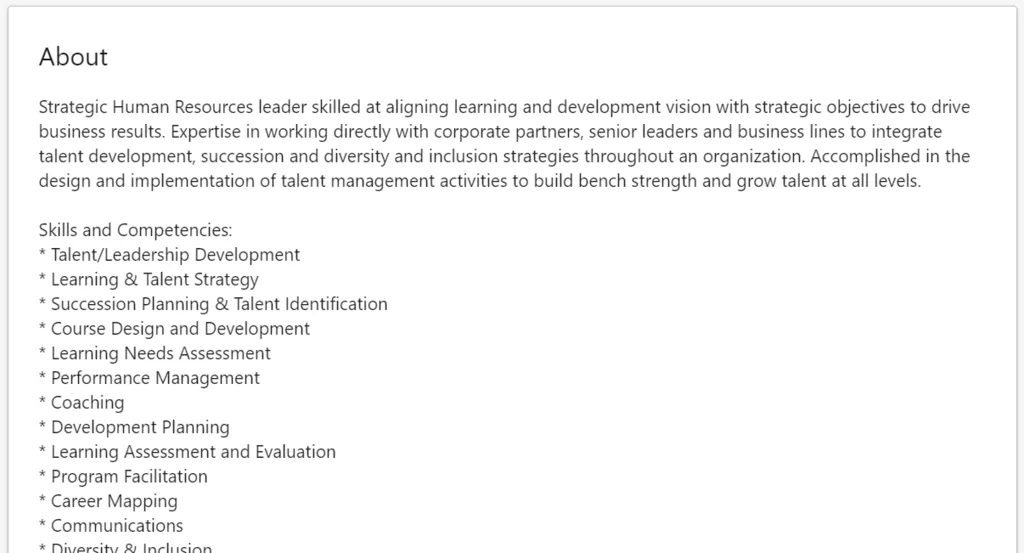
Your LinkedIn summary is the most valuable piece of real estate in your job search, and most professionals waste it. Recruiters spend an average of six to eight seconds scanning a profile before deciding whether to dig deeper. Your summary, visible in the About section of your profile, is where that decision gets made.
The problem is that most LinkedIn summaries read like watered-down resumes or collections of buzzwords that say nothing specific about the person behind the profile. Phrases like "results-driven professional" and "passionate team player" have appeared in so many summaries that they have become meaningless background noise. Recruiters scroll past them reflexively.
This guide provides more than 10 LinkedIn summary examples organized by role and career situation. Each example follows a proven structural formula that front-loads your strongest credentials, communicates your value with specific metrics, and includes the keywords that surface your profile in recruiter searches.
You will also learn what recruiters actually look for, how LinkedIn's search algorithm works, the character limits you need to respect, and the common mistakes that cause qualified candidates to get overlooked.
The LinkedIn Summary Structure Formula
Before diving into examples, you need to understand the structural formula that consistently performs well across industries and roles. Every high-performing LinkedIn summary contains these five elements in this order.
Element 1: The Hook (First 300 Characters)
LinkedIn truncates your summary behind a "See more" link on both desktop and mobile. Only the first approximately 300 characters are visible without clicking. This is your most critical real estate. The hook must accomplish one of three things: make a bold claim backed by a specific number, state your professional identity in a way that is immediately clear and compelling, or present a concise narrative that creates curiosity.
Strong hooks:
- "I have helped 47 SaaS companies build demand generation engines that consistently produce $10M+ in annual pipeline."
- "I write the code that keeps 800 million financial transactions secure every single day."
- "After spending a decade prosecuting white-collar crime at the DOJ, I now help companies build compliance programs that prevent the problems I used to investigate."
Weak hooks to avoid:
- "I am a passionate professional looking for my next opportunity."
- "Seasoned marketing executive with 15+ years of experience."
- "Results-oriented leader dedicated to driving organizational growth."
Element 2: Current Role and Scope
After the hook, establish your current professional context. State your title, organization, and the scope of your responsibility in concrete terms. Mention team size, budget, revenue, or any metric that communicates the scale at which you operate.
Element 3: Track Record and Achievements
This is the core of your summary. Present three to five achievements with specific metrics. These should demonstrate consistent performance over time rather than a single isolated win. Use dollar amounts, percentages, timeframes, and scale indicators.
Element 4: Expertise Areas
List your key skills and domains of expertise. This section serves double duty: it communicates your capabilities to human readers and embeds keywords that LinkedIn's search algorithm uses to surface your profile to recruiters.
Element 5: Call to Action
Close with a clear statement of what you want to happen next. This could be an invitation to connect, a description of what opportunities interest you, or a prompt for conversation about shared professional interests.
LinkedIn Summary Examples by Role
1. Software Engineer
I architect distributed systems that process 4.2 billion events per day without breaking a sweat.
As a Staff Software Engineer at Confluent, I lead the technical design and implementation of our core streaming platform infrastructure. My team of eight engineers owns the services responsible for message routing, partition management, and cluster orchestration for customers including Goldman Sachs, Netflix, and Walmart.
In the past three years at Confluent, I have:
- Designed the new partition rebalancing algorithm that reduced consumer group rebalance time by 73 percent
- Led the migration of our control plane from a monolithic architecture to microservices, improving deployment frequency from weekly to multiple times daily
- Built the automated capacity planning system that reduced infrastructure costs by $4.8M annually
- Mentored six engineers through promotion to senior and staff levels
Before Confluent, I spent five years at LinkedIn on the data infrastructure team, where I helped build the real-time data pipeline that powers LinkedIn's feed ranking and notification systems.
Core expertise: distributed systems, stream processing, Apache Kafka, Java, Go, Kubernetes, system design, technical leadership, performance optimization at scale.
I write about distributed systems challenges on my technical blog and speak at conferences including Strange Loop, QCon, and Kafka Summit. Always interested in connecting with engineers working on interesting data infrastructure problems.
2. Marketing Professional
I have generated $127M in qualified pipeline over the past four years through integrated B2B marketing campaigns that actually convert.
As Director of Demand Generation at Databricks, I lead a team of 14 marketers responsible for the programs that drive enterprise pipeline across our data and AI platform. Our campaigns consistently deliver qualified pipeline at 40 percent lower cost-per-lead than industry benchmarks while maintaining lead-to-opportunity conversion rates above 18 percent.
What sets my approach apart is a relentless focus on full-funnel attribution and sales alignment. Every campaign my team launches has clear pipeline targets, and we measure success by revenue influenced, not vanity metrics.
Career highlights:
- Built Databricks' ABM program targeting Global 2000 accounts, generating $34M in first-year pipeline
- At HubSpot, scaled the webinar program from 2,000 to 45,000 monthly registrants while improving attendee-to-MQL conversion by 28 percent
- Managed annual marketing budgets of $8M+ with consistent positive ROI across channels
Areas of expertise: demand generation, account-based marketing, marketing operations, Marketo, Salesforce, 6sense, content strategy, event marketing, pipeline analytics.
I am always happy to connect with fellow B2B marketers who take pipeline accountability seriously. Let us swap notes.
3. Sales Professional
I have closed $42M in enterprise SaaS contracts over the past six years. My average deal size is $520K and my lifetime quota attainment is 134 percent.
As a Senior Enterprise Account Executive at CrowdStrike, I manage 35 named Fortune 500 accounts in the financial services vertical. My role involves navigating complex buying committees of 8 to 15 stakeholders, managing 6 to 12 month sales cycles, and building long-term strategic partnerships that expand year over year.
My approach is simple but disciplined: I invest more time understanding each customer's security posture, compliance obligations, and business risks than any competing rep. This deep preparation consistently wins over CISOs and security teams who are tired of vendor pitches that do not address their actual environment.
Track record:
- Number 1 ranked AE at CrowdStrike in fiscal year 2025 out of 180 enterprise reps
- Closed the company's largest financial services deal: a $3.8M three-year platform agreement with a top-5 US bank
- Maintained 90 percent gross retention and 128 percent net retention across my portfolio
- President's Club five consecutive years across CrowdStrike and my previous role at Palo Alto Networks
Specialties: enterprise cybersecurity sales, financial services vertical, complex multi-stakeholder negotiations, value selling, MEDDPICC methodology, strategic account management.
I mentor newer enterprise reps and speak on cybersecurity sales strategy at industry events. Happy to connect with security leaders and fellow sales professionals.
4. People Manager / Director
I build engineering teams that ship products on time, scale gracefully, and retain top talent at rates well above industry average.
As Director of Engineering at Stripe, I lead five teams totaling 48 engineers responsible for our merchant onboarding and identity verification platform. Since I took over this organization, we have reduced merchant onboarding time by 60 percent, decreased fraud losses by 34 percent, and improved our engineering team retention to 94 percent annually versus the industry average of 82 percent.
My management philosophy is straightforward. I hire exceptional engineers, give them clear problems to solve with well-defined success criteria, remove organizational obstacles from their path, and invest heavily in their career development. Over the past eight years, I have directly managed 70+ engineers, promoted 22 into senior roles, and developed six into engineering managers who now lead their own teams.
Before Stripe, I led teams at Plaid and Square building financial data infrastructure and payment processing systems. I started my career as a software engineer at Amazon, which taught me that operational excellence is the foundation everything else is built on.
What I do: engineering leadership, team building and scaling, technical strategy, agile delivery, cross-functional collaboration, performance management, organizational design, hiring and interview system design.
I write about engineering management on my blog and am always interested in connecting with other engineering leaders thinking about team effectiveness and developer experience.
5. Career Changer
Three years ago, I left a successful career as a corporate litigation attorney to become a UX researcher. It was the best professional decision I have ever made, and my legal background turns out to be a superpower in this field.
As a Senior UX Researcher at Intuit, I lead qualitative and quantitative research for TurboTax's most complex product experiences, including audit defense, cryptocurrency tax reporting, and small business deductions. My legal training gave me skills that translate directly to UX research: the ability to construct precise questions, synthesize large volumes of testimony into coherent narratives, evaluate evidence objectively, and present persuasive arguments to skeptical stakeholders.
Since joining Intuit, I have:
- Conducted 300+ user interviews and usability studies across six product lines
- Identified a critical navigation issue in the audit defense flow that, once resolved, increased feature adoption by 41 percent
- Built the company's first longitudinal research program tracking user behavior across three consecutive tax seasons
- Presented findings that directly influenced $2.3M in product development investment decisions
My transition involved completing a Master of Human-Computer Interaction at Carnegie Mellon, and I bring a unique perspective that blends rigorous analytical thinking with deep empathy for users navigating complex, high-stakes processes.
Skills: qualitative research, usability testing, survey design, A/B testing, journey mapping, persona development, UserTesting, Dovetail, Qualtrics, statistical analysis, stakeholder communication.
If you are a fellow career changer or someone building a research team that values diverse professional backgrounds, I would love to connect.
6. Recent Graduate
I graduated from Georgia Tech with a 3.9 GPA in Industrial Engineering and three internships that gave me hands-on experience solving real operational problems at real companies.
Most recently at Amazon, I designed and implemented a new pick-path optimization algorithm for a fulfillment center in Nashville that reduced average pick time by 18 percent and saved an estimated $1.2M annually. At Delta Air Lines, I modeled crew scheduling scenarios that identified $3.4M in potential annual savings from revised rotation patterns. At Procter and Gamble, I analyzed packaging line efficiency data and recommended changes that increased throughput by 12 percent.
These experiences taught me that the best engineering solutions come from spending time on the floor with the people doing the work, not just running models in a conference room.
Technical skills: Python, R, SQL, Tableau, Arena simulation, linear programming, stochastic modeling, Lean Six Sigma Green Belt, Excel/VBA, process mapping.
I am looking for an operations research, supply chain analytics, or industrial engineering role where I can apply quantitative methods to complex operational challenges. I thrive in environments where I can connect data analysis directly to measurable business outcomes.
Let us connect if you are hiring entry-level engineers or analysts who bring both technical skills and practical operations experience.
7. Consultant
I help private equity portfolio companies fix broken operations and unlock the EBITDA improvement they promised their investors. Over the past nine years, I have delivered $380M in verified cost savings and margin improvements across 28 engagements.
As a Principal at Bain and Company, I lead operational due diligence and post-acquisition value creation engagements for private equity clients. My work typically involves diagnosing operational inefficiencies within 60 days of deal close, building detailed improvement roadmaps with monthly milestones, and embedding with management teams to drive execution over 12 to 24 months.
Representative results:
- Led the post-merger integration of two specialty chemical companies, delivering $65M in synergies over 18 months, 30 percent ahead of the deal model
- Redesigned the distribution network for a $900M food manufacturer, reducing logistics costs by 22 percent while improving on-time delivery from 88 to 97 percent
- Built the operational improvement playbook that a mid-market PE firm now deploys across all portfolio companies
Before consulting, I spent four years in operations management at Toyota's Georgetown, Kentucky plant, where I learned the Toyota Production System firsthand.
Expertise: operational due diligence, post-merger integration, cost transformation, supply chain optimization, manufacturing operations, organizational design, Lean operations, performance management.
MBA from Kellogg. Industrial Engineering degree from Purdue. Always interested in connecting with PE operating partners and portfolio company executives.
8. Executive
I have built three cybersecurity companies from early revenue to exit, generating over $2.1 billion in combined enterprise value for investors and employees.
As CEO of Sentinel Defense, I lead a 650-person organization providing zero-trust security infrastructure to federal agencies and Fortune 500 enterprises. Since I assumed the CEO role in 2021, we have grown annual recurring revenue from $48M to $210M, expanded our federal customer base from 12 to 34 agencies, and achieved FedRAMP High authorization, positioning Sentinel as one of only four companies approved for the most sensitive government workloads.
My previous companies include CipherShield (CEO, $85M ARR at acquisition by Palo Alto Networks for $780M in 2020) and DataGuard Systems (co-founder, $42M ARR at acquisition by Fortinet for $340M in 2016). Before founding companies, I served as a cybersecurity officer at the National Security Agency.
What drives every decision I make as a leader: building organizations where elite technical talent wants to work, where customers become advocates, and where disciplined execution compounds into durable competitive advantage.
Board member at two venture-backed security companies. Member of the Aspen Cybersecurity Group. Stanford MBA. Georgetown BS in Computer Science.
I invest in and advise early-stage cybersecurity founders. If you are building in this space, reach out.
9. Freelancer
I am a freelance brand strategist who has named 23 companies, developed visual identities for 80+ brands, and created positioning that has helped startups raise a combined $340M in venture funding.
My clients range from pre-seed startups searching for their first brand identity to Series C companies ready to professionalize their brand as they scale. I work as an embedded partner for two to six months, typically delivering brand strategy, naming, visual identity direction, messaging frameworks, and brand guidelines.
Recent work includes:
- Naming and brand strategy for Meridian AI (Series B, $45M raised three months after rebrand)
- Complete visual identity redesign for Heartland Foods that accompanied a successful expansion from 3 to 18 retail markets
- Positioning and messaging framework for Stratos Cloud that their sales team credits with improving enterprise close rates by 25 percent
Before going independent, I was a Brand Director at Pentagram and a Senior Strategist at Wolff Olins, working on brand programs for American Express, Samsung, and the Metropolitan Museum of Art.
I take on four to six clients per year to maintain the depth of attention every brand deserves.
If you are building something remarkable and need a brand that matches your ambition, let us talk.
10. Creative Professional
I have directed photography for 14 national advertising campaigns, shot covers for Vogue, GQ, and Architectural Digest, and built a commercial photography studio that generates $1.8M in annual revenue.
As founder and lead photographer at Lumina Studios, I oversee a team of four photographers and three producers serving clients in fashion, luxury goods, architecture, and editorial. Our client list includes Chanel, BMW, Marriott, and Nike, and our work has been recognized with three Communication Arts Photography Awards and a Cannes Lions Bronze.
My approach combines technical precision with creative risk-taking. I invest heavily in pre-production, working with art directors and clients to develop shot concepts that push boundaries while staying true to brand identity. On set, I create an environment where creative experimentation is encouraged and every team member contributes to the final image.
Before founding Lumina, I spent six years as a staff photographer at Conde Nast, where I learned that the best commercial photography happens at the intersection of artistic vision and strategic communication.
BFA in Photography from the Rhode Island School of Design. Based in Los Angeles.
Available for commercial commissions, editorial assignments, and creative consulting. View my portfolio at luminastudios.com.
Keywords and ATS Optimization for LinkedIn
While LinkedIn is not a traditional applicant tracking system, its search algorithm functions similarly. Recruiters use LinkedIn Recruiter, which searches profile text using keyword matching and semantic analysis. Understanding this system is essential for visibility.
How LinkedIn Search Works
When a recruiter searches for "senior product manager fintech payments," LinkedIn's algorithm scans multiple profile fields including your headline, summary, experience descriptions, skills section, and endorsements. Profiles with exact keyword matches in multiple sections rank higher in search results.
Keyword Strategy
Step 1: Research target keywords. Look at 10 to 15 job postings for your target role and identify the terms that appear most frequently. Pay attention to exact phrases, not just individual words.
Step 2: Include both full terms and abbreviations. Recruiters search for both "search engine optimization" and "SEO," both "project management professional" and "PMP," both "customer relationship management" and "CRM." Include both versions in your summary.
Step 3: Use keywords in natural sentences. LinkedIn's algorithm is sophisticated enough to detect keyword stuffing. Weave your target terms into meaningful sentences rather than listing them awkwardly.
Step 4: Reinforce keywords across sections. The same terms should appear in your headline, summary, experience descriptions, and skills section. This cross-section reinforcement increases your search ranking significantly.
High-Value Keywords by Function
Software Engineering: distributed systems, microservices, cloud architecture, CI/CD, DevOps, system design, API development, full stack, machine learning, data engineering, specific languages and frameworks
Marketing: demand generation, growth marketing, brand strategy, content marketing, SEO, paid media, marketing automation, ABM, analytics, conversion optimization
Sales: enterprise sales, quota attainment, pipeline management, account management, business development, strategic partnerships, CRM, consultative selling, specific methodologies (MEDDPICC, Challenger, SPIN)
Product Management: product strategy, roadmap, user research, A/B testing, agile, product-led growth, feature prioritization, stakeholder management, go-to-market
Finance: financial modeling, valuation, M&A, due diligence, financial planning and analysis, budgeting, forecasting, compliance, audit, specific accounting standards
Human Resources: talent acquisition, employee engagement, performance management, compensation and benefits, HRIS, organizational development, diversity and inclusion, workforce planning
What Recruiters Actually Look For
Understanding recruiter behavior helps you optimize your summary for the people who matter most to your job search.
The Six-Second Scan
Recruiters processing hundreds of profiles per day develop a rapid scanning pattern. They look at your photo, headline, current title and company, and the first two to three lines of your summary before deciding whether to invest more time. This means your headline and opening hook carry disproportionate weight.
Recruiter Decision Factors
Relevance: Does this person's experience match the role I am filling? Recruiters look for industry alignment, functional expertise, and seniority level.
Credibility: Can this person back up their claims? Specific metrics, recognized company names, and credible credentials signal that the candidate is legitimate.
Trajectory: Is this person's career moving in the right direction? Recruiters assess career progression through title changes, scope expansion, and increasing complexity of achievements.
Availability signals: Is this person likely to respond? Recruiters look for signals like "Open to Work" settings, recent profile updates, and language in the summary that indicates openness to conversations.
Cultural indicators: Will this person fit the team? Tone, writing style, and the way a candidate describes their work provide cultural signals that experienced recruiters detect quickly.
What Turns Recruiters Off
- Summaries that read like job descriptions with no personal voice
- Unsubstantiated claims without any metrics or specifics
- Negative language about previous employers or experiences
- Extremely long summaries that show poor communication skills
- Obvious exaggeration or inflated titles
- Outdated information that has not been refreshed in years
- Generic language that could describe anyone in the field
Character Limits and Formatting
LinkedIn About Section Limits
- Maximum characters: 2,600 (including spaces)
- Visible before "See more": Approximately 300 characters on desktop, slightly less on mobile
- Recommended length: 1,500 to 2,000 characters for optimal engagement
Formatting Best Practices
Use short paragraphs. Two to three sentences per paragraph. Long blocks of text are difficult to scan and most readers will skip them entirely.
Use line breaks generously. White space makes your summary more inviting and easier to read on mobile devices, where the majority of LinkedIn usage occurs.
Use bullet points strategically. A bulleted list of achievements or skills breaks up the prose and draws the eye to your strongest credentials. Limit bulleted sections to three to six items.
Avoid special characters and symbols. While LinkedIn supports some formatting, special characters can display inconsistently across devices and may interfere with search indexing.
Do not use all caps for emphasis. It reads as shouting and looks unprofessional. Use sentence case throughout.
Mobile Optimization
More than 60 percent of LinkedIn traffic comes from mobile devices. This means your summary must be readable on a small screen. Test how your summary looks on your phone after publishing. If paragraphs feel too dense on mobile, add more line breaks.
Common LinkedIn Summary Mistakes
Mistake 1: The Empty Summary
Approximately 40 percent of LinkedIn profiles have no summary at all. An empty summary tells recruiters that you either do not care about your professional presence or do not understand how LinkedIn works. Both conclusions reduce your chances of being contacted.
Mistake 2: The Resume Paste
Copying your resume into the summary field is one of the most common mistakes and one of the least effective approaches. Resumes are structured for a different medium with different conventions. They lack the narrative flow and personal voice that make LinkedIn summaries compelling. Your summary should complement your resume, not duplicate it.
Mistake 3: The Buzzword Collection
"Dynamic, results-driven thought leader passionate about leveraging synergies to drive innovation in a fast-paced environment." This sentence communicates absolutely nothing. Every word is a placeholder for specificity. Replace every buzzword with a concrete detail.
Mistake 4: The Humble Brag
"I never expected to become the youngest VP in company history, but here I am." Self-deprecating frames around accomplishments read as inauthentic. State your achievements directly and let the facts speak for themselves.
Mistake 5: The Desperate Job Seeker
"Urgently seeking new opportunities after being laid off." While honesty is admirable, leading with urgency and negative circumstances undermines your negotiating position. Instead, frame your search positively: "Exploring senior product management roles in fintech where I can apply my experience building payment platforms at scale."
Mistake 6: The Third-Person Summary
LinkedIn is a first-person platform. Writing your summary in third person ("John is a senior engineer...") creates uncomfortable distance and suggests the profile was written by someone else or auto-generated. Always use first person on LinkedIn.
Mistake 7: Ignoring the Fold
If your most compelling content is buried below the "See more" link, most recruiters will never see it. Front-load your summary with your strongest hook and most impressive credentials. Assume that 50 percent of viewers will not click to expand.
Industry-Specific Tips
Technology Roles
Lead with technical specifics. Mention the scale of systems you work with (transactions per second, data volume, user base), name the technologies you use, and reference open-source contributions or technical blog posts. Tech recruiters filter heavily on specific technology experience.
Financial Services
Compliance matters. Be careful about disclosing specific deal values or client names that may be confidential. Focus on deal types, transaction sizes, and the complexity of your work. Mention certifications (CFA, CPA, Series licenses) prominently as they are baseline requirements in this industry.
Healthcare
Lead with your clinical or research specialty and credentials. Mention publications, grants, and institutional affiliations. Healthcare recruiters verify credentials rigorously, so accuracy is paramount. If you hold board certifications, include them with their full designations.
Creative Fields
Your portfolio matters more than your summary, so include a link prominently. However, use the summary to communicate your creative philosophy, your process, and the types of clients and projects you pursue. Name recognizable clients and publications when possible.
Consulting
Quantify your impact at the client level rather than just your role level. Consultants are hired for the results they deliver, so your summary should read as a track record of client outcomes. Include industry specializations and methodology expertise.
Updating Your Summary for Different Goals
Your LinkedIn summary should not be static. Update it when your professional goals change.
When Actively Job Searching
- Include your target role and industry in the first sentence
- Emphasize transferable achievements that match your target
- Enable the Open to Work feature in your profile settings
- Add a clear statement of what you are looking for in your closing
- Ensure your keywords match the job postings you are targeting
When Building Your Network
- Lead with what you offer to your professional community
- Mention topics you write or speak about
- Include an invitation to connect around shared professional interests
- Highlight thought leadership activities
When Attracting Clients
- Frame your summary around the problems you solve for clients
- Include specific client outcomes and results
- Mention your process and what makes your approach distinctive
- Close with how potential clients can engage with you
When Seeking Board or Advisory Roles
- Emphasize strategic and governance experience
- Highlight industry breadth and senior relationships
- Mention existing board service and committee involvement
- Include your perspective on governance best practices
LinkedIn Summary Templates You Can Copy and Customize
If you prefer to start with a structural template rather than a blank page, use these fill-in-the-blank frameworks. Each template follows the five-element formula and is designed for a different career situation.
Template A: The Achievement-Led Summary (Best for Experienced Professionals)
I have [quantified achievement] over the past [timeframe] by [method or approach].
As [title] at [company], I [scope of responsibility including team size, budget, or scale]. My work focuses on [primary function] with a particular emphasis on [specialty or differentiator].
Key results:
- [Achievement 1 with metric]
- [Achievement 2 with metric]
- [Achievement 3 with metric]
Before [current company], I [previous role context with one notable achievement].
Expertise: [comma-separated list of 8 to 12 skills and domains].
[Call to action: what you want the reader to do next].
Template B: The Narrative Summary (Best for Career Changers and Founders)
[Opening sentence that establishes your unique angle or story].
[Two to three sentences explaining your professional journey and what led you to your current role. Include a specific turning point or decision that makes your path interesting and memorable.]
Since [joining/founding/starting], I have [two to three accomplishments with specific metrics that demonstrate you have been successful in your new direction].
What I bring to this work: [two to three sentences connecting your background to your current value, explaining why your unconventional path is actually an advantage].
Skills: [comma-separated list of relevant capabilities].
[Call to action tailored to your goal].
Template C: The Problem-Solver Summary (Best for Consultants and Freelancers)
I help [target client description] solve [specific problem] so they can [desired outcome].
Over the past [timeframe], I have worked with [number] clients including [two to three recognizable names or categories] to deliver [type of results]. My approach involves [brief description of your methodology or what makes your process different].
Representative results:
- [Client outcome 1 with metric]
- [Client outcome 2 with metric]
- [Client outcome 3 with metric]
Before [going independent/founding my firm], I spent [timeframe] at [previous organizations] where I [relevant experience that builds credibility].
I take on [number] clients per [timeframe] to maintain [quality/depth/attention]. [Call to action for potential clients].
Template D: The Aspiring Professional Summary (Best for Students and Recent Graduates)
I graduated from [university] with [degree] and [number] [internships/projects/experiences] that gave me hands-on exposure to [field or industry].
[Two to three sentences describing your most impressive internship or project with specific contributions and measurable results. Be concrete about what you built, analyzed, improved, or delivered.]
[One to two sentences about a second experience that demonstrates a different skill or dimension of your capabilities.]
Technical skills: [comma-separated list of tools, languages, methodologies, and certifications].
I am looking for [target role] where I can [what you want to contribute and learn]. [Invitation to connect].
Before and After: LinkedIn Summary Transformations
Seeing the contrast between a weak summary and a strong one makes the principles concrete. Here are two before-and-after transformations.
Transformation 1: Marketing Manager
Before (weak):
Passionate marketing professional with 8+ years of experience in digital marketing, content strategy, and brand management. Skilled in SEO, social media, email marketing, and analytics. Team player who thrives in fast-paced environments. Looking for new opportunities to grow and make an impact.
After (strong):
The content marketing program I built at Zendesk generates 40 percent of the company's inbound pipeline, producing $22M in qualified opportunities annually from a $1.8M content budget.
As Senior Content Marketing Manager, I lead a team of six writers, two designers, and a video producer who create the blog posts, whitepapers, webinars, and video content that Zendesk's 100,000+ customers rely on to get more value from the platform. Our content hub attracts 1.2 million unique visitors per month with an organic search portfolio ranking for 14,000 keywords.
Before Zendesk, I built the content engine at Intercom from zero to 800K monthly visitors in three years, and I led content strategy at Drift during the company's growth from $10M to $50M ARR.
What I do: content strategy, SEO-driven editorial planning, team building, content operations, marketing attribution, thought leadership programs, demand generation through content.
I write about content marketing strategy on my Substack and speak at Content Marketing World and MozCon. Always happy to connect with fellow content marketers who are building programs that drive real pipeline.
What changed: The weak version uses buzzwords ("passionate," "team player," "fast-paced"), lists skills without context, and includes no metrics. The strong version opens with a specific achievement, quantifies everything, names recognizable companies, and closes with a clear professional identity.
Transformation 2: Project Manager
Before (weak):
Experienced project manager with PMP certification. Managed multiple projects across various industries. Strong communicator and leader. Proficient in Agile and Waterfall methodologies. Seeking a challenging role where I can utilize my skills.
After (strong):
I have delivered 34 technology projects worth a combined $180M on time and within budget over the past nine years. My specialty is the complex, cross-functional programs that other PMs avoid.
As a Senior Program Manager at Deloitte Digital, I lead multi-workstream transformation programs for Fortune 500 clients. My current engagement involves a $28M SAP S/4HANA implementation for a global manufacturer spanning 14 countries, 4,200 users, and an 18-month timeline. We are currently three months ahead of schedule.
Track record highlights:
- Led a $42M cloud migration for a major healthcare provider: completed two months early, $3.1M under budget
- Managed the integration of three acquired companies onto a unified technology platform for a PE portfolio company: zero business disruption during cutover
- Rescued a failing $15M ERP implementation that was six months behind schedule: delivered within 90 days of takeover
Methodologies and tools: PMP, PgMP, SAFe Agilist, Agile/Scrum, Waterfall, hybrid approaches, Jira, Microsoft Project, Smartsheet, ServiceNow PPM.
I am most effective when projects are complex, stakes are high, and multiple stakeholders need to be aligned. If you are managing a transformation that needs experienced program leadership, let us talk.
What changed: The weak version is generic and could describe thousands of project managers. The strong version leads with a compelling metric, describes the complexity and scale of current work, provides three proof points with specific outcomes, and communicates a clear professional identity.
Final Summary Optimization Checklist
Before publishing your LinkedIn summary, verify every item on this list:
- The first 300 characters contain your strongest hook
- Your current role, company, and scope are clearly stated
- At least three achievements include specific metrics
- Target role keywords appear naturally in the text
- Paragraphs are two to three sentences maximum
- The summary is written in first person
- A clear call to action closes the summary
- The total length is between 1,500 and 2,000 characters
- The summary reads well on a mobile device
- There are no buzzwords without supporting specifics
- The tone is confident and professional without arrogance
- All claims are truthful and verifiable
Your LinkedIn summary is not a static document. It is a strategic communication tool that should evolve as your career progresses, your goals shift, and your achievements accumulate. Invest 30 minutes every quarter to review and refresh it. The recruiters searching for someone with your exact skills are out there right now. Make sure your summary is ready when they find your profile.
Frequently Asked Questions
How long should a LinkedIn summary be to attract recruiters?
LinkedIn allows up to 2,600 characters in the About section, but research on recruiter behavior shows that the most effective summaries fall between 1,500 and 2,000 characters. This length provides enough space to communicate your value proposition, key achievements, and expertise without losing the reader.
The first 300 characters are the most critical because LinkedIn truncates your summary behind a See More link on both desktop and mobile.
Recruiters scanning dozens of profiles often make their decision to read further based solely on those opening lines.
Front-load your strongest credentials, a compelling hook, or a clear statement of your professional identity. Avoid wasting those precious first characters on generic statements like I am a passionate professional. Instead, lead with specifics that differentiate you immediately.
What keywords should I include in my LinkedIn summary for ATS?
While LinkedIn is not a traditional ATS, its search algorithm functions similarly by matching keyword queries from recruiters to profile content. Include exact job titles you are targeting, core technical skills, industry-standard certifications, tools and platforms you use, and methodologies relevant to your field.
Study five to ten job postings for your target role and identify the terms that appear most frequently.
Weave these naturally into your summary rather than listing them artificially. Include both spelled-out terms and common abbreviations since recruiters search for both.
For example, use both search engine optimization and SEO, or project management professional and PMP. Place the most important keywords in your headline and the first paragraph of your summary where they carry the most weight in search ranking algorithms.
Can I use the same LinkedIn summary when applying to different types of roles?
Using a single static summary across different role types is one of the most common mistakes job seekers make on LinkedIn. Your summary should be tailored to reflect the specific value you bring to your primary target role.
If you are exploring two distinctly different career paths, prioritize the one you are most actively pursuing and craft your summary around that direction.
However, you can write a versatile summary that highlights transferable skills if your target roles share common requirements. The key is specificity.
A summary that tries to appeal to everyone ends up compelling to no one. Update your summary when you shift your job search focus. Recruiters can tell when a summary is generic, and it signals a lack of clarity about your professional direction, which reduces their confidence in you as a candidate.