
A press release is a strange document. It is one of the few pieces of corporate writing explicitly written for a middleman. The intended reader is a journalist, not the eventual audience. If the press release does its job, the journalist reshapes it into a story that reaches the real audience. If the press release fails, the story does not get written, and the company's news disappears into the uncovered backlog that every business reporter accumulates.
Despite this, most press releases are written as if the reader is the general public. They are full of marketing language, scrubbed of specific numbers, and structured around the company's preferred narrative rather than the journalist's need for news. They land in inboxes already primed for deletion. The ones that survive follow a specific structure, use specific language patterns, and respect the specific habits of the reporter at the other end.
This guide walks through the format that works, with templates, examples, and the failure modes that sink most press releases before a reporter finishes the first paragraph.
Why Press Releases Still Matter
The premature obituary of the press release has been written many times. The reality is that press releases remain the primary way news enters the business media ecosystem. Reporters scan them, wire services index them, search engines surface them, and competitors track them.
What has changed is the standard. A press release used to reach readers directly through newspapers that printed much of the release verbatim. Today, a press release is almost always rewritten before readers see it, if it is covered at all. The standard is therefore higher: the release must be good enough to earn a rewrite rather than a pass.
A second change is distribution. Wire services once held a near-monopoly on distribution. Today, press releases are published on company sites, indexed by search engines, scraped by AI tools, and shared directly by executives on LinkedIn. The audience is no longer only the reporter. But the reporter remains the primary reader, and writing for that reader still produces the strongest releases.
A press release is a strange literary form in this sense: it is written for one reader (the reporter) who will never be thanked if the piece runs well, and who may be blamed internally if it does not.
The Structural Elements of a Press Release
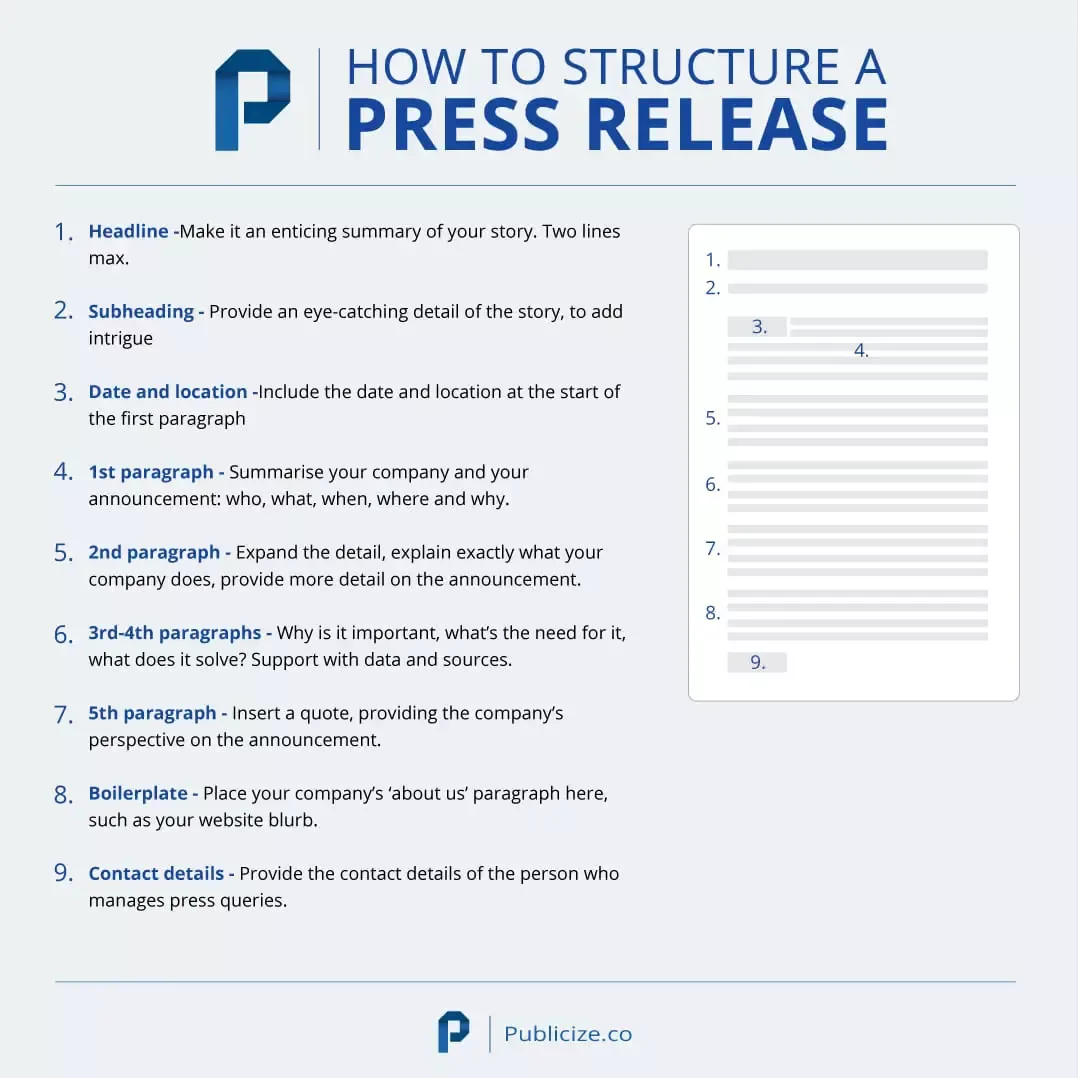
A standard press release has seven structural elements. Each has a specific purpose and a specific position.
1. The dateline. Location and date, at the top of the release. Signals to the reporter when and where the news originated.
2. The headline. A single line summarizing the news. Not a clever title. A news headline in the form reporters would write.
3. The subhead. Optional, one line, providing a secondary angle or key detail the headline did not fit.
4. The lead paragraph. The most important paragraph in the release. Answers who, what, when, where, why, and often how, in 35 to 50 words. If a reporter reads only this paragraph, they should have the complete news.
5. The body. Three to five paragraphs expanding the lead with detail, context, and supporting quotes.
6. The boilerplate. A short standing paragraph about the company, placed at the end. Used as reference material by reporters.
7. The contact block. Name, title, email, and phone of the person who can be reached for interviews or follow-up.
Missing any of these signals to a reporter that the release was written by someone who has not written a release before. That perception alone is often enough to send the release to the delete folder.
Standard Press Release Template
FOR IMMEDIATE RELEASE
[Or: FOR RELEASE ON [date] AT [time]]

[HEADLINE IN NEWS FORMAT, TITLE CASE, NO PERIOD]
[Optional subhead providing secondary angle]

[CITY, STATE/COUNTRY] [Date, Year] - [Lead paragraph containing who, what, when, where, why. 35 to 50 words. Active voice. Specific detail.]

[Second paragraph: expansion of the lead with one or two additional facts, specific numbers, and context.]

"[Quote from named executive, one to two sentences, conveying the strategic why behind the news]," said [Name], [Title] of [Company]. "[Optional second sentence providing forward-looking context or customer impact.]"

[Third paragraph: additional context, supporting details, relevant industry or market background, customer or partner perspective if applicable.]

"[Optional second quote, from a different source: customer, partner, analyst, or secondary executive]," said [Name], [Title, Organization]. "[Second sentence if useful.]"

[Fourth paragraph: any remaining specific facts, availability, pricing, timeline details, or next steps readers need.]

## About [Company]

[Two to four sentences of boilerplate. What the company does, scale markers, headquarters, and website.]

## Media contact

[Name]
[Title]
[Company]
[Email]
[Phone]
[Website]

###
The three pound signs at the bottom are the traditional "end of release" marker, sometimes rendered as "-30-". They signal to a reporter that nothing follows and avoid confusion if the release is printed or converted.
Writing the Headline
The headline is the single most consequential line in the release. Reporters skim dozens of releases a day. A weak headline earns a pass. A strong headline earns a read.
Three patterns work consistently:
Named subject plus action plus object. "[Company] Acquires [Company] for $X Million to Expand Into [Market]." The reporter knows immediately what the news is.
Company plus launches plus specific product. "[Company] Launches [Product] to [Specific Benefit]." Clean and informative.
Company plus named milestone. "[Company] Raises $X in Series B Led by [Investor]." Familiar format for business reporters.
Three patterns fail consistently:
Rhetorical questions. "What if the Future of Logistics Looked Like This?" Reporters are not going to answer the question. They will move on.
Marketing-speak. "Revolutionary Platform Transforms How Enterprises Achieve Excellence." Says nothing specific.
Cleverness over clarity. "A New Dawn in Data." Charming in a magazine. Useless in a press release.
The headline on a press release really has one job: tell the reporter what the news is with enough specificity that they can decide if it fits their beat. Everything else is secondary.
Writing the Lead Paragraph
The lead paragraph, sometimes spelled lede, is the paragraph the reporter will most closely read. A weak lead means a reporter will not read the body. A strong lead lets a reporter pitch the story to their editor from the lead alone.
A strong lead answers five questions in 35 to 50 words:
- Who: the organization making the news
- What: the specific action, launch, or milestone
- When: the date the news is effective or occurred
- Where: the geography or market
- Why: the primary business reason or benefit
An optional sixth question, how, is sometimes included but often deferred to the second paragraph.
Example of a strong lead:
"San Francisco, CA, January 14, 2026. Linden Analytics today announced the acquisition of Port Data Systems, a Boston-based provider of freight visibility software, for $48 million. The acquisition gives Linden direct integration with 240 North American carriers and is expected to close by the end of the first quarter."
In 45 words the reader has the company, the action, the dollar figure, the geography, the strategic reason, the scale markers, and the timeline.
Example of a weak lead, same news:
"Linden Analytics, a leading innovator in data solutions, is excited to announce a transformative new chapter in its journey. Through a strategic acquisition, Linden will strengthen its mission of empowering customers through data-driven insights, marking an exciting milestone in the industry."
The second version gives a reporter no reason to read further. No company name is mentioned for the target, no dollar figure, no timeline, no geography. The paragraph is pure marketing affect.
Quote Standards
Quotes in press releases are often their weakest element. Executives approve quotes that sound like marketing copy, which reporters recognize as manufactured and rarely use.
A quote works when it sounds like something a real person would actually say, contains a specific insight or perspective, and adds something the narrative cannot carry on its own. It fails when it is a restatement of the lead paragraph, a list of adjectives, or a sequence of corporate phrases.
| Weak Quote | Stronger Quote |
|---|---|
| "We are excited to announce this strategic partnership that will deliver significant value to our customers." | "We looked at every freight visibility provider in North America before deciding that Port Data's carrier integrations were two years ahead of anyone else's." |
| "This acquisition represents a transformative milestone in our journey to empower customers." | "Most of our enterprise customers told us the same thing: they wanted one platform instead of three. Acquiring Port Data lets us deliver that by Q3." |
| "We are thrilled to welcome this innovative team to our family." | "Port Data's engineering team has spent eight years solving a specific problem that our customers have been paying three vendors to solve. We are bringing that to them as one product." |
| "The future of our industry lies in harnessing the power of data." | "Port Data will report to our Chief Product Officer, and we expect the combined roadmap to ship its first integrated release within six months." |
A good discipline: read the quote aloud. If it sounds like something an executive would say in a company all-hands, it is probably too polished. If it sounds like something they would say in a one-on-one with an analyst, it is probably about right.
Boilerplate Standards
The boilerplate is the short standing paragraph at the end of every release about the company. It is the section most commonly ignored by writers and most commonly read by reporters writing their own first paragraph about the company.
A strong boilerplate has four elements:
- One sentence on what the company does, in concrete terms
- One sentence on scale (customers, revenue, employee count, founding year)
- One sentence on relevant positioning or differentiation
- A URL for readers who want more
Example:
"Linden Analytics builds freight visibility software for North American enterprise shippers. Founded in 2018 and headquartered in San Francisco, the company serves more than 400 customers including three of the top ten retailers by revenue. Linden is backed by Index Ventures and General Catalyst. More information at linden.com."
Boilerplate paragraphs should be updated at least once a year. The founding year should stay. The scale markers should change as the company grows.
Categories of Press Release
Different news types call for different structures and emphasis. Matching the structure to the news type improves both clarity and pickup rate.
| Release Type | Lead Emphasis | Body Emphasis | Typical Length |
|---|---|---|---|
| Product launch | Specific product, target user, availability date | Problem solved, key features, pricing | 400 to 600 words |
| Funding announcement | Amount, investors, valuation (if disclosed) | Use of proceeds, growth metrics, hiring plans | 350 to 500 words |
| Acquisition | Target name, deal size, strategic rationale | Integration plans, team disposition, timeline | 400 to 600 words |
| Executive hire | Name, prior company, role | Prior experience, strategic context | 250 to 400 words |
| Partnership | Both parties, specific scope | Customer benefit, commercial terms if disclosed | 300 to 450 words |
| Earnings | Revenue, growth rate, key metric movements | Forward guidance, segment detail | 600 to 1200 words |
| Research or data release | Key finding, methodology source | Additional findings, implications | 400 to 700 words |
| Award or recognition | Award name, category, issuer | Selection criteria, prior recipients | 200 to 350 words |
| Crisis or correction | The news, affected parties, action taken | Cause, remediation, contact information | 250 to 500 words |
| Event or conference | Event, dates, keynote or major speakers | Agenda highlights, registration details | 300 to 500 words |
Releases outside these standard categories are harder to write well because they lack a familiar structure. When the news does not fit a category, a useful test is to ask what news peg a reporter would use to pitch the story.
The category of a release is often the first clue to the reporter about how to shape the story. A release that does not clearly signal its category forces the reporter to invent one, which most will not bother to do.
Distribution and Timing
When a press release goes out matters almost as much as what is in it. Several patterns hold.
Tuesday through Thursday mornings are the highest-response windows for most business press releases. Monday mornings compete with weekend pickup. Friday afternoons look like bad-news burial.
Embargoed release allows selected reporters to prepare longer stories. An embargo typically runs 24 to 48 hours before the public release and is offered to a short list of outlets. Embargoes are binding; breaking them burns the reporter's relationship with every company in the industry.
Coordinated announcements with a partner, customer, or portfolio company require careful choreography. Each party needs an approved version of the release, a quote policy, and a timing rule. Conflicts emerge often, and resolving them at 2 a.m. the night before is a terrible experience.
Wire distribution (PR Newswire, Business Wire, GlobeNewswire) remains useful for SEO, regulatory compliance in some cases, and broad distribution. But wire distribution does not substitute for personal outreach to individual reporters. The best results combine a wire release with direct pitches to specific reporters whose beats match the news.
For companies operating internationally, distribution decisions vary by market. The business-operations guidance at Corpy covers jurisdictional variations in corporate disclosure requirements that sometimes determine press release timing.
Common Failure Modes
Failure: The release is too long. A 1500-word release on a minor product update signals that the writer does not understand the news's importance relative to other news. Fix: cut to the essential news and let reporters ask follow-up questions.
Failure: The release leads with the company. The first paragraph is about how great the company is rather than what news is being announced. Fix: rewrite with the news as the subject, not the company.
Failure: Every specific is hedged. Revenue is "significant." Growth is "strong." The team is "rapidly expanding." No reporter can build a story from this. Fix: use real numbers or do not use numbers. Vague numbers are worse than none.
Failure: Quotes sound synthetic. The CEO quote is a sequence of corporate phrases no human would actually say. Fix: draft the quote as the actual words from a real conversation, then tighten, rather than writing quote language from scratch.
Failure: No clear news peg. The release describes an ongoing state of affairs rather than a specific news event. Fix: name the specific thing that is new today that was not new yesterday.
Failure: Weak or missing contact block. A journalist who wants to reach out cannot find a phone number. Fix: include a named contact with both email and phone, and make sure that contact is reachable the day of the release.
Writing for the Modern Reporter
The modern business reporter is usually covering more beats than they used to, facing tighter deadlines, and responsible for more stories per week. This reality shapes what works in a press release.
Reporters appreciate releases that include specific numbers with clear attribution, customer examples with named companies (if permissioned), photo and video assets linked at the top, a subject matter expert available for an interview within hours of the release, and a crisp one-sentence pitch in the email that delivers the release. They also appreciate knowing in advance about exclusives, embargoes, and coordinated announcements, so they can plan their day.
Reporters dislike marketing language, vague superlatives, releases without specific contacts, executives who approve quotes but are unavailable for follow-up, and releases that over-promise on the follow-up materials they actually have. They also dislike releases that do not match the subject matter of their beat, which often reflects poor PR targeting rather than poor writing.
The content strategy resources at File Converter Free for preparing shareable PDF and image assets, and the productivity patterns at When Notes Fly for coordinating cross-functional launches, support the logistics side of press release operations. The cognitive work on attention and retention at What's Your IQ also offers insight into why front-loaded, specific releases get read and back-loaded ones do not.
Measuring Press Release Effectiveness
Companies that invest in press releases often under-measure them. A few metrics are worth tracking.
Pickup rate. Of the reporters who received the release, how many covered it. This is the most direct measure. Low pickup often signals weak news, weak writing, or weak targeting.
Story depth. Of the coverage received, how many were brief aggregations versus original stories with reporting and quotes. Original stories indicate the release earned the reporter's time, which is the higher-quality outcome.
Message accuracy. In the stories that ran, how accurately did reporters convey the intended message. Distortion indicates the release was unclear.
Downstream effects. Did the release generate inbound interest from analysts, customers, candidates, or investors. This is often the actual business goal.
Teams that measure across these dimensions tend to refine their release practices more quickly than teams that stop at "it went out on schedule."
Building a Press Release Practice
Companies that consistently land press coverage tend to share a few traits. They write fewer releases but invest more in each one. They maintain relationships with specific reporters rather than blasting large lists. They brief executives before releases so quotes are genuine rather than manufactured. They treat each release as a chance to build or draw on a relationship.
Companies whose releases consistently disappear also share traits. Releases go out on a calendar cadence regardless of whether there is real news. Distribution is broad but undifferentiated. Executive quotes are written by PR and approved without conversation. Releases are treated as a checkbox on a launch plan rather than an earned opportunity.
The most efficient improvement for most teams is to cut the release volume in half and double the investment per release. Within a few quarters, pickup rates tend to rise.
For related guidance on communicating with external audiences, see our articles on business proposal writing guide with templates and how to write an executive summary that gets read.
References
Handley, A. (2014). Everybody Writes: Your Go-To Guide to Creating Ridiculously Good Content. Wiley. https://annhandley.com/everybodywrites/
Bernoff, J. (2016). Writing Without Bullshit. Harper Business.
Pinker, S. (2014). The Sense of Style. Viking.
Associated Press Stylebook. https://www.apstylebook.com/
Institute for Public Relations. Press Release Research. https://instituteforpr.org/
PR Newswire. Anatomy of a Press Release. https://www.prnewswire.com/knowledge-center/
Muck Rack. State of Journalism Report. https://muckrack.com/blog/state-of-journalism
Columbia Journalism Review. The Press Release Problem. https://www.cjr.org/
Frequently Asked Questions
How long should a press release be?
Most effective business press releases run 300 to 600 words, with longer formats of 600 to 1200 words for earnings releases and complex deals. Releases over 800 words rarely get fully read. A shorter release with stronger specifics outperforms a long release padded with marketing language.
What goes in the lead paragraph of a press release?
The lead paragraph should answer who, what, when, where, and why in 35 to 50 words of active-voice prose. If a reporter reads only the lead, they should know the complete news. Avoid opening with the company’s mission, vision, or excitement language. Lead with the fact.
Should a press release include quotes?
Yes, one to two quotes from named sources add credibility and provide material reporters can use directly. Strong quotes sound like real human speech with specific insight. Weak quotes restate the lead paragraph or string together corporate phrases. Draft quotes from actual conversations, then tighten.
What is the boilerplate in a press release?
The boilerplate is a short standing paragraph at the end of every release describing the company, including what it does, scale markers like customers or employee count, positioning, and a URL. Reporters use it as reference material when writing their own first paragraph about the company.
When is the best time to send a press release?
Tuesday through Thursday mornings are the highest response windows for business news. Avoid Friday afternoons, which look like bad-news burial, and Monday mornings, which compete with weekend pickup. Major news coordinated with industry events may benefit from specific-day timing tied to those events.
What is an embargoed press release?
An embargoed release gives selected reporters access to the news 24 to 48 hours before public release, allowing them to prepare longer stories. Embargoes are binding agreements. Breaking an embargo burns the reporter’s relationship with every company in the industry, so they are usually honored.
Is a press release still effective in the age of social media?
Yes, but differently than before. Press releases remain the primary way news enters the business media ecosystem and get indexed by search engines and wire services. They no longer reach readers directly the way they once did, but they still earn rewrites and coverage when written well.