
Leaving a job is one of the most consequential professional decisions you will make, and the way you handle your departure shapes your reputation long after you have moved on. The two weeks notice letter is the cornerstone of a professional resignation.
It is a written document that formally informs your employer of your intention to leave, specifies your final working day, and sets the tone for a transition period that can either preserve or destroy years of relationship-building. Despite the simplicity of the concept, most people agonize over this letter because the stakes feel high. What if you say too much? What if you say too little?
What if your manager reacts badly? This guide eliminates the uncertainty by providing 10 expertly crafted two weeks notice letter templates covering every common scenario, along with comprehensive guidance on legal considerations, professional etiquette, and the strategic decisions that surround a well-executed resignation.
Understanding the Two Weeks Notice Convention
The History and Purpose of Two Weeks Notice
The two weeks notice convention in American workplaces evolved as an informal standard during the mid-twentieth century, when the relationship between employers and employees was governed more by mutual expectations than by formal contracts. The two-week period represented a reasonable compromise: enough time for employers to begin the process of finding or training a replacement, but not so long that the departing employee would be stuck in an uncomfortable limbo for months.
Today, two weeks remains the default expectation across most industries, though the actual appropriate notice period varies significantly depending on your role, seniority, industry, and the specific circumstances of your departure. Senior executives and highly specialized professionals often give 30 to 90 days of notice. Hourly workers in high-turnover industries may give as little as one week. The two-week standard applies most consistently to mid-level salaried professionals.
At-Will Employment and Your Legal Rights
The vast majority of American workers are employed under the at-will doctrine, which means that either the employer or the employee can terminate the employment relationship at any time, for any lawful reason, with or without notice. This means that, legally, you are generally not required to give any notice at all before leaving a job.
There are important exceptions to be aware of:
- Written employment contracts that specify a notice period create a legal obligation to honor that period.
- Collective bargaining agreements in unionized workplaces often mandate specific notice requirements.
- State-specific laws may impose notice requirements in certain industries or situations, though these are relatively uncommon.
- Company policies regarding notice periods may affect your eligibility for certain benefits upon departure, such as payouts for accrued vacation time or eligibility for rehire.
While you may not be legally required to give notice, failing to do so carries significant professional consequences. Former employers are the most common source of professional references, and a no-notice departure almost guarantees a negative reference or, at minimum, a refusal to provide one.
State Laws That Affect Resignation
Several states have laws that interact with the resignation process in important ways:
Final paycheck timing: States vary significantly in how quickly employers must issue your final paycheck after resignation. California requires payment within 72 hours if you resign without notice, or on your last day if you give at least 72 hours of notice. Other states allow employers to pay on the next regular payday.
Vacation payout: Some states, including California, Colorado, and Montana, require employers to pay out all accrued but unused vacation time regardless of how you leave. Others allow companies to establish use-it-or-lose-it policies or to condition payouts on providing adequate notice.
Non-compete enforcement: If you signed a non-compete agreement, the manner and circumstances of your departure may affect its enforceability. Some states, including California, have largely banned non-competes entirely.
How to Write an Effective Two Weeks Notice Letter
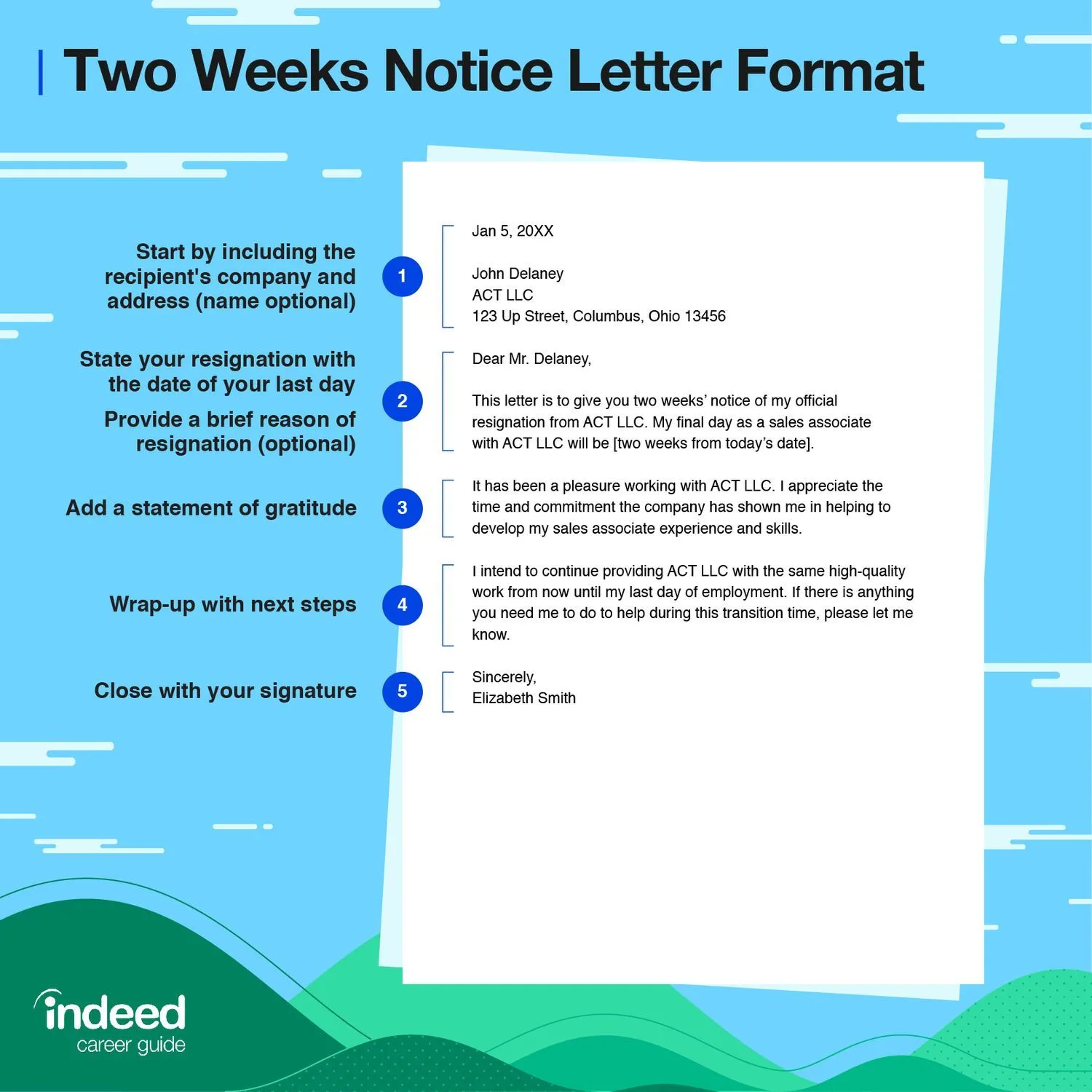
An effective two weeks notice letter is short, dated, and unambiguous about your final day. It does not need to explain your reasons or evaluate the job, and letters that attempt either tend to age badly. The components below are what the letter genuinely requires, in the order they normally appear.
Essential Components
Every two weeks notice letter should contain the following elements:
- Clear statement of resignation - There should be no ambiguity about the purpose of the letter.
- Your last working day - Calculate exactly two weeks from the date you submit the letter, accounting for business days.
- Brief expression of gratitude - Even if your experience was imperfect, acknowledge something positive.
- Offer to assist with transition - This demonstrates professionalism and protects your reputation.
- Professional closing - End on a forward-looking, positive note.
What to Leave Out
Equally important is what your two weeks notice letter should not contain:
- Detailed reasons for leaving - Your resignation letter is not the place for an exit interview. Keep reasons general or omit them entirely.
- Complaints or grievances - No matter how justified, airing grievances in writing creates a permanent record that can follow you.
- Details about your new position - Mentioning your new employer, salary, or role can create unnecessary tension and may violate confidentiality expectations.
- Ultimatums or conditions - Your resignation should not be a negotiating tactic unless you are genuinely prepared to leave.
- Apologies for leaving - You have every right to pursue your career goals. Excessive apologizing undermines your professionalism.
Calculating Your Last Day
When calculating your two weeks, count 14 calendar days from the date you submit your letter. If you submit your resignation on a Monday, your last day would be the second Friday after that Monday (the Friday of the following week). Most employers count by calendar days rather than business days, but confirm this with your HR department if you are uncertain.
Consider timing your resignation strategically. Submitting on a Monday gives your manager the full week to process the news and begin transition planning. Submitting late on a Friday, while sometimes necessary, can create a difficult weekend for your manager and may be perceived as inconsiderate.
10 Two Weeks Notice Letter Templates
Template 1 - Standard Two Weeks Notice Letter
This is the most widely applicable template, suitable for the majority of professional resignations.
[Your Name] [Your Address] [City, State, ZIP Code] [Your Email Address] [Date]
[Manager's Name] [Manager's Title] [Company Name] [Company Address] [City, State, ZIP Code]
Dear [Manager's Name],
I am writing to formally notify you of my resignation from my position as [Your Job Title] at [Company Name]. My last day of work will be [Date - two weeks from the date of this letter].
I have valued my time at [Company Name] and am grateful for the opportunities I have had to grow professionally during my [duration] here. Working with you and the team on [specific project or area] has been a genuinely rewarding experience.
During the next two weeks, I am committed to ensuring a smooth transition. I am happy to assist with training my replacement, documenting my current projects and processes, and completing any outstanding work that can reasonably be finished within the notice period.
Thank you for your support and leadership during my time here. I wish you and the entire team continued success.
Sincerely,
[Your Name]
Template 2 - Two Weeks Notice Email Format
For workplaces where email is the primary communication channel, or when your manager is remote.
Subject Line: Resignation Notice - [Your Name] - Last Day [Date]
Dear [Manager's Name],
I am writing to formally submit my resignation from my position as [Your Job Title] at [Company Name], effective [Date - two weeks from today].
This decision was not made lightly. I have genuinely appreciated the opportunity to contribute to [Company Name] over the past [duration], and I am particularly grateful for your mentorship and the chance to work on [specific project or initiative].
I want to ensure the smoothest possible transition during my remaining two weeks. Please let me know how I can best support the handover of my responsibilities, whether that involves training a colleague, documenting processes, or completing priority tasks.
I will follow up on this email with a formal printed letter for HR records. Please confirm receipt of this notice at your convenience.
Thank you for everything, [Manager's Name]. I look forward to staying in touch.
Best regards,
[Your Name] [Your Job Title] [Your Phone Number]
Template 3 - Short and Simple Two Weeks Notice
For straightforward situations where brevity is appropriate and preferred.
[Your Name] [Date]
Dear [Manager's Name],
Please accept this letter as formal notification of my resignation from [Company Name]. My last day of work will be [Date], two weeks from today.
Thank you for the opportunity to work here. I am happy to help with the transition in any way I can during my remaining time.
Sincerely,
[Your Name]
Template 4 - Detailed Two Weeks Notice with Transition Plan
For professionals in complex roles where a structured handover is critical.
[Your Name] [Your Address] [City, State, ZIP Code] [Date]
[Manager's Name] [Manager's Title] [Company Name]
Dear [Manager's Name],
I am writing to formally resign from my position as [Your Job Title] at [Company Name], with my last day of work being [Date].
I recognize that my role involves several ongoing responsibilities and projects that require careful transition planning. To that end, I have prepared the following proposed transition plan for my remaining two weeks:
Week 1 (Dates):
- Complete documentation of all current projects, including status, next steps, and key contacts
- Finalize the [specific deliverable] that is due on [date]
- Begin training [colleague's name] on [responsibility area]
- Transfer all client relationships with introductory emails to the designated point of contact
Week 2 (Dates):
- Continue training sessions on [system/process/responsibility]
- Hand over all passwords, access credentials, and account information to [IT/manager]
- Complete any remaining documentation
- Be available for final questions from team members
I have created a shared document at [location] that contains a comprehensive overview of my active projects, recurring tasks, vendor contacts, and process documentation. I will continue updating this document throughout my notice period.
My time at [Company Name] has been a meaningful chapter in my career. I am grateful for the investment the company has made in my professional development and for the relationships I have built here.
Please let me know if you would like to adjust this transition plan in any way. I am flexible and committed to making this as seamless as possible.
Respectfully,
[Your Name]
Template 5 - Management and Executive Two Weeks Notice
For directors, vice presidents, and senior leaders whose departures have broader organizational impact.
[Your Name] [Your Address] [City, State, ZIP Code] [Date]
[Executive's Name] [Executive's Title] [Company Name]
Dear [Executive's Name],
After considerable reflection, I have made the decision to resign from my position as [Your Title] at [Company Name]. I am providing this notice effective today, with my proposed last day being [Date]. I recognize that given the scope of my responsibilities, you may wish to discuss a modified timeline, and I am open to that conversation.
Leading the [department/division/team] over the past [duration] has been one of the most professionally fulfilling experiences of my career. Together, we have [specific achievement], [specific achievement], and built a team that I believe is positioned for continued success under new leadership.
I want to address the transition proactively. My direct reports are a strong, capable group, and I recommend [Name] as an interim leader who has both the respect of the team and the operational knowledge to maintain continuity. I have also begun compiling a comprehensive leadership transition document covering strategic priorities, key relationships, budget considerations, and pending decisions that will require attention.
I am committed to working with you to determine the best approach for communicating this change to the broader organization and to our external stakeholders. I understand the importance of controlling the narrative and timing of this announcement.
This decision is not a reflection of dissatisfaction with [Company Name]. I hold this organization, its mission, and its people in the highest regard. I am happy to discuss my reasons in person at your convenience.
With deep respect and gratitude,
[Your Name]
Template 6 - Part-Time Position Two Weeks Notice
For part-time employees, which requires adjustments to the standard format.
[Your Name] [Date]
Dear [Manager's Name],
I am writing to give my formal two weeks notice of resignation from my part-time position as [Your Job Title] at [Company Name]. Based on my regular schedule of [days/hours per week], my last scheduled shift will be [Date].
I have appreciated the flexibility and opportunity this position has provided over the past [duration]. The experience I have gained in [specific area] has been valuable to my professional growth.
During my remaining shifts, I am happy to help train my replacement and ensure that all of my responsibilities are properly handed off. Please let me know if there is anything specific you would like me to prioritize during this time.
Thank you for being a supportive manager and for accommodating my schedule throughout my time here.
Sincerely,
[Your Name]
Template 7 - Remote Worker Two Weeks Notice
For employees who work remotely and may not have the opportunity for an in-person conversation.
Subject Line: Formal Resignation Notice - [Your Name]
Dear [Manager's Name],
I am writing to formally resign from my remote position as [Your Job Title] at [Company Name]. My last working day will be [Date], two weeks from today.
I want to express my sincere gratitude for the trust [Company Name] placed in me to work independently and contribute remotely. Despite the physical distance, I have felt genuinely connected to the team and mission throughout my [duration] here.
To ensure a seamless transition, I propose the following steps during my notice period:
- Digital handover: I will transfer all project files, documents, and assets to the shared company drive and ensure my replacement or team members have access to everything they need.
- Account and access transfer: I will compile a complete list of all tools, platforms, and accounts I use in my role, along with instructions for transferring or revoking my access.
- Knowledge transfer sessions: I am available for video calls with my replacement or team members to walk through my workflows, processes, and any undocumented institutional knowledge.
- Equipment return: Please provide instructions for returning company-issued equipment, including laptop, monitors, and any other hardware. I will ship everything by my last day or arrange a return method that works for the company.
I would welcome the opportunity to have a video call with you to discuss the transition in more detail and to say a proper goodbye to the team.
Thank you for everything.
Best regards,
[Your Name]
Template 8 - Two Weeks Notice After Short Tenure
For situations where you are leaving a position after less than a year, which requires additional tact.
[Your Name] [Date]
Dear [Manager's Name],
I am writing to inform you of my resignation from my position as [Your Job Title] at [Company Name], effective [Date - two weeks from today].
I want to be straightforward about the fact that my tenure here has been shorter than either of us anticipated when I accepted this role. I want you to know that this decision is not a reflection of the team, the work environment, or your leadership. After careful consideration, I have determined that my long-term career path requires me to pursue an opportunity that more closely aligns with my professional goals in [general area - do not name the new company].
Despite the short time I have been here, I have valued the experience of working with this team. I learned a great deal from [specific positive experience], and I appreciate the investment the company made in my onboarding and training.
I am fully committed to making the most of my remaining two weeks. I will ensure that all of my current work is properly documented and transitioned, and I am available to assist with whatever is most helpful during this period.
I apologize for any inconvenience this may cause and sincerely wish the team every success going forward.
Respectfully,
[Your Name]
Template 9 - Two Weeks Notice During Probationary Period
For resigning during a probationary or introductory period, which has unique considerations.
[Your Name] [Date]
Dear [Manager's Name],
I am writing to resign from my position as [Your Job Title] at [Company Name]. While I understand that I am currently within my probationary period, I want to extend the professional courtesy of providing two weeks notice, with my last day being [Date].
I appreciate the opportunity you and the team have given me during this introductory period. After careful evaluation, I have concluded that the role is not the right fit for my skills and career objectives. I came to this conclusion after giving the position a genuine effort and thoughtful consideration, and I believe it is better for both parties to address this now rather than later.
I am committed to a professional departure and will complete any outstanding tasks and transition my responsibilities during the notice period. If the company prefers a shorter notice period given my probationary status, I am flexible and will accommodate whatever timeline works best.
Thank you for your understanding and for the opportunity to experience working at [Company Name].
Sincerely,
[Your Name]
Template 10 - Two Weeks Notice with Immediate Counter-Offer Decline
For situations where you anticipate a counter-offer and want to preemptively but gracefully decline.
[Your Name] [Date]
Dear [Manager's Name],
I am writing to formally submit my resignation from my position as [Your Job Title] at [Company Name], effective [Date - two weeks from today].
I want to be transparent that this decision is final and has been made after extensive deliberation. While I am deeply grateful for the opportunities and growth I have experienced here over the past [duration], I have accepted a position that aligns with the next stage of my career in ways that go beyond what any single adjustment to my current role could address. I share this not to foreclose conversation but to be respectful of your time and transparent about where I stand.
My decision is driven by factors including [general non-inflammatory reasons such as: a desire for a different type of work, a geographic relocation, a career pivot into a new industry, or a pursuit of a long-held professional goal]. I have not made this decision in response to any specific dissatisfaction that could be addressed through changes to compensation, title, or responsibilities.
I remain committed to a professional and thorough transition. I will spend the next two weeks ensuring that my projects, client relationships, and institutional knowledge are properly transferred.
Working at [Company Name] has been a formative experience in my career, and I am genuinely grateful. I hope we can maintain a positive professional relationship going forward.
With sincere appreciation,
[Your Name]
The Exit Checklist - What to Do Before Your Last Day
A professional departure involves far more than submitting a letter. The following checklist covers the practical, legal, and strategic steps you should take during your notice period and beyond.
Before Submitting Your Letter
- Secure your next opportunity in writing. Never resign based on a verbal offer. Wait until you have a signed offer letter or employment agreement.
- Review your employment agreement. Check for non-compete clauses, non-solicitation agreements, intellectual property assignments, and notice period requirements.
- Understand your benefits. Research the timeline for health insurance continuation (COBRA), 401(k) rollover options, stock option vesting schedules, and any other benefits that may be affected by your departure date.
- Save personal files. Remove any personal documents, emails, or files from company systems before submitting your resignation. Do not take any company proprietary information, client lists, or intellectual property.
- Calculate your accrued benefits. Know how much vacation time, sick leave, or other paid time off you have accrued and whether your state or company policy requires payout.
During Your Notice Period
- Tell your manager first. Always inform your direct supervisor before telling colleagues, clients, or anyone else. Your manager should never learn about your resignation secondhand.
- Prepare a transition document. Create a comprehensive written overview of your role, including active projects, recurring tasks, key contacts, passwords, account access, and institutional knowledge.
- Maintain your performance. Continue working at your normal standard. Slacking off during your notice period is one of the quickest ways to damage your professional reputation.
- Be careful with your words. Even if you are leaving because of workplace issues, keep your comments during the notice period positive and professional. What you say will be remembered.
- Complete an IT and access checklist. Work with IT to transfer accounts, revoke access, return equipment, and ensure nothing falls through the cracks.
After Your Last Day
- Send a professional farewell email. On your last day, send a brief, positive message to colleagues you worked closely with. Include your personal contact information if you want to stay in touch.
- Update your LinkedIn profile. Wait at least a few days after your departure before updating your profile to reflect your new position, out of courtesy to your former employer.
- Follow through on COBRA and benefits. You typically have 60 days to elect COBRA continuation coverage. Do not let this deadline pass without making a conscious decision.
- Return all company property. Ensure you have returned every piece of company equipment, from laptops and badges to parking passes and keys.
- Request a reference in writing. Before you leave, ask your manager or a senior colleague if they would be willing to serve as a reference for you in the future. Having this agreement in place while the relationship is fresh is much easier than asking months later.
Navigating Difficult Resignation Scenarios
When Your Employer Reacts Badly
Some managers respond to resignations with anger, disappointment, guilt trips, or even hostility. This reaction, while unprofessional on their part, is surprisingly common and usually stems from the stress of losing a team member and the work it creates.
If your manager reacts negatively, remain calm and professional. Do not engage in arguments or feel obligated to justify your decision beyond a brief, general explanation. Repeat your commitment to a smooth transition and redirect the conversation to practical handover steps. If the reaction becomes hostile, abusive, or retaliatory, escalate the situation to HR immediately and document everything in writing.
When You Are Asked to Stay Longer Than Two Weeks
It is not uncommon for employers to ask you to extend your notice period, particularly if you are in a critical role or the company needs more time to find a replacement. You are under no obligation to extend, but consider the request carefully.
If your new employer's start date allows flexibility, extending your notice by a week or two can significantly strengthen your professional reputation and preserve the relationship. If you cannot extend, politely decline and explain that your start date with your new employer is fixed. Offer to be available for questions by phone or email after your departure if needed.
When You Have a Counter-Offer
Statistics consistently show that the majority of employees who accept counter-offers leave the company within 12 to 18 months anyway. The underlying reasons for wanting to leave rarely change simply because of a salary increase or title adjustment. Additionally, accepting a counter-offer can mark you as a flight risk in the eyes of management, potentially affecting your standing during future layoffs or promotion decisions.
If you receive a counter-offer, consider it carefully and objectively. Evaluate whether the counter-offer addresses the root causes of your decision to leave, not just the surface-level factors. In most cases, the professional and strategic choice is to decline gracefully and proceed with your original plan.
When You Cannot Give Full Two Weeks Notice
Sometimes circumstances prevent you from providing a full two weeks of notice. A hostile work environment, a new employer requiring an immediate start, health concerns, or family emergencies may all necessitate a shorter notice period.
In these situations, provide as much notice as you can, even if it is only a few days. Explain the circumstances briefly without over-sharing, and express your regret at not being able to provide the standard notice period. A short notice period is always better than no notice at all.
Industry-Specific Considerations
Healthcare
Healthcare professionals, particularly nurses, physicians, and therapists, often have contractual notice requirements that exceed the standard two weeks. Many healthcare organizations require 30 to 90 days of notice due to licensing, credentialing, and patient care continuity requirements. Review your employment agreement carefully and comply with any contractual obligations.
Education
Teachers and academic professionals typically resign at the end of an academic year or semester. Mid-year resignations are particularly disruptive in education and may have contractual or licensure implications. If you must resign mid-year, provide the maximum notice possible and work with administration to minimize impact on students.
Technology
In the technology sector, two weeks is standard, but some companies in competitive industries may ask you to leave immediately upon resignation to protect intellectual property and competitive information. This is often referred to as being "garden-leaved" and typically includes pay through the original notice period.
Finance and Legal
Professionals in finance, law, and consulting may have extended notice requirements in their employment agreements, sometimes as long as 60 to 90 days. These fields also tend to have strict non-compete and non-solicitation provisions that affect what you can do after departure.
Government and Military
Government employees and military personnel have specific regulatory frameworks governing resignation and separation. Federal employees must follow their agency's specific procedures, and military personnel must follow separation or discharge processes that are distinct from civilian resignation.
Frequently Asked Questions About Two Weeks Notice
Can my employer fire me after I give two weeks notice?
Yes. In at-will employment states, your employer can terminate you at any time, including immediately after you submit your resignation. While this may feel unfair, it is legal. Some employers do this for security reasons, or simply because they prefer to move on quickly. If you are terminated before your notice period ends, you may be eligible for unemployment benefits for the remaining days, depending on your state.
Should I give two weeks notice if I hate my job?
Yes. Regardless of your feelings about the job, the two weeks notice convention exists to protect your professional reputation rather than to reward the employer. The way you leave a job follows you throughout your career, in references, in industry reputation, and in the people you will encounter again. A short notice period is a small cost for that.
Future employers may contact your former company for references, and a reputation for unprofessional departures can close doors you did not even know existed. Channel your negative feelings into making the most of your remaining time, and save the venting for private conversations with trusted friends and family.
Do I need to give two weeks notice for a contract or temporary position?
This depends on your contract terms. Many contract and temporary positions have specific termination provisions that outline notice requirements for both parties. If your contract does not specify a notice period, providing one to two weeks of courtesy notice is professional and appropriate, even if not strictly required.
What if my new employer wants me to start immediately?
If your new employer is pressuring you to start before your two weeks are up, this is actually a yellow flag about the new organization's culture and expectations. Most reputable employers not only understand the need for a notice period but view it positively because it signals that you will extend the same professional courtesy to them in the future.
Explain that you want to honor your commitment to your current employer, and negotiate a start date that allows for a proper transition. If the new employer refuses to wait two weeks, consider whether this is an organization that will respect your boundaries going forward.
The Conversation - How to Deliver Your Two Weeks Notice in Person
Preparing for the Meeting
Before handing over your letter, you should have the conversation with your manager in person whenever possible. Request a private meeting, and do not reveal the purpose in advance. Simply say something like, "I would like to schedule 15 minutes to discuss something important with you. When would be a good time today?" Having the conversation in a private setting, whether a closed office or a reserved conference room, shows respect for both your manager and the sensitivity of the situation.
What to Say
Keep the verbal conversation brief, direct, and professional. A strong approach follows this sequence:
- State the purpose clearly. "I wanted to let you know in person that I have decided to resign from my position."
- Provide the timeline. "My last day will be [Date], two weeks from today."
- Express genuine gratitude. "I want to thank you for [specific positive element of the working relationship]."
- Offer transition support. "I am committed to making this transition as smooth as possible and have already begun thinking about how to hand off my responsibilities."
- Hand over the letter. "I have prepared a formal letter for your records and for HR."
Do not over-explain your reasons. If pressed, a brief and general response is sufficient: "I have accepted an opportunity that aligns with my long-term career goals." You are not obligated to share the name of your new employer, your new salary, or the specific reasons behind your decision.
Managing Your Emotions
Resigning can be unexpectedly emotional, even when you are confident in your decision. You may feel guilt about leaving colleagues who depend on you, anxiety about your manager's reaction, or sadness about closing a chapter of your life. These feelings are normal.
Acknowledge them internally but maintain a composed, professional demeanor during the conversation. If you feel yourself becoming emotional, it is perfectly acceptable to pause, take a breath, and redirect the conversation to the practical aspects of the transition.
Final Considerations
Writing a two weeks notice letter is a straightforward task that carries significant professional weight. The templates and guidance in this article give you the tools to handle any resignation scenario with confidence and professionalism. Remember that every job you leave becomes part of your professional history, and every colleague you part ways with becomes part of your professional network.
The small investment of time and care required to resign properly pays dividends throughout your career in the form of strong references, maintained relationships, and a reputation for integrity that opens doors long after you have moved on.
Choose the template that best matches your situation, customize it with genuine and specific details about your experience, and deliver it with the confidence that comes from knowing you are handling one of the most important professional transitions the right way.
Frequently Asked Questions
Is two weeks notice legally required when resigning from a job?
In the United States, two weeks notice is not legally required in most situations. The majority of American workers are employed at-will, meaning either party can end the employment relationship at any time for any lawful reason without advance notice. However, there are important exceptions.
If you have a written employment contract that specifies a notice period, you are legally obligated to honor that contract.
Some union collective bargaining agreements also mandate specific notice periods. Certain states have laws requiring notice for specific industries or circumstances, though these are relatively rare.
Beyond legal requirements, two weeks notice is a deeply established professional norm, and failing to provide it can damage your professional reputation, cost you positive references, and potentially affect benefits like accrued vacation payouts depending on company policy and state law.
What should you do if your employer asks you to leave immediately after giving two weeks notice?
Being asked to leave immediately after submitting your two weeks notice is more common than most people expect, particularly in industries involving sensitive data, client relationships, or competitive concerns. If it happens, remain calm and professional rather than treating it as a rejection. Then move to the practical questions: whether you will be paid for the remaining two weeks, when your benefits end, and written confirmation of your final day.
Ask whether you will be paid for the remaining two weeks, as many companies will honor the pay even if they prefer you not to work during the notice period.
Clarify the status of your benefits, including when health insurance coverage ends. Request written confirmation of your final day and any agreements about remaining pay.
If the company refuses to pay you for the notice period, this is generally legal in at-will employment states, though it may entitle you to collect unemployment benefits for those two weeks in some jurisdictions. Document everything and collect any personal belongings and files you need before leaving the building.
Can you retract a two weeks notice after submitting it?
Technically, you can attempt to retract a resignation, but your employer is under no obligation to accept the retraction. Once you submit a resignation letter, your employer may have already begun planning for your departure, interviewing replacements, or reassigning your responsibilities.
Some employers will welcome a retraction, particularly if you are a valued employee and the resignation was motivated by factors the company can address.
Others will hold you to the original resignation. If you are considering retracting, act quickly, ideally within 24 to 48 hours.
Request a private meeting with your manager, explain your reasons honestly, and be prepared for either outcome. It is worth noting that retracting a resignation can sometimes change your standing in the organization, as management may view you as a flight risk going forward.