
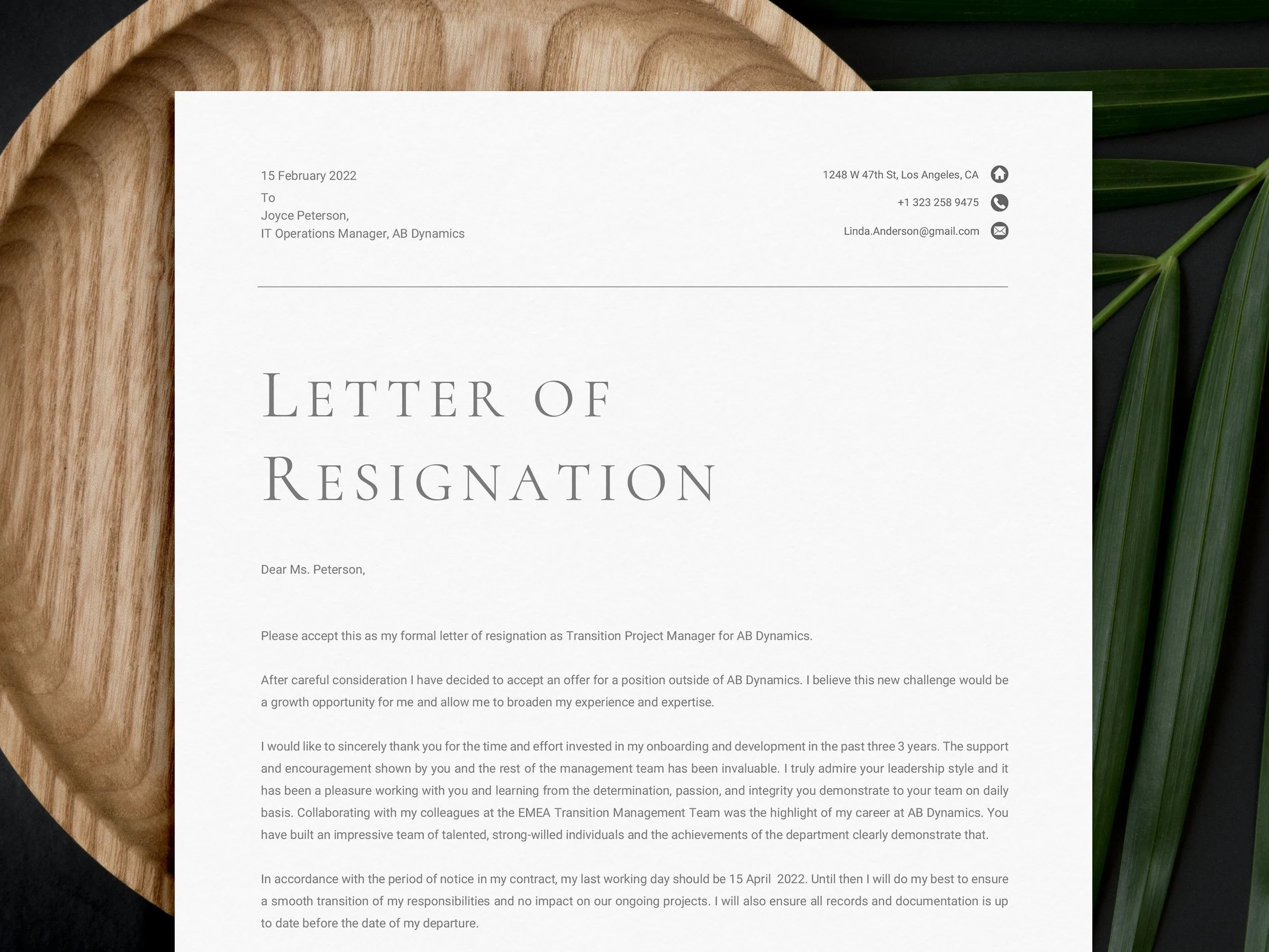
Leaving a job is one of the most consequential professional decisions you will make, and the resignation letter is the document that formalizes that decision. Despite its importance, most professionals receive no guidance on how to write one until the moment arrives, and the emotional complexity of the situation often leads to letters that are either too blunt, too emotional, too vague, or too detailed.
The right resignation letter protects your professional reputation, preserves relationships that may matter for decades, satisfies legal and contractual requirements, and sets the stage for a graceful transition. The wrong one can burn bridges, forfeit benefits, create legal complications, and follow you through your career in ways you did not anticipate.
This guide provides ten professionally written resignation letter templates for every common departure scenario, along with expert guidance on legal considerations, notice periods, handover planning, and the critical mistakes that turn a routine professional transition into lasting reputational damage.
The Strategic Importance of a Resignation Letter
A resignation letter is not merely a formality. It is a strategic document that serves multiple functions simultaneously, and understanding these functions will help you write one that serves your interests well.
The Documentation Function
Your resignation letter creates a written record of your departure date, your intended last day of work, and the terms of your departure as you understand them. This documentation protects you in disputes about final pay, accrued benefits, severance eligibility, and unemployment insurance claims.
In litigation or regulatory proceedings, resignation letters are discoverable documents that may be reviewed years later. Every word should be written with the awareness that it may be read by someone other than the intended recipient in a context you did not anticipate.
The Relationship Preservation Function
Most industries are smaller than they appear. The manager you resign from today may be the hiring decision-maker at your target company five years from now, or the reference that a future employer calls, or the person sitting across from you at an industry conference. A graceful, professional resignation letter maintains the relationship and leaves the door open for future interaction on positive terms.
The Transition Function
A well-written resignation letter initiates the transition process by establishing your timeline, expressing willingness to assist with handover, and setting expectations for your remaining time with the organization. This function is often overlooked but is essential for maintaining your professional reputation among colleagues who will remember how you handled your departure.
Legal Considerations Before You Write
Before drafting your resignation letter, review the following legal and contractual elements that may affect its content.
Employment Contract Review
If you signed an employment contract, review it carefully for provisions related to notice periods, resignation procedures, non-compete clauses, non-solicitation agreements, intellectual property assignments, and return of company property. Your resignation letter should comply with any contractual notice requirements and should not include language that could be interpreted as violating restrictive covenants.
At-Will Employment
In at-will employment states, you are generally free to resign at any time for any reason with no legally required notice period. However, company policies may tie certain benefits such as unused vacation payout or severance eligibility to providing adequate notice. Check your employee handbook before assuming that two weeks is sufficient.
Benefits and Compensation
Understand how your resignation timing affects health insurance continuation (COBRA eligibility typically begins the day after your last day of coverage), retirement account vesting schedules, stock option exercise windows, bonus eligibility, and commission payouts. In some cases, delaying your resignation by a few days or weeks can have significant financial implications.
Unemployment Insurance
In most jurisdictions, voluntarily resigning disqualifies you from unemployment benefits unless you can demonstrate constructive dismissal or other qualifying circumstances. Your resignation letter's language matters here because a letter expressing positive reasons for leaving makes it difficult to later claim you were forced out.
What Every Resignation Letter Must Include
Regardless of your specific situation, every resignation letter should contain these essential elements.
Required Elements
- Clear statement of resignation - unambiguous language that you are resigning from your position
- Your last day of work - a specific date, not a vague timeframe
- Gratitude - a genuine expression of appreciation for the opportunity, even if brief
- Transition offer - willingness to assist with handover during your remaining time
- Professional tone - courteous and forward-looking regardless of your reasons for leaving
Elements to Exclude
- Negative comments about managers, colleagues, or company culture
- Detailed reasons for your departure, especially if they involve dissatisfaction
- Information about your new position beyond what is professionally necessary
- Emotional language - anger, sadness, resentment, or excessive sentimentality
- Threats or ultimatums that could be construed as unprofessional or hostile
- Confidential information about company operations, finances, or strategy
Template 1 - Standard Two Weeks Notice
This is the most commonly needed resignation letter, suitable for departures on good terms with a standard notice period.
[Your Name] [Your Address] [City, State ZIP] [Email] [Phone]
[Date]
[Manager's Name] [Manager's Title] [Company Name] [Address] [City, State ZIP]
Dear [Manager's Name],
I am writing to formally notify you of my resignation from my position as [Your Title] at [Company Name], effective [Last Day of Work - two weeks from the date of this letter].
I have valued my time at [Company Name] and am grateful for the opportunities I have had to [specific professional growth or contribution - develop my skills in project management, contribute to the product development team, work with exceptional colleagues in the marketing department, etc.]. The experience I have gained here has been instrumental in my professional development, and I appreciate the support and guidance I have received from you and the broader team.
During my remaining [two weeks/notice period], I am committed to ensuring a smooth transition. I am happy to [document my current projects, train my replacement, complete outstanding deliverables, or prepare handover materials] - whatever would be most helpful for the team. Please let me know how I can make this transition as seamless as possible.
Thank you again for the opportunity to be part of [Company Name]. I wish you and the team continued success.
Sincerely,
[Your Signature] [Your Typed Name]
Template 2 - Immediate Resignation
Immediate resignation letters should be used only when circumstances make continued employment untenable. They require careful wording to protect your professional reputation.
[Your Name] [Your Address] [City, State ZIP] [Email] [Phone]
[Date]
[Manager's Name] [Manager's Title] [Company Name] [Address] [City, State ZIP]
Dear [Manager's Name],
I am writing to inform you of my resignation from my position as [Your Title] at [Company Name], effective immediately.
I understand that this departure without the standard notice period may create challenges, and I sincerely apologize for any disruption this causes. [Optional: brief, professional reason if appropriate - Due to an urgent family matter that requires my immediate and full attention / Due to circumstances that make continued employment not feasible at this time].
I have made every effort to [leave my work in an organized state / document the status of my current projects / prepare materials that will help with the transition].
I am grateful for the experience I gained during my time at [Company Name] and for the professional relationships I have built here. I wish the team every success going forward.
Please let me know the process for returning company property and receiving my final paycheck and benefits information. I can be reached at [email] or [phone] for any questions during the transition.
Sincerely,
[Your Signature] [Your Typed Name]
Template 3 - Retirement Resignation Letter
Retirement letters typically carry a more reflective tone and longer notice period, acknowledging a significant career milestone.
[Your Name] [Your Address] [City, State ZIP] [Email] [Phone]
[Date]
[Manager's Name] [Manager's Title] [Company Name] [Address] [City, State ZIP]
Dear [Manager's Name],
After [number] years with [Company Name] and [total number] years in [industry/profession], I am writing to announce my retirement, effective [Last Day - typically 30 to 90 days for senior employees].
This decision comes after careful consideration and planning. My time at [Company Name] has been the defining chapter of my professional life.
I have had the privilege of [specific career highlights - leading the expansion into international markets, mentoring a generation of analysts who now lead their own teams, contributing to projects that transformed our approach to client service, watching the company grow from 50 employees to over 500]. These experiences have been immensely fulfilling, and I am proud of what we have accomplished together.
I am providing [length of notice] to ensure adequate time for a thorough transition. I am committed to [documenting institutional knowledge, training my successor, completing current projects, and supporting the team through this change]. I have prepared a preliminary transition plan that outlines my current responsibilities, key relationships, and ongoing projects, and I am happy to discuss it at your convenience.
While I look forward to this next chapter, I will miss the work, the mission, and above all the people. Thank you for your leadership and for the opportunities you have provided. I hope to stay connected and wish [Company Name] continued growth and success.
With deep gratitude,
[Your Signature] [Your Typed Name]
Template 4 - Career Change Resignation Letter
When leaving to pursue a fundamentally different career path, this letter acknowledges the transition while maintaining professionalism.
[Your Name] [Your Address] [City, State ZIP] [Email] [Phone]
[Date]
[Manager's Name] [Manager's Title] [Company Name] [Address] [City, State ZIP]
Dear [Manager's Name],
I am writing to formally resign from my position as [Your Title] at [Company Name], effective [Last Day of Work]. I have made the decision to pursue a career in [new field or direction], a path I have been considering carefully over the past [timeframe].
This was not an easy decision. My [number] years at [Company Name] have provided me with [specific skills, experiences, or professional growth that you genuinely value]. The [specific positive aspects of the role or company] have set a high standard that I will carry with me into this new chapter. I am grateful for the investment you and the organization have made in my development.
During my notice period, I will ensure a complete handover of my responsibilities. I am prepared to [document processes, train team members, complete current deliverables, or other specific transition tasks relevant to your role]. My goal is to leave the team in the strongest possible position.
I hope we will stay in touch, and I wish you and the entire [department/team] continued success. Thank you for your support and understanding.
Sincerely,
[Your Signature] [Your Typed Name]
Template 5 - Returning to School Resignation Letter
[Your Name] [Your Address] [City, State ZIP] [Email] [Phone]
[Date]
[Manager's Name] [Manager's Title] [Company Name] [Address] [City, State ZIP]
Dear [Manager's Name],
I am writing to resign from my position as [Your Title] at [Company Name], effective [Last Day of Work]. I have been accepted into [Program Name] at [University], beginning [start date], and have decided to pursue this educational opportunity on a full-time basis.
I want to express my sincere gratitude for the professional experience I have gained at [Company Name]. Working with [you and the team / in the department / on specific projects] has been invaluable, and the skills I have developed here are a significant part of why I was accepted into this program. The practical knowledge I gained in [specific area] will directly inform my academic work and future career.
I am committed to making this transition as smooth as possible during my [notice period]. I will [specific transition actions - complete the current project phase, document all client relationships, prepare a comprehensive handover brief for my replacement]. Please let me know what would be most helpful.
Thank you for your mentorship and for creating an environment where professional growth was encouraged. I hope our paths will cross again in the future.
With appreciation,
[Your Signature] [Your Typed Name]
Template 6 - Health Reasons Resignation Letter
Health-related resignations require sensitivity and discretion. You are not obligated to disclose specific medical details.
[Your Name] [Your Address] [City, State ZIP] [Email] [Phone]
[Date]
[Manager's Name] [Manager's Title] [Company Name] [Address] [City, State ZIP]
Dear [Manager's Name],
I am writing to resign from my position as [Your Title] at [Company Name], effective [Last Day of Work]. I am stepping away from my professional responsibilities to focus on a personal health matter that requires my full attention.
I recognize this may come as unexpected news, and I appreciate your understanding. I have valued my time at [Company Name] and the opportunity to contribute to [specific area or achievement]. The support I have received from you and my colleagues during my time here has been meaningful, and I am grateful for it.
I will do everything I can to facilitate a smooth transition during my [notice period / remaining time]. I have [already begun documenting my current projects and responsibilities / prepared notes on the status of all active work] and am happy to assist in whatever way is most helpful.
Please coordinate with me regarding the return of company property and the process for my final compensation and benefits transition. I understand I will be eligible for COBRA continuation of health benefits and would appreciate receiving the relevant enrollment materials.
Thank you for your understanding and support. I wish [Company Name] and the team all the best.
Sincerely,
[Your Signature] [Your Typed Name]
Template 7 - Relocation Resignation Letter
[Your Name] [Your Address] [City, State ZIP] [Email] [Phone]
[Date]
[Manager's Name] [Manager's Title] [Company Name] [Address] [City, State ZIP]
Dear [Manager's Name],
I am writing to notify you of my resignation from my position as [Your Title] at [Company Name], effective [Last Day of Work]. My [spouse/partner/family] and I are relocating to [City/State/Country] due to [family obligations, spouse's career opportunity, or personal reasons - keep brief], and this move makes continuing in my current role not feasible.
I want to emphasize that this decision is driven entirely by personal circumstances and not by any dissatisfaction with my role, the team, or [Company Name]. My [number] years here have been professionally rewarding, and I have genuinely enjoyed working with [specific people or teams] on [specific projects or responsibilities]. If remote work or a transfer were possible, I would have explored those options first.
I am providing [notice period] to allow time for a thorough transition. During this time, I will [document all ongoing projects, train team members on my processes, complete critical deliverables, and prepare comprehensive handover materials]. I want to ensure that my departure creates minimal disruption.
If opportunities arise at [Company Name]'s [location] office or in remote capacity in the future, I would be very interested in reconnecting. In the meantime, thank you for the experience and opportunities you have provided.
Warm regards,
[Your Signature] [Your Typed Name]
Template 8 - Diplomatic Dissatisfaction Resignation Letter
When you are leaving due to dissatisfaction but want to maintain the relationship, diplomacy is essential. This letter says nothing negative while clearly communicating a deliberate departure.
[Your Name] [Your Address] [City, State ZIP] [Email] [Phone]
[Date]
[Manager's Name] [Manager's Title] [Company Name] [Address] [City, State ZIP]
Dear [Manager's Name],
I am writing to formally resign from my position as [Your Title] at [Company Name], effective [Last Day of Work]. After careful reflection, I have decided to pursue a new direction that I believe is the right next step for my career at this time.
I appreciate the opportunities I have had at [Company Name], including [one or two genuine positives you can cite honestly - the chance to lead cross-functional projects, exposure to enterprise-level operations, working with talented colleagues in the engineering team]. These experiences have contributed to my professional growth in meaningful ways.
During my remaining [notice period], I am committed to ensuring a smooth transition of my responsibilities. I will [specific transition tasks] and am available to support the team through this change in whatever way is most helpful.
Thank you for your leadership during my time here. I wish you and [Company Name] continued success.
Professionally,
[Your Signature] [Your Typed Name]
Template 9 - Short Notice Resignation Letter
When circumstances prevent you from providing the standard two weeks, this letter acknowledges the shortened timeline while maintaining professionalism.
[Your Name] [Your Address] [City, State ZIP] [Email] [Phone]
[Date]
[Manager's Name] [Manager's Title] [Company Name] [Address] [City, State ZIP]
Dear [Manager's Name],
I am writing to resign from my position as [Your Title] at [Company Name], effective [Last Day of Work - less than two weeks from now]. I understand that this notice period is shorter than the standard expectation, and I sincerely apologize for any inconvenience this may cause.
[Optional brief explanation: The timeline of this opportunity required a faster transition than I had anticipated / Circumstances outside my control have necessitated an expedited departure]. I have made every effort to minimize the impact of this shortened notice.
Despite the compressed timeline, I am committed to making the transition as orderly as possible. I have [already prepared handover documentation for my current projects / organized my files and documented ongoing work / briefed key team members on the status of shared responsibilities]. In the [remaining days], I will prioritize [most critical handover tasks] and am available to assist with anything the team needs to ensure continuity.
I am grateful for the experience and opportunities I have had at [Company Name]. This is not how I would have preferred to manage my departure, and I hope you understand the circumstances. I wish the team every success.
Sincerely,
[Your Signature] [Your Typed Name]
Template 10 - Long-Tenure Farewell Resignation Letter
For employees departing after many years of service, this letter strikes the right balance between reflection and professionalism.
[Your Name] [Your Address] [City, State ZIP] [Email] [Phone]
[Date]
[Manager's Name] [Manager's Title] [Company Name] [Address] [City, State ZIP]
Dear [Manager's Name],
After [number] years with [Company Name], I am writing to formally resign from my position as [Your Title], effective [Last Day of Work]. This is a decision I have considered for some time, and while it was not made lightly, I believe the time has come for a new chapter.
It is difficult to overstate what [Company Name] has meant to my professional life. I joined as [original title] in [year] and have had the privilege of [brief career progression - growing from an individual contributor to leading a team of 15, witnessing the company's expansion from a regional firm to a national presence, working across four departments and contributing to projects that defined our market position].
The colleagues I have worked with over these years are not just professional contacts - they are people I genuinely respect and care about.
Among the many experiences I will carry forward, [two or three specific highlights - the launch of the product line that became our fastest-growing segment, the cross-country office opening where we built a team from scratch, the mentoring relationships that produced leaders who now run their own departments]. These were not just professional accomplishments; they were formative experiences that shaped who I am.
I am committed to an exemplary transition. Given my tenure and the breadth of my responsibilities, I recommend [specific transition timeline and approach]. I have begun preparing comprehensive documentation of [institutional knowledge areas], and I am available to support my successor through their onboarding period, including after my last day if needed.
Thank you, sincerely, for [number] years of trust, opportunity, and professional fulfillment. I leave with gratitude and pride in what we have built together.
With deepest respect,
[Your Signature] [Your Typed Name]
Handover Planning - Leaving Well
How you manage the transition after submitting your resignation says as much about your professionalism as the letter itself. A thorough handover protects your reputation and demonstrates respect for your colleagues.
Create a Transition Document
Prepare a comprehensive document that covers all of your current responsibilities, organized by priority and timeline. Include the following for each area of responsibility:
- Current status of all projects and initiatives
- Key contacts and relationship context (not just names and numbers, but the nature of the relationship and any sensitivities)
- Upcoming deadlines and milestones
- Documented processes for recurring tasks
- Login credentials and access information (handed over securely to appropriate parties)
- File locations and organizational structure of your work product
- Known issues and pending decisions
Train Your Replacement
If a replacement has been identified before your departure, invest time in direct training. Walk them through the transition document, introduce them to key contacts, and share the unwritten knowledge that documentation alone cannot capture: the preferences of particular clients, the internal dynamics that affect how work gets done, and the lessons you learned through experience.
Manage Client and Stakeholder Communication
Coordinate with your manager on how to communicate your departure to clients, vendors, and other external stakeholders. In most cases, a warm introduction to your successor or interim contact is preferable to an abrupt transition. Draft communication templates if helpful and ensure every external relationship has a clear point of contact after your departure.
What to Avoid in Your Final Weeks
Do Not Check Out Early
Your final two weeks are an audition for your professional reputation. Colleagues will remember how you spent your last days far more vividly than they remember your average Tuesday from three years ago. Maintain your normal work standard, attend meetings, complete assigned tasks, and be present.
Do Not Recruit Colleagues
Attempting to convince colleagues to follow you to your new organization during your notice period is a serious professional violation that can have legal consequences if you are bound by non-solicitation agreements. Even without legal restrictions, recruiting during your notice period is considered a breach of professional trust.
Do Not Criticize the Organization
The period between submitting your resignation and your last day is not the time to share your honest opinions about everything that is wrong with the company. Save substantive feedback for the exit interview, where it is expected and typically treated as confidential. Casual complaints to colleagues during your final weeks create awkwardness for those who remain and reflect poorly on your character.
Do Not Take Proprietary Information
Company documents, client lists, strategic plans, proprietary data, and work product created during your employment belong to the organization. Taking copies of proprietary information, even information you personally created, can have serious legal consequences. Understand the boundary between your personal professional knowledge and the company's intellectual property.
The Exit Interview - A Separate Conversation
Many organizations conduct exit interviews as part of the departure process. This is a separate interaction from the resignation letter and serves a different purpose. While the resignation letter should be uniformly positive and professional, the exit interview is an appropriate venue for constructive feedback about the organization, management, culture, compensation, and working conditions.
How to Approach Exit Interviews
An exit interview is a professional conversation, not a chance to settle scores, and whatever you say may be summarised in writing and read by people you will meet again. Aim for feedback that is useful to the organisation and safe for your reputation. The guidelines below strike that balance.
- Be honest but diplomatic - frame criticism constructively and avoid making it personal
- Focus on systemic issues rather than individual grievances
- Provide specific examples rather than vague complaints
- Suggest solutions when you identify problems
- Keep perspective - this conversation may be summarized in writing and shared with management
What Not to Say
- Anything you would not want read back to you in a legal proceeding
- Personal attacks on specific colleagues or managers
- Confidential information about your new employer
- Exaggerated or unsubstantiated claims about the organization
Timing Your Resignation
Strategic Timing Considerations
The timing of your resignation can affect your financial outcomes, professional relationships, and transition quality. Consider the following factors:
Bonus and commission cycles: If you are close to a bonus payment date, vesting milestone, or commission payout, understand whether resignation before that date forfeits the payment. Review your compensation agreements carefully.
Project milestones: When possible, time your departure to coincide with the completion of a major project or the natural end of a work cycle. This demonstrates professionalism and makes the transition less disruptive.
Team impact: Consider how your departure timing affects your team, especially during critical periods like product launches, audit season, or annual planning. Leaving during a crisis creates lasting negative impressions.
Your new employer's timeline: Coordinate with your new employer to establish a start date that allows adequate notice at your current position. Most new employers respect and prefer candidates who honor their notice commitments.
Day of the Week
Resign early in the week, ideally Monday or Tuesday, so that you and your manager have the full work week to begin planning the transition. Resigning on a Friday afternoon leaves the news to sit over the weekend, preventing productive planning and allowing anxiety or frustration to build.
Time of Day
Request a private meeting early in the day so your manager can process the news and begin responding before the workday ends. Presenting your resignation at the end of the day, especially on a Friday, is inconsiderate and suggests avoidance.
After the Resignation Letter - Next Steps Checklist
Once you have submitted your resignation letter and your manager has acknowledged it, work through the following checklist during your remaining time.
- Confirm your last day and notice period in writing with HR
- Understand your final compensation - last paycheck date, vacation payout, bonus pro-rating
- Initiate benefits transition - COBRA enrollment, retirement account rollover options, life insurance conversion
- Return company property - laptop, phone, access cards, keys, parking passes
- Remove personal files and property from your workspace and devices
- Update professional contacts - provide personal contact information to people you want to stay in touch with
- Prepare and deliver transition materials as described in the handover planning section
- Complete all outstanding expense reports before your access to company systems ends
- Update your LinkedIn profile after your last day, not before
- Send a professional farewell message to close colleagues on your last day or shortly after
Resignation Letter Formatting and Delivery
Format Standards
A resignation letter should follow standard business letter formatting. Use a professional font such as Times New Roman, Calibri, or Arial in 11 or 12 point size. Maintain one-inch margins on all sides. Include your full contact information at the top, followed by the date, your manager's name and title, and the company name and address. The letter should be single-spaced with a blank line between paragraphs.
Keep the letter to one page. A resignation letter is not the place for lengthy reflection or detailed justification. Brevity demonstrates professionalism and respect for the reader's time. Even the long-tenure farewell template above fits on a single page when properly formatted.
Delivery Method
The ideal approach is to deliver your resignation letter in person during a private meeting with your direct manager. Hand the printed letter to your manager after verbally communicating your decision. This shows respect and allows for an immediate conversation about transition planning.
If in-person delivery is not possible due to remote work arrangements, geographic distance, or other circumstances, email delivery to your direct manager is acceptable. Send the letter as a PDF attachment with a brief email body stating that you are submitting your formal resignation and that the details are in the attached letter. Follow up with a phone or video call as soon as possible.
Never resign by text message, instant message, or social media. Never resign through a colleague or have someone else deliver the message on your behalf unless extraordinary circumstances make direct communication impossible.
Who Receives a Copy
Your direct manager should always be the first person to receive your resignation letter. After that conversation, send a copy to HR for your personnel file. Do not send copies to your manager's supervisor, to other departments, or to colleagues until your manager has acknowledged the resignation and you have agreed on a communication plan.
Counteroffers - What to Expect and How to Respond
In many cases, submitting a resignation triggers a counteroffer from your employer. Understanding the dynamics of counteroffers will help you navigate this situation thoughtfully.
Why Companies Make Counteroffers
Companies make counteroffers primarily to avoid the cost and disruption of replacing you. The typical cost of replacing an employee ranges from 50 to 200 percent of their annual salary when accounting for recruiting, onboarding, training, and productivity loss during the transition. A counteroffer that includes a salary increase or title change may actually be cheaper for the company than processing your departure.
The Statistics on Counteroffers
Industry research consistently shows that the majority of employees who accept counteroffers leave the organization within 12 to 18 months anyway. The underlying reasons for the resignation - whether dissatisfaction with culture, management, growth opportunities, or work-life balance - are rarely resolved by a salary increase or title adjustment.
Additionally, accepting a counteroffer can alter your relationship with your employer: some managers view employees who considered leaving as less loyal, and the trust dynamic may shift in subtle but meaningful ways.
How to Handle a Counteroffer
If you receive a counteroffer, take 24 to 48 hours to evaluate it thoughtfully rather than responding immediately. Ask yourself whether the counteroffer addresses the actual reasons you decided to leave, not just the surface-level factors. If you were leaving for a better opportunity, more money from your current employer does not change the fact that the other opportunity exists. If you were leaving due to management issues, a raise does not fix the management.
If you decide to decline the counteroffer, do so graciously and firmly. Thank your employer for the offer, acknowledge that it demonstrates how much they value your contribution, and confirm that your decision to leave remains unchanged. Do not use the counteroffer as leverage with your new employer - this damages trust before the new relationship has even begun.
Industry-Specific Resignation Norms
Different industries have different expectations around resignation procedures, and understanding these norms demonstrates professionalism.
Financial Services
Financial services firms often escort departing employees out of the building immediately upon resignation, particularly in roles with access to sensitive client data, trading systems, or proprietary strategies. This is not personal - it is standard risk management practice. Be prepared for immediate separation even if you offer two weeks of notice. Ensure your personal belongings are manageable before the resignation meeting.
Healthcare
Healthcare professionals, especially physicians and nurses, typically have contractual notice periods ranging from 30 to 90 days due to credentialing, patient care continuity, and scheduling requirements. Review your employment agreement carefully and plan your timeline accordingly. Providing less notice than contractually required can result in financial penalties and professional licensing complications.
Education
Academic resignations follow the academic calendar. The standard expectation is to complete the current semester or academic year before departing. Mid-semester resignations are viewed extremely negatively in academic communities and can damage your reputation with peers and future employers. If you must resign during a semester, offer to complete the current term whenever possible.
Technology
Technology companies generally follow the standard two-week notice convention, though four weeks is common for engineering managers and senior technical leads due to the complexity of knowledge transfer. Some technology companies will ask you to leave immediately if you are going to a competitor, with payment through your notice period. This is known as "garden leave."
Government and Military
Government employees may have specific resignation procedures mandated by their agency's regulations. Military personnel cannot simply resign - separation from military service requires formal processes that vary by branch and circumstance. Consult your chain of command and legal assistance office before taking any action.
Frequently Asked Questions
Is a resignation letter legally required?
In most jurisdictions with at-will employment, a resignation letter is not legally required. You can technically resign verbally and walk away without legal consequences in at-will states. However, submitting a written resignation letter is strongly advisable for several practical and strategic reasons.
First, it creates a documented record of your resignation date and intended last day, which protects you in disputes about final pay, benefits continuation, or unemployment eligibility.
Second, many employment contracts and company policies specify written notice as a requirement, and failing to comply could affect severance pay, unused vacation payout, or rehire eligibility.
Third, in industries with non-compete clauses or intellectual property agreements, a written resignation with a clear end date establishes the timeline for when restrictive covenants begin. Always check your employment contract and company handbook for specific requirements before assuming verbal notice is sufficient.
How much notice should you give when resigning?
Two weeks is the standard professional notice period in the United States, but the appropriate notice period depends on your role, seniority, industry norms, and employment contract. Senior executives and directors typically provide four to eight weeks of notice because their positions require longer transition periods for knowledge transfer and successor identification.
Employees in specialized technical roles where replacement is difficult should consider three to four weeks when feasible.
Some industries have established norms that differ from the two-week standard: academia often expects a full semester of notice, while healthcare workers may have contractual notice requirements of 30 to 90 days.
Always review your employment agreement first, as contractual notice periods supersede general conventions. If your contract specifies 30 days, providing only two weeks could constitute a breach with financial consequences.
Should you explain your reasons for leaving in a resignation letter?
A resignation letter does not require a detailed explanation of your reasons for leaving, and in most cases, less detail is more professionally advantageous. The letter’s primary purpose is to formally communicate your departure and last working day, not to provide feedback about the organization.
Stating that you are leaving to pursue a new opportunity or for personal reasons is sufficient.
Avoid mentioning negative reasons such as dissatisfaction with management, compensation disputes, toxic culture, or conflicts with colleagues, even if those are the genuine motivating factors. Written criticism in a resignation letter becomes a permanent record that can surface during background checks, reference calls, or legal proceedings.
If you want to provide constructive feedback, do so verbally in an exit interview where comments are typically treated as confidential. The one exception is resignation for documented workplace violations, where written records may be necessary for legal protection.