
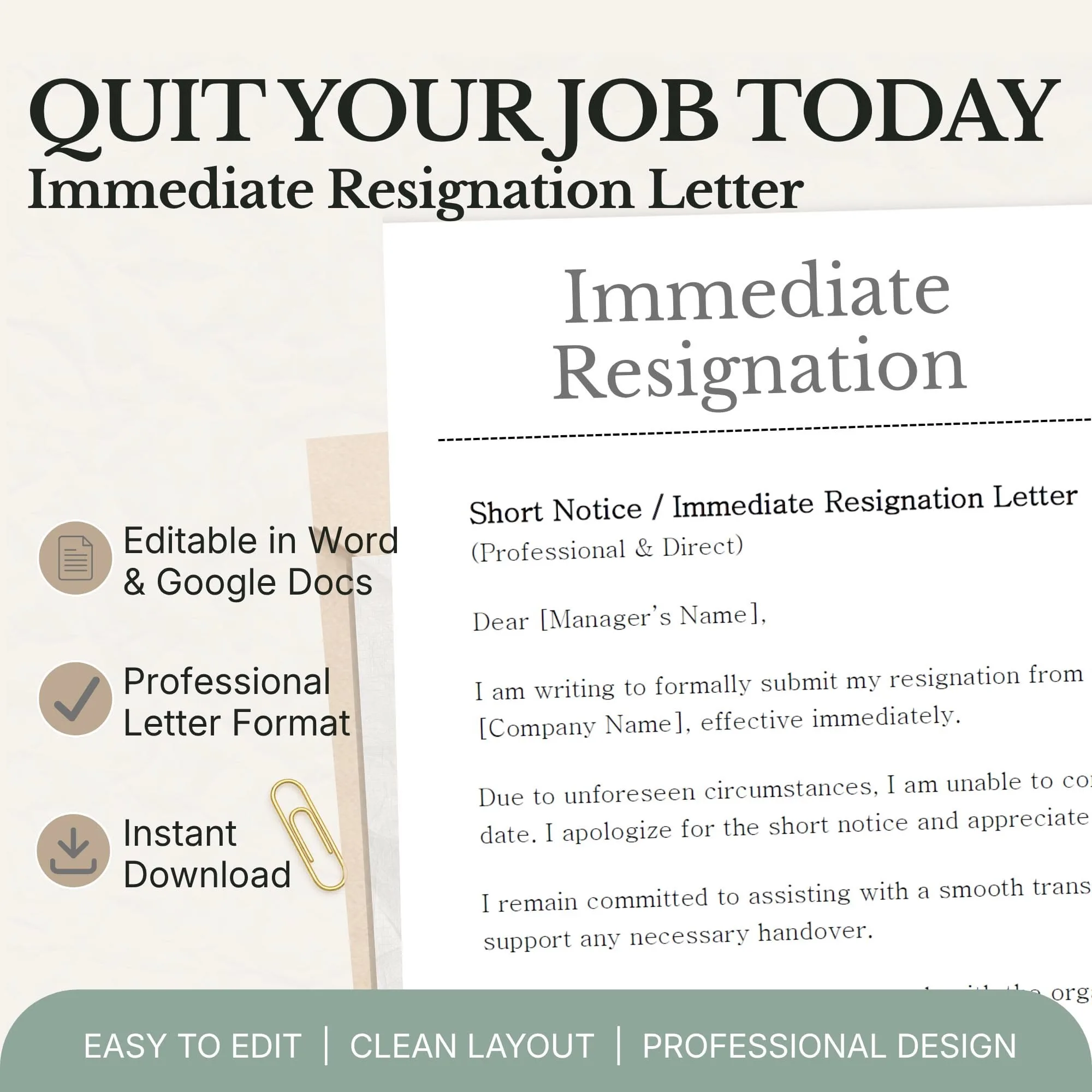
Resigning without notice is one of the most fraught professional decisions an employee makes. The standard two-week notice is both a workplace norm and, in many cases, a courtesy that protects future references, final pay, and the orderly transition of work. But there are situations in which the standard notice is impossible, inappropriate, or actively harmful to the employee, and in those situations, a carefully drafted immediate resignation letter is both necessary and defensible.
A health crisis, a family emergency, a hostile work environment, a time-sensitive job offer, or a relocation need may all justify an immediate departure, and the letter that accompanies the decision determines whether the transition closes cleanly or leaves a trail of disputes over final pay, references, and potential claims.
This guide provides ten ready-to-copy immediate resignation letter templates covering the most common scenarios that force a departure without notice, including serious health issues, family emergencies, hostile workplace conditions, a competing job offer with an immediate start date, unsafe working conditions, harassment, sudden relocation, contract or classification disputes, personal crisis, and mutual agreement.
Each template is written to protect the employee's interests while maintaining the professional tone that preserves the relationship to the extent possible, because even immediate resignations leave a reference trail that can shape future opportunities.
The templates are supported by a framework for deciding whether immediate resignation is the right choice, common mistakes that expose employees to legal or reputational risk, a delivery and documentation strategy, and a FAQ drawn from the questions employment attorneys most frequently field from workers considering an abrupt exit.
When Immediate Resignation Is the Right Choice
The decision to resign without notice should be weighed carefully, because the two-week notice custom exists for reasons that generally protect the employee. Before drafting an immediate resignation letter, consider whether one of the following situations genuinely applies.
Serious Health Condition
A sudden or worsening health issue that prevents continued work is the most common justifiable reason for immediate resignation. If you have FMLA eligibility, consider whether leave rather than resignation is the correct step, and if you are resigning, keep medical specifics out of the letter while making clear that health is the driver.
Family Emergency
Caregiving crises, unexpected deaths in the immediate family, a child's medical situation, or an elder parent's decline can require the employee to leave the workforce with little or no notice. As with health-related departures, leave may be a better option than outright resignation when the employment provides benefits worth preserving.
Hostile Work Environment
If the work environment has become genuinely hostile, meaning discrimination, harassment, retaliation, or a safety concern that the employer will not address, an immediate departure can be a legitimate protective step. In these cases, document the conditions thoroughly before resigning, because the circumstances may support a legal claim.
Competing Offer With Immediate Start
A compelling job offer with an immediate or very short start date is a legitimate but more delicate reason for immediate departure, because it involves a voluntary choice that the current employer may view differently from circumstances beyond the employee's control.
Unsafe Conditions
If the workplace poses an imminent safety risk that the employer has failed to address, immediate departure may be both appropriate and legally protected. Document the safety conditions and your prior reports before resigning.
"Immediate resignation is a tool, not a reflex. Before using it, ask whether the situation genuinely cannot wait two weeks. If the answer is yes, the letter should be short, professional, and explicit about the fact that notice is being waived."
What to Include in an Immediate Resignation Letter
An immediate resignation letter differs from a standard two-week resignation in several important ways. The structure should be tighter, the reason should be stated more explicitly, and the transition elements should be addressed even when notice cannot be provided.
| Element | Purpose | Typical Content |
|---|---|---|
| Date and address block | Establishes when resignation is tendered | Full date, employer name, HR contact |
| Statement of immediate resignation | Removes ambiguity | Explicit statement that resignation is effective immediately |
| Effective date | Confirms last day | Same as letter date, or specific date |
| Brief reason | Explains the exigency | One sentence, appropriate to the situation |
| Transition offer where possible | Shows professionalism | Offer to answer questions, document handover |
| Logistics | Addresses practical matters | Final paycheck, benefits, return of property |
| Closing | Preserves professionalism | Gratitude where sincere, clean close |
Proper Format for an Immediate Resignation Letter
Immediate resignation letters should be short, typically half a page to one page. They should be typed, signed, and delivered in a way that creates a clear record.
Header
Include your name and contact information. Include the date. Include the recipient's name, title, and company address.
Salutation
Use a formal salutation. "Dear [Manager Name]," or "Dear [HR Director Name]," as appropriate.
Opening
State that you are resigning, effective immediately. Include the specific date.
Body
Provide a brief, appropriate reason. Keep it to one or two sentences. Do not offer extensive justification, because the reasons are rarely the employer's concern, and detailed explanations can invite disputes.
Transition
Where possible, offer to support a reasonable transition by phone or email. This is optional when the circumstances preclude it.
Logistics
Reference final pay, return of company property, and benefits, or indicate that you will coordinate these with HR.
Close
Thank the employer for the opportunity if sincere, and close with a professional salutation.
10+ Immediate Resignation Letter Templates
Replace bracketed fields with your specific information. Keep the letter brief and professional regardless of the circumstances that prompted the departure.
Template 1: Serious Health Condition
[Your Name] [Your Address] [Phone] | [Email]
[Date]
[Manager Name] [Title] [Company Name] [Address]
Dear [Manager Name],
I am writing to inform you that I am resigning from my position as [Title] at [Company], effective immediately.
A significant health issue has made it impossible for me to continue in the role, and the timing does not allow for the standard notice period. I regret that circumstances prevent a more orderly transition.
I am happy to answer questions by email over the coming week as my health allows, and I will coordinate with HR on the return of company equipment and any outstanding final-pay matters. Please let me know the best point of contact.
Thank you for the opportunity to have worked with the team.
Sincerely,
[Signature] [Typed Name]
Template 2: Family Emergency
[Header block]
Dear [Manager Name],
I am writing to resign from my position as [Title] at [Company], effective immediately, due to a family emergency that requires my full attention.
I recognize that this is not the notice period either of us would have hoped for, and I am sorry for the disruption. Circumstances have moved faster than I could have anticipated.
I will be available by email during the next week to help route any open matters to the appropriate colleagues. I will coordinate with HR on final logistics, including the return of company property.
Thank you for the opportunity and for your understanding in this difficult moment.
Sincerely,
[Signature] [Typed Name]
Template 3: Hostile Work Environment
[Header block]
Dear [HR Director Name],
I am writing to resign from my position as [Title] at [Company], effective immediately.
The working conditions that I have previously raised with [specific manager or HR contact, with date of prior report] have continued without meaningful resolution, and I have concluded that I cannot continue in the environment without risk to my well-being. This resignation is made under duress in that I believe I am being forced out by conditions that should have been addressed.
I am preserving my rights under applicable state and federal law with respect to the conditions that led to this resignation, and I will be in contact regarding final pay, benefits continuation, and the return of company property.
Sincerely,
[Signature] [Typed Name]
Template 4: Competing Offer With Immediate Start
[Header block]
Dear [Manager Name],
I am writing to resign from my position as [Title] at [Company], effective immediately.
I have accepted an opportunity that requires an immediate start, and the employer was unable to accommodate a standard notice period. I regret that this compresses the transition, and I am prepared to do what I can to make the handover as clean as possible.
I will be available by email over the next [Number] days to answer questions from my colleagues and help route open work. I will coordinate with HR on final pay, benefits, and the return of company property.
Thank you for the experience I have gained during my time at [Company]. I am grateful for the opportunity and for the relationships I have built with the team.
Sincerely,
[Signature] [Typed Name]
Template 5: Unsafe Working Conditions
[Header block]
Dear [HR Director Name],
I am writing to resign from my position as [Title] at [Company], effective immediately.
The [specific safety concern, for example, "ongoing ventilation issue in the production area that was previously reported on [Date]"] has not been resolved, and I can no longer continue to work under conditions that I believe pose a meaningful health and safety risk. I have raised this issue previously through [specific channels and dates], and the situation has continued.
I am preserving my rights under applicable occupational safety laws and will be in contact regarding final pay and the return of company property. I am prepared to provide further detail if needed in the context of any subsequent investigation.
Sincerely,
[Signature] [Typed Name]
Template 6: Harassment or Discrimination
[Header block]
Dear [HR Director Name],
I am writing to resign from my position as [Title] at [Company], effective immediately.
Given the conditions I have documented in prior communications with [specific contacts, with dates], including but not limited to [brief characterization of the conduct], I cannot continue in this role. This resignation is a direct consequence of those conditions rather than a voluntary departure.
I am preserving all rights available to me under applicable anti-discrimination and anti-harassment law, and I have retained the documentation necessary to support those rights. Any communication regarding this matter going forward should be directed to me at the contact information above, and I will respond in coordination with counsel as appropriate.
I will coordinate with HR on the logistics of final pay, benefits continuation, and the return of company property.
Sincerely,
[Signature] [Typed Name]
Template 7: Sudden Relocation
[Header block]
Dear [Manager Name],
I am writing to resign from my position as [Title] at [Company], effective immediately.
An unexpected personal relocation to [City or state] has arisen with a timeline that does not allow for the standard notice period. I regret the shortened transition and am sorry for the disruption.
I can be available by email for the next [Number] days to answer questions from my colleagues and help route any open work to the right person. I will coordinate with HR on final pay, benefits, and the return of company property.
Thank you for the opportunity to work with the team.
Sincerely,
[Signature] [Typed Name]
Template 8: Contract or Classification Dispute
[Header block]
Dear [HR Director Name],
I am writing to resign from my position as [Title] at [Company], effective immediately.
Following the recent changes to my classification, compensation structure, and reporting relationship, I have concluded that the role I accepted has materially changed in ways that were not agreed to in my offer letter dated [Date]. Given the changes, I am ending the engagement effective immediately.
I am preserving my rights with respect to any outstanding commissions, bonuses, equity vesting, or other compensation due under the terms of my original offer letter and subsequent agreements. I will coordinate with HR on the logistics of final pay and the return of company property.
Sincerely,
[Signature] [Typed Name]
Template 9: Personal Crisis
[Header block]
Dear [Manager Name],
I am writing to resign from my position as [Title] at [Company], effective immediately.
A personal matter has arisen that I cannot address while continuing in the role, and the timing does not permit a standard notice period. I appreciate your understanding in what is a difficult moment.
I will coordinate with HR on final pay, benefits, and the return of company property. I will also be available by email over the coming week as I am able, to answer questions and help with any essential handover.
Thank you for the opportunity I have had at [Company].
Sincerely,
[Signature] [Typed Name]
Template 10: Mutual Agreement / Negotiated Departure
[Header block]
Dear [HR Director Name],
As discussed and agreed with [Counterpart Name] on [Date], I am writing to confirm my resignation from my position as [Title] at [Company], effective immediately, [Date].
This resignation is pursuant to the separation arrangement we have reached, the terms of which are set out in the separate separation agreement dated [Date]. I will comply with the transition obligations set out in that agreement, including [any specific obligations].
Please confirm the processing of final pay and benefits in accordance with the separation agreement, and let me know the logistics for the return of company property.
Sincerely,
[Signature] [Typed Name]
Template 11: Short General-Purpose Immediate Resignation
[Header block]
Dear [Manager Name],
I am writing to resign from my position as [Title] at [Company], effective immediately. Personal circumstances require my immediate attention and preclude a standard notice period.
I will coordinate with HR on the return of company property, final pay, and benefits. Thank you for the opportunity I have had at [Company].
Sincerely,
[Signature] [Typed Name]
Common Mistakes in Immediate Resignation Letters
Immediate resignations are high-stress moments, and predictable mistakes can compound the costs.
Oversharing the Reason
Detailed justification for the immediate departure invites disputes and second-guessing. Keep the reason to one or two sentences. Specifics belong with HR or counsel, not in the resignation letter.
Venting or Settling Scores
A resignation letter that becomes a complaint memo damages references and can be used against the employee in future disputes. Keep the tone professional regardless of the circumstances that prompted the departure.
Forgetting to Document Conditions
If the resignation is driven by hostile work environment, harassment, safety issues, or contract disputes, the documentation needs to exist before the resignation letter is sent. The letter is not the place to document the underlying conditions for the first time.
Forfeiting Final Compensation
In some states, employees who leave without notice may forfeit accrued vacation pay or other benefits under specific circumstances. Review your employee handbook and state law before submitting the letter, because the few hours of review can be worth thousands of dollars.
Ignoring Restrictive Covenants
Non-compete, non-solicit, and confidentiality obligations typically survive resignation regardless of notice. The immediate resignation letter is not an opportunity to renegotiate or escape those obligations, and casual language in the letter can create evidence that undermines future positions.
"Every immediate resignation letter should be written as if an attorney will read it six months later. That framing forces the discipline of a short, professional, defensible letter that does not create problems where problems do not need to exist."
Delivery and Documentation
How and when you deliver the letter shapes the employer's response and your ability to pursue any follow-up claims.
Deliver in Writing
A verbal resignation is not a resignation for most practical and legal purposes. Always deliver the letter in writing, whether by email, printed copy, or both.
Keep Copies
Retain a copy of the letter, the delivery record (email timestamp, certified mail receipt, or signed acknowledgment), and any response.
Address to the Right Person
Depending on company policy and the circumstances, the letter should be addressed to your direct manager, HR director, or both. For sensitive situations, copying a trusted HR contact provides a protective record.
Return Company Property Promptly
Laptops, phones, access badges, and other company property should be returned according to company instructions. Delays can trigger final pay deductions or legal demands.
| Resignation Context | Recommended Delivery | Additional Documentation |
|---|---|---|
| Health or family | Email to manager and HR | Medical documentation retained privately |
| Hostile environment | Email with HR and manager | Prior complaints, witness list |
| Competing offer | Email to manager with HR copied | New offer letter retained privately |
| Safety | Email with HR, cc union if applicable | OSHA complaint consideration |
| Harassment | Email to HR and employment counsel | Full documentation with counsel |
| Relocation or personal | Email to manager, HR copied | Relocation documentation as needed |
"Deliver the letter, retain the proof of delivery, and then stop engaging with the content. Subsequent conversations with the employer about the reasons for the resignation belong with HR or counsel, not in follow-up emails that can complicate the record."
Legal Considerations
Immediate resignation interacts with several areas of employment law that employees often overlook.
At-Will Employment
In most U.S. jurisdictions, employment is at-will, meaning the employee can resign at any time with or without notice. However, specific industries and contracts can impose notice requirements that survive the at-will doctrine.
Final Pay Deadlines
State laws vary on when final pay is due. Some states require final pay on the last day worked, while others allow it to wait until the next regular payroll cycle. Accrued vacation pay may or may not be required to be paid out depending on state law and company policy.
Benefits Continuation
COBRA provides up to 18 months of continuation coverage for most employer-sponsored health plans, though the employee typically pays the full premium plus an administrative fee. Other benefits such as life insurance, disability, and retirement plans have their own continuation rules.
Constructive Discharge
When conditions are so intolerable that a reasonable person would feel forced to resign, the resignation may be legally treated as a termination for purposes of unemployment benefits and some employment claims. Documentation of the conditions and prior attempts to address them is critical to preserving these rights.
Restrictive Covenants
Non-compete, non-solicit, confidentiality, and IP assignment obligations generally survive resignation. Review any relevant agreements carefully before accepting a new role or starting any activity that could implicate these obligations.
Frequently Asked Questions
Can I resign without notice without any legal consequences?
In most U.S. jurisdictions, employment is at-will, which means you can resign at any time without legal penalty. However, specific contracts, professional licensing obligations, and industry practices can create notice requirements.
Immediate resignation may also affect unused vacation payout, eligibility for rehire, and the tone of future references. Review your employment agreement and any applicable policies before resigning without notice, because the legal answer is often less important than the practical consequences.
Will my employer still pay me for my final days?
Yes. Final pay for hours already worked is required by law in every state, although the specific timing of that final pay varies. Some states require payment on the last day worked, others on the next regular payroll cycle. Accrued vacation pay, bonuses, and commissions are governed by state law and company policy. Keep records of your last day, hours worked, and any compensation you believe is owed in case a dispute arises.
Should I explain the reason for my immediate resignation?
Briefly. One or two sentences is usually sufficient, and the framing should match the situation. Oversharing invites disputes and second-guessing. The reason belongs in HR conversations or, if the circumstances warrant, in documentation retained for potential legal claims. The resignation letter itself should be short, professional, and explicit that notice is being waived.
Can I still get a good reference after resigning without notice?
Possibly, depending on the circumstances and the quality of the underlying relationship. Employers are sometimes willing to provide neutral references that confirm dates of employment and positions held, even when they will not serve as enthusiastic referees. If reference quality matters for your next role, consider identifying peer-level colleagues or former managers who can speak to your work independently of the employer's formal reference policy.
What if my employer tries to negotiate me out of resigning immediately?
Evaluate the offer on its merits. If the employer offers a better severance, delayed departure with paid time, or resolution of the conditions that prompted the resignation, these may be worth considering. Do not feel pressured to stay, and do not reverse a resignation that was carefully considered unless the terms offered genuinely address the underlying situation. Any agreement to modify the resignation should be documented in writing.
Can I file for unemployment if I resign immediately?
Resigning voluntarily usually disqualifies you from unemployment benefits unless the resignation meets the legal standard of constructive discharge or involved qualifying circumstances such as documented harassment, safety issues, or domestic violence. Rules vary by state. File a claim and let the state determine eligibility rather than assuming you are disqualified. The documentation you preserved before and during the resignation will be important to the determination.
Conclusion and Next Steps
An immediate resignation letter is a short document with long consequences. The templates in this guide are starting points that must be tailored to your specific circumstances, the applicable state and federal law, and any contractual obligations that survive the resignation.
Before sending any immediate resignation letter, review three checkpoints: the letter is short and professional, the documentation of any underlying issues has been preserved, and the practical logistics of final pay, benefits, property return, and ongoing obligations are clear.
The goal of an immediate resignation is to close the chapter as cleanly as circumstances allow, protecting your interests, preserving your rights, and leaving open the possibility of a decent professional relationship with the former employer. A well-drafted letter does all three without creating the kinds of disputes that immediate departures often invite.
Frequently Asked Questions
Can I resign without notice without any legal consequences?
In most U.S. jurisdictions, employment is at-will, which means you can resign at any time without legal penalty. However, specific contracts, professional licensing obligations, and industry practices can create notice requirements. Immediate resignation may also affect unused vacation payout, eligibility for rehire, and the tone of future references.
Review your employment agreement and any applicable policies before resigning without notice, because the legal answer is often less important than the practical consequences.
If you are bound by a written contract with a specified notice period, violating that provision can expose you to contract claims even though the underlying employment is at-will.
Will my employer still pay me for my final days?
Yes. Final pay for hours already worked is required by law in every state, although the specific timing of that final pay varies. Some states require payment on the last day worked, others on the next regular payroll cycle. Accrued vacation pay, bonuses, and commissions are governed by state law and company policy.
Keep records of your last day, hours worked, and any compensation you believe is owed in case a dispute arises.
If the employer withholds any portion of the final pay improperly, most states have expedited wage claim procedures through the state labor commissioner that can resolve the dispute quickly without formal litigation.
Should I explain the reason for my immediate resignation?
Briefly. One or two sentences is usually sufficient, and the framing should match the situation. Oversharing invites disputes and second-guessing. The reason belongs in HR conversations or, if the circumstances warrant, in documentation retained for potential legal claims.
The resignation letter itself should be short, professional, and explicit that notice is being waived. Avoid emotional language, personal attacks, or extensive narrative about what went wrong.
A terse professional letter is both harder to argue with and easier to explain to future employers who may ask about the departure.
Can I still get a good reference after resigning without notice?
Possibly, depending on the circumstances and the quality of the underlying relationship. Employers are sometimes willing to provide neutral references that confirm dates of employment and positions held, even when they will not serve as enthusiastic referees.
If reference quality matters for your next role, consider identifying peer-level colleagues or former managers who can speak to your work independently of the employer’s formal reference policy.
Some employers have blanket policies of providing only neutral references regardless of departure circumstances, which means the impact of immediate resignation on your reference may be smaller than you fear.
What if my employer tries to negotiate me out of resigning immediately?
Evaluate the offer on its merits. If the employer offers a better severance, delayed departure with paid time, or resolution of the conditions that prompted the resignation, these may be worth considering. Do not feel pressured to stay, and do not reverse a resignation that was carefully considered unless the terms offered genuinely address the underlying situation.
Any agreement to modify the resignation should be documented in writing.
Retention counteroffers are often less attractive on closer examination because the underlying reasons for the resignation rarely change, and employees who accept them frequently leave within a year anyway.
Can I file for unemployment if I resign immediately?
Resigning voluntarily usually disqualifies you from unemployment benefits unless the resignation meets the legal standard of constructive discharge or involved qualifying circumstances such as documented harassment, safety issues, or domestic violence. Rules vary by state. File a claim and let the state determine eligibility rather than assuming you are disqualified.
The documentation you preserved before and during the resignation will be important to the determination.
Some states also recognize additional qualifying reasons, including care of an ill family member or forced relocation, so the specific circumstances and the applicable state law determine eligibility.