
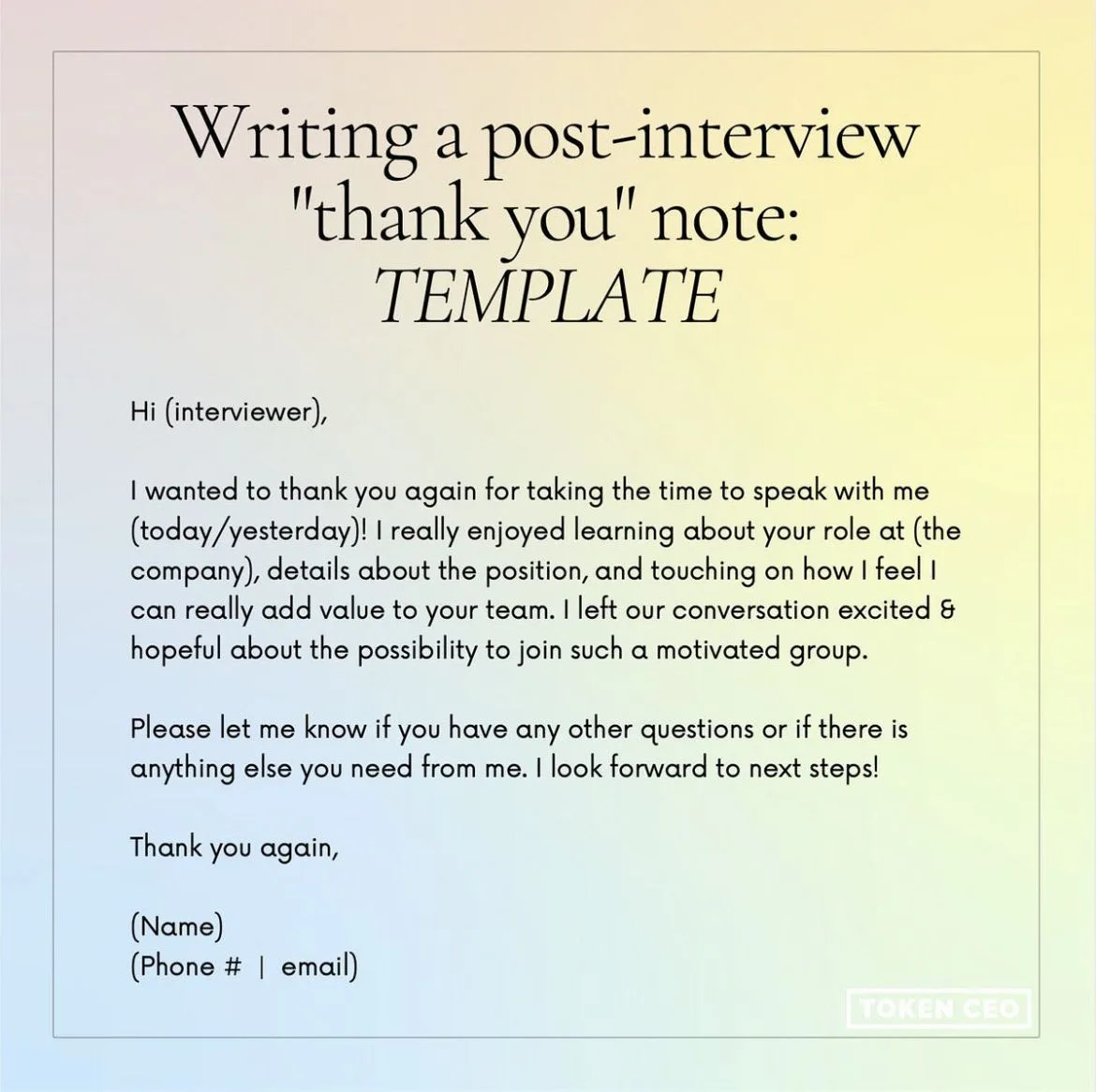
Sending a thank you letter after a job interview is one of the most universally recommended pieces of career advice, yet the majority of candidates either skip it entirely or send something so generic that it adds no value to their candidacy. According to hiring managers surveyed across multiple industries, fewer than half of all interview candidates send any form of follow-up, and of those who do, most send variations of the same tepid message: "Thank you for your time.
I enjoyed learning about the role. I look forward to hearing from you." That kind of letter checks a box but moves no needles. The thank you letters that actually influence hiring decisions are specific, personal, strategic, and timely.
They reference particular moments from the conversation, address concerns the interviewer raised, reinforce the candidate's unique qualifications, and demonstrate the kind of thoughtfulness and communication skill that every employer values. This guide provides 10 expert-crafted thank you letter templates for every type of interview scenario, along with detailed guidance on timing, format, personalization, and the strategic thinking that separates memorable follow-ups from forgettable ones.
Why Thank You Letters Still Matter
The Data Behind the Practice
Hiring decisions are rarely made on qualifications alone. When two or more candidates are similarly qualified, which is extremely common in competitive job markets, the decision often comes down to intangible factors: cultural fit, communication ability, professionalism, and genuine enthusiasm for the role. A well-crafted thank you letter provides evidence of all four.
Multiple surveys of hiring managers and recruiters have found that:
- A significant percentage of hiring managers say they consider the absence of a thank you letter when evaluating candidates, with some reporting that it negatively affects a candidate's chances.
- Thank you letters are particularly influential in close decisions where two or more candidates are similarly qualified.
- The quality of the thank you letter matters more than simply sending one. Generic messages are often viewed as no better than sending nothing at all.
What a Thank You Letter Actually Accomplishes
A strategic thank you letter serves several purposes beyond basic politeness:
It reinforces your candidacy. By referencing specific topics from the interview, you remind the interviewer of the strongest moments of your conversation and keep your qualifications top of mind during the deliberation period.
It addresses gaps or concerns. If the interviewer raised a concern about your experience, qualifications, or fit, the thank you letter gives you an opportunity to address that concern with additional information or context that you did not have time to share during the interview.
It demonstrates communication skill. Every role requires some degree of written communication ability. A well-written thank you letter is a direct, real-world sample of your writing quality.
It shows follow-through. Sending a timely, personalized follow-up demonstrates that you pay attention to details and complete tasks without being prompted, qualities that every employer values.
It creates a final impression. The recency effect in psychology means that the last thing an interviewer encounters from you carries disproportionate weight in their overall evaluation. A strong thank you letter can become that final positive impression.
Timing - The 24-Hour Rule
When to Send
The optimal window for sending a thank you letter is within 24 hours of your interview, with the ideal target being the same business day. Here is the general framework:
Morning interview (before noon): Send your thank you by 3:00 PM the same day.
Afternoon interview (after noon): Send your thank you by 10:00 AM the following business day.
Friday afternoon interview: Send your thank you by Saturday morning or, at the latest, Monday morning. Waiting until Monday afternoon or later significantly diminishes the impact.
Why Speed Matters
Hiring decisions often move faster than candidates expect. In many organizations, interviewers debrief and compare candidates within 24 to 48 hours of the final interviews. If your thank you arrives after the decision has been made, or even after initial impressions have solidified, its influence is negligible. Sending your thank you promptly ensures it arrives while your interview is still fresh in the interviewer's mind and before deliberations conclude.
The Exception - Handwritten Notes
If you choose to send a handwritten thank you note, either in addition to or instead of an email, the timing expectation adjusts to account for mail delivery. A handwritten note sent the day after the interview that arrives 2 to 3 days later is perfectly acceptable. However, for most professional contexts, email is the recommended primary format, with a handwritten note serving as an optional supplementary touchpoint.
Email vs. Handwritten - Choosing the Right Format
When Email Is the Right Choice
Email is the standard and preferred format for post-interview thank you letters in the vast majority of situations. Choose email when:
- The hiring timeline is short (less than two weeks from interview to decision)
- The company culture is modern, fast-paced, or technology-oriented
- Your interviewer communicated with you primarily via email
- Multiple interviewers need to receive individual thank you messages
- The role involves digital communication as a core responsibility
When a Handwritten Note Adds Value
Handwritten notes can differentiate you in specific contexts where the personal touch carries extra weight:
- Executive-level positions where relationship-building is paramount
- Roles in luxury retail, hospitality, or high-end client service
- Organizations with traditional corporate cultures (law firms, financial institutions, family-owned businesses)
- Situations where you want to create a second positive touchpoint after an email thank you
- When the interviewer mentioned a preference for personal communication
The Dual Approach
For positions you are particularly enthusiastic about, consider sending both: an immediate email thank you (for speed and practicality) followed by a mailed handwritten note (for differentiation and personal touch). The handwritten note should not be a copy of the email; instead, it should reference a different aspect of the conversation or express your enthusiasm from a slightly different angle.
Personalization - The Non-Negotiable Element
Why Generic Thank You Letters Fail
A generic thank you letter signals to the interviewer that you send the same message after every interview, which undermines the sincerity and strategic value of the communication. If the interviewer cannot tell from reading your letter which company or role it refers to, the letter is too generic.
How to Personalize Effectively
Reference a specific conversation topic. Mention something particular that was discussed during the interview, such as a project the team is working on, a challenge the department is facing, or an insight the interviewer shared about the company's direction.
Connect the topic to your qualifications. After referencing the specific topic, briefly connect it to a relevant skill, experience, or accomplishment that demonstrates your ability to contribute in that area.
Address the interviewer's priorities. Every interviewer reveals, directly or indirectly, what they most need in the person they hire. Your thank you letter should acknowledge those priorities and reinforce how you meet them.
Use the interviewer's name and specific details. Mention the interviewer by name, refer to specific team members or projects that were discussed, and use the company's actual terminology rather than generic corporate language.
10 Thank You Letter Templates
Template 1 - After First Interview
Subject Line: Thank You - [Job Title] Interview
Dear [Interviewer's Name],
Thank you for taking the time to meet with me today to discuss the [Job Title] position at [Company Name]. I thoroughly enjoyed our conversation, and I left the interview with a much deeper understanding of both the role and the team's goals for the coming year.
I was particularly interested in what you shared about [specific topic discussed during the interview, e.g., "the team's initiative to migrate the customer database to a cloud-based platform by Q3"].
This resonated with me because it closely mirrors a project I led at [Previous Company], where I [specific, brief description of relevant accomplishment, e.g., "managed the migration of 2.5 million customer records to AWS, completing the project three weeks ahead of schedule and reducing query response times by 40%"]. I am confident that this experience would allow me to contribute meaningfully to your team's efforts from day one.
You mentioned that the ideal candidate would need to balance [specific quality or responsibility the interviewer emphasized]. I want to reiterate that this balance is something I have managed throughout my career, and I would welcome the opportunity to bring that approach to [Company Name].
Thank you again for your time and for sharing your vision for the [department/team]. I am genuinely enthusiastic about this opportunity and look forward to the possibility of contributing to [Company Name]'s continued success.
Warm regards,
[Your Name] [Phone Number] [Email Address]
Template 2 - After Second Interview
Subject Line: Thank You for the Second Interview - [Job Title]
Dear [Interviewer's Name],
Thank you for inviting me back for a second conversation about the [Job Title] role. Having the opportunity to go deeper into the specifics of the position and to meet with [names of additional people you met] has only strengthened my enthusiasm for this opportunity.
Our discussion today gave me a much clearer picture of the day-to-day realities of the role, and I want you to know that what I learned excites rather than intimidates me.
In particular, the challenge you described regarding [specific challenge discussed, e.g., "reducing customer churn in the mid-market segment while maintaining acquisition velocity"] is exactly the kind of problem I find most engaging. At [Previous Company], I faced a similar dynamic and addressed it by [brief description of approach and result].
I also appreciated the opportunity to speak with [colleague's name] about [topic]. Their perspective on [specific point] reinforced my sense that this is a team where collaboration is genuine, not just a talking point.
Having now had two in-depth conversations about this role, I want to confirm unequivocally that this is the position I want. The combination of [specific aspects: the team culture, the technical challenges, the company's growth trajectory, the leadership approach] aligns perfectly with where I want to take my career.
If there is any additional information I can provide or any remaining questions I can answer, please do not hesitate to reach out. I look forward to hearing from you.
Sincerely,
[Your Name] [Phone Number] [Email Address]
Template 3 - After Panel Interview
Subject Line: Thank You - [Job Title] Panel Interview
Dear [Primary Interviewer's Name],
Thank you for organizing today's panel interview for the [Job Title] position. I appreciated the opportunity to meet with you, [Name 2], [Name 3], and [Name 4], and to hear each of your perspectives on what makes someone successful in this role.
One of the most valuable aspects of a panel format is learning how different stakeholders view the same position, and today's conversation gave me excellent insight into the cross-functional nature of this role. [Name 2]'s questions about [topic] highlighted the importance of [skill/quality], while [Name 3]'s focus on [different topic] underscored the need for [different skill/quality].
I believe my background demonstrates both of these capabilities, as evidenced by [brief example that addresses both areas].
I was particularly struck by the question about [specific challenging or interesting question from the panel]. While I addressed it during the interview, I have been reflecting on it further and wanted to add that [additional thought or perspective that strengthens your answer].
I recognize that panel interviews require significant coordination across busy schedules, and I am grateful that the team invested that time in my candidacy. Please extend my thanks to each member of the panel.
I am confident that I can add value to your team and look forward to the next steps in the process.
Best regards,
[Your Name] [Phone Number] [Email Address]
Note: When you interview with a panel, consider sending individual thank you emails to each panelist in addition to the primary thank you to the lead interviewer. Each individual message should reference a specific point from that person's questions or comments, demonstrating that you were attentive and engaged with each participant.
Template 4 - After Phone Screen
Subject Line: Thank You for Our Conversation - [Job Title]
Dear [Recruiter's/Interviewer's Name],
Thank you for speaking with me today about the [Job Title] opportunity at [Company Name]. Even in a phone conversation, your enthusiasm for the company and the role came through clearly, and it has increased my interest significantly.
The overview you provided of [specific aspect discussed, e.g., "the company's expansion into the European market and the operational challenges that come with scaling internationally"] aligns well with my experience in [relevant area]. I am eager to explore in a more detailed conversation how my background in [specific skill or experience] could support the team's objectives.
You mentioned that the next step would be [whatever they described: an in-person interview, a technical assessment, a meeting with the hiring manager, etc.]. I want to confirm that I am available and prepared for that step at your convenience. My schedule is flexible during [specific dates/times].
Thank you again for your time and for the detailed overview of both the role and [Company Name]'s trajectory. I look forward to moving forward in the process.
Best,
[Your Name] [Phone Number] [Email Address]
Template 5 - After Video Interview
Subject Line: Thank You - [Job Title] Video Interview
Dear [Interviewer's Name],
Thank you for meeting with me via video today to discuss the [Job Title] position at [Company Name]. While video interviews have become standard, I appreciate your effort to make the conversation feel personal and engaging despite the screen between us.
Our discussion about [specific topic, e.g., "the team's approach to agile development and the transition from two-week to one-week sprints"] was particularly interesting to me.
Having worked in both sprint cadences, I understand the tradeoffs involved, and I was impressed by the thoughtful way your team approached the transition. At [Previous Company], I played a central role in a similar shift and found that [specific insight or lesson learned], which might be relevant as your team continues to refine its processes.
I also wanted to follow up on your question about [specific question]. I gave what I hope was a solid answer in the moment, but I have been thinking about it since our call and wanted to add [additional point or perspective]. I find that the best answers to complex questions often develop after the initial response, which is one reason I value the thank you letter as an opportunity for continued dialogue.
Thank you for the engaging conversation. I am very interested in this opportunity and would welcome the chance to continue the discussion in a subsequent round.
Kind regards,
[Your Name] [Phone Number] [Email Address]
Template 6 - After Working Interview or Trial Day
Subject Line: Thank You for the Working Interview Experience - [Job Title]
Dear [Manager's/Interviewer's Name],
Thank you for the opportunity to participate in the working interview for the [Job Title] position yesterday. Spending [duration] with the team gave me an invaluable perspective on the role, the work environment, and the day-to-day dynamics of the [department] that no traditional interview could provide.
I want to share a few reflections from the experience:
The [specific task or project you worked on] was both challenging and engaging. I found that my experience with [relevant skill] translated well to your team's workflow, and I was able to [specific contribution or observation about what you accomplished during the trial]. I was also impressed by [specific positive observation about the team, processes, or culture that you noticed during the working interview].
I particularly enjoyed working alongside [colleague's name], whose approach to [specific area] aligned well with my own work style. The collaborative dynamic I observed within the team is something I value highly and would be excited to be part of.
If there were areas where my performance during the working interview raised questions or where you would like additional context about my approach, I am happy to discuss those in a follow-up conversation.
The experience confirmed my strong interest in joining [Company Name]. Thank you for the time, preparation, and openness your team invested in making the working interview a meaningful experience.
With appreciation,
[Your Name] [Phone Number] [Email Address]
Template 7 - After Informational Interview
Subject Line: Thank You for Your Time and Insights
Dear [Contact's Name],
Thank you for generously sharing your time and expertise with me during our conversation on [Day]. Your insights into [industry/field/company/role] were invaluable, and I learned more in our [duration] conversation than I could have from weeks of independent research.
Several points from our discussion particularly resonated with me:
First, your observation about [specific insight the person shared, e.g., "the increasing importance of data literacy for marketing professionals"] has prompted me to [specific action you plan to take, e.g., "enroll in the Google Analytics certification program you recommended"]. I appreciate the specificity of that advice because it gives me a clear, actionable next step.
Second, your career path from [starting point] to [current position] through [interesting transition] was genuinely inspiring. It reinforced my belief that [relevant career lesson or takeaway].
You mentioned that [specific suggestion or connection they offered, e.g., "your colleague Sarah Chen might be a good person for me to speak with about the product management side of the industry"]. With your permission, I would like to reach out to her and mention that you suggested the connection. Please let me know if that would be appropriate.
I want to be respectful of your time and not presume on your generosity, but I wanted you to know that your advice is being acted upon, not just appreciated. If there is ever anything I can do for you in return, please do not hesitate to ask.
With sincere gratitude,
[Your Name] [Phone Number] [Email Address] [LinkedIn Profile, if appropriate]
Template 8 - After Internal Interview
Subject Line: Thank You for Considering My Application - [Job Title]
Dear [Hiring Manager's Name],
Thank you for taking the time to interview me for the [Job Title] position within [Department]. As someone who has been with [Company Name] for [duration] and cares deeply about the organization's success, the opportunity to discuss how I might contribute in a new capacity was exciting and meaningful.
I appreciated your candor about the challenges the [Department] is facing, particularly regarding [specific challenge discussed]. Drawing on my experience in [current department], where I [specific relevant accomplishment], I believe I can bring a perspective to this challenge that is both fresh and grounded in a deep understanding of how [Company Name] operates.
One advantage I bring as an internal candidate is institutional knowledge that no external hire could match. I understand [Company Name]'s culture, processes, and stakeholders, and I have established relationships across departments that would allow me to hit the ground running in this role. At the same time, I want to assure you that I approach this opportunity with the same hunger and commitment I would bring to any new role, not with any sense of entitlement based on my tenure.
I also want to acknowledge that if the team determines another candidate is a better fit, I respect that decision completely and it will not affect my commitment to [Company Name] in my current role. My interest in this position is additive, not a sign of dissatisfaction with my current work.
Thank you again for the consideration. I look forward to hearing about the next steps.
Respectfully,
[Your Name] [Current Department] [Extension/Contact]
Template 9 - After Executive-Level Interview
Subject Line: Thank You - [Executive Title] Discussion
Dear [Interviewer's Name],
Thank you for the substantive conversation about the [Executive Title] opportunity at [Company Name]. Discussions at this level require a degree of openness and strategic thinking from both parties, and I appreciate the candor with which you shared your vision for the organization's trajectory over the next three to five years.
Your description of the strategic priorities, particularly [specific strategic initiative discussed, e.g., "the planned expansion into the Asia-Pacific region and the need to build local leadership teams while maintaining corporate culture coherence"], is exactly the type of challenge that energizes me.
In my current role at [Current/Previous Company], I led a comparable initiative when we [specific parallel experience with measurable outcomes]. The lessons I learned during that process, particularly regarding [specific strategic lesson], would be directly transferable to the situation you described at [Company Name].
I was also struck by the cultural values you emphasized, especially [specific value]. In my experience, organizations that genuinely embed this value into their operations, rather than treating it as a talking point, consistently outperform those that do not. I would welcome the opportunity to contribute to and reinforce that culture at the leadership level.
At the executive level, fit is mutual. I want to be transparent that our conversation reinforced my assessment that [Company Name] is an organization where I could make a meaningful impact while continuing to grow as a leader. The alignment between your strategic needs and my experience feels genuine and substantive.
I look forward to continuing our dialogue and meeting with [other stakeholders mentioned, e.g., "the board members you suggested"]. Please let me know how I can be helpful in moving the process forward.
With respect and enthusiasm,
[Your Name] [Phone Number] [Email Address]
Template 10 - After Group Interview
Subject Line: Thank You for the Group Interview - [Job Title]
Dear [Interviewer's/Coordinator's Name],
Thank you for including me in today's group interview for the [Job Title] position. The group format was a unique and engaging way to evaluate candidates, and I appreciated the opportunity to demonstrate my skills in a collaborative, real-time setting.
I found the [specific group exercise or discussion topic] particularly interesting. While group dynamics can be unpredictable, I felt that our group produced strong results, and I was glad to contribute by [specific contribution you made, e.g., "suggesting the framework we used to organize our approach to the case study" or "facilitating the discussion when we reached the time management challenge in the second exercise"].
I noticed that the interviewers seemed to observe not just what candidates said but how they interacted, listened, and built on each other's ideas, which tells me a great deal about the collaborative culture [Company Name] values.
In a group setting, it can be difficult to fully convey individual qualifications, so I wanted to take this opportunity to reiterate a few key points about my background:
- [Key qualification 1 that was difficult to fully communicate in the group setting]
- [Key qualification 2]
- [Key qualification 3]
I understand that group interviews are designed to assess interpersonal dynamics, teamwork, and leadership in ways that one-on-one interviews cannot. I hope my participation demonstrated the collaborative, communicative, and solution-oriented approach I would bring to the [Job Title] role every day.
Thank you for the well-organized and thought-provoking experience. I look forward to the next step in the process.
Best regards,
[Your Name] [Phone Number] [Email Address]
Advanced Strategies for Maximum Impact
Referencing Specific Conversation Points
The most powerful technique in a thank you letter is demonstrating that you were genuinely listening during the interview. This is accomplished by referencing specific moments from the conversation, not broad topics. The difference is significant:
Broad (weak): "I enjoyed learning about the company's growth plans."
Specific (strong): "Your explanation of how the acquisition of Meridian Technologies will create cross-selling opportunities in the healthcare vertical gave me a clear picture of the strategic direction, and it is a direction I find genuinely exciting."
The specific reference accomplishes three things simultaneously: it proves you were paying attention, it shows you understood the business implications of what was discussed, and it creates a vivid memory anchor that connects the interviewer's own words to your candidacy.
Addressing Concerns Without Being Defensive
If you sensed hesitation from the interviewer about a specific aspect of your candidacy, the thank you letter is your opportunity to address it. The key is to be proactive without being defensive:
Defensive (weak): "I noticed you seemed concerned about my lack of management experience, but I want to assure you that I am a fast learner."
Proactive (strong): "Reflecting on our discussion about the team leadership component of the role, I wanted to share that while my formal management experience is in its early stages, I have consistently sought out leadership opportunities, including [specific example]. I am also currently enrolled in [relevant course or program] to further develop my leadership capabilities."
When Multiple Interviewers Are Involved
If you interviewed with multiple people, send individual thank you messages to each person. Each message should:
- Be unique, not a copy-paste with the name changed
- Reference something specific that individual said or asked
- Be consistent in your expressed enthusiasm for the role (interviewers compare notes)
- Vary in length and focus to feel natural rather than formulaic
Common Mistakes to Avoid
The Generic Template Trap
Sending a thank you that could apply to any company or any role is worse than sending none at all because it signals low effort and low genuine interest. Every thank you letter must contain at least one specific detail from the actual conversation that occurred.
Overly Long Messages
A thank you letter should be three to five paragraphs. Anything longer than one page (or approximately 400 words for email) risks losing the reader's attention and diluting your key messages. Be concise and strategic with every sentence.
Desperation and Over-Eagerness
There is a line between enthusiasm and desperation. Phrases like "this is my dream job," "I would do anything for this opportunity," or "please give me a chance" cross it. Confident enthusiasm sounds like this: "Our conversation reinforced my strong interest in this role and my confidence that I can make a meaningful contribution."
Typos and Errors
A thank you letter with spelling or grammatical errors is counterproductive. It suggests carelessness at a moment when attention to detail matters most. Proofread carefully, use spell-check, and if possible, have someone else review your message before sending.
Sending to the Wrong Person
Double-check the name, email address, and title of every person you send a thank you to. Sending a personalized message addressed to the wrong interviewer or referencing details from a different interview is a memorable mistake, and not in a good way.
Following Up Too Aggressively After the Thank You
Your thank you letter is your follow-up. Do not send additional messages asking about the status of the hiring decision unless the stated timeline has passed. If the interviewer told you to expect a decision by a specific date and that date passes, one polite check-in is appropriate. Beyond that, wait for them to contact you.
Special Situations
When You Interviewed but Are No Longer Interested
If the interview revealed that the role or company is not the right fit for you, you should still send a thank you. Keep it brief and genuine, and do not express interest you do not feel. You never know when your path might cross with that interviewer again, and leaving a positive final impression preserves the relationship for future opportunities.
When the Interview Went Poorly
Even if you feel the interview did not go well, send a thank you letter. Sometimes your perception of the interview does not match the interviewer's. A strong follow-up can recover from a mediocre interview performance. Address any stumbles briefly and positively, and refocus on your strengths and enthusiasm.
When You Are One of Many Candidates
In high-volume hiring processes where you know many candidates are being considered, your thank you letter becomes even more important as a differentiator. Make it specific, make it memorable, and make it clear that you invested thought and effort in the follow-up, because most of your competitors will not.
Industry-Specific Considerations
Technology and Startups
Technology companies and startups tend to have faster hiring cycles and more informal communication cultures. Thank you emails in this space can be slightly less formal in tone while still maintaining professionalism. Referencing specific technical challenges discussed during the interview and connecting them to your skills is particularly effective.
If you completed a technical assessment or coding challenge as part of the process, the thank you letter is an appropriate place to briefly reflect on your approach and mention any additional thoughts you had afterward.
Finance, Law, and Consulting
Traditional professional services firms tend to have more formal cultures, and thank you letters should reflect that. Use formal salutations and closings, avoid contractions, and maintain a serious professional tone throughout. In these industries, the quality of your written communication is being evaluated as directly relevant to the work you would perform. Precision in language, logical structure, and attention to detail carry extra weight.
Healthcare
Healthcare interviews often involve clinical scenarios, case discussions, or assessments of patient care philosophy. Your thank you letter should reference specific clinical topics discussed and demonstrate your clinical reasoning and patient-centered approach. If the interview included a tour of facilities or introduction to clinical teams, mention specific positive observations about the care environment.
Creative Industries
In creative fields such as marketing, design, advertising, and media, your thank you letter can reflect slightly more personality and creative flair while remaining professional. Consider the tone and voice of the company's own communications and match it appropriately. If you discussed specific creative projects during the interview, reference them and add a thoughtful perspective that demonstrates your creative thinking.
Government and Nonprofit
Government and nonprofit hiring processes tend to move more slowly than private sector equivalents. Your thank you letter should express patience with the process while still conveying genuine enthusiasm. Referencing the organization's mission and connecting it to your personal values is particularly effective in these sectors, where mission alignment is often weighted as heavily as technical qualifications.
Final Guidance
A thank you letter after an interview is not a formality; it is a strategic communication that can meaningfully influence the hiring decision. The templates in this guide provide proven structures for ten common interview scenarios, but the effectiveness of your thank you ultimately depends on the specific, personal details you weave into each message.
Listen carefully during every interview, take notes immediately afterward, and craft your follow-up with the same care and professionalism you brought to the interview itself. In a competitive job market where similarly qualified candidates compete for the same positions, the candidate who follows up thoughtfully, promptly, and personally gains an edge that no resume bullet point can match.
Frequently Asked Questions
How quickly should you send a thank you letter after an interview?
The optimal window for sending a thank you letter after an interview is within 24 hours, with the ideal target being the same business day as the interview. Sending your thank you within a few hours of the interview keeps you fresh in the interviewer’s mind and demonstrates both enthusiasm and strong follow-through.
If your interview was in the morning, aim to send your thank you by early afternoon.
If your interview was in the afternoon, sending it the following morning before 10 AM is perfectly acceptable. Waiting longer than 24 hours significantly diminishes the impact, as interviewers may have already begun forming final impressions and comparing candidates.
For positions where hiring decisions are made quickly, such as retail or service industry roles, even a few hours can make the difference. The one exception is handwritten thank you notes, which are acceptable to arrive 2 to 3 days later due to mail delivery times.
Should you send a thank you email or a handwritten thank you letter after an interview?
Email is the standard and preferred format for post-interview thank you letters in the vast majority of industries and roles today. The primary advantage of email is speed: it reaches the interviewer within minutes, ensuring your message arrives while the conversation is still fresh.
For most corporate, technology, healthcare, and professional services roles, email is not only acceptable but expected.
Handwritten notes can be a powerful differentiator in certain contexts, particularly for roles in luxury retail, hospitality, executive positions, or organizations with traditional corporate cultures.
Some candidates use a dual approach: sending an immediate email thank you followed by a mailed handwritten note that arrives a few days later. This strategy works well for positions you are particularly interested in, as the handwritten note serves as a second positive touchpoint. Avoid handwritten notes if your handwriting is difficult to read or if the hiring timeline is compressed.
What should you include in a thank you letter if you forgot to mention something during the interview?
A thank you letter is an excellent opportunity to address points you missed during the interview, and doing so can actually work in your favor by giving the interviewer additional information to support your candidacy. The key is to integrate the missed point naturally rather than making the letter feel like a correction or addendum.
After your opening thank you and reference to a specific discussion topic, include a brief paragraph that transitions naturally, such as: ‘Our conversation about your team’s expansion into international markets reminded me of my experience leading a similar initiative at my previous company, which I did not have the chance to detail during our meeting.’
Keep the addition concise and directly relevant to a topic that was discussed. Avoid trying to address more than one or two missed points, as the primary purpose of the letter remains expressing genuine appreciation and reinforcing your fit for the role.