
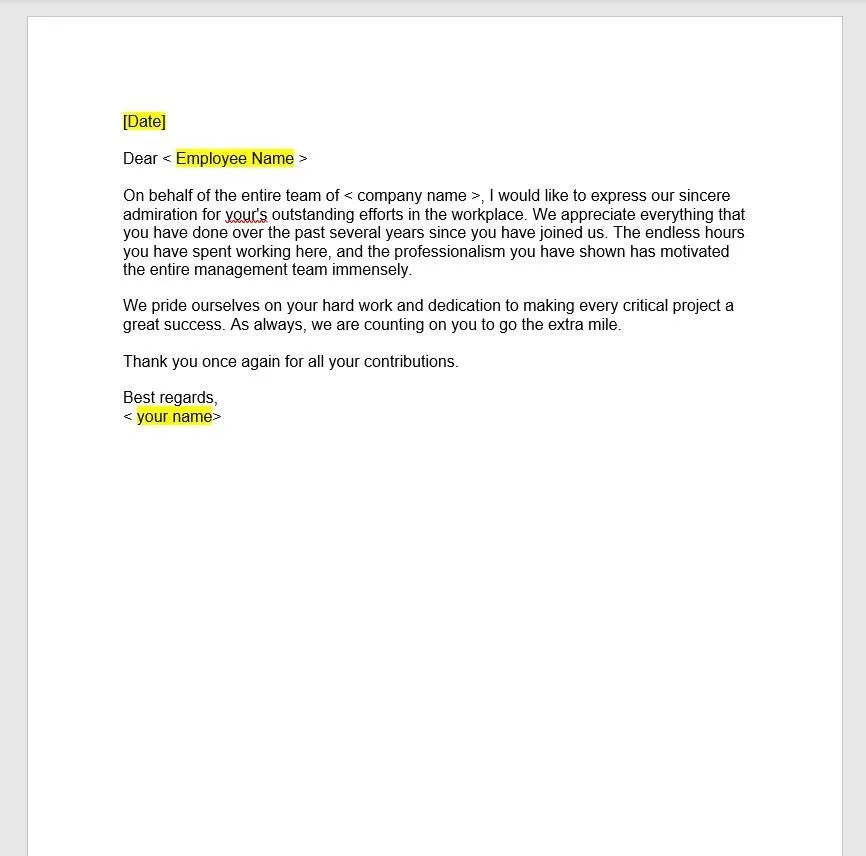
Appreciation letters are among the most underutilized yet powerful tools in professional communication. A thoughtful, well-written appreciation letter strengthens relationships, boosts morale, reinforces positive behaviors, and creates a lasting record of gratitude that the recipient can revisit for years.
Unlike a quick verbal thank you or a brief email, a formal appreciation letter signals a level of intentionality and respect that resonates deeply. This comprehensive guide provides ten professionally written appreciation letter templates covering every common occasion, along with detailed guidance on timing, tone, specificity, format, and the strategic benefits of building a culture of recognition through written appreciation.
The Power of Written Appreciation
Written appreciation carries weight that verbal thanks cannot match. When someone receives a thoughtful appreciation letter, several things happen simultaneously: the recipient feels valued and recognized, the specific behaviors or contributions being praised are reinforced, and a permanent record is created that can be referenced during performance reviews, included in portfolios, or simply revisited on difficult days.
Impact on Workplace Culture
Organizations that prioritize written recognition experience measurable benefits. Employee engagement studies consistently show that feeling appreciated is one of the strongest predictors of job satisfaction, retention, and discretionary effort. When appreciation is specific, timely, and genuine, it creates a positive feedback loop that elevates performance across the team.
Impact on Professional Relationships
In business relationships with clients, vendors, and partners, appreciation letters differentiate your organization from competitors who take these relationships for granted. A client who receives a genuine appreciation letter is more likely to renew a contract, refer new business, and extend grace when challenges arise.
Impact on Personal Relationships
Appreciation letters for mentors, teachers, volunteers, and community members acknowledge contributions that often go unrecognized. These letters can be profoundly meaningful to recipients who dedicate their time and energy without expectation of formal recognition.
Principles of Effective Appreciation Letters
Before diving into the templates, understanding the core principles that make appreciation letters effective will help you adapt any template to your specific situation.
Specificity Over Generality
The most common mistake in appreciation letters is being too vague. Statements like "thank you for everything you do" or "we appreciate your hard work" feel generic and can actually diminish the impact of the recognition. Effective appreciation identifies exactly what the person did, when they did it, and why it mattered. The more specific the appreciation, the more genuine it feels.
Sincerity Over Formality
While a professional tone is important, the letter should sound like it was written by a real person who genuinely values the recipient's contributions. Overly formal, template-sounding letters can feel hollow. Let your authentic voice come through while maintaining professionalism.
Timeliness
The closer the appreciation letter is to the event or contribution being recognized, the more powerful it is. A letter sent within a week of a project completion feels timely and relevant. The same letter sent three months later feels like an afterthought.
Format Considerations
The format of the appreciation letter should match the context and relationship:
- Handwritten letters are most personal and appropriate for individual recognition, milestone celebrations, and close professional relationships
- Typed letters on company letterhead are appropriate for formal business appreciation and letters that will become part of official records
- Emails are acceptable for timely appreciation when physical letters are impractical, especially in remote or distributed teams
- Printed cards offer a middle ground between handwritten letters and formal typed documents
Template 1 - Employee Recognition Letter
[Your Name] [Your Title] [Company Name] [Date]
Dear [Employee Name],
I am writing to formally recognize and thank you for your exceptional work on [specific project, initiative, or ongoing contribution]. Your dedication, skill, and professionalism have made a significant impact on our team and the organization as a whole.
Specifically, I want to acknowledge your contributions in the following areas:
[Project/Initiative Name]: Your leadership in [specific role or responsibility] was instrumental in the project's success. You [specific actions taken, such as developed a new workflow, resolved a critical technical issue, managed a difficult client relationship, or coordinated across multiple teams] with a level of competence and composure that impressed everyone involved.
The result - [specific measurable outcome such as a 20% reduction in processing time, successful launch three days ahead of schedule, client satisfaction score of 98%, or cost savings of $50,000] - speaks directly to the quality of your work.
Team Collaboration: Beyond your individual contributions, your willingness to [specific collaborative behaviors such as mentor new team members, share knowledge during team meetings, stay late to help a colleague meet a deadline, or volunteer for tasks outside your core responsibilities] has strengthened our entire team. Several of your colleagues have mentioned how much they value working alongside you.
Consistency: What makes your contributions particularly noteworthy is their consistency. This is not an isolated instance of excellent work but rather a continuation of the high standards you have maintained throughout your [number] years with us.
This letter will be placed in your personnel file as a formal record of your outstanding performance. I am grateful to have you on our team and look forward to your continued growth and success at [Company Name].
With sincere appreciation,
[Your Full Name] [Your Title] [Company Name]
Template 2 - Client Appreciation Letter
[Company Name] [Company Address] [City, State ZIP Code] [Date]
[Client Name] [Client Title] [Client Company Name] [Address] [City, State ZIP Code]
Dear [Client Name],
As we [mark the anniversary of our partnership / complete another successful project together / approach the end of the year], I want to take a moment to express our sincere appreciation for the relationship between [Your Company] and [Client Company].
Over the past [number] years, your organization has been more than a client - you have been a trusted partner whose feedback, collaboration, and trust have helped us improve and grow.
Working with you on [specific projects or initiatives] has been a highlight of our professional experience, and the results we have achieved together - including [specific outcomes such as the successful launch of the new platform, a 35% increase in operational efficiency, or the expansion into three new markets] - reflect the strength of our collaboration.
What we value most about our relationship with [Client Company] is [specific quality such as the open communication, the shared commitment to excellence, the willingness to innovate, or the mutual respect that defines every interaction]. [Specific example, such as: When the supply chain disruption threatened the Q3 timeline, your team's flexibility and proactive communication allowed us to pivot quickly and deliver on schedule.]
We do not take your business for granted. Every project we undertake for [Client Company] receives our best effort because you have consistently demonstrated that you expect and deserve nothing less. Your trust in our team is something we work to earn every day.
Thank you for choosing [Your Company] as your partner. We look forward to continuing to deliver value and to the opportunities that lie ahead.
With warm regards,
[Your Full Name] [Your Title] [Company Name] [Phone Number] [Email Address]
Template 3 - Vendor Thank You Letter
[Your Name] [Your Title] [Company Name] [Company Address] [City, State ZIP Code] [Date]
[Vendor Contact Name] [Vendor Title] [Vendor Company Name] [Address] [City, State ZIP Code]
Dear [Vendor Contact Name],
I am writing to express our appreciation for the outstanding service and partnership that [Vendor Company] has provided to [Your Company] over the past [time period].
In a business landscape where reliable vendor relationships are increasingly valuable, your team has consistently exceeded our expectations. Specifically, I want to acknowledge:
Quality: The [products/services] you have delivered have consistently met or exceeded our specifications. [Specific example, such as: The materials supplied for the Q2 production run were delivered at a 99.7% quality rate, which directly contributed to our ability to meet our own quality standards for our end customers.]
Reliability: Your on-time delivery rate of [percentage] over the past [time period] has been exceptional. When unexpected demand spikes have occurred, such as [specific instance], your team responded with flexibility and urgency that prevented disruptions to our operations.
Communication: [Vendor Contact Name or Account Manager Name] has been an outstanding point of contact, providing proactive updates, responding promptly to inquiries, and escalating issues effectively when needed.
Problem Resolution: On the occasion when [specific issue arose, such as a shipment discrepancy or quality concern], your team addressed it [quickly, transparently, and to our complete satisfaction]. The way you handle challenges is as impressive as your day-to-day performance.
Our business depends on partners like [Vendor Company], and we want you to know that your efforts do not go unnoticed. We value this relationship and look forward to many more years of successful collaboration.
Thank you for being an exceptional partner.
Sincerely,
[Your Full Name] [Your Title] [Company Name]
Template 4 - Mentor Appreciation Letter
[Your Name] [Your Address or Company] [Date]
Dear [Mentor Name],
I am writing to express my deep and sincere gratitude for the mentorship you have provided me over the past [time period]. Your guidance has had a profound impact on my professional development and my career trajectory, and I want you to know how much it has meant to me.
When I first approached you for guidance [timeframe or context, such as when I was navigating the transition from individual contributor to manager, when I was considering a career change, or during my first year in the industry], I was [honest description of where you were, such as uncertain about my direction, struggling with a specific challenge, or eager to grow but unsure how to proceed].
Your willingness to share your time, experience, and honest perspective gave me a foundation that I continue to build upon.
There are several specific ways your mentorship has shaped my professional growth:
Strategic Thinking: Your advice to [specific guidance, such as always consider the second and third-order effects of decisions, focus on building systems rather than fighting fires, or invest time in understanding the business context before proposing solutions] fundamentally changed how I approach my work. I use this framework daily, and it has been recognized by [my manager, peers, or leadership].
Difficult Conversations: When I faced [specific professional challenge], your coaching on [specific advice given] gave me the confidence and the approach I needed to navigate the situation successfully. The outcome - [what happened] - would not have been possible without your guidance.
Career Direction: Your candid feedback about [specific area, such as my strengths, areas for development, or career options] helped me make informed decisions about [specific career decision]. I am now [where you are professionally] in large part because of the clarity your perspective provided.
What I appreciate most is that your mentorship has always been honest rather than merely encouraging. You challenged my assumptions, pointed out blind spots, and held me to a higher standard than I held myself. That kind of mentorship is rare and invaluable.
Thank you for investing in my growth. I hope to honor your generosity by mentoring others with the same level of care and candor you have shown me.
With profound gratitude,
[Your Full Name]
Template 5 - Volunteer Appreciation Letter
[Organization Name] [Address] [City, State ZIP Code] [Date]
Dear [Volunteer Name],
On behalf of [Organization Name] and the communities we serve, I want to express our heartfelt gratitude for your dedicated volunteer service over the past [time period].
Your commitment to our mission has been extraordinary. During [time period], you contributed approximately [number] hours of volunteer service, and the impact of those hours extends far beyond what any number can capture.
Your work with [specific program, event, or initiative] has directly [specific impact, such as provided tutoring support to 15 students who improved their reading levels by an average of two grades, organized a fundraising event that raised $12,000 for our scholarship fund, sorted and distributed food assistance to 200 families during the holiday season, or mentored three young professionals through our career development program].
What makes your volunteerism particularly remarkable is [specific quality, such as your consistency in showing up week after week regardless of weather or personal schedule, your ability to connect with the people we serve in a way that makes them feel dignified and valued, your willingness to take on any task whether it is glamorous or not, or your talent for recruiting and inspiring other volunteers].
I want to share a specific moment that illustrates your impact: [specific anecdote, such as: Last month, one of the families you helped during the housing assistance program stopped by to tell us that they had secured permanent housing and wanted us to thank the volunteer who spent extra time helping them navigate the application process. That volunteer was you.] Moments like these remind us why this work matters, and they are possible because of people like you.
Your service is a gift to our organization and our community. We are deeply grateful for your time, your talents, and your generous spirit.
With sincere thanks,
[Your Full Name] [Your Title] [Organization Name]
Template 6 - Donation Thank You Letter
[Organization Name] [Address] [City, State ZIP Code] [Date]
[Donor Name] [Address] [City, State ZIP Code]
Dear [Donor Name],
On behalf of [Organization Name], I want to express our sincere gratitude for your generous contribution of $[Amount] received on [Date]. Your support makes a meaningful difference in our ability to [brief mission statement, such as provide educational opportunities to underserved youth, deliver critical medical services to uninsured families, protect and restore local waterways, or support veterans transitioning to civilian life].
Your Gift at Work:
Your donation will directly support [specific program or initiative]. To give you a sense of the impact, a gift of this size allows us to [specific tangible outcome, such as provide school supplies for 25 students for an entire academic year, fund 40 hours of counseling services for families in crisis, purchase equipment that will serve 100 participants in our workforce training program, or plant 500 native trees along the riverbank restoration area].
Our Progress:
Thanks to the generosity of supporters like you, [Organization Name] has been able to [recent accomplishments, such as expand our programming to three new neighborhoods, serve 30% more families than last year, achieve a 90% program completion rate, or launch a new initiative that addresses a critical community need]. Your contribution is a vital part of this progress.
Tax Information:
This letter serves as your official tax receipt. [Organization Name] is a 501(c)(3) nonprofit organization, and your donation is tax-deductible to the extent permitted by law. Our EIN is [number]. No goods or services were provided in exchange for this contribution [or, if applicable: In exchange for your contribution, you received [description and fair market value of any goods or services provided]].
We are honored by your trust in our organization and our mission. If you would like to learn more about how your gift is making a difference, please visit [website] or contact me directly at [phone/email]. We would also welcome you to [visit our facility, attend an upcoming event, or volunteer] to see the impact of your generosity firsthand.
Thank you for your compassion and your commitment to [cause/community].
With gratitude,
[Your Full Name] [Your Title] [Organization Name] [Phone Number] [Email Address]
Template 7 - Teacher Appreciation Letter
[Your Name] [Date]
Dear [Teacher Name],
I am writing to express my sincere appreciation for the exceptional impact you have had on [my/my child's] education and personal growth. As the [school year comes to a close / semester ends / academic journey reaches a milestone], I want to make sure you know how much your dedication and skill have meant to [me/our family].
[Student Name / I] entered your [class name / grade level] [feeling/with/facing] [honest description of starting point, such as anxious about the subject, behind grade level in reading, uncertain about academic abilities, or eager but undisciplined].
Over the course of the [year/semester], your [specific teaching approaches, such as patient one-on-one attention, creative lesson plans that made the material engaging, high expectations paired with genuine support, or ability to make every student feel capable]
transformed that starting point into [specific outcome, such as genuine confidence and enthusiasm for the subject, a two-grade-level improvement in reading comprehension, a love of learning that extends beyond the classroom, or the discipline and study skills needed for academic success].
There are specific moments that stand out:
- [Specific example, such as: When (Student Name) struggled with the science project, you stayed after school twice to help him develop a plan, which not only saved the project but taught him how to break large tasks into manageable steps - a skill he now applies to everything.]
- [Specific example, such as: Your feedback on the research paper was more detailed and constructive than anything I received in college. It pushed me to revise my thinking, not just my writing, and the final product was work I am genuinely proud of.]
- [Specific example, such as: The way you handled the classroom conflict in October - with fairness, empathy, and clear boundaries - taught the entire class a lesson about respect that went far beyond academics.]
Teaching is among the most important and most demanding professions, and not everyone who enters it does so with the passion, skill, and genuine care that you bring to your work every day. Your students are fortunate, and [I am / we are] grateful.
Thank you for the difference you make.
With deep appreciation,
[Your Name]
Template 8 - Team Appreciation After Project Completion
[Your Name] [Your Title] [Company Name] [Date]
Dear [Team Name / Team Members],
I want to take a moment to formally recognize and thank each of you for your outstanding work on [Project Name]. What this team accomplished over the past [time period] was remarkable, and I want to make sure that your contributions are documented and celebrated.
The Challenge:
When we began [Project Name] in [date], we faced [honest description of the challenge, such as an aggressive timeline that many believed was unrealistic, a technical problem that had stymied previous attempts, a client expectation that required us to fundamentally rethink our approach, or budget constraints that demanded creative solutions].
What You Delivered:
Despite these challenges, this team delivered [specific outcomes]:
- [Specific measurable result, such as: Completed the platform migration two days ahead of the deadline with zero data loss and 99.9% uptime during the transition]
- [Specific measurable result, such as: Reduced the projected budget by 15% through innovative process improvements identified during the planning phase]
- [Specific measurable result, such as: Achieved a client satisfaction rating of 4.9 out of 5.0, the highest in our division's history for a project of this scope]
- [Specific measurable result, such as: Developed a reusable framework that will reduce implementation time for similar projects by an estimated 40%]
Individual Contributions:
While this was truly a team effort, I want to acknowledge several individual contributions that were particularly impactful:
- [Team Member Name]: [Specific contribution and its impact]
- [Team Member Name]: [Specific contribution and its impact]
- [Team Member Name]: [Specific contribution and its impact]
- [Team Member Name]: [Specific contribution and its impact]
What Made This Team Special:
Beyond the deliverables, what impressed me most about this team was [specific team dynamic, such as the way you communicated openly about obstacles rather than hiding them, the willingness of every member to step outside their comfort zone when the project required it, the collaborative spirit that meant no one considered any task beneath them, or the calm professionalism you maintained during the most stressful phases].
This project is a testament to what talented, committed people can accomplish when they work together effectively. I am proud to have been part of this team, and I hope you are as proud of what you achieved as I am.
Thank you.
[Your Full Name] [Your Title]
Template 9 - Retirement Appreciation Letter
[Your Name / Company Name] [Address] [Date]
Dear [Retiree Name],
As you prepare to begin the next chapter of your life, I want to take this opportunity to express the deep appreciation that [I / we / Company Name] feel for your [number] years of dedicated service.
When you joined [Company Name] in [year] as a [original title], the company was [brief description of the company at that time]. Over the course of your career, you have been an integral part of the journey from [then] to [now], and your fingerprints are on many of the achievements that define who we are today.
Your Legacy:
Your contributions to [Company Name] are extensive, but several stand out as particularly defining:
- [Specific major achievement, such as: You built the customer service department from a three-person team into a 45-person operation that consistently achieves the highest satisfaction ratings in the industry. The systems and culture you established continue to serve as the foundation for our client relationships.]
- [Specific major achievement, such as: Your leadership during the 2018 acquisition was critical to the successful integration of two very different organizational cultures. The fact that we retained 95% of key talent from both organizations is a direct result of your thoughtful and empathetic approach.]
- [Specific major achievement, such as: You mentored more than 20 professionals who have gone on to leadership roles, both within our organization and beyond. Your commitment to developing the next generation of leaders is perhaps your most enduring contribution.]
What We Will Miss:
Beyond your professional accomplishments, we will miss [specific personal qualities, such as your dry sense of humor that lightened even the most tense meetings, your open-door policy that made everyone feel welcome regardless of their title, your legendary ability to remember the name and family details of every person you met, or your tradition of bringing homemade cookies on the first Monday of every month].
Our Gratitude:
[Number] years of service to one organization is a remarkable commitment, and it reflects the values of loyalty, perseverance, and dedication that you have embodied throughout your career. You have earned this retirement many times over, and we hope it brings you the fulfillment, adventure, and rest that you deserve.
You will always be a part of the [Company Name] family, and you are always welcome here.
With deep respect and appreciation,
[Your Full Name] [Your Title] [Company Name]
Template 10 - Customer Loyalty Appreciation Letter
[Company Name] [Company Address] [City, State ZIP Code] [Date]
[Customer Name] [Address] [City, State ZIP Code]
Dear [Customer Name],
I am writing to personally thank you for your continued loyalty to [Company Name]. As we [reach this milestone / reflect on the past year], I want you to know that we recognize and deeply value the trust you have placed in us over the past [number] years.
In an era when customers have more choices than ever, the fact that you continue to choose [Company Name] is something we never take for granted. Your loyalty is both a compliment and a responsibility - a compliment because it tells us we are doing something right, and a responsibility because it motivates us to continue earning your trust with every interaction.
What Your Loyalty Means to Us:
Since you first became a customer in [year/date], you have [specific details about the customer relationship, such as entrusted us with X projects, purchased X products, referred X new customers to us, or been a member of our service program]. Each of these interactions represents a choice - your choice - to continue this relationship, and we are grateful for every one.
Our Commitment to You:
As a valued long-term customer, we want to ensure you always receive the best experience possible. To that end, [specific commitment or benefit, such as: you now have access to our priority support line at (phone number), your dedicated account representative (name) is available to assist you with any needs, you will receive early access to new products and services, or you are invited to our exclusive customer appreciation event on (date)].
[If applicable: As a token of our appreciation, we have [enclosed a gift card, applied a loyalty discount to your account, upgraded your service level, or arranged a complimentary service].]
Thank you for being part of the [Company Name] story. We look forward to continuing to serve you and to finding new ways to exceed your expectations.
With sincere appreciation,
[Your Full Name] [Your Title] [Company Name] [Phone Number] [Email Address]
Strategic Uses of Appreciation Letters
Building a Culture of Recognition
Appreciation letters should not be reserved for extraordinary accomplishments. While major achievements certainly warrant formal recognition, incorporating appreciation letters into regular management practice creates a culture where people feel valued on an ongoing basis. Consider writing appreciation letters:
- After successful project completions, regardless of size
- When an employee demonstrates a company value in an observable way
- During annual reviews as a supplement to the formal evaluation
- When a team member goes above and beyond their normal responsibilities
- After a particularly challenging period when the team showed resilience
Strengthening Business Relationships
In business-to-business relationships, appreciation letters serve a strategic function alongside their genuine expression of gratitude. They reinforce positive relationships, differentiate your organization from competitors, and create goodwill that pays dividends during negotiations, renewals, and challenging situations.
Documenting Performance
Appreciation letters placed in personnel files create a documented record of positive performance that supports promotion decisions, compensation adjustments, and retention efforts. They provide specific evidence of contributions that can be referenced months or years later.
Appreciation Letters Across Different Contexts
Internal vs. External Appreciation
Appreciation letters written for internal audiences (employees, teams) differ from those written for external audiences (clients, vendors, donors) in several important ways. Internal letters can reference company-specific metrics, projects, and culture. External letters should be more formal and avoid sharing proprietary information while still being specific enough to feel genuine.
Cross-Cultural Considerations
In global organizations, appreciation practices vary across cultures. Some cultures value public recognition while others prefer private acknowledgment. Some cultures favor modest, understated praise while others respond well to enthusiastic commendation. Before sending appreciation letters to international colleagues, clients, or partners, consider the cultural context:
- In many East Asian cultures, group recognition is often preferred over individual spotlighting, and modesty in praise is valued
- In Latin American and Mediterranean cultures, warm, personal language and relationship-focused content resonate strongly
- In Northern European cultures, factual, understated recognition that focuses on specific outcomes tends to be most effective
- In Middle Eastern cultures, hospitality-oriented language and expressions of personal respect carry significant weight
Digital Appreciation in Remote Workplaces
Remote and hybrid work environments have created new challenges for appreciation. Without the option to leave a handwritten note on someone's desk or recognize them in a hallway conversation, leaders must be more intentional about written appreciation. Best practices for digital appreciation include:
- Send the appreciation letter as a standalone message, not buried in a thread about other topics
- Copy the recipient's manager when appropriate, so the recognition reaches their leadership chain
- Consider following up a digital letter with a physical card or small gift mailed to the recipient's home
- Use video messages as a complement to written letters for a more personal touch
- Archive digital appreciation letters in the employee's performance file for future reference
Common Mistakes to Avoid
Generic Language
The most damaging mistake is using language so generic that it could apply to anyone. Every appreciation letter should contain at least one detail that makes it unmistakably about the specific recipient.
Mixing Appreciation with Criticism
An appreciation letter should never include constructive feedback, performance improvement suggestions, or any negative commentary. Mixing positive recognition with criticism undermines the entire message. Save feedback for separate conversations and documents.
Delayed Recognition
Timeliness matters. An appreciation letter sent months after the contribution it recognizes feels like an afterthought. Aim for within one to two weeks of the event or behavior being acknowledged.
Insincere Tone
People can detect insincerity. If you do not genuinely appreciate what the person did, do not write an appreciation letter about it. Forced or insincere recognition is worse than no recognition at all.
Inconsistent Recognition
Recognizing some team members while overlooking others who made comparable contributions creates resentment. Be mindful of equity in your appreciation practices, ensuring that recognition is distributed fairly across your team.
Creating a Systematic Appreciation Practice
For leaders and managers who want to build recognition into their regular routine rather than relying on sporadic gestures, a systematic approach to appreciation ensures that recognition is consistent, equitable, and sustainable.
Monthly Recognition Review
Set aside time at the end of each month to review your team's contributions and identify individuals who deserve written recognition. Keep a running list throughout the month of notable contributions, so details are fresh when you sit down to write.
Tracking Recognition Distribution
Maintain a simple log of appreciation letters sent, including the recipient, the date, and the reason. This helps ensure that recognition is distributed equitably across the team and that no one's contributions are consistently overlooked. Reviewing this log quarterly can reveal patterns and blind spots in your recognition practices.
Building Appreciation into Team Culture
Encourage team members to write appreciation letters to each other, not just from manager to direct report. Peer-to-peer recognition is often more meaningful than top-down recognition because it comes from people who directly experience the impact of a colleague's work. Create opportunities for team members to share appreciation publicly during team meetings, through shared channels, or through formal peer recognition programs.
Integrating with Performance Management
Appreciation letters should complement, not replace, formal performance management processes. Reference specific appreciation letters during annual reviews as evidence of sustained excellent performance. This creates a more complete picture of the employee's contributions and reinforces the connection between daily effort and formal evaluation.
Final Thoughts
An appreciation letter takes ten to twenty minutes to write and can impact the recipient for years. It is one of the highest-return investments a leader, colleague, client, or community member can make. The templates in this guide provide starting points, but the most effective appreciation letters come from genuine observation and authentic gratitude.
Pay attention to what the people around you do well, be specific in acknowledging it, and take the time to put it in writing. The result is stronger relationships, higher morale, and a professional environment where people feel valued for the contributions they make.
Frequently Asked Questions
Should an appreciation letter be handwritten or typed?
The choice between handwritten and typed depends on the context, relationship, and purpose. Handwritten appreciation letters carry a personal touch that typed communications cannot replicate. They signal that the writer invested time and thought into the message, making them particularly effective for individual recognition, milestone celebrations, and close professional relationships.
However, typed letters are more appropriate for formal business contexts, when the letter will become part of an employee’s personnel file, or when the message needs to reach multiple recipients.
A practical middle ground is to type the letter for clarity and formality but add a handwritten note or signature at the bottom. For digital workplaces and remote teams, a thoughtfully crafted email with specific details about the recipient’s contributions can be equally meaningful when a physical letter is impractical.
How specific should an appreciation letter be?
Specificity is the single most important factor that separates a meaningful appreciation letter from a generic one. Vague praise such as great job or thanks for everything feels hollow and can actually diminish the impact of the recognition.
An effective appreciation letter identifies the exact actions, behaviors, or results being recognized and explains their impact on the team, project, or organization.
Include specific dates, project names, metrics, or outcomes whenever possible.
For example, instead of writing thank you for your hard work on the project, write your thorough analysis of the Q3 supply chain data identified cost savings of approximately forty thousand dollars and directly influenced the board’s decision to expand the logistics partnership. This level of detail demonstrates genuine awareness of the recipient’s contributions and makes the recognition feel earned and authentic.
When is the best time to send an appreciation letter?
Timing significantly impacts the effectiveness of an appreciation letter. The ideal window is within one to two weeks of the event, accomplishment, or behavior being recognized. Immediate recognition feels reactive and sometimes insincere, while waiting too long can make the gesture feel like an afterthought.
For project completions, send the letter within a week of the project’s conclusion while the details are still fresh.
For ongoing contributions, choose a natural milestone such as a quarterly review, work anniversary, or the end of a fiscal year.
Avoid sending appreciation letters at the same time as performance reviews or compensation discussions, as this can blur the line between genuine recognition and performance management. Holiday seasons are appropriate for general appreciation but should supplement, not replace, timely recognition of specific contributions throughout the year.