
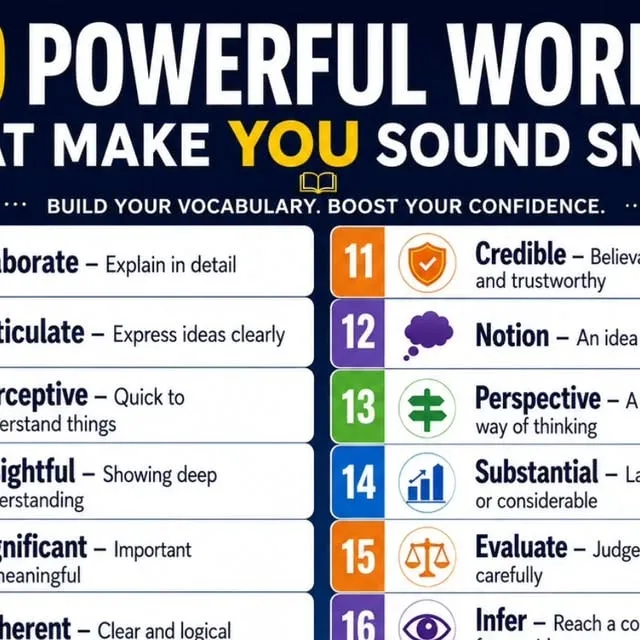
The words you choose in professional settings shape how people perceive your competence, authority, and credibility. A well-placed word can sharpen your message, demonstrate expertise, and distinguish you from peers who rely on generic language. But there is a fine line between sounding professional and sounding pretentious. The goal is precision, not performance.
This guide provides 50+ power words organized by professional category, with context for each, along with guidance on words to avoid, industry-specific vocabulary, and practical strategies for expanding your vocabulary naturally.
The Difference Between Professional and Pretentious
Before building your vocabulary, understand this critical distinction.
Professional vocabulary adds precision and clarity. It communicates your meaning more accurately than a simpler alternative would.
Pretentious vocabulary adds complexity without adding meaning. It obscures your message behind unnecessarily elevated language.
| Pretentious | Professional | Plain |
|---|---|---|
| We must ideate a paradigm-shifting solution. | We need to develop an innovative solution. | We need to come up with a new approach. |
| The deliverable failed to actualize stakeholder expectations. | The project did not meet stakeholder expectations. | The project fell short of what people expected. |
| We must synergistically leverage our core competencies. | We should combine our strengths effectively. | We should work together using what we do best. |
The professional column strikes the right balance. It is more precise than the plain column without the absurdity of the pretentious column.
The test: If your word choice makes the reader pause to decode your meaning, and a simpler word would have communicated the same idea, you have crossed from professional into pretentious.
Leadership and Management Words
These words convey authority, decision-making ability, and strategic thinking.
Words for Taking Action
| Word | Definition | Example |
|---|---|---|
| Spearhead | To lead or initiate an effort | "She spearheaded the company's expansion into Asian markets." |
| Champion | To actively support and advocate for | "He championed the diversity initiative from its earliest stages." |
| Orchestrate | To coordinate multiple elements into a unified effort | "The COO orchestrated a seamless transition during the acquisition." |
| Galvanize | To motivate and energize a group toward action | "The new CEO galvanized the workforce around a shared vision." |
| Delegate | To assign responsibility strategically | "Effective leaders delegate tasks based on individual strengths." |
| Empower | To give authority and confidence to others | "The program empowers mid-level managers to make budget decisions independently." |
Words for Decision-Making
| Word | Definition | Example |
|---|---|---|
| Discern | To recognize or judge with insight | "She was able to discern the underlying issue that others had missed." |
| Prioritize | To rank items by importance and urgency | "We need to prioritize the initiatives that deliver the highest ROI." |
| Adjudicate | To make a formal judgment or decision | "The committee will adjudicate the competing proposals next week." |
| Mandate | To officially require or authorize | "The board mandated quarterly compliance reviews." |
| Ratify | To formally approve or confirm | "The shareholders ratified the proposed merger." |
Words for Influence
| Word | Definition | Example |
|---|---|---|
| Cultivate | To develop deliberately over time | "She cultivated strong relationships with key stakeholders." |
| Leverage | To use strategically for maximum advantage | "We can leverage our brand reputation to enter new markets." |
| Align | To bring into agreement or cooperation | "The workshop aligned all departments around the company's new strategic direction." |
| Foster | To encourage and promote development | "The mentorship program fosters professional growth at every level." |
Analysis and Critical Thinking Words
These words demonstrate intellectual rigor and analytical capability.
Words for Examining Information
| Word | Definition | Example |
|---|---|---|
| Assess | To evaluate the nature, quality, or significance of | "We need to assess the financial impact before proceeding." |
| Scrutinize | To examine closely and critically | "The auditors scrutinized every transaction from the past fiscal year." |
| Evaluate | To judge the value, quality, or effectiveness of | "The committee will evaluate each candidate against five criteria." |
| Dissect | To analyze in minute detail | "Let us dissect the customer feedback to identify root causes." |
| Benchmark | To compare against a standard | "We benchmark our performance against industry leaders quarterly." |
| Quantify | To express as a measurable amount | "Can we quantify the impact of the new training program on productivity?" |
Words for Drawing Conclusions
| Word | Definition | Example |
|---|---|---|
| Deduce | To reach a conclusion through logical reasoning | "From the data, we can deduce that customer retention is our primary growth driver." |
| Infer | To conclude from evidence and reasoning | "We can infer from the trend data that demand will increase in Q4." |
| Substantiate | To provide evidence to support a claim | "The pilot results substantiate our hypothesis about user behavior." |
| Corroborate | To confirm or support with additional evidence | "The survey findings corroborate what we observed in the focus groups." |
| Extrapolate | To extend known data to project future trends | "If we extrapolate from current growth rates, revenue will double by 2028." |
Words for Problem-Solving
| Word | Definition | Example |
|---|---|---|
| Diagnose | To identify the root cause of a problem | "Before proposing solutions, we need to accurately diagnose the issue." |
| Mitigate | To reduce the severity or impact of | "We implemented safeguards to mitigate the risk of data breaches." |
| Rectify | To correct or put right | "The engineering team moved quickly to rectify the production error." |
| Reconcile | To make compatible or consistent | "We need to reconcile the discrepancies between the two reports." |
| Streamline | To make more efficient by removing unnecessary steps | "The new software streamlines the approval process from five steps to two." |
Communication and Collaboration Words
These words demonstrate interpersonal skill and the ability to work effectively with others.
Words for Sharing Information
| Word | Definition | Example |
|---|---|---|
| Articulate | To express clearly and effectively | "She articulated the company's vision in a way that resonated with every department." |
| Convey | To communicate a message or feeling | "The report should convey both the challenges and the opportunities ahead." |
| Elucidate | To make something clear by explanation | "Could you elucidate the methodology behind these projections?" |
| Distill | To extract the essential meaning from complex information | "He has the ability to distill complicated data into actionable insights." |
| Disseminate | To spread information widely | "We need to disseminate the updated guidelines to all regional offices." |
Words for Working Together
| Word | Definition | Example |
|---|---|---|
| Collaborate | To work jointly toward a shared goal | "The design and engineering teams collaborated to create a more user-friendly interface." |
| Facilitate | To make a process easier or more achievable | "The project manager facilitated productive discussions between the competing stakeholders." |
| Mediate | To intervene to resolve a dispute | "HR mediated the disagreement between the two department heads." |
| Coordinate | To organize people and activities to work together efficiently | "She coordinates logistics across three time zones for every product launch." |
| Synthesize | To combine different elements into a coherent whole | "The analyst synthesized data from six sources into a comprehensive market report." |
Words for Persuasion
| Word | Definition | Example |
|---|---|---|
| Advocate | To publicly support or recommend | "I strongly advocate for investing in employee development programs." |
| Compel | To bring about through force of argument | "The evidence compels us to reconsider our current pricing strategy." |
| Validate | To confirm the soundness or correctness of | "The market research validates our decision to expand into healthcare." |
| Reinforce | To strengthen an argument or position | "These quarterly results reinforce the effectiveness of our new strategy." |
Strategy and Innovation Words
These words signal forward-thinking and strategic capability.
Words for Planning
| Word | Definition | Example |
|---|---|---|
| Formulate | To create or devise methodically | "The team formulated a three-year growth strategy." |
| Devise | To plan or invent through careful thought | "We need to devise a contingency plan for supply chain disruptions." |
| Calibrate | To adjust precisely for optimal performance | "We calibrated our marketing spend based on channel performance data." |
| Allocate | To distribute resources for a particular purpose | "The budget committee allocated additional funding to research and development." |
| Forecast | To predict future trends based on analysis | "Our models forecast a 15% increase in demand over the next two quarters." |
Words for Change and Innovation
| Word | Definition | Example |
|---|---|---|
| Transform | To change fundamentally in form, nature, or function | "Automation has transformed the way our warehouse operations function." |
| Optimize | To make as effective or functional as possible | "We optimized the onboarding process, reducing time-to-productivity by 40%." |
| Iterate | To repeat a process with refinements | "We iterated on the prototype based on user testing feedback." |
| Pivot | To fundamentally change direction or approach | "The company pivoted from hardware to software-as-a-service in 2019." |
| Scale | To increase in size or capacity proportionally | "The infrastructure allows us to scale operations without proportional cost increases." |
| Disrupt | To radically change an established industry or process | "Streaming services disrupted the traditional television broadcasting model." |
Words for Results
| Word | Definition | Example |
|---|---|---|
| Accelerate | To increase the speed of progress | "The partnership accelerated our product development timeline by six months." |
| Amplify | To increase the magnitude or effect of | "Social media amplified the reach of our campaign beyond initial projections." |
| Consolidate | To combine for greater strength or efficiency | "We consolidated three regional offices into one central hub." |
| Maximize | To make as large or great as possible | "The new pricing model maximizes revenue per customer." |
| Sustain | To maintain at a consistent level over time | "The challenge is to sustain this growth rate through the next fiscal year." |
Words to Avoid: The Pretension Trap
These words and phrases are technically correct but are frequently misused or overused to the point where they signal pretension rather than professionalism.
Unnecessarily Elevated Vocabulary
| Avoid | Use Instead | Why |
|---|---|---|
| Utilize | Use | "Utilize" adds nothing that "use" does not already convey. |
| Endeavor | Try, Work toward | Overly formal for most business contexts. |
| Aforementioned | Previous, Earlier | Sounds like legal jargon outside of legal documents. |
| Heretofore | Until now, Previously | Archaic and unnecessarily complex. |
| Paradigm | Model, Framework, Approach | Overused to the point of meaninglessness. |
| Synergy | Collaboration, Combined effect | The most mocked word in corporate vocabulary. |
| Granular | Detailed | Often used to sound technical when "detailed" works fine. |
| Incentivize | Motivate, Encourage | Unnecessarily converts a noun into a verb. |
| Impactful | Effective, Significant | Considered jargon by many style guides. |
| Bandwidth (for human capacity) | Time, Capacity | Metaphor borrowed from technology that feels dehumanizing. |
Context Matters
Some words are perfectly appropriate in specific contexts but pretentious in others.
| Word | Appropriate Context | Pretentious Context |
|---|---|---|
| Juxtapose | Academic analysis, art criticism | Casual business emails |
| Dichotomy | Philosophical or analytical discussion | Describing a simple choice between two options |
| Ubiquitous | Technology or cultural commentary | Describing something that is simply common |
| Ephemeral | Discussing temporary trends or phenomena | Describing a short meeting |
| Cognitive | Psychology, neuroscience, UX research | General business discussion about thinking |
Industry-Specific Vocabulary
Finance and Accounting
| Word | Definition | Usage |
|---|---|---|
| Amortize | To spread a cost over a period of time | "We will amortize the development costs over five years." |
| Depreciate | To decrease in value over time | "The equipment depreciates at 20% per year." |
| Accrue | To accumulate over time | "Interest accrues monthly on the outstanding balance." |
| Divest | To sell off assets or a business division | "The company divested its retail division to focus on wholesale." |
| Hedge | To reduce risk through offsetting positions | "We hedge currency exposure through forward contracts." |
| Solvent | Able to pay debts as they come due | "The restructuring plan ensures the company remains solvent." |
Technology
| Word | Definition | Usage |
|---|---|---|
| Deploy | To release software or systems into production | "We will deploy the update to all users on Friday." |
| Integrate | To combine systems or components to work together | "The platform integrates with all major CRM tools." |
| Deprecate | To phase out a feature or system | "We are deprecating the legacy API by end of quarter." |
| Provision | To set up and configure resources | "The cloud infrastructure is provisioned automatically based on demand." |
| Architect (verb) | To design the structure of a system | "She architected the microservices framework from scratch." |
Marketing
| Word | Definition | Usage |
|---|---|---|
| Segment | To divide a market into distinct groups | "We segment our audience by industry, company size, and buying behavior." |
| Position | To establish a brand's identity relative to competitors | "The rebrand positions us as the premium option in the market." |
| Attribute | To identify which marketing effort caused a result | "We attribute 60% of conversions to organic search traffic." |
| Saturate | To fill a market to the point of diminishing returns | "The domestic market is nearly saturated, which drives our international expansion." |
| Curate | To select and organize content or products thoughtfully | "Our editorial team curates industry news for the weekly newsletter." |
Legal
| Word | Definition | Usage |
|---|---|---|
| Stipulate | To specify a required condition | "The contract stipulates a 90-day termination notice period." |
| Indemnify | To protect against legal liability | "The agreement indemnifies both parties against third-party claims." |
| Arbitrate | To settle a dispute through a neutral third party | "The contract requires that disputes be arbitrated rather than litigated." |
| Precedent | A previous decision used as a guide for future cases | "The ruling sets a precedent for similar disputes in the industry." |
| Supersede | To take the place of something that came before | "This agreement supersedes all prior written and oral agreements." |
Power Word Combinations
Individual words become more powerful when combined thoughtfully. Here are professional phrasing patterns that demonstrate sophistication.
For Reports and Proposals
| Instead Of | Use |
|---|---|
| We looked at the numbers. | We conducted a thorough analysis of the financial data. |
| This will probably work. | The evidence strongly supports this approach. |
| We should do this soon. | We recommend implementing this initiative within the current quarter. |
| The results were good. | The results exceeded our established benchmarks. |
| There is a problem. | We have identified a significant discrepancy that warrants attention. |
For Performance Reviews
| Instead Of | Use |
|---|---|
| She does good work. | She consistently delivers high-quality work that exceeds expectations. |
| He needs to communicate better. | He would benefit from strengthening his stakeholder communication skills. |
| The team worked hard. | The team demonstrated exceptional dedication throughout the project lifecycle. |
| She leads well. | She demonstrates strong leadership acumen and inspires confidence across the organization. |
For Presentations
| Instead Of | Use |
|---|---|
| This is important. | This represents a pivotal opportunity for the organization. |
| Let me explain. | Allow me to provide some context. |
| We have a lot of data. | We have compiled comprehensive data across multiple dimensions. |
| This changes things. | This fundamentally alters our competitive landscape. |
How to Naturally Expand Your Professional Vocabulary
Vocabulary that sticks is acquired in context rather than memorised from lists, which is why word-a-day apps rarely change how anyone writes. The strategies below work because each puts new words in front of you the way you will eventually use them, with enough repetition that recall becomes automatic rather than effortful.
Strategy 1: Read Widely and Intentionally
The single most effective way to build vocabulary is extensive reading of high-quality professional content. Subscribe to publications relevant to your industry and read outside your field for cross-pollination.
Recommended reading habits:
- Read one long-form business article per day from publications like Harvard Business Review, The Economist, or the Financial Times
- Read quarterly or annual reports from companies you admire (these are written by skilled communicators)
- Read books by respected thinkers in your field
- Read well-written opinion pieces and editorials
When you encounter an unfamiliar word, note it along with the sentence it appeared in. Context is more valuable than dictionary definitions for building usable vocabulary.
Strategy 2: Practice the Two-Word-Per-Week Rule
Choose two new words per week and commit to using them in your writing and speech. But follow these rules:
- Understand the nuance, not just the definition. "Mitigate" and "reduce" both involve making something smaller, but "mitigate" specifically refers to reducing severity or harm.
- Use each word in at least three different contexts before considering it part of your active vocabulary.
- Listen for the word in professional settings to confirm you are using it correctly.
- Stop using the word if it feels forced. Not every word suits every person's communication style.
Strategy 3: Study Word Roots
Many professional English words derive from Latin and Greek roots. Learning common roots gives you the ability to decode unfamiliar words.
| Root | Meaning | Words |
|---|---|---|
| dict | say, speak | predict, contradict, dictate, verdict |
| duc/duct | lead | deduce, conduct, produce, reduce |
| spec/spect | look, see | inspect, prospect, perspective, spectrum |
| cred | believe | credible, credential, accredit, incredulous |
| vert/vers | turn | convert, diversify, revert, versatile |
| pos/pon | place, put | propose, component, deposit, disposition |
| mit/mis | send | submit, transmit, commission, remit |
| scrib/script | write | prescribe, transcript, describe, subscription |
| gen | produce, origin | generate, generic, indigenous, genesis |
| port | carry | import, report, transport, portfolio |
Strategy 4: Build a Personal Vocabulary Journal
Create a digital or physical journal organized by professional category. For each word, record:
- The word itself
- Its precise definition
- The sentence or context where you first encountered it
- Two to three example sentences you have written
- Notes on nuance (how it differs from similar words)
Review your journal weekly. Test yourself not on definitions but on usage: can you write a natural-sounding sentence using this word?
Strategy 5: Listen to Expert Communicators
Watch TED talks, listen to business podcasts, and attend industry presentations. Pay attention not just to what speakers say but to how they say it. Notice which words create impact and which fall flat. The most effective speakers use sophisticated vocabulary sparingly and strategically, like spice in cooking. A little adds flavor. Too much overwhelms the dish.
Strategy 6: Use the Replacement Method
When writing, draft your first version using your natural vocabulary. Then review it with fresh eyes and ask: is there a more precise word for what I mean? Replace generic words with specific ones, but only when the replacement genuinely adds clarity.
Draft: "The project had a good impact on team morale."
Revised: "The project had a measurable positive impact on team morale."
Further revised: "The project demonstrably improved team morale."
Each revision is more precise. "Demonstrably improved" communicates not just that morale got better but that the improvement is provable.
Common Vocabulary Mistakes
Mistake 1: Using Big Words When Small Words Work Better
"We should utilize this opportunity to optimize our operational efficiency."
This sentence sounds inflated. "We should use this chance to improve how we work" communicates the same idea more clearly.
Rule: Use the simplest word that accurately conveys your meaning. Elevate your vocabulary only when the elevated word is genuinely more precise.
Mistake 2: Using Words Without Understanding Their Nuance
"The report begs the question of whether our strategy is effective."
Most people use "begs the question" to mean "raises the question." In logic, "begging the question" refers to a circular argument. Using the phrase incorrectly in front of someone who knows the difference undermines your credibility.
Common misused words:
| Word | Common Misuse | Actual Meaning |
|---|---|---|
| Literally | Used for emphasis ("I literally died") | Actually, in a non-figurative sense |
| Ironic | Used to mean coincidental or unfortunate | A contradiction between expectation and reality |
| Comprise | "The team is comprised of five members" | "The team comprises five members" (the whole comprises the parts) |
| Peruse | Used to mean skim or glance | To read carefully and thoroughly |
| Enormity | Used to mean enormousness | Extreme wickedness or moral outrage |
| Moot | Used to mean irrelevant | Debatable, open to discussion (US usage has shifted) |
Mistake 3: Vocabulary Mismatch with Audience
Using technical financial vocabulary in a presentation to the marketing team, or academic language in a sales email, creates a communication barrier. Match your vocabulary to your audience's expertise and expectations.
Mistake 4: Overloading a Single Sentence
"The team's synergistic collaboration culminated in the formulation of a transformative, innovative strategic framework that fundamentally disrupted the existing paradigm."
This sentence tries too hard. One or two elevated words per sentence is sufficient. More than that and you lose the reader.
Better: "The team's collaboration produced a strategy that fundamentally changed our approach to the market."
Vocabulary for Specific Professional Scenarios
Performance Reviews and Self-Assessments
When writing or contributing to performance reviews, word choice matters enormously. The right vocabulary can frame accomplishments compellingly and describe growth areas constructively.
Words for describing achievements:
| Word | Usage | Example |
|---|---|---|
| Exceeded | Surpassing a target or expectation | "Exceeded quarterly revenue targets by 22%." |
| Pioneered | Being the first to do or introduce something | "Pioneered the company's first automated testing framework." |
| Instrumental | Playing a crucial role | "Was instrumental in securing the partnership with Meridian Corp." |
| Catalyzed | Causing something important to happen | "Catalyzed a culture shift toward data-driven decision-making." |
| Elevated | Raising the standard or quality | "Elevated the quality of client deliverables through rigorous review processes." |
Words for growth areas (constructive framing):
| Instead Of | Use |
|---|---|
| Needs to improve at public speaking | Would benefit from additional presentation experience |
| Bad at time management | Has opportunity to strengthen prioritization skills |
| Disorganized | Would benefit from implementing more structured workflows |
| Does not take feedback well | Is developing receptivity to constructive feedback |
| Struggles with teamwork | Is building collaborative skills across cross-functional teams |
Job Interviews
Interviews reward precise, confident vocabulary that demonstrates competence without arrogance.
Powerful interview phrases:
- "I spearheaded the initiative that resulted in..."
- "My approach was to first assess the situation, then formulate a targeted strategy."
- "I collaborated with cross-functional teams to deliver..."
- "The most significant challenge I navigated was..."
- "I identified an opportunity to streamline the process, which reduced costs by..."
- "I take a systematic approach to problem-solving, starting with root cause analysis."
Words to avoid in interviews:
| Avoid | Why | Use Instead |
|---|---|---|
| Basically | Sounds uncertain and diminishing | (Remove it entirely) |
| Honestly | Implies you are not normally honest | (Remove it entirely) |
| Kind of / Sort of | Weakens your statements | (State your point directly) |
| Stuff / Things | Vague and unprofessional | Specific nouns (tasks, deliverables, projects) |
| Amazing / Awesome | Overused and lacks specificity | Effective, impactful, rewarding, significant |
Written Proposals and Pitches
Proposals require vocabulary that conveys competence, value, and confidence.
| Weak | Strong |
|---|---|
| We will try to deliver on time. | We are committed to delivering on schedule. |
| Our team is pretty experienced. | Our team brings over 50 years of combined expertise. |
| We think this will work. | Our track record demonstrates the effectiveness of this approach. |
| This is a good deal. | This represents exceptional value relative to market alternatives. |
| We have done this before. | We have successfully executed comparable engagements for organizations including [names]. |
Building Vocabulary Through Prefixes and Suffixes
Understanding common prefixes and suffixes allows you to decode and construct professional vocabulary on the fly.
Professional Prefixes
| Prefix | Meaning | Professional Words |
|---|---|---|
| re- | again, back | restructure, reallocate, reassess, reimagine, reposition |
| pre- | before | prerequisite, preemptive, precedent, preliminary, proactive |
| mis- | wrongly | misallocate, miscalculate, miscommunicate, misrepresent |
| over- | excessive | overestimate, overextend, overlook, overhaul, oversee |
| under- | insufficient | underperform, underestimate, underutilize, underrepresent |
| inter- | between | interdepartmental, interoperable, interconnect, interdisciplinary |
| trans- | across | transform, transcend, transition, transparent, transactional |
| counter- | against | counterproductive, counterargument, counteroffer, counterbalance |
Professional Suffixes
| Suffix | Creates | Examples |
|---|---|---|
| -ize | Verb (to make) | prioritize, optimize, standardize, customize, monetize |
| -ment | Noun (result of action) | assessment, deployment, alignment, development, engagement |
| -tion/-sion | Noun (act or state) | implementation, allocation, acquisition, diversification |
| -able/-ible | Adjective (capable of) | scalable, measurable, sustainable, actionable, feasible |
| -ive | Adjective (having quality) | productive, innovative, competitive, proactive, collaborative |
| -ity | Noun (quality) | accountability, profitability, visibility, scalability, feasibility |
Understanding these patterns means you can often figure out the meaning of unfamiliar professional vocabulary by breaking it into its components. "Interdepartmental" breaks down to "inter" (between) + "department" + "al" (relating to) - meaning "relating to the interaction between departments."
Vocabulary Traps: Words People Think They Know
Some words are so commonly misused that the incorrect meaning has nearly overtaken the correct one. Using these words precisely signals genuine linguistic sophistication.
| Word | Common (Incorrect) Usage | Correct Usage |
|---|---|---|
| Decimate | To destroy completely | To reduce by one-tenth (historically); to cause great destruction (modern accepted) |
| Disinterested | Not interested, bored | Impartial, unbiased ("A judge should be disinterested." Not interested = uninterested) |
| Fulsome | Full, abundant, generous | Excessively flattering, insincere ("Fulsome praise" is not a compliment) |
| Fortuitous | Fortunate, lucky | Happening by chance ("A fortuitous meeting" is accidental, not necessarily lucky) |
| Nonplussed | Calm, unfazed | Bewildered, at a loss (the exact opposite of how many people use it) |
| Penultimate | The very last, the ultimate | Second to last ("The penultimate chapter" is the one before the final chapter) |
| Refute | To deny or dispute | To prove wrong with evidence (stronger than just disagreeing) |
| Bemused | Amused, entertained | Confused, bewildered (not a synonym for amused) |
Knowing the precise meaning of these words and using them correctly is far more impressive than using a big word imprecisely. When you use "disinterested" to mean "impartial," those who know the distinction will notice and respect your precision.
Quick Reference: Power Words by Situation
In Emails
| Situation | Power Words |
|---|---|
| Making a request | appreciate, grateful, accommodate |
| Sharing results | exceeded, surpassed, demonstrated |
| Acknowledging work | commend, recognize, exemplary |
| Addressing problems | rectify, resolve, mitigate |
| Proposing changes | recommend, suggest, propose |
In Meetings
| Situation | Power Words |
|---|---|
| Presenting data | substantiate, corroborate, validate |
| Offering ideas | propose, recommend, advocate |
| Disagreeing | reconsider, reassess, alternative |
| Building consensus | align, converge, unify |
| Summarizing | distill, synthesize, encapsulate |
In Resumes and Reviews
| Situation | Power Words |
|---|---|
| Describing achievements | spearheaded, orchestrated, transformed |
| Showing impact | accelerated, amplified, maximized |
| Demonstrating skills | proficient, adept, accomplished |
| Indicating growth | progressed, advanced, evolved |
| Highlighting leadership | mentored, championed, empowered |
Summary
Professional vocabulary is a tool, not a trophy. The goal is never to impress people with the size of your word bank. The goal is to communicate your ideas with precision, clarity, and confidence. Every word you add to your professional vocabulary should earn its place by conveying meaning more accurately than the alternative.
Start with the words most relevant to your role and industry. Practice them in context, not isolation. Listen for how skilled communicators in your field use language, and adapt their techniques to your own voice. Be patient with the process. Vocabulary growth is gradual, and rushing it leads to the pretension trap.
The professionals who earn the most respect through their communication are those who can explain complex ideas simply, who choose precise words over impressive ones, and who understand that clarity is the highest form of intelligence in professional writing.
Writers who want to extend their vocabulary into a specific professional domain will find a focused follow-on in the guide to business English phrases, which covers the fixed expressions, polite formulas, and industry idioms that appear in meetings, emails, and negotiations.
Frequently Asked Questions
What words make you sound more professional in the workplace?
Words that make you sound professional are precise, clear, and demonstrate expertise without pretension. Instead of ‘good,’ use ‘effective,’ ‘productive,’ or ‘beneficial’ depending on context. Replace ‘think’ with ‘anticipate,’ ‘assess,’ or ‘evaluate’ when describing analysis. Swap ‘help’ for ‘facilitate,’ ‘support,’ or ‘enable’ to convey a more active role.
Use ‘implement’ instead of ‘do,’ ‘allocate’ instead of ‘give out,’ and ‘consolidate’ instead of ‘put together.’
The distinction between professional and pretentious vocabulary lies in appropriateness. Using ‘utilize’ when ‘use’ works perfectly is pretentious. Using ‘mitigate’ instead of ‘reduce risk’ adds genuine precision. Always choose the word that most accurately conveys your meaning.
How can I naturally expand my professional vocabulary?
The most effective method is contextual learning through professional reading. Subscribe to industry publications, read reports from respected firms, and study well-written business communications you receive. When you encounter an unfamiliar word, note it along with the sentence it appeared in rather than just its dictionary definition, because context is what teaches you when the word is appropriate. Words learned in isolation tend to be used awkwardly.
When you encounter an unfamiliar word, note it along with its context rather than just its dictionary definition. Practice using two or three new words per week in your writing and speech, but only after you fully understand their nuances.
Listen to TED talks, business podcasts, and presentations by respected leaders in your field.
Join professional discussion groups where sophisticated language is used naturally. Keep a vocabulary journal organized by category such as analysis, leadership, and strategy. Review it weekly and test yourself on usage rather than definitions alone.
What is the difference between sounding professional and sounding pretentious?
Professional vocabulary adds precision and clarity to your communication, while pretentious vocabulary adds complexity without adding meaning. We need to strategize our approach to client retention is professional, because strategize implies deliberate planning beyond simply thinking about something. The test is whether your word choice helps the audience understand you better or forces them to decode your meaning. If a simpler word communicates the same idea equally well, use it.
Saying ‘We need to ideate a paradigm-shifting methodology for client retention optimization’ is pretentious because it buries a simple idea under unnecessary jargon.
The test is whether your word choice helps the audience understand you better or forces them to decode your meaning.
If a simpler word communicates the same idea equally well, use the simpler word. Professional speakers use elevated vocabulary selectively to add precision, not to showcase their education or create distance from their audience.