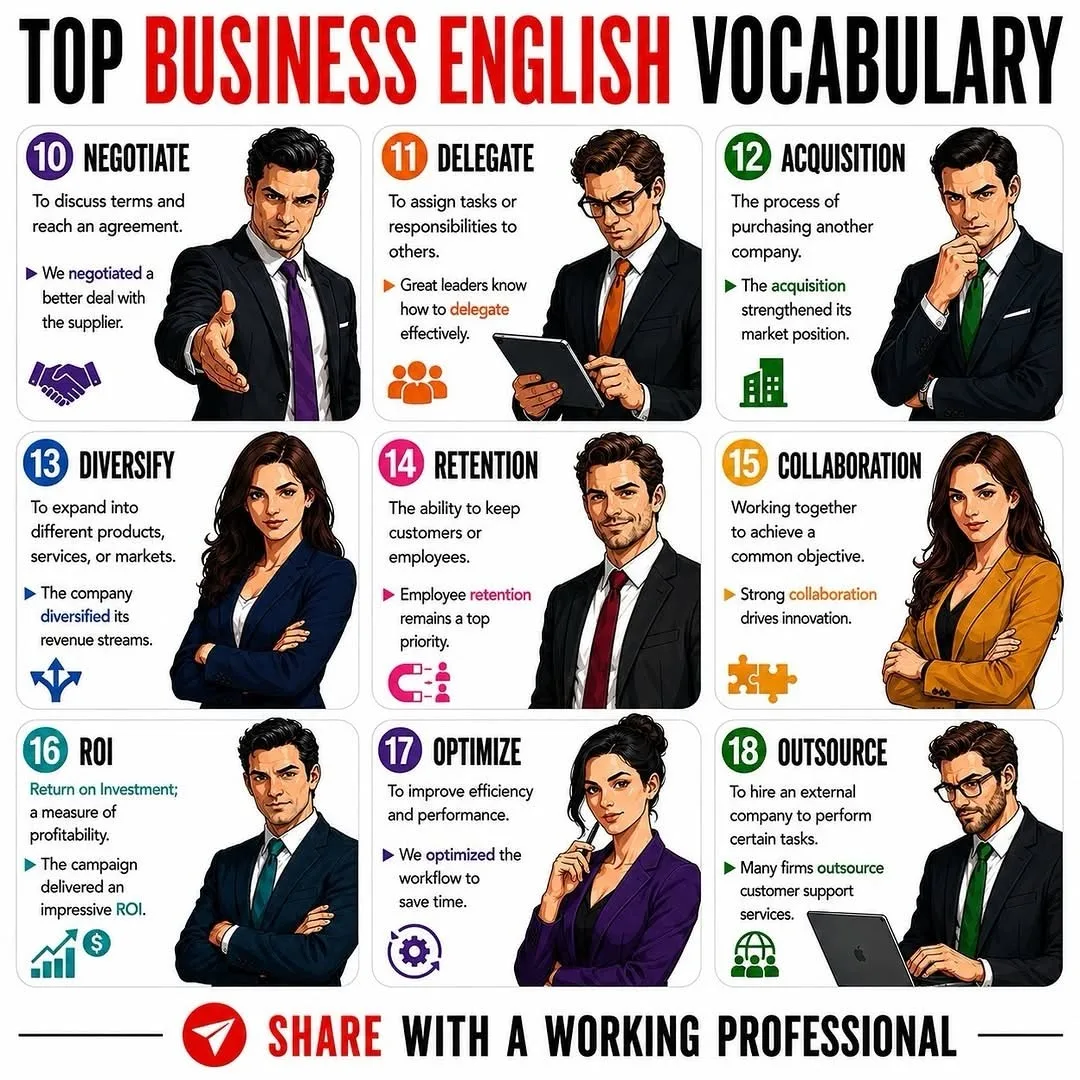
Knowing the right phrase at the right time is one of the most valuable professional skills you can develop. Whether you are writing an email, leading a meeting, delivering a presentation, or navigating a difficult negotiation, having a repertoire of polished business expressions allows you to communicate with confidence and precision.
This guide provides over 100 essential business English phrases organized by situation, with context for when and how to use each one. You will also find alternatives to overused corporate jargon and phrases that professionals find annoying, so you can sound polished without sounding like a cliche.
Email Opening Phrases
The way you open an email sets the tone for everything that follows. Choose your opening based on the relationship and context.
| Phrase |
When to Use |
| I am writing to inquire about... |
Requesting information from an unfamiliar contact |
| I am reaching out regarding... |
Introducing yourself in a professional context |
| I was referred to you by [Name]... |
Leveraging a mutual connection |
| I hope this message finds you well. |
Standard formal opening (use sparingly to avoid cliche) |
| Thank you for taking the time to speak with me on [date]. |
Following up after a conversation |
| Allow me to introduce myself. I am [Name], [Title] at [Company]. |
Cold outreach or networking |
Ongoing Professional Relationships
| Phrase |
When to Use |
| Thank you for your prompt response. |
Acknowledging a quick reply |
| I appreciate you sharing this information. |
Recognizing someone's effort |
| Following up on our conversation from [date]... |
Continuing a discussion thread |
| I wanted to touch base regarding... |
Checking in on a project or relationship |
| Hope you had a great weekend. |
Monday morning emails to familiar contacts |
| Thank you for your patience while we reviewed this. |
When your response was delayed |
Internal Team Communication
| Phrase |
When to Use |
| Quick update on [project name]... |
Brief status reports |
| Just a heads-up that... |
Alerting the team to something coming |
| Wanted to flag something for you... |
Drawing attention to a potential issue |
| Good news regarding [topic]... |
Sharing positive developments |
| A few things to cover... |
Emails with multiple points |
Making Requests
Requesting something via email requires balancing directness with courtesy. Too indirect and your request gets lost. Too blunt and you seem demanding.
Polite but Direct Requests
| Phrase |
Tone Level |
| Could you please provide... |
Standard professional |
| I would appreciate it if you could... |
Slightly more formal |
| Would you be able to send me... |
Conversational professional |
| Would it be possible to... |
More deferential, good for upward requests |
| I would be grateful if you could... |
Formal, strong courtesy signal |
| May I request that you... |
Very formal, legal or executive contexts |
Requests with Deadlines
| Phrase |
Context |
| Could you please send this by [date]? |
Clear, direct, and polite |
| I would need this by end of day [day]. |
Sets a firm expectation |
| If possible, I would appreciate receiving this by [date]. |
Flexible but with a target |
| This is time-sensitive, so I would appreciate a response by [date]. |
Emphasizes urgency without being aggressive |
| Would [date] be a realistic deadline for this? |
Collaborative, invites discussion |
Requests for Meetings
| Phrase |
Context |
| Would you be available for a brief call this week? |
Casual meeting request |
| I would like to schedule a meeting to discuss... |
Formal meeting request |
| Could we find 30 minutes this week to go over...? |
Specific time request |
| I would value your input on this matter. Could we meet briefly? |
Flattering and purposeful |
| Please let me know your availability for the week of [date]. |
Scheduling coordination |
Status Updates
| Phrase |
Context |
| I wanted to keep you informed about... |
Proactive update to stakeholders |
| Here is a brief update on our progress. |
Regular status report |
| I am pleased to report that... |
Sharing positive progress |
| We are on track to meet the [date] deadline. |
Confirming timeline adherence |
| We have encountered a delay due to... |
Honest communication about setbacks |
| The project is approximately [X]% complete. |
Quantified progress report |
| We anticipate completion by [date]. |
Forward-looking projection |
| Phrase |
Context |
| Please find attached... |
Standard (though some find it formal) |
| I have attached [document] for your review. |
Modern alternative |
| Attached is the [document] we discussed. |
Direct and clear |
| For your reference, I have included... |
When sharing supporting information |
| The relevant details are outlined below. |
When information is in the email body |
| I have compiled the requested information below. |
When responding to a data request |
Meeting Phrases
Opening a Meeting
| Phrase |
Context |
| Thank you all for joining today. |
Standard meeting opening |
| Let us get started. We have a full agenda today. |
Moving efficiently into the meeting |
| The purpose of today's meeting is to... |
Setting clear expectations |
| Before we begin, does anyone have anything to add to the agenda? |
Inclusive opening |
| Let me start by summarizing where we left off. |
Continuation meeting |
Facilitating Discussion
| Phrase |
Context |
| I would like to hear everyone's thoughts on this. |
Inviting participation |
| [Name], what is your perspective? |
Directing a question to a specific person |
| Does anyone have a different view? |
Encouraging diverse opinions |
| Let us explore that idea further. |
Showing interest in a contribution |
| That is an excellent point. Building on that... |
Acknowledging and extending an idea |
| Let us table that for now and come back to it. |
Parking an off-topic discussion |
| Can we stay focused on the agenda item? |
Redirecting politely |
| I want to make sure we hear from everyone. |
Encouraging quieter participants |
Presenting Ideas in Meetings
| Phrase |
Context |
| I would like to propose that... |
Formal suggestion |
| One approach we might consider is... |
Offering an option without pushing it |
| Based on the data, I recommend... |
Evidence-based recommendation |
| From my experience, what has worked well is... |
Drawing on expertise |
| The way I see it, our best option is... |
Confident but not aggressive |
| Here is what I suggest, and I am open to feedback. |
Collaborative framing |
Agreeing and Building
| Phrase |
Context |
| I completely agree with that assessment. |
Strong agreement |
| That aligns with what we have been seeing. |
Supporting with evidence |
| I think you are onto something there. |
Encouraging a developing idea |
| Exactly. And to add to that... |
Validating and extending |
| That is consistent with our findings. |
Data-backed agreement |
Disagreeing Professionally
| Phrase |
Context |
| I see your point, and I would like to offer another perspective. |
Respectful counter |
| I understand the reasoning, but I have some concerns. |
Measured disagreement |
| That is one way to look at it. Another angle might be... |
Reframing without confrontation |
| I appreciate the suggestion. My concern is that... |
Acknowledging before disagreeing |
| The data actually suggests a different conclusion. |
Evidence-based disagreement |
| I respectfully disagree. Here is why... |
Direct but professional |
| Playing devil's advocate for a moment... |
Framing disagreement as exploration |
| Have we considered the implications of...? |
Questioning through inquiry |
Closing a Meeting
| Phrase |
Context |
| To summarize the key takeaways... |
Wrapping up main points |
| Let me recap the action items. |
Ensuring accountability |
| Who is responsible for each next step? |
Assigning ownership |
| What is our deadline for these action items? |
Setting timelines |
| Does anyone have any final questions or concerns? |
Last chance for input |
| Thank you all for your time and input today. |
Standard professional closing |
| I will send a summary email after this meeting. |
Committing to follow-through |
Presentation Phrases
Opening Your Presentation
| Phrase |
Context |
| Good morning. Thank you for being here today. |
Standard opening |
| I am here today to talk about... |
Direct purpose statement |
| Over the next [time], I will walk you through... |
Setting expectations |
| By the end of this presentation, you will have a clear understanding of... |
Outcome-focused opening |
| Let me start with a question: [relevant question]? |
Engaging the audience immediately |
| The challenge we are facing is... |
Problem-first framing |
Transitioning Between Sections
| Phrase |
Context |
| Now, moving on to... |
Simple transition |
| This brings me to my next point... |
Logical connection |
| With that context in mind, let us look at... |
Building on previous section |
| Now that we have covered [topic], let us turn to... |
Clear section change |
| This leads us to an important question... |
Creating anticipation |
| Before we move on, are there any questions about this section? |
Interactive transition |
Handling Questions
| Phrase |
Context |
| That is a great question. |
Validating the questioner (use genuinely, not reflexively) |
| I am glad you raised that point. |
Showing appreciation for the question |
| Let me address that. |
Confident response opener |
| I do not have that figure in front of me, but I will follow up. |
Honest when you do not know |
| That is outside the scope of today's presentation, but I would be happy to discuss it afterward. |
Redirecting politely |
Closing Your Presentation
| Phrase |
Context |
| To summarize the key points... |
Standard summary opener |
| The bottom line is... |
Cutting to the essential message |
| I would like to leave you with this thought... |
Memorable closing |
| The next steps are... |
Action-oriented closing |
| Thank you for your time and attention. |
Professional closing |
| I welcome any questions or feedback. |
Inviting discussion |
Negotiation Phrases
Opening Positions
| Phrase |
Context |
| We would like to propose... |
Formal opening offer |
| Our initial position is... |
Stating where you start |
| Based on our analysis, we believe a fair arrangement would be... |
Evidence-based opening |
| We value this partnership and want to find a solution that works for both sides. |
Collaborative framing |
Exploring Options
| Phrase |
Context |
| What if we were to...? |
Exploring hypotheticals |
| Would you be open to considering...? |
Testing flexibility |
| Is there any flexibility on...? |
Direct inquiry about movement |
| What would make this work for your side? |
Understanding their priorities |
| Let us think creatively about how to bridge this gap. |
Encouraging problem-solving |
| What are your key priorities in this arrangement? |
Understanding underlying interests |
Making Concessions
| Phrase |
Context |
| We are prepared to adjust our position on [X] if... |
Conditional concession |
| In the spirit of reaching an agreement, we can offer... |
Showing good faith |
| We can be flexible on [X], provided that [Y]... |
Linked concession |
| That is something we could consider. |
Non-committal but positive |
Reaching Agreement
| Phrase |
Context |
| I believe we have found common ground. |
Signaling progress |
| It sounds like we are aligned on the key points. |
Confirming agreement |
| Let us document what we have agreed to so far. |
Formalizing progress |
| I am confident we can finalize the details. |
Positive momentum |
| Shall we proceed on this basis? |
Moving to commitment |
Giving and Receiving Feedback
Giving Positive Feedback
| Phrase |
Context |
| I wanted to recognize your excellent work on... |
Specific praise |
| The quality of your [deliverable] was outstanding. |
Acknowledging quality |
| Your contribution to [project] made a real difference. |
Connecting effort to impact |
| I have been impressed by your [specific skill/behavior]. |
Behavioral feedback |
| The client specifically mentioned how well you handled... |
Third-party validation |
Giving Constructive Feedback
| Phrase |
Context |
| I have some observations that might help strengthen... |
Framing feedback as helpful |
| One area where I see opportunity for growth is... |
Positive framing of improvement area |
| I noticed [specific behavior]. Going forward, it might be more effective to... |
Specific and actionable |
| Can I share some feedback that I think could help? |
Asking permission (builds receptivity) |
| The outcome was not quite what we needed. Let us talk about how to approach it differently. |
Collaborative problem-solving |
| I appreciate the effort you put into this. Here is how we can make it even stronger. |
Balancing praise with guidance |
Receiving Feedback Gracefully
| Phrase |
Context |
| Thank you for the feedback. I appreciate your honesty. |
Professional acceptance |
| That is a fair point. I will work on that. |
Acknowledging and committing |
| Could you give me a specific example so I can understand better? |
Seeking clarity |
| I value your perspective on this. |
Showing you take it seriously |
| I will take that on board and adjust my approach. |
Committing to action |
Email Closing Phrases
Action-Oriented Closings
| Phrase |
Context |
| Please let me know if you need any additional information. |
Offering support |
| I look forward to your response. |
Expecting a reply |
| I look forward to hearing your thoughts. |
When seeking feedback |
| Please confirm receipt at your earliest convenience. |
When confirmation matters |
| I will follow up on [date] if I have not heard back. |
Polite deadline setting |
Relationship-Building Closings
| Phrase |
Context |
| Thank you for your time and consideration. |
After a request or proposal |
| I appreciate your support on this matter. |
Acknowledging help |
| Thank you for your continued partnership. |
Long-term relationship |
| I value our working relationship and look forward to continued collaboration. |
Strengthening a partnership |
| Please do not hesitate to reach out if you have any questions. |
Keeping the door open |
| Formality |
Sign-Off |
| Very formal |
Respectfully, / Sincerely, |
| Formal |
Best regards, / Kind regards, |
| Semi-formal |
Best, / Many thanks, |
| Semi-informal |
Thanks, / Cheers, (UK/AU) |
| Informal |
Talk soon, / Thanks! |
Phrases to Avoid (Corporate Jargon That Annoys People)
These phrases have been used so frequently that they have lost their meaning and often irritate recipients. Here are the offenders and what to say instead.
Overused and Meaningless
| Avoid |
Say Instead |
| Let us synergize on this. |
Let us work together on this. |
| We need to leverage our core competencies. |
We should use our strengths. |
| Let us think outside the box. |
Let us consider unconventional approaches. |
| We need to move the needle. |
We need to make measurable progress. |
| Let us circle back on this. |
Let us revisit this on [specific date]. |
| We need to take a deep dive into this. |
We need to analyze this thoroughly. |
| It is what it is. |
(Say nothing. This adds zero value.) |
| At the end of the day... |
Ultimately... / In summary... |
| Low-hanging fruit. |
Quick wins. / Easy opportunities. |
| Boil the ocean. |
Try to do too much at once. |
| Open the kimono. |
Be transparent. / Share the details. |
| Drink the Kool-Aid. |
Buy into the idea. / Fully commit. |
Passive-Aggressive Email Phrases
| Avoid |
Say Instead |
| Per my last email... |
I wanted to follow up on my previous message about... |
| As previously stated... |
To reiterate... / As a reminder... |
| Going forward... (as a reprimand) |
From now on, let us... |
| I have copied [boss] for visibility. |
I have included [boss] so they are aware of the timeline. |
| Not sure if you saw my email... |
I wanted to make sure this did not get lost in your inbox. |
| Please advise. |
I would appreciate your guidance on this. |
| Friendly reminder... (when not friendly at all) |
Quick reminder... / Just following up on... |
| Correct me if I am wrong, but... |
My understanding is that... |
Overused Filler Phrases
| Avoid |
Say Instead |
| Just wanted to reach out to... |
(State your purpose directly.) |
| I just wanted to quickly... |
(Remove "just" and "quickly" and state it.) |
| Basically... |
(Remove it. Start with your point.) |
| To be honest... |
(Remove it. The implication that you are not normally honest is not great.) |
| With all due respect... |
(Remove it. What follows is never respectful.) |
| No offense, but... |
(Remove it. Rephrase your point diplomatically.) |
Industry-Specific Phrases
Finance and Banking
| Phrase |
Meaning |
| The numbers are tracking above forecast. |
Results are exceeding predictions. |
| We need to reconcile these figures. |
We need to match and verify these numbers. |
| What is the run rate on this project? |
What is the current spending pace? |
| We are looking at a favorable variance. |
Actual results are better than budgeted. |
| The ROI justifies the investment. |
The return makes the cost worthwhile. |
Technology and Software
| Phrase |
Meaning |
| We need to scope this feature. |
We need to define the requirements and boundaries. |
| The system is scalable. |
The system can handle growth. |
| We are in the testing phase. |
We are verifying the product works correctly. |
| Let us do a post-mortem on this incident. |
Let us analyze what went wrong and why. |
| We need to prioritize the backlog. |
We need to rank pending work by importance. |
Marketing and Sales
| Phrase |
Meaning |
| We need to increase our conversion rate. |
More prospects need to become customers. |
| What is our customer acquisition cost? |
How much do we spend to gain each new customer? |
| The campaign is generating strong engagement. |
People are interacting with our content. |
| We need to nurture these leads. |
We need to build relationships with potential customers over time. |
| The value proposition is clear. |
The benefit to the customer is obvious. |
Human Resources
| Phrase |
Meaning |
| We are looking for a strong cultural fit. |
The candidate's values should align with the organization's. |
| The role offers competitive compensation. |
The pay is in line with market rates. |
| We would like to discuss your career trajectory. |
We want to talk about your professional growth path. |
| This position reports to the VP of Operations. |
The VP of Operations is the direct supervisor. |
| We are committed to professional development. |
We invest in employee growth and training. |
Phrases for Difficult Situations
Delivering Bad News
| Phrase |
Context |
| I regret to inform you that... |
Formal bad news delivery |
| Unfortunately, we are unable to... |
Denying a request |
| After careful consideration, we have decided... |
Decision that will disappoint |
| I understand this is not the outcome you were hoping for. |
Acknowledging the impact |
| While we cannot accommodate [X], we can offer [Y]. |
Providing an alternative |
Apologizing Professionally
| Phrase |
Context |
| I sincerely apologize for the oversight. |
Taking responsibility |
| I take full responsibility for this error. |
Owning a mistake |
| Please accept my apologies for any inconvenience caused. |
Formal apology |
| We are taking steps to ensure this does not happen again. |
Demonstrating corrective action |
| Thank you for bringing this to our attention. |
Framing the complaint positively |
Managing Conflict
| Phrase |
Context |
| I think there may be a misunderstanding. Let me clarify. |
De-escalating |
| I want to make sure we are on the same page. |
Seeking alignment |
| Can we take a step back and look at the bigger picture? |
Broadening perspective |
| I understand your frustration, and I want to find a solution. |
Validating and redirecting |
| What would a successful outcome look like for you? |
Understanding the other party's needs |
Phrases for Written Reports and Documentation
Introducing Findings
| Phrase |
Context |
| The data reveals that... |
Presenting analytical findings |
| Our analysis indicates... |
Evidence-based conclusion |
| A key finding of this review is... |
Highlighting important results |
| The evidence suggests... |
Measured claim based on data |
| Upon closer examination, it becomes clear that... |
Building toward a conclusion |
| Several patterns emerged from the data. |
Introducing thematic findings |
Providing Recommendations
| Phrase |
Context |
| Based on these findings, we recommend... |
Standard recommendation format |
| We strongly advise... |
Urgent recommendation |
| It would be prudent to... |
Cautious recommendation |
| The most effective course of action would be... |
Confident recommendation |
| We propose implementing the following measures... |
Formal proposal language |
| To address this challenge, we suggest... |
Solution-oriented recommendation |
Describing Limitations
| Phrase |
Context |
| It is important to note that... |
Flagging a caveat |
| One limitation of this analysis is... |
Academic and report writing |
| These findings should be interpreted with caution due to... |
Tempering conclusions |
| While the results are promising, further investigation is needed. |
Calling for additional work |
| The scope of this review did not include... |
Defining boundaries |
Phrases for Customer and Client Communication
Building Rapport
| Phrase |
Context |
| We value your business and appreciate your loyalty. |
Long-term client relationship |
| Thank you for choosing [Company]. |
After a purchase or commitment |
| We are committed to your satisfaction. |
Customer service orientation |
| Your feedback is important to us. |
Encouraging customer input |
| We understand how important this is to you. |
Empathetic response |
Setting Expectations
| Phrase |
Context |
| You can expect to receive... by [date]. |
Clear timeline communication |
| Our standard turnaround time is... |
Managing expectations |
| We will keep you updated on the progress. |
Commitment to communication |
| Should you have any questions in the meantime, please do not hesitate to reach out. |
Keeping the door open |
| We anticipate this will be resolved within... |
Timeline for issue resolution |
Handling Complaints
| Phrase |
Context |
| I understand your frustration, and I want to help resolve this. |
Empathetic opening |
| Thank you for bringing this to our attention. |
Positive framing of a complaint |
| I apologize for the inconvenience this has caused. |
Taking responsibility |
| Here is what I can do to make this right. |
Solution-oriented response |
| We take this matter seriously and are looking into it. |
Acknowledging severity |
| I have escalated this to our [team/manager] for immediate attention. |
Showing urgency |
Transitional Phrases for Professional Writing
Smooth transitions between ideas mark the difference between choppy, amateur writing and polished, professional prose.
| Phrase |
Tone |
| Furthermore... |
Formal |
| In addition to this... |
Semi-formal |
| Moreover... |
Formal |
| It is also worth noting that... |
Semi-formal |
| On top of this... |
Informal |
| Another key consideration is... |
Semi-formal |
Contrasting Ideas
| Phrase |
Tone |
| However... |
Universal |
| On the other hand... |
Semi-formal |
| Conversely... |
Formal |
| Despite this... |
Semi-formal |
| That said... |
Semi-formal to informal |
| While this is true, it is equally important to consider... |
Formal |
Showing Cause and Effect
| Phrase |
Tone |
| As a result... |
Universal |
| Consequently... |
Formal |
| This has led to... |
Semi-formal |
| Therefore... |
Universal |
| For this reason... |
Semi-formal |
| This means that... |
Semi-formal to informal |
Summarizing
| Phrase |
Tone |
| In summary... |
Universal |
| To conclude... |
Formal |
| The key takeaway is... |
Semi-formal |
| All things considered... |
Semi-formal |
| In short... |
Semi-formal to informal |
| The bottom line is... |
Informal |
Phrases for Remote Work Communication
The rise of remote and hybrid work has created new communication needs. These phrases help navigate common remote work situations.
Video Call Etiquette
| Phrase |
Context |
| Can everyone hear me clearly? |
Starting a call |
| I think you are on mute. |
Politely notifying someone |
| Could you repeat that? The connection dropped for a moment. |
Technical difficulties |
| I will share my screen now. |
Before screen sharing |
| Does anyone have anything to add before we wrap up? |
Ending a video call |
| I will put that in the chat. |
Sharing links or details during a call |
Asynchronous Communication
| Phrase |
Context |
| No need to respond right away. |
Removing urgency from a message |
| When you get a chance, could you... |
Respectful of the recipient's schedule |
| I have documented this in [shared location] for reference. |
Pointing to async resources |
| I will leave a summary in the channel for anyone who could not attend. |
Inclusive communication |
| Just logging this here for visibility. |
Recording information for the team |
Building Your Phrase Repertoire
Strategy 1: Observe Effective Communicators
Pay attention to how respected leaders in your organization write and speak. Note the phrases they use and the situations in which they use them. You will notice that the best communicators rarely resort to jargon. They use clear, direct language that sounds natural and professional.
Strategy 2: Create a Personal Phrase Bank
Keep a document or note where you collect useful phrases you encounter. Organize them by situation (emails, meetings, presentations, difficult conversations). Review and practice them regularly until they become part of your natural vocabulary.
Strategy 3: Adapt, Do Not Memorize
These phrases are starting points, not scripts. Adapt them to your personal style and the specific context. A phrase that sounds natural for one person may sound forced for another. The goal is to have options, not to recite templates.
Strategy 4: Match Your Audience
The same message requires different phrasing for different audiences. "We need to pivot our strategy" might work with your marketing team but would be better phrased as "We need to adjust our approach" for a non-business audience. Always consider who is reading or listening.
Summary
Professional communication is not about using complicated language or impressive-sounding phrases. It is about choosing the right words for the right situation. The phrases in this guide give you a foundation for every common business scenario, from routine emails to high-stakes negotiations.
The most effective communicators combine polished phrases with authentic voice. They know when to be formal and when to be direct, when to soften their language and when to be assertive. As you incorporate these expressions into your daily communication, focus on clarity first and polish second. A clear, simple message always beats a convoluted one, regardless of how impressive the vocabulary.
Practice the phrases that feel most natural to you, retire the ones that sound forced, and always remember that the best business communication sounds like a real person talking to another real person, just with a bit more polish.
End a formal English email with a full-sentence closing line, a formal sign-off, and a complete signature block. Formal sign-offs ranked from most to least formal: 'Yours sincerely' (when you know the recipient's name), 'Yours faithfully' (when you do not, e.g., 'Dear Sir/Madam'), 'Sincerely,' 'Kind regards,' 'Best regards.' Avoid 'Cheers,' 'Thanks!,' 'Best,' and anything with an exclamation point in truly formal contexts.
The guide's business-English phrases apply here: complete sentences, no contractions in the final line, and correct punctuation. End with your full name, title, organization, and direct contact details - no nicknames, no casual abbreviations.
End an information-request email with a specific list of what you need, a preferred format, and a polite sign-off. Template: 'Could you send (1) the Q3 sales figures, (2) the updated customer list, and (3) the churn report, ideally as a single PDF, by Wednesday? Thank you.
Kind regards, [Name].' The business-English guide emphasizes numbered asks and clear formats as the hallmarks of a well-written request. Saying 'any details you can share' forces the other person to decide what matters - naming specific items respects their time. Thank in advance only when you have a warm relationship; for first contact, save the thanks for after the information arrives.
Frequently Asked Questions
What are the most useful business English phrases for emails?
The most versatile business email phrases cover openings, requests, and closings. For openings, ‘I hope this message finds you well’ and ‘Thank you for your prompt response’ set a professional tone. For requests, ‘I would appreciate it if you could’ and ‘Could you please provide’ are polite yet direct. For follow-ups, ‘I wanted to circle back on’ and ‘Just a gentle reminder regarding’ maintain courtesy.
For closings, ‘Please do not hesitate to reach out’ and ‘I look forward to hearing from you’ invite continued communication. The key is matching your phrase choice to the relationship and context. A first email to a potential client requires more formal phrasing than a routine update to a close colleague.
How do I politely disagree in a business meeting?
Polite disagreement in business requires acknowledging the other person’s point before presenting your alternative view. Phrases like ‘I see your point, and I would like to offer another perspective’ and ‘That is an interesting approach.
Have we considered…’ show respect while redirecting. ‘I understand where you are coming from, but the data suggests otherwise’ balances diplomacy with evidence.
For stronger disagreement, ‘I have some concerns about that approach’ signals a substantive objection without personal confrontation.
Avoid ‘I disagree’ as a standalone statement, ‘You are wrong,’ or ‘That will never work.’ The goal is to challenge ideas constructively while preserving working relationships and encouraging open dialogue among all participants.
What business English phrases should I avoid?
Avoid overused corporate jargon that obscures meaning and irritates colleagues. ‘Let us synergize our core competencies’ says nothing that ‘Let us combine our strengths’ does not say better. ‘We need to move the needle on this deliverable’ is vague and buzzword-heavy. Phrases like ‘let us take this offline,’ ‘low-hanging fruit,’ ‘circle back,’ and ‘deep dive’ have become so overused they feel empty.
Similarly, avoid passive-aggressive phrases like ‘per my last email,’ ‘as previously stated,’ and ‘going forward’ when used as a veiled reprimand. Empty intensifiers like ‘very unique’ (something is unique or not) and ‘literally’ used figuratively also undermine credibility. Choose plain, direct language that communicates your actual meaning.