Everyday words for official ones
Formal-sounding words slow readers down without adding meaning. Use the plain word unless a specialist term is genuinely needed.
utilise→use
commence→start
facilitate→help
prior to→before
in relation to→about
with effect from→from
endeavour→try
sufficient→enough
obtain→get
in the event of→if
it has been determined→we have decided
please be advised that→(cut it)
Five rules for plain sentences
1Point firstState the main message or request before the background. Please approve the budget by Friday. The details are below.
2One idea per sentenceSplit sentences that carry two or more ideas. The supplier was late. We have moved the launch to June.
3Say who actsName the person or team doing the action. The finance team will send invoices on the 1st.
4Use “you” and “we”Speak directly to the reader. You can book a room online. We will confirm within an hour.
5Show structureHeadings, short paragraphs and lists for anything over a few paragraphs. Use a numbered list when the order matters.
The three-pass edit
Editing everything at once means missing things. Read the draft three times, each time looking for one kind of problem, from the biggest to the smallest.
Pass 1 · Structure Is it in the right order?
Is the main point at the top?Does each section earn its place?Is anything missing?
Pass 2 · Lines Is every sentence clear?
One idea per sentence?Plain words, active verbs?Can it be shorter?
Pass 3 · Proof Is every detail right?
Names, numbers, dates, linksSpelling and punctuationRead aloud once
A memo, before and after
First draft · 68 words Further to recent discussions regarding the utilisation of meeting rooms, it has been determined that, with effect from 1 July, all staff will be required to make bookings via the new online system prior to use. This is in order to facilitate the more efficient allocation of space. Any queries in relation to this matter should be directed to the facilities team.
After three passes · 38 words From 1 July, please book meeting rooms online before you use them. This lets us share rooms more fairly. Book at rooms.example.com. Questions? Email the facilities team at facilities@example.com.
Point moved to the topThe action, booking online from 1 July, is now the first sentence and in bold.
Plain words“Utilisation”, “facilitate” and “prior to” became “use”, “share” and “before”.
Who acts is clear“It has been determined” hid the decision-maker; the new version speaks directly to the reader.
Details made usableThe booking link and email address replace “via the new online system”.
Write for one reader
Before you write, picture one real person who will read the text: their job, what they already know and what they need to do next. Writing for “everyone” produces text that suits no one.
| Question | Why it matters |
|---|---|
| What does the reader already know? | Tells you which terms to explain and which to skip. |
| What do they need to do after reading? | Becomes your first sentence. |
| How will they read it? | On a phone, in a meeting, printed? Decides length and layout. |
| What might they worry about? | Answer it before they have to ask. |
Make it easy to scan
Most people scan before they read. Help them find what they need in seconds.
Headings that say something“Rooms must be booked online from 1 July” beats “Room booking”.
One idea per paragraphStart each paragraph with its main point, so readers can stop after the first line.
Front-load links and labelsPut the key words at the start of headings and link text: “Booking form for meeting rooms”, not “Click here”.
Bold for the one thingBold a deadline or decision, not whole sentences.
The two-minute self-test
Run your draft against these before you send it. Tick each one it passes.
Guides on writing skills
3 guides · newest first
How to Write Clearly: The Fundamentals of Plain LanguageLearn the fundamentals of clear, plain-language writing: write for the reader, use short direct sentences, plain words, good structure, and ruthless editing.Jul 1, 2026 · 5 min read
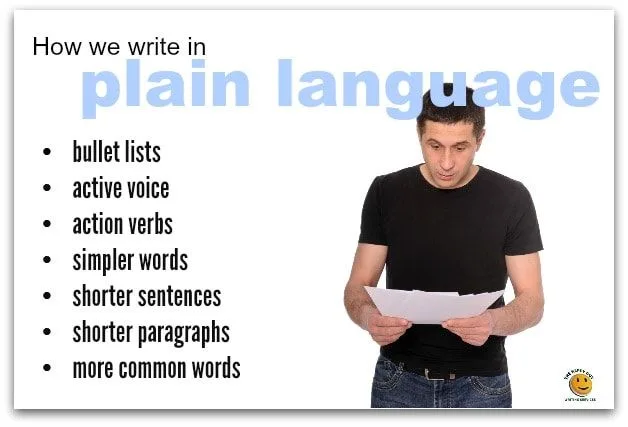
Plain Language Writing Techniques for ProfessionalsPlain-language techniques used by editors of memos, proposals, and disclosures. Substitution tables, layering, and a two-minute self-test.Apr 23, 2026 · 13 min read
How to Edit Your Own Writing (The Three-Pass Method)Separate structural, line, and proof edits the way working journalists do. Checks, timings, and a worked example that trims a memo in half.Apr 23, 2026 · 14 min read