
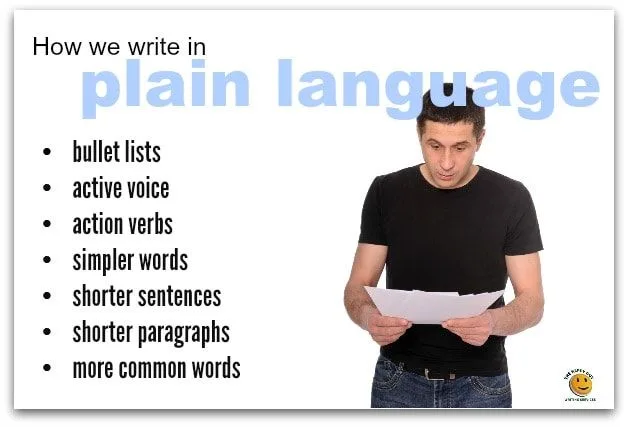
Plain language is not dumbing down. It is the hardest form of expert writing. Anyone can write a paragraph dense with jargon, hedges, and abstractions. Far fewer can convey the same ideas so clearly that a busy reader absorbs them on a single pass. The professionals who can do this reliably become the ones whose memos get circulated, whose proposals win, and whose recommendations move from drafts to decisions.
The case for plain language is not aesthetic. It is economic. The United States Plain Writing Act of 2010 was passed because poorly written government documents cost agencies millions of hours in clarification requests. Corporate internal audits routinely find that ambiguous language is the root cause of botched launches, miscommunicated strategy, and contract disputes. Clear writing is risk management dressed as style.
This article gathers the techniques that the best plain-language writers use, the tests they run on their own drafts, and the specific patterns to strip from your prose.
What Plain Language Actually Is
Plain language is writing that an intended reader can understand on the first reading and act on without further explanation. That is the definition from the U.S. federal plain language guidelines, and it is more rigorous than it looks.
Three things are worth pulling apart in it. First, the audience is specified. Plain language for a cardiologist is not plain language for a patient. Second, the standard is first-pass comprehension. If a sentence requires rereading to decode, it is not plain. Third, the purpose is action. A plain sentence enables the reader to do something.
"Plain language is not about shortening. It is about whether the next thing the reader does is the right thing. Everything else is literature." Ginny Redish, Letting Go of the Words
Writers who understand this definition stop trying to impress. They start trying to enable. That shift alone produces better first drafts.
Why Experts Write Badly
There is a specific pattern in how subject-matter experts write, and it is almost universal. Research on expert communication identifies it as the curse of knowledge. When you know a topic deeply, you cannot remember what it was like not to know it. You use jargon because it is efficient for you. You compress steps because you have automated them. You leave out context because it feels obvious.
To the reader who does not share your expertise, those compressions read as opacity. They cannot tell whether you are being profound or imprecise. They cannot tell whether the missing steps are assumed or were never thought through. The resulting distance between writer and reader is not a question of vocabulary. It is a question of empathy under deadline.
Plain-language writing is the discipline of reversing the curse of knowledge. It requires the writer to hold two mental models at once: the one that knows the material and the one that does not yet. The best plain writers work from the second model and edit back toward the first.
The Five Principles
Most plain-language guidelines converge on five principles. They are not ranked in order of importance because they are all equally non-negotiable.
One: Short sentences by default. The average sentence in expert writing runs 24 to 35 words. The average sentence in strong plain writing runs 14 to 18. Shorter sentences are easier to parse and harder to hide in.
Two: Concrete nouns over abstractions. "Employees" beats "personnel resources." "Price" beats "pricing architecture." Concrete nouns anchor the reader's mental picture.
Three: Active voice wherever possible. "The committee approved the budget" beats "The budget was approved by the committee." Passive voice is not wrong, but it is overused, and it obscures who did what.
Four: Verbs do the work. Strong verbs replace noun constructions. "We decided" beats "We made a decision." "She analyzed" beats "She conducted an analysis."
Five: Structure is content. Headings, short paragraphs, and bulleted lists are not presentation. They are how the reader navigates meaning. A wall of text signals that the writer did not do the sorting work.
These five principles will improve any draft. The harder work is the specific techniques that implement them on the page.
The Substitution Table Every Professional Should Memorize
One of the fastest ways to strengthen prose is to substitute direct words for the bloated constructions that creep into business writing.
| Bloated Phrase | Plain Substitute |
|---|---|
| In order to | To |
| Due to the fact that | Because |
| At this point in time | Now |
| In the event that | If |
| Prior to the commencement of | Before |
| With regard to | About |
| Pursuant to our conversation | As we discussed |
| Please be advised that | Please note, or delete entirely |
| It is important to note that | Delete, or use Note |
| In a timely manner | On time, or by [date] |
| Utilize | Use |
| Facilitate | Help, run, or lead |
| Leverage | Use |
| Operationalize | Put into practice |
| Bandwidth | Time, or capacity |
| Circle back | Follow up |
| Deep dive | Look closely |
| Going forward | From now on |
Running these substitutions across a draft shortens it by 10 to 20 percent without losing any content. Readers finish your message faster and remember more of it.
The Two-Minute Plain Language Test
After you write a draft, run it through a two-minute test before you send it. The test has four questions.
Can a reader state your main point after reading the first paragraph only? If not, your lead is buried.
Are any sentences longer than 25 words? If yes, break them.
Is any sentence still passive when active would work? Rewrite it.
Would a smart person outside your field understand every term? If not, define or replace it.
This test catches about 80 percent of the plain-language problems in most drafts. It takes less time than re-reading the draft once, and it produces a version you can send with confidence.
Structuring Long Documents for First-Pass Comprehension
Long documents compound every weakness in the underlying prose. A reader who missed the point at paragraph two has little chance of recovering it by paragraph forty. Structure is the load-bearing element of long-form plain writing.
Three structural moves help.
Move one: the front-loaded summary. The first 150 words state the conclusion, the three main reasons, and the decision or action required. Readers who stop there have enough to act. Readers who continue do so with the conclusion already framed.
Move two: the parallel subheadings. Every section heading uses the same grammatical pattern. If one heading reads "Assess the risk," the next reads "Identify the cost" and not "Costs are identified." Parallelism signals that the reader is in a predictable document.
Move three: the preview-then-deliver pattern. Each section opens with one sentence previewing what the section will argue, then delivers on that preview. A reader who skims the first sentence of each paragraph should come away with the whole spine of the document.
"If you take the first sentence from every paragraph and they do not tell the story on their own, you have not done your job. The reader will skim whether you like it or not." Roy Peter Clark, Writing Tools
Specific Sentence Patterns to Cut
Beyond word-level substitutions, certain sentence patterns drain clarity. Professional editors hunt these ruthlessly.
The hedging preamble. Sentences that open with "I think that" or "It could be argued that" tell the reader you are not committed. If you believe it, say it. If you do not, do not say it.
The stacked nominalization. Strings of abstract nouns like "The implementation of the optimization of the communication channels" hide the actor and the action. Rewrite as verbs: "We will make communication channels work better."
The throat-clearing opener. Sentences that begin "As you are aware" or "As previously mentioned" add no content. Delete them.
The empty qualifier. Words like "very," "somewhat," "quite," and "rather" dilute meaning. Either commit to a stronger word or remove the qualifier.
The double negative. "Not uncommon" should be "common." "Not without risk" should be "risky." Double negatives force the reader to do algebra in their head.
| Pattern | Example | Plain Version |
|---|---|---|
| Hedging preamble | I think that the budget may perhaps need review | The budget needs review |
| Stacked nominalization | There was a reduction in the level of customer satisfaction | Customer satisfaction dropped |
| Throat-clearing opener | As previously discussed, the deadline is Friday | The deadline is Friday |
| Empty qualifier | This is quite a significant risk | This is a significant risk |
| Double negative | The solution is not without merit | The solution has merit |
| Abstract agent | It has been determined that costs must be reduced | The leadership team decided to cut costs |
| False precision | Very carefully chosen language | Carefully chosen language |
Jargon: When to Keep It, When to Cut It
Plain language does not require eliminating all technical terms. It requires using them intentionally. The test is whether the reader you have in mind knows the term already. If yes, use it and save space. If no, either define it on first use or substitute a plain equivalent.
The failure mode in most business writing is jargon used to signal membership rather than convey meaning. A phrase like "synergies across the portfolio" communicates belonging to a management class more than it communicates an idea. Strip phrases that do identity work for phrases that do information work.
Three rules apply. Define technical terms the first time you use them if your audience is mixed. Avoid trendy jargon that will date your writing in six months. And never chain three jargon terms together in a single sentence, because the reader loses the thread even if they know each term individually.
Numbers, Tables, and Visual Load
Plain language extends to how you present numbers. A paragraph with five numbers in it is almost always harder to read than a table with the same five numbers.
Three rules help. Put numbers in tables when there are more than three in proximity. Round aggressively in prose, save precision for tables. And always include the unit, period, and context on the first occurrence of any number.
| Writing Move | Why It Works |
|---|---|
| Rounding in prose, precision in tables | Prose is for comprehension, tables are for reference |
| One number per sentence maximum | Multiple numbers in a sentence overwhelm working memory |
| Units and periods on first use | Prevents readers from scrolling back to check |
| Comparisons as percentages or ratios | Absolute numbers without context mean little |
| Change expressed as before and after | Deltas alone are hard to interpret |
"The reader does not have extra computational capacity for your sentences. Give them the math already done." Stephen Few, Show Me the Numbers
Translating Technical Content for Non-Technical Readers
Some of the hardest plain-language writing is translation. You are an expert writing for executives, regulators, customers, or cross-functional colleagues who need to understand enough to make a decision but not enough to implement the underlying technique.
The translation technique that works is layering. State the conclusion first in plain terms. Add one sentence of the mechanism in slightly more technical language. Add a detailed paragraph only if the reader needs it. Most readers stop at layer one, and that is the point.
Layer 1 (decision-maker summary): We can cut server costs by 40 percent next quarter by switching our file storage provider.

Layer 2 (mechanism in plain terms): The new provider charges for data retrieval rather than data storage, which matches our pattern of writing many files but rarely reading them.

Layer 3 (for the technical reviewer): We benchmarked egress, latency, and API compatibility against our existing workloads. Cold-tier storage rates at the new vendor are 18 percent lower and retrieval charges are negligible at our usage profile.
Layered writing respects the reader's time and the complexity of the subject simultaneously. It is the house style of the best internal communications functions in technology companies and regulated industries.
Editing for Rhythm and Readability
Plain language is not flat language. The best plain writers vary sentence length, mix short declarative sentences with occasional longer ones for rhythm, and read their drafts aloud to catch stumbles.
Three editing habits strengthen rhythm.
Read it aloud. Anywhere you stumble, the reader will too. Rewrite until the sentence flows through your mouth without hesitation.
Vary sentence length. A paragraph of all 10-word sentences reads choppily. A paragraph of all 25-word sentences reads heavily. The best paragraphs mix short, medium, and occasional longer sentences for texture.
Cut the last 10 percent. The final sentences of most paragraphs repeat what was already said. Professional editors call this the closing drift. Cut it and the paragraph lands harder.
Plain Language in Different Professional Contexts
Different professional contexts have different tolerances for style, but the underlying principles hold.
Legal writing. Modern legal drafting has moved sharply toward plain language. Insurance policies, privacy notices, and consumer contracts are now routinely tested for plain-language compliance. Writers in legal roles should follow the Plain Writing Association's guidance and audit their own standard language annually.
Scientific and medical writing. Abstracts should follow plain-language summary conventions increasingly required by journals. For patient-facing material, readability scores at the eighth-grade level or below are standard.
Financial writing. The SEC's Plain English Handbook remains the authoritative guide for disclosures. Its core rules translate directly to investor letters, board decks, and analyst memos.
Internal corporate writing. Memos, strategy documents, and operational updates benefit most from plain-language discipline because they are read fastest and remembered longest when clear.
The certification study frameworks at Pass4 Sure include professional writing modules for technical credentials, which reinforce many of these patterns. The cognitive research collected at What's Your IQ covers the working-memory limits that make plain language effective, and the document conversion workflows at File Converter Free help when you need to deliver plain-language drafts in the formats different audiences expect.
Running a Plain Language Audit on Your Own Writing
Writers who want to improve measurably should audit their own work quarterly. The audit does not require software, though tools can help.
Pick three pieces you wrote in the last 90 days that mattered. A memo, a proposal, an email to leadership. Read each one aloud with a timer running. Mark every sentence you stumbled on. Count the words in your longest sentence. Count the passive constructions in the first three paragraphs. Identify the jargon that was not defined.
Then rewrite one paragraph from each piece using the techniques in this article. Compare the before and after. The gap between them is your margin for improvement, and it will be uncomfortably large. It is also how every professional who writes well got there.
"Vigorous writing is concise. A sentence should contain no unnecessary words, a paragraph no unnecessary sentences, for the same reason that a drawing should have no unnecessary lines and a machine no unnecessary parts." William Strunk Jr., The Elements of Style
The compounding benefit of plain language is real. Colleagues read your messages first. Clients refer other clients because they understood what you were asking. Executives invite you to write the memos that matter. None of this is visible in any single document. All of it is visible across a career.
For related guidance, see our articles on the three-pass method for editing your own writing and clear communication under pressure.
References
Redish, J. (2012). Letting Go of the Words: Writing Web Content that Works (2nd ed.). Morgan Kaufmann. Redish (2012)
Strunk, W. Jr., White, E. B. (1999). The Elements of Style (4th ed.). Longman. Strunk et al. (1999): The Elements of Style (4th ed.)
Pinker, S. (2014). The Sense of Style: The Thinking Person's Guide to Writing in the 21st Century. Viking. https://stevenpinker.com/publications/sense-style
United States Government. Federal Plain Language Guidelines. United States Government
Securities and Exchange Commission. A Plain English Handbook. Securities and Exchange Commission
Schriver, K. A. (2017). Plain language in the US gains momentum: 1940-2015. IEEE Transactions on Professional Communication, 60(4), 343-383. Schriver (2017): Plain language in the US gains momentum: 1940-2015
Clark, R. P. (2008). Writing Tools: 55 Essential Strategies for Every Writer. Little, Brown. Clark (2008): Writing Tools: 55 Essential Strategies for Every Writer
Kimble, J. (2012). Writing for Dollars, Writing to Please: The Case for Plain Language in Business, Government, and Law. Carolina Academic Press. Kimble (2012)
Frequently Asked Questions
Is plain language the same as simple language?
No. Plain language is writing your specific intended reader can understand on a first reading and act on without help. That can still include technical terms if the audience knows them. Simple language implies stripping complexity regardless of audience, which is a different and narrower goal.
How short should my sentences actually be?
The average sentence in strong plain writing runs 14 to 18 words, though you should vary sentence length for rhythm. Any single sentence over 25 words is worth a second look. Longer sentences are not automatically wrong, but they usually hide structural problems that shorter versions would expose.
When should I keep jargon in a professional document?
Keep jargon when your reader already knows the term and substituting a plain equivalent would add words without adding clarity. Cut it when it signals membership rather than conveying meaning. Never stack three jargon terms in the same sentence, because the reader loses the thread even if they know each term.
Does plain language work for legal and regulatory writing?
Yes, and regulators increasingly require it. The SEC Plain English Handbook, the U.S. Plain Writing Act of 2010, and similar standards in other jurisdictions have moved legal and disclosure writing toward plain language. Modern insurance policies, privacy notices, and consumer contracts are routinely tested for plain-language compliance.
How do I handle technical content for a non-technical reader?
Layer your writing. State the conclusion in plain terms first, add one sentence of mechanism in slightly more technical language, and add detailed paragraphs only for readers who need them. Most readers stop at the first layer, and that is the point. Layering respects the reader’s time and the complexity of the subject simultaneously.
Can I run a plain-language audit on my own writing?
Yes. Pick three recent pieces that mattered, read each aloud with a timer, mark every sentence you stumbled on, and count long sentences and passive constructions in the first few paragraphs. Rewrite one paragraph from each piece using plain-language techniques, then compare. The gap is your margin for improvement.
What is the single highest-leverage plain-language habit?
Reading the draft aloud before sending. Anywhere you stumble, the reader will stumble too. Most overlong sentences, buried subjects, and jargon stacks expose themselves immediately when the text passes through your voice. It takes three minutes and catches most of the problems that a silent re-read misses.