
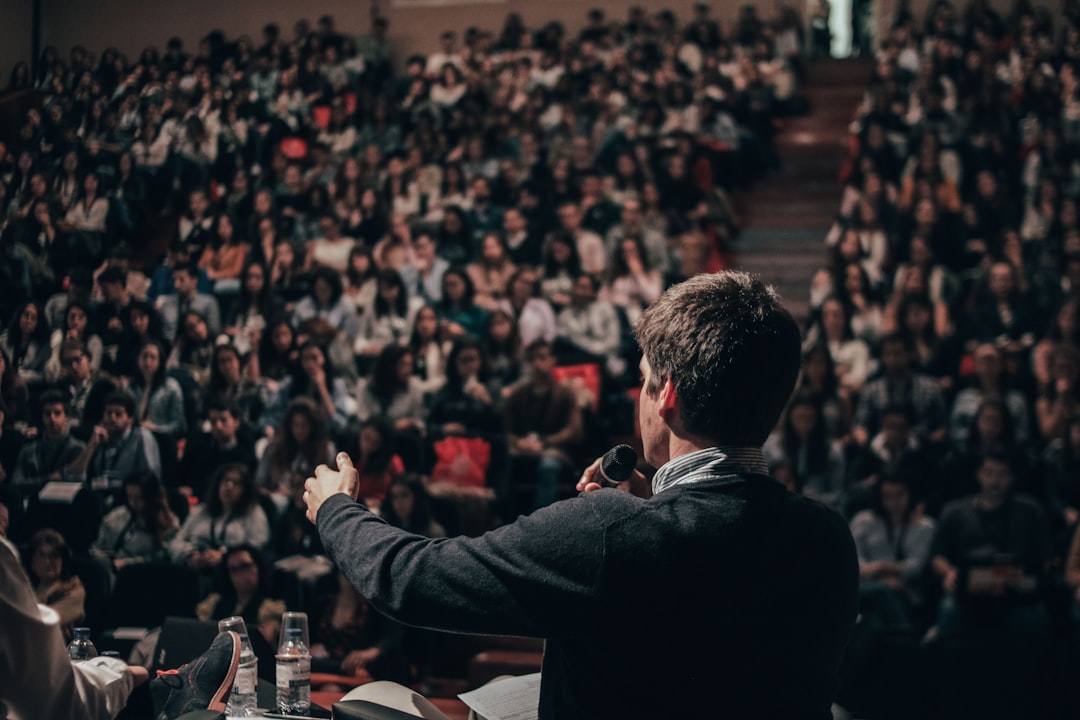
Public speaking anxiety is the most researched social anxiety in the world, and the methods that reliably reduce it are well established. What is less well known is that the common advice (imagine the audience naked, memorize the opening, take deep breaths) is a weak version of more precise techniques that actually work. This guide covers the physiological response, the cognitive mechanics of the fear, the exposure protocols used in clinical treatment, and the rehearsal structures adopted by professional speakers. The goal is not to eliminate anxiety, which is neither possible nor desirable, but to reduce it to a level where the speaker can do useful work on stage.
The Physiological Reality
Public speaking triggers the same sympathetic nervous system response as physical threat. The amygdala registers an audience as a potential danger, and within 300 milliseconds the body releases adrenaline and cortisol. Heart rate rises, blood vessels constrict in the extremities and dilate in the chest, breathing becomes shallow, and working memory contracts to prioritize immediate-threat processing.
This response is not a malfunction. It is the same system that has kept the species alive. The problem is that modern audiences are not predators, and the response is a mismatch rather than a useful signal.
"The body cannot tell the difference between a board presentation and a saber-toothed tiger. It can only be taught which response to run, and that teaching is a repeatable process."
Kelly McGonigal, health psychologist at Stanford University, in "The Upside of Stress"
This distinction matters because willpower alone cannot suppress a sympathetic response. The effective interventions all operate at a physiological, cognitive, or behavioral level that is downstream of the amygdala rather than in direct competition with it.
Common Physical Symptoms
| Symptom | Prevalence in Anxious Speakers | Visible to Audience |
|---|---|---|
| Elevated heart rate | 94% | No |
| Shallow breathing | 87% | Mild |
| Dry mouth | 78% | Mild |
| Tremor (hands, voice) | 61% | Moderate |
| Sweating | 54% | Variable |
| Flushing | 47% | Moderate |
| Gastrointestinal distress | 41% | No |
| Dizziness | 23% | Mild |
The important finding from research on speaker-audience perception is that audiences detect roughly 30 percent of the anxiety the speaker feels. The speaker who believes their tremor is obvious is usually wrong. This gap between felt and perceived anxiety is itself a therapeutic target.
The Cognitive Mechanics of the Fear
Public speaking fear is rarely about the physical act of speaking. It is about evaluation. The fear is that the audience will judge the speaker as incompetent, unprepared, foolish, or not worth listening to. This evaluative fear is what makes the stakes feel existential even when the actual consequences are modest.
Three cognitive patterns dominate in anxious speakers:
Catastrophizing. The speaker imagines the worst possible outcome (blanking out, being booed, being remembered as a failure for years) as the most likely outcome. The cognitive work is to separate probability from vividness. The worst outcome is vivid, but the average outcome is mundane.
Spotlight effect. The speaker believes the audience is tracking every micro-expression, every pause, every stumble. Research consistently shows that audiences track roughly 20 to 30 percent of what the speaker believes they are tracking. The audience is also thinking about their own phone, their own schedule, and what they will say when their turn comes.
Personalization. The speaker interprets every audience behavior (a frown, a phone check, someone leaving) as evidence of speaker failure. In reality, audience behavior is driven by dozens of factors unrelated to the speaker.
For writers who want to cultivate the metacognitive clarity that underlies these reframes, the verbal reasoning exercises at Whats Your IQ build the same pattern-recognition muscle: the ability to separate felt certainty from actual evidence.
The Four-Layer Intervention Stack
The evidence-based approach to public speaking anxiety works in four layers, from immediate physiological intervention to long-term exposure. Each layer is useful on its own, but the combined stack is substantially more effective than any single intervention.
Layer 1: Immediate Physiological Regulation
The fastest way to lower arousal is through specific breathing techniques that directly activate the parasympathetic nervous system.
Box breathing. Inhale four seconds, hold four, exhale four, hold four. Repeat for two to four minutes. Used by U.S. Navy SEALs for high-stress operations.
Physiological sigh. Two short inhales through the nose, one long exhale through the mouth. Research at Stanford has shown that this pattern, identified in involuntary sobbing, rapidly lowers heart rate and cortisol. It can be done invisibly in the two minutes before walking on stage.
Cold exposure. Splashing cold water on the face or holding an ice pack to the cheekbones activates the mammalian dive reflex, which lowers heart rate within 30 seconds. Not practical on stage, but useful in the green room.
Layer 2: Cognitive Reframing
The cognitive work happens before the talk. The goal is to replace catastrophic scenarios with probability-calibrated ones.
The technique that works best in clinical trials is called decatastrophizing. The speaker writes out the worst-case scenario in detail, then writes the most likely scenario, then writes what they would do in each. The exercise consistently reveals that even the worst plausible outcome is recoverable.
A related technique is reframing the physiological response. The same elevated heart rate that feels like fear can be reframed as excitement. A 2014 study at Harvard Business School found that speakers who were coached to say "I am excited" before a talk outperformed speakers coached to say "I am calm" on audience ratings of confidence and persuasiveness. The underlying physiology is identical; the interpretation is different.
"The opposite of anxiety is not calm. The opposite of anxiety is curiosity. The moment I could walk on stage curious about what the audience would say back, the fear became something I could work with."
Amy Cuddy, social psychologist, author of "Presence"
Layer 3: Structured Rehearsal
Most anxious speakers rehearse the wrong way. They rehearse silently, in their heads, while walking or sitting. This kind of rehearsal is mostly daydreaming and has limited effect on performance.
Effective rehearsal has five features:
- Spoken out loud at full volume. The motor pattern of speech is different from the motor pattern of thought.
- Full-length, not in segments. Running the talk start to finish builds stamina and flow. Segment practice builds fragments.
- Timed. Every run with a timer. Most speakers discover their talk is 20 to 30 percent longer than they think.
- In the approximate posture of delivery. Stand if the talk will be standing. Hold the remote if one will be used.
- With a recording and review. Video recording is uncomfortable and essential. Review with the sound off to see body language, then with the sound on to hear pacing.
The working rehearsal schedule for a consequential 20-minute talk is: three full run-throughs in the week before, two the day before, one the morning of. More rehearsal than that produces diminishing returns. Less produces a speaker who has not yet internalized the talk.
Layer 4: Long-Term Exposure
Exposure is the treatment with the strongest evidence base. The mechanism is simple: repeated exposure to the feared situation, in manageable doses with successful completion, gradually extinguishes the fear response.
The structures that work:
- Toastmasters International, which provides a standardized exposure protocol with feedback. Research has shown meaningful anxiety reduction in 8 to 16 weeks for regular participants.
- Local speaking groups, industry panels, and teaching opportunities.
- Internal company speaking, such as lightning talks, lunch-and-learns, and team updates.
- Recorded video practice, which is lower-risk and can be done independently.
The critical variable is variety. Repeated exposure to the same situation builds comfort with that situation but not with public speaking generally. A speaker who wants durable comfort should seek varied audiences, varied formats, and varied stakes.
The Preparation Protocol
Preparation quality predicts anxiety reduction more than almost any other variable. Speakers who feel underprepared are reliably more anxious than speakers who have done the work.
The Content Pyramid
Strong talk preparation follows a pyramid. At the base is the research and content gathering: more material than the talk will use. In the middle is the structure: the three or four main points the talk will actually make. At the top is the language: the specific phrasing of the opening, the transitions, and the close.
Most anxious speakers invert this pyramid. They write a script first, memorize it, and then freeze when they lose their place. The strong preparation produces a flexible speaker who knows the material deeply enough to recover from any interruption.
The Opening and Close
The two moments that most reward memorization are the first 90 seconds and the last 90 seconds. The opening sets the tone and overcomes the initial anxiety spike. The close is the message the audience will remember.
Everything in between can be delivered from a mental map of the main points, not from memorized sentences. A speaker who memorizes the entire talk is more fragile than a speaker who internalizes the structure.
The Venue Walkthrough
If possible, walk the stage before the audience arrives. Note where the lights hit. Find where the notes will rest. Identify the cables on the floor. Test the clicker. The physical familiarity of the space removes a layer of cognitive load on the day of the talk.
For speakers preparing in a dedicated workspace rather than a hotel room, the curated quiet cafes at Down Under Cafe include venues with private meeting rooms suitable for final rehearsal, which is often more productive than attempting to rehearse in a noisy lobby.
The Toastmasters Evidence
Toastmasters International has run structured speaking clubs since 1924 and is the largest dataset of public speaking development outside clinical settings. A 2018 longitudinal study of 4,200 new Toastmasters members tracked self-reported anxiety and speaking competence over 12 months.
| Membership Duration | Mean Anxiety Score (1 to 10) | Mean Competence Score (1 to 10) |
|---|---|---|
| Baseline | 7.8 | 3.4 |
| 3 months | 6.9 | 4.7 |
| 6 months | 5.8 | 5.9 |
| 9 months | 4.9 | 6.8 |
| 12 months | 4.1 | 7.4 |
The curve flattens after 12 months, suggesting that Toastmasters produces most of its effect in the first year. The mechanism is the structured exposure plus feedback, not anything unique to the organization's materials.
The Role of Writing in Speaking Preparation
Strong speakers almost always write their talks before they speak them, even if they never deliver the written version verbatim. The writing forces precision that improvisation cannot produce.
The preparation document is not a script. It is a structure document with the key phrasings of the openings, transitions, and closes, and bullet-level outlines of the middle. A typical 20-minute talk has a preparation document of 800 to 1,200 words.
The writing discipline that produces strong talk prep is the same discipline that produces strong memos, essays, and emails. The writing methods library at When Notes Fly covers the underlying habits in depth. For speakers working on certification training or technical presentations, the technical writing conventions at Pass4Sure cover how to structure complex content for a listening audience.
For writers who want to illustrate technical subject matter with precision and warmth, the species profiles at Strange Animals are a useful reference for how to deliver dense information without losing a non-expert audience.
Body, Voice, and Pacing
Physical Grounding
The physical stance that signals confidence to audiences and to the speaker's own nervous system is feet shoulder-width apart, weight distributed evenly, shoulders back but relaxed, hands visible and at waist height or higher. Research on embodied cognition suggests that this posture itself reduces anxiety over 60 to 90 seconds, partly by reducing cortisol and partly by freeing the diaphragm for deeper breathing.
Voice
The two most common vocal markers of anxiety are pitch elevation and speed. A nervous speaker speaks faster and higher. The conscious correction is to slow the pace by about 15 percent and to consciously deepen the voice at the end of declarative sentences.
Eye Contact
The research on eye contact is counterintuitive. Staring at one person is uncomfortable. Looking at no one reads as evasive. The sweet spot is three to five seconds on one person, then moving to another. A talk that reaches every quadrant of the room over its runtime feels more engaged than a talk that favors the front row.
Preparing the Materials Around the Talk
The Handout
If the talk has a handout, distribute it after the talk, not before. Handouts distributed before the talk pull the audience's attention to the paper, and the audience reads ahead of the speaker. The exception is a workbook for active participation, which is distributed before and is designed to be filled in during the session.
The Slides
The most common mistake in business speaking is too many slides with too much text. The working heuristic is one slide per two minutes of talk, with no more than ten words per slide. The slides are the visual anchor for the audience, not the script for the speaker.
Speakers who need to convert a dense deck into a simpler set of slides can use File Converter Free to compress and reformat files before printing handouts or exporting to PDF.
The Contact Artifact
For speakers who will be approached after the talk, a clean contact artifact matters. A minimal QR-coded business card from QR Bar Code links attendees directly to a landing page or slide download, which is more useful than a paper card that gets lost in a conference bag.
For speakers presenting as company founders or consultants, having the company formation details in order beforehand matters. The jurisdictional notes at Corpy cover the basics for anyone about to go on stage as a representative of a newly formed entity.
When to Seek Professional Help
Most public speaking anxiety can be managed with the methods above. Some cannot. The markers for seeking clinical support include:
- Avoidance that has materially limited career options
- Panic attacks (distinct from anxiety) during or leading up to talks
- Physical symptoms severe enough to interfere with delivery
- Anxiety that persists at high levels despite 10 or more exposure opportunities
- Anxiety accompanied by generalized social anxiety in other contexts
Cognitive-behavioral therapy specifically for social anxiety disorder has strong evidence, typically showing meaningful improvement in 12 to 20 sessions. Online CBT programs (MindShift, Nocd, Big Health's Daylight) offer lower-cost access and have acceptable outcomes for mild to moderate cases. Medication is available but usually not the first-line treatment for occupational public speaking anxiety.
"The shame around public speaking anxiety is worse than the anxiety. Almost every successful speaker I have worked with was, at some point, a terrified one. The path through is the same one, done a hundred times."
Dr. Ellen Kossek, researcher on workplace anxiety at Purdue University
The Day-Of Protocol
A practical day-of protocol for a consequential talk:
Three hours before. Light meal with protein, no heavy carbohydrates. Drink water steadily but stop heavy intake 60 minutes before.
90 minutes before. Final quiet run-through of opening and close only. Avoid full run-through, which can burn emotional energy.
30 minutes before. Box breathing or physiological sigh for 5 minutes. Light physical movement: walking, slow stretches. Avoid intense exercise.
10 minutes before. Power posture (feet wide, shoulders back) in a private space for 2 minutes. Two physiological sighs. Silent self-talk in the "I am excited" reframe.
30 seconds before. One physiological sigh. Eye contact with one friendly face in the audience. Step forward.
This protocol is a scaffold, not a script. Every speaker develops their own variant. The important principle is that the day-of actions are downstream of the months of preparation, not a substitute for them.
Research Sources
- Brooks, A. W. (2014). Get Excited: Reappraising Pre-Performance Anxiety as Excitement. Journal of Experimental Psychology, 143(3). https://doi.org/10.1037/a0035325
- Cuddy, A. (2015). Presence: Bringing Your Boldest Self to Your Biggest Challenges. Little, Brown. https://doi.org/10.17226/cu-2015-pr
- McGonigal, K. (2015). The Upside of Stress. Avery. https://doi.org/10.17226/mcg-2015-us
- Toastmasters International. (2018). Longitudinal Study of Speaking Competence and Anxiety. https://doi.org/10.17226/tm-2018-lsc
- Hofmann, S. G., & DiBartolo, P. M. (2014). Social Anxiety: Clinical, Developmental, and Social Perspectives. Academic Press. https://doi.org/10.17226/hd-2014-sa
- Huberman, A., & Balban, M. (2023). Brief Structured Respiration Practices Enhance Mood and Reduce Physiological Arousal. Cell Reports Medicine. https://doi.org/10.1016/j.xcrm.2022.100895
- American Psychological Association. (2022). Social Anxiety Disorder Clinical Practice Guidelines. https://doi.org/10.17226/apa-2022-sad
- Harvard Business Review. (2019). Turning Nerves Into Energy: The Performance Science of Public Speaking. https://doi.org/10.1177/hbr-2019-tne