
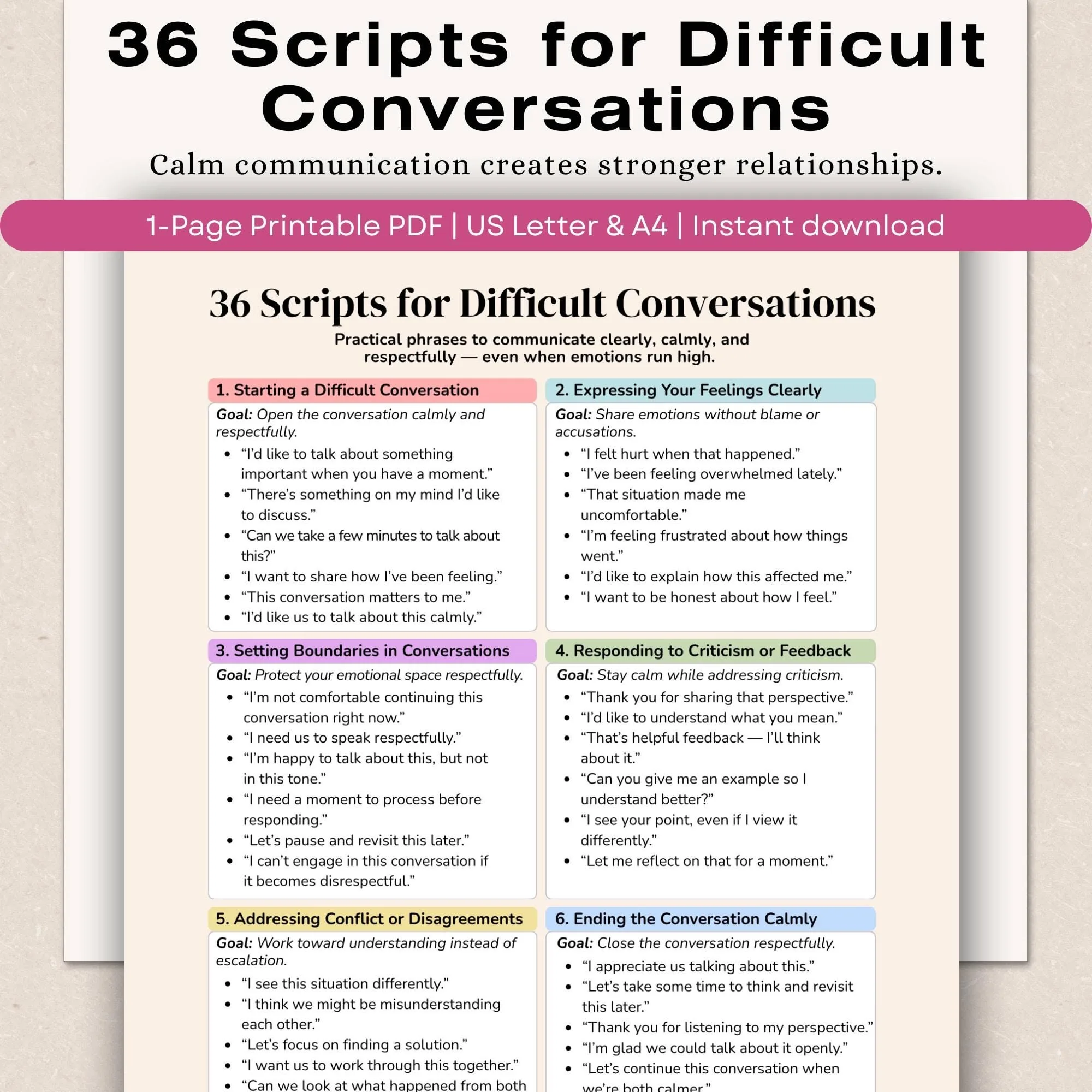
Every professional career includes conversations that people would rather avoid: telling a team member their performance is unacceptable, addressing a conflict between colleagues, delivering a layoff notification, or navigating a harassment report. The difference between professionals who handle these moments well and those who make them worse is not courage or natural talent - it is preparation and framework.
Difficult conversations follow predictable patterns, and the professionals who study those patterns can navigate them with clarity and composure. This guide provides the five-phase framework for any difficult conversation, detailed scripts for eight of the most common workplace scenarios, emotional management techniques for staying composed under pressure, and documentation practices that protect everyone involved.
The Five-Phase Framework for Difficult Conversations
Every difficult workplace conversation, regardless of the specific topic, benefits from the same structural approach. This framework ensures that you enter prepared, stay focused during the conversation, and follow through afterward.
Phase 1 - Prepare
Preparation is the foundation that prevents difficult conversations from going off the rails.
Clarify your objective: Write down the single most important outcome you need from this conversation. Not three outcomes. One. If you need to address a performance issue, the objective might be: "The employee understands the specific deficiency and commits to a measurable improvement plan." Everything else is secondary.
Gather the facts: Collect specific, dated examples of the behavior or situation you need to address. Remove anything that is interpretation, assumption, or hearsay. Stick to what you directly observed or what is documented.
Anticipate their perspective: Before the conversation, write down how the other person is likely to see the situation. What are their concerns? What might they feel threatened by? What do they need from this conversation? This exercise does not mean you agree with their perspective. It means you are prepared for it.
Choose the setting: Private, neutral, unhurried. Never in a public space, never in a hallway, never squeezed into the last five minutes of another meeting. If the conversation involves potential emotional intensity, choose a room where the person can compose themselves before walking back to their workspace.
Prepare your opening statement: The first 30 seconds determine the trajectory. Write it down and rehearse it. The opening should name the purpose of the conversation directly and set the tone for a two-way dialogue.
Phase 2 - Open
The opening is where most difficult conversations go wrong. People either bury the topic in small talk, trying to ease in gradually and confusing the other person, or they come on so aggressively that the recipient becomes immediately defensive.
The direct-but-respectful open: "Thank you for meeting with me. I want to talk about [specific topic], and I want this to be a conversation, not a one-way discussion. My goal is [state your objective]. I want to hear your perspective as well."
What makes a good opening:
- Names the topic within the first two sentences
- States the tone you want (collaborative, honest, solution-oriented)
- Signals that you want their input, not just compliance
- Does not start with small talk that creates false comfort
What to avoid in the opening:
- "This is really hard for me to say..." (centers your discomfort)
- "Do not take this personally..." (guarantees they will)
- "We need to talk..." (triggers anxiety without context)
- Starting with a question like "How do you think things are going?" when you already have a specific issue to address (feels manipulative when the real topic emerges)
Phase 3 - Explore
After the opening, shift to inquiry. This is where you learn information that may change your understanding of the situation.
Key questions for the explore phase:
- "Help me understand your perspective on this."
- "What was your experience of that situation?"
- "Are there factors I might not be aware of?"
- "What would have needed to be different for a better outcome?"
Active listening during this phase:
- Paraphrase what you hear: "What I am hearing is that..."
- Ask clarifying questions: "When you say [X], can you give me a specific example?"
- Acknowledge emotions without necessarily agreeing with conclusions: "I can understand why that was frustrating."
- Resist the urge to rebut each point as it is made. Hear the full picture first.
What to do with new information: Sometimes the explore phase reveals that the situation is different from what you assumed. The mark of a strong leader is adjusting course based on new information rather than plowing ahead with the original plan. If you learn something that changes the picture, say so: "I did not know that. That changes how I see this, and I want to factor it in."
Phase 4 - Resolve
Once both sides have been heard, move toward resolution. This is where specific, actionable commitments are made.
Effective resolution looks like:
- A clear description of what will change going forward
- Specific, measurable actions with deadlines
- Mutual agreement on what success looks like
- Defined check-in dates to assess progress
- Clarity on consequences if commitments are not met (when relevant)
Script for moving to resolution: "Based on what we have discussed, here is what I think we need to agree on going forward. [State specific actions.] Does that feel fair to you? Is there anything you would add or adjust?"
Avoid vague agreements: "Let us both try harder" is not a resolution. "We will hold a 15-minute sync every Tuesday to review the project status, and you will flag any deadline risks at least 48 hours in advance" is a resolution.
Phase 5 - Follow Up
A difficult conversation without follow-up is an incomplete conversation. The follow-up is what turns words into changed behavior.
Within 24 hours: Send a written summary of what was discussed, what was agreed, and what the next check-in date is.
At the agreed check-in: Review progress against the specific commitments made. Acknowledge improvement. Address any ongoing gaps.
Ongoing: Reference the conversation and its agreements naturally in future interactions. This signals that the discussion was real and the expectations stand.
Scenario 1 - Addressing a Performance Issue
This is the most common difficult conversation and the one most frequently avoided or mishandled.
Preparation Checklist
- Specific examples with dates and details (minimum three)
- Documentation of any previous conversations about performance
- Clear articulation of the expected standard
- A proposed improvement plan with measurable milestones
- Awareness of any mitigating circumstances (personal issues, lack of resources, unclear expectations)
The Script
Opening: "I appreciate you making time for this. I want to have an honest conversation about your performance on the Sullivan account over the past quarter. My goal is to be transparent about what I have observed, hear your perspective, and work together on a path forward."
Presenting the issue: "Over the past three months, there have been three specific instances where deliverables fell below the standard we need. On March 8, the client report contained data errors that the client caught before we did.
On March 22, the progress update was submitted four days past the deadline without advance notice. On April 3, the presentation to the client had formatting inconsistencies and a missing section. Each of these required rework and had a direct impact on the client relationship."
Exploration: "I want to understand what has been going on from your side. Are there obstacles, unclear expectations, or resource issues that have contributed to this?"
Resolution: "Based on our conversation, here is what I propose for the next 60 days. We will establish a review checkpoint for all client deliverables 48 hours before the deadline. You will use the quality checklist we discussed for every report.
We will have a brief weekly check-in on Wednesdays to discuss progress and address any blockers early. At the end of the 60 days, we will evaluate whether the standard is being met consistently. I want to be clear that meeting this standard is a requirement of the role, and I am committed to supporting you in getting there."
Scenario 2 - Mediating Conflict Between Team Members
Conflict between colleagues is common, and left unaddressed, it spreads to affect the entire team.
The Approach - Separate, Then Together
Step 1: Meet with each person individually to understand their perspective.
Step 2: Identify the specific behaviors at the root of the conflict (not personality complaints).
Step 3: Bring both parties together for a structured conversation.
Individual Meeting Script
"I have noticed some tension between you and [colleague name], and I want to address it before it affects the team or the work. This is not about assigning blame. I want to hear your perspective on what is happening. Can you walk me through it from your side?"
During the individual meetings, listen for:
- Specific behaviors that are causing the friction
- Underlying needs that are not being met (respect, recognition, autonomy, fairness)
- Whether there is a misunderstanding that can be cleared up
- Whether one or both parties have attempted to resolve it directly
Joint Meeting Script
Opening: "Thank you both for being here. I want to address the tension that has been affecting your working relationship. Ground rules: each person will have uninterrupted time to share their perspective. We will focus on specific behaviors and going forward, not on who is right or wrong about the past. My goal is for us to leave with a clear agreement on how you will work together."
Structure:
- Person A shares their perspective (2 to 3 minutes, uninterrupted)
- Person B paraphrases what they heard
- Person B shares their perspective (2 to 3 minutes, uninterrupted)
- Person A paraphrases what they heard
- Facilitator identifies common ground and specific friction points
- Both parties propose solutions
- Agreement is documented
Closing: "We have agreed that [specific commitments]. I am going to check in with both of you individually next week and then together in two weeks to see how things are progressing. If either of you encounters a situation before then where these agreements are not working, come to me directly rather than letting it build up."
Scenario 3 - Delivering a Layoff Notification
This is one of the most emotionally difficult conversations in any professional's career. Handling it with clarity and compassion is essential for the affected person's dignity and the remaining team's trust.
The Script
Opening: "Thank you for coming in. I need to share some difficult news with you today. The company has made the decision to eliminate your position as part of a broader restructuring. I want to be direct with you because I respect you and your contributions."
The message: "Your last day will be [date]. This decision was made at the organizational level and is not a reflection of your individual performance. I know that does not make it easier, but I want you to know that."
The details: "Here is what happens next. [HR representative name] is going to walk through the severance package, benefits continuation, and outplacement support with you today. You will receive [specific details: severance amount, benefits duration, job search support]. I have all of this in writing for you."
The human element: "I am sorry this is happening. You have contributed [specific acknowledgment] during your time here, and that matters. Take whatever time you need right now."
Critical Rules for Layoff Conversations
- Be direct. Do not bury the lead in small talk or false positivity.
- Deliver the news in the first 30 seconds. Delaying increases anxiety.
- Do not negotiate. The decision is made. Reopening it creates false hope.
- Have all logistical details ready. The person should not have to chase down information about their severance.
- Allow silence and emotion. Do not fill the space with nervous chatter.
- Have tissues and water available.
- Plan for the person's exit logistics. How will they gather their things? When? Who will they interact with?
- Do not ask them to keep it confidential from the team. This is their information to share.
Scenario 4 - Handling a Harassment Report
When someone reports harassment, the first conversation sets the tone for whether they feel safe and whether the organization handles it responsibly.
The Script (As the Recipient of the Report)
Opening: "Thank you for coming to me with this. I want you to know that I take this seriously, and I am going to handle it appropriately. I am going to listen to what you want to share, and then I will explain the process from here."
Listening: Allow the person to share their experience without interruption. Take notes if they are comfortable with it. Do not question the validity of their account. Do not ask what they did to provoke it. Do not suggest they might be overreacting.
Response: "What you have described is not acceptable, and you were right to report it. Here is what happens next: I am required to report this to HR so they can conduct a proper investigation. You will be kept informed throughout the process. There will be no retaliation for making this report, and if you experience any, I need you to come to me or HR immediately."
Support: "What do you need right now to feel safe and supported while this is being addressed? Is there anything about your immediate work situation - seating, reporting structure, meeting schedules - that needs to change in the short term?"
What NOT to Do
- Do not promise specific outcomes ("I will make sure he is fired")
- Do not conduct your own investigation (that is HR's role)
- Do not confront the accused person directly
- Do not suggest the reporter address it with the accused directly
- Do not share the report with anyone other than HR and those who need to know
- Do not delay. Report to HR the same day
Scenario 5 - Addressing a Salary Dispute
When an employee believes they are underpaid and raises the issue, the response matters for retention and morale.
The Script (As the Manager)
Opening: "I appreciate you raising this directly. Compensation is an important topic and I want to give it the attention it deserves."
Listening: "Walk me through what is driving this concern. Have you done any research on market rates, and are there specific aspects of your role or contributions you feel are not reflected in your current compensation?"
Honest assessment: If they are right that they are underpaid: "I hear what you are saying, and I want to look into this. I am going to review the data you have shared, compare it with our internal benchmarks, and come back to you within [timeframe] with a clear answer on what we can do."
If the compensation is appropriate: "I hear your concern. Based on the data I have access to, including our internal equity analysis and market benchmarks, your compensation is within the appropriate range for your role and experience level. Here is what I can share about how that was determined. I also want to discuss what growth path would lead to the compensation level you are targeting."
Resolution: "Let us schedule a follow-up in [timeframe] to continue this conversation with the data on the table. I commit to being transparent about what is and is not possible."
Scenario 6 - The Resignation Conversation (When Someone Resigns to You)
How you handle a resignation affects the departing employee, the remaining team, and your reputation as a leader.
The Script
Immediate response: "Thank you for telling me directly. I respect your decision. Can you share what led to this? I am asking not to talk you out of it, but because I genuinely want to understand."
If you want to retain them: "I want to be honest - you are valuable to this team, and I would like to explore whether there is anything we could change that would make you reconsider. Would you be open to that conversation, or is your decision final?"
If you accept the resignation: "I respect your decision. Let us talk about how we can make the transition as smooth as possible for you and the team. What does your timeline look like, and how can I support you during the transition?"
What not to do:
- Do not guilt-trip: "After everything the company has done for you?"
- Do not get angry or cold
- Do not immediately start talking about transition logistics before acknowledging the human element
- Do not badmouth the person to the team after they leave
Scenario 7 - Delivering Bad News to Your Team
Whether it is a lost client, a cancelled project, budget cuts, or organizational changes, delivering bad news requires balancing honesty with stability.
The Script
Opening: "I called this meeting because I have important information to share. I want to be direct and transparent with you, and I want to leave time for your questions."
The news: "We have lost the Meridian account. The client has decided to move to a competitor effective at the end of this month. I know this is disappointing, especially given the work this team put in."
Context (what you can share): "The decision was driven by [honest reason if you can share it]. It was not a reflection of the quality of our work. I want to be clear about what this means for the team: [specific implications - workload changes, financial impact, staffing changes, or explicitly that there are no staffing changes]."
What comes next: "Here is the plan going forward. [Specific actions.] I am committed to keeping you informed as things develop. If you hear rumors or have concerns, come to me directly."
Opening for questions: "I want to hear your questions and concerns. There may be things I cannot answer today, but I will be honest about what I know and what I do not."
Scenario 8 - Addressing Workplace Rumors
Rumors spread faster than official communication. Addressing them directly prevents erosion of trust and productivity.
The Script
Opening: "I have become aware that there are conversations happening about [topic - layoffs, reorganization, executive departure, etc.]. I want to address this directly rather than let speculation continue."
What you can confirm: "Here is what I can tell you: [share whatever facts you are authorized to share]."
What you cannot confirm: "There are aspects of this situation that I am not able to discuss right now, either because decisions have not been finalized or because I am not authorized to share them yet. I am telling you this so you know I am being honest about the limits of what I can say, rather than pretending there is nothing to discuss."
Commitment: "As soon as I have information I can share, I will communicate it to the team directly. I ask that in the meantime, if you hear something concerning, come to me or [HR contact] rather than speculating with each other. Speculation tends to be more alarming than reality."
Emotional Management - Staying Composed Under Pressure
Difficult conversations trigger fight-or-flight responses in both parties. Managing your emotional state is a skill that can be practiced and improved.
Before the Conversation
Physical preparation: Your body affects your emotional state. Before a difficult conversation, take five slow breaths, roll your shoulders back, and relax your jaw. These physical actions reduce cortisol levels and signal to your nervous system that you are safe.
Mental preparation: Visualize the conversation going well. Not perfectly - well. Imagine yourself staying calm when challenged, listening actively, and moving toward resolution. This mental rehearsal primes your brain to respond rather than react.
Emotional acknowledgment: Name your own feelings before entering the room. "I am nervous about this conversation because I care about the outcome" is honest self-awareness. Suppressing emotions does not eliminate them - it just ensures they leak out at the worst moment.
During the Conversation
The pause technique: When you feel a surge of emotion - anger, frustration, anxiety - take a deliberate pause. Take a breath, take a sip of water, or simply say "Let me think about that for a moment." Three seconds of pause can prevent three months of damage.
Grounding: If you feel your emotional state escalating, focus on a physical sensation - your feet on the floor, your hands on the table, the texture of your pen. This grounding technique keeps your prefrontal cortex engaged and prevents the amygdala from hijacking the conversation.
Name the dynamic: If the conversation is becoming heated, name what is happening without judgment. "I can feel that we are both getting frustrated. Let us take a step back and make sure we are hearing each other." Naming the dynamic often deflates it.
The observer perspective: Imagine you are watching this conversation from outside the room. What would an objective observer notice? This mental shift creates distance from the emotional intensity and helps you make better decisions in the moment.
After the Conversation
Debrief with yourself: Within an hour of the conversation, take 10 minutes to reflect. What went well? What would you do differently? What did you learn about the other person's perspective? This reflection builds your skill for the next difficult conversation.
Physical reset: Difficult conversations are physically taxing. Go for a walk, stretch, or take a break before jumping into the next task. Your body needs time to process the stress hormones released during the conversation.
Do not replay endlessly: Reflecting is productive. Ruminating is destructive. Analyze once, identify lessons, and move on. If you find yourself replaying the conversation hours later, redirect your attention deliberately.
Documentation Best Practices
Proper documentation of difficult conversations protects everyone involved and creates accountability for follow-through.
What to Document
- Date, time, and location of the conversation
- Who was present
- The specific topic discussed
- Key points raised by each party
- Agreements and commitments made
- Next steps and follow-up dates
- Any escalation paths discussed
What NOT to Document
- Your personal opinions about the person's character
- Speculative diagnoses ("I think she might have anxiety")
- Hearsay from third parties
- Emotional descriptions ("He was incredibly hostile")
- Anything you would not be comfortable presenting in a legal proceeding
Documentation Format
Use neutral, factual language. Write as if the document might be read by a lawyer, a jury, or the other person's future manager.
Good: "Employee stated that the project deadline was unclear and that they had not received the updated timeline. Manager confirmed that the timeline was sent via email on March 3 and shared a copy during the meeting."
Bad: "Employee made excuses about not knowing the deadline even though it was obviously communicated. Classic avoidance behavior."
Storage and Confidentiality
Store documentation according to your company's HR policies. Keep copies in a secure location. Share only with individuals who have a legitimate need to know - typically your manager, HR, or legal counsel. Never discuss documentation details with other team members.
When to Involve HR
Not every difficult conversation requires HR involvement, but some absolutely do. Know the difference.
Always Involve HR For
- Harassment or discrimination reports of any kind
- Termination or layoff conversations
- Formal performance improvement plans
- Legal compliance issues
- Accommodation requests under disability or religious grounds
- Situations involving potential violence or threats
- Substance abuse concerns
- When an employee retains legal counsel
Consider Involving HR For
- Chronic performance issues that have not responded to direct management
- Interpersonal conflicts that have escalated beyond normal friction
- Compensation disputes you do not have authority to resolve
- Situations where you need a witness present
- Any conversation where you feel unsure about the legal implications
Handle Without HR Initially
- Routine performance feedback
- Minor interpersonal friction
- First-time behavioral issues
- General career development conversations
- Workload or resource allocation discussions
Building Your Difficult Conversation Skill Set
Like any professional skill, handling difficult conversations improves with deliberate practice.
The Conversation Preparation Template
Use this template before every significant difficult conversation:
Objective: What is the one outcome I need?
Facts: What specific, dated examples support my case?
Their perspective: How does the other person likely see this situation?
Opening: What are my exact first two sentences?
Potential reactions: What are the three most likely responses, and how will I handle each?
Resolution: What specific agreement do I want to leave with?
Follow-up: When and how will I document and check in?
Practice Scenarios
If you manage people, you should practice difficult conversations the way athletes practice game situations - regularly and with realistic pressure. Ask a trusted colleague to role-play the other party. Give them permission to push back, get emotional, and make it realistic. The first time you handle a tearful employee should not be in a real conversation.
The Retrospective
After every difficult conversation, spend 10 minutes on this retrospective:
- What was my objective, and did I achieve it?
- What did I do well?
- What would I do differently?
- What did I learn about the other person?
- What is my follow-up plan?
Over time, this retrospective builds a library of experience that makes each subsequent conversation easier and more effective.
Summary - The Difficult Conversation Toolkit
Difficult conversations are not obstacles to professional effectiveness. They are professional effectiveness. The ability to address performance issues, resolve conflicts, deliver hard truths, and navigate sensitive situations is what separates managers from leaders and professionals from occupants of a role.
The five-phase framework - Prepare, Open, Explore, Resolve, Follow Up - provides the structure. The scripts provide the starting language. The emotional management techniques provide the composure. And the documentation practices provide the accountability.
Every difficult conversation you handle well builds trust, resolves problems earlier, and prevents the slow deterioration that happens when issues are avoided. The short-term discomfort of having these conversations is always less than the long-term damage of not having them.
How to End an Email Delivering Bad News?
End a bad-news email with empathy, next steps, and availability. Template: 'I know this is not the outcome we hoped for. If it would help to talk through the decision or what comes next, I am available on [Day] or [Day] - please pick any time that works. I am sorry for the impact, and I appreciate your understanding.
Sincerely, [Name].' This is the final beat of the bad-news framework the guide outlines: acknowledge the human impact, offer a concrete path forward, and sign off with dignity. Never close a bad-news email with 'Have a great day' or any line that feels out of sync with the news.
How to Start an Email Delivering Bad News?
Start a bad-news email with a one-sentence opener that signals seriousness without burying the headline. Avoid false starts like 'Hope you are well' - they read as tone-deaf. Template: 'I wanted to share some difficult news as soon as I had it.' Then state the decision clearly in the next paragraph.
The difficult-conversations guide calls this the 'lead with the headline' principle: recipients prefer the news first, then the context, then the path forward - not a long warm-up followed by a bombshell. Never start a bad-news email with casual pleasantries or a request you will then undercut. Clarity plus empathy in the opener sets the tone for everything that follows.
How to Write a Harassment Complaint at Work?
Write a workplace harassment complaint in writing, with specific dated incidents, direct quotes, witnesses, and impact. Address to HR and, if appropriate, the skip-level manager - never to the person being complained about.
Include: your contact and employee ID, a chronological list of incidents with dates, times, and direct quotes, names of witnesses, any supporting documents (emails, messages), impact on your work and well-being, previous resolution attempts, and the remedy you are requesting. The difficult-conversations guide stresses that harassment complaints require precision, not emotion.
Consult an employment lawyer before submitting if the behavior may be illegal - timing, wording, and distribution affect your legal options. Know your company's anti-retaliation protections and federal and state coverage before filing.
Frequently Asked Questions
How do I prepare for a difficult conversation at work?
Preparation is the single most important factor in determining the outcome of a difficult conversation. Begin by clarifying your objective: what specific outcome do you need from this conversation? Write down the key points you must communicate, and anticipate the other person’s likely response by considering their perspective, concerns, and emotional state.
Gather relevant facts, documentation, and examples before the meeting so you are not relying on memory.
Choose a private, neutral location and schedule enough time so neither party feels rushed. Practice your opening statement aloud, as the first thirty seconds set the tone for the entire conversation.
Prepare emotionally by acknowledging your own feelings and deciding in advance how you will respond if the conversation becomes heated. Finally, have a clear plan for how the conversation should end, including specific next steps and follow-up commitments.
What should I do if the other person becomes emotional or angry during a difficult conversation?
When emotions escalate, your primary role shifts from communicating your message to creating safety. First, resist the urge to match their emotional intensity or become defensive. Lower your voice slightly and slow your speaking pace, as this physiologically encourages the other person to calm down.
Acknowledge their emotion directly with statements like ‘I can see this is really frustrating for you’ without agreeing or disagreeing with their position.
If they need a moment, offer a brief pause: ‘Let us take five minutes and come back to this.’
Never tell someone to calm down, as this invariably produces the opposite effect. Use active listening by reflecting back what you hear: ‘What I am hearing is that you feel the decision was unfair because…’ If the situation becomes hostile or threatening, end the conversation firmly and professionally, and involve HR if necessary.
How do I document difficult workplace conversations and why is it important?
Documentation creates accountability, prevents memory distortions, and provides legal protection for all parties. Within 24 hours of any difficult conversation, send a follow-up email summarizing the key discussion points, agreed-upon actions, and deadlines. Use factual, neutral language and avoid editorial commentary.
Structure the summary as: what was discussed, what was agreed, what the next steps are, and when the follow-up will occur.
Keep copies of all related documentation including emails, performance records, and witness statements if applicable. Store documentation according to your company’s record-keeping policies.
For conversations involving potential legal implications such as harassment reports, discrimination claims, or termination discussions, consult with HR or legal counsel about proper documentation procedures before the conversation takes place. Good documentation protects both the organization and the individual.