
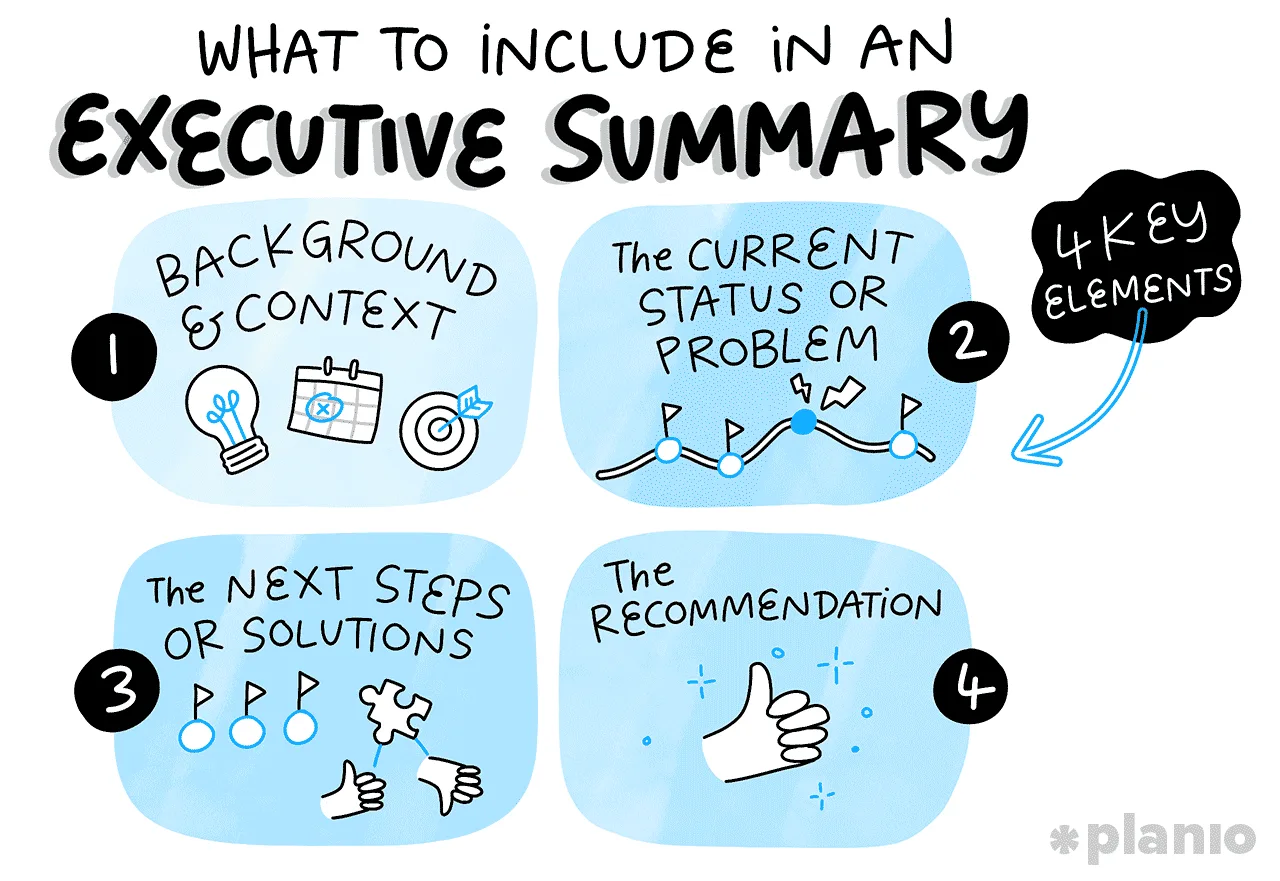
The executive summary is the most read and least understood section of any business document. It appears at the beginning of business plans, project reports, proposals, and research papers, yet many writers treat it as an afterthought - a hasty condensation of the full document rather than the carefully crafted strategic communication it should be.
A strong executive summary allows a busy decision-maker to understand the essential message, key findings, and recommended actions without reading another page. A weak one guarantees that the full document will never be read at all. This guide breaks down the structure, strategy, and technique behind executive summaries that actually work, with complete templates and examples across multiple business contexts.
What an Executive Summary Is and What It Is Not
An executive summary is a standalone overview of a longer document that presents the key information a decision-maker needs to take action. It is not an introduction, an abstract, or a table of contents in paragraph form.
Executive Summary vs. Introduction
An introduction sets the stage for what follows. It provides background, states the purpose, and outlines the structure of the document. It does not reveal conclusions or recommendations.
An executive summary, by contrast, reveals everything. It states the problem, presents the solution, shares the key data, delivers the conclusion, and makes the recommendation. A reader who reads only the executive summary should be able to make an informed decision or at least understand the full picture.
Executive Summary vs. Abstract
An abstract, commonly used in academic and scientific writing, summarizes the research methodology and findings in a structured, objective format. An executive summary is more persuasive in tone. It is written for decision-makers, not researchers, and it emphasizes implications and recommended actions rather than methodology.
The Core Purpose
The executive summary exists because the people who make decisions rarely have time to read 50-page reports. Chief executives, board members, investors, and senior managers need the essential information distilled into a format they can review in five minutes or less. The full document provides the evidence and detail for those who need it. The executive summary provides the verdict.
How Long Should an Executive Summary Be
The standard guideline is 5 to 10 percent of the parent document's length:
- 10-page proposal - Half a page to one page
- 20-page business plan - One to two pages
- 50-page project report - Two to five pages
- 100-page research study - Five to ten pages
These are guidelines, not rules. The true test of appropriate length is whether the executive summary covers every critical point without including anything unnecessary. Some complex documents require longer summaries. Some straightforward reports need only a few paragraphs.
The two most common length mistakes:
- Too long - The writer includes details that belong in the full document, turning the summary into a redundant retelling rather than a distillation
- Too short - The writer omits key findings, financial data, or recommendations, forcing the reader to dig into the full document for essential information
The Universal Executive Summary Structure
Regardless of the document type, effective executive summaries follow a consistent structure with five core elements.
Element 1: The Context
Open with a brief statement that establishes why this document exists. What situation, opportunity, or problem prompted the analysis, plan, or proposal?
Element 2: The Problem or Opportunity
Clearly articulate the central challenge or opportunity being addressed. Quantify it whenever possible. A vague problem statement produces a vague executive summary.
Element 3: The Solution or Approach
Describe what is being proposed, recommended, or concluded. This is the heart of the executive summary and should receive the most space.
Element 4: The Key Data
Include the most important numbers, findings, or evidence that support the recommended course of action. Decision-makers rely on data to justify their choices to stakeholders and boards.
Element 5: The Recommendation or Call to Action
End with a clear statement of what the reader should do next. Approve the budget. Authorize the project. Invest in the company. Accept the proposal. The executive summary should always point toward a specific action.
Executive Summary Template - General Purpose
The following template works for most business documents. Adapt the section headings and emphasis to match your specific context.
EXECUTIVE SUMMARY

Purpose
[One to two sentences stating why this document was created and
what question it answers.]

Background
[Two to three sentences providing the essential context that
the reader needs to understand the situation. Include only the
information that is necessary to follow the rest of the summary.]

Key Findings / Analysis
[Three to five bullet points presenting the most important
data, findings, or insights from the full document.]

- [Finding 1 with quantitative data]
- [Finding 2 with quantitative data]
- [Finding 3 with quantitative data]
- [Finding 4 if needed]

Recommendation
[Two to three sentences clearly stating the recommended course
of action, the investment or resources required, and the
expected outcome.]

Next Steps
[Two to three bullet points outlining the immediate actions
needed to move forward.]

- [Action 1 with responsible party and timeline]
- [Action 2 with responsible party and timeline]
- [Action 3 with responsible party and timeline]
Executive Summary for a Business Plan
Business plan executive summaries serve a specific purpose: they must convince investors, lenders, or internal stakeholders to read the full plan and ultimately commit capital. Every sentence should build toward the investment ask.
What to Include in a Business Plan Executive Summary
- Company description - What the business does, in one to two sentences
- Problem and market opportunity - The gap in the market being addressed
- Solution - The product or service and its value proposition
- Target market - Who the customers are and how large the market is
- Business model - How the company generates revenue
- Traction - Current revenue, customers, partnerships, or milestones achieved
- Financial highlights - Revenue projections, margin expectations, key financial metrics
- The ask - How much funding is needed and what it will be used for
- Team - Key team members and relevant experience (brief)
Business Plan Executive Summary Template
EXECUTIVE SUMMARY

[Company Name] is a [type of business] that [core value proposition
in one sentence]. The company was founded in [year] and is
headquartered in [location].

The Problem
[Description of the market problem or unmet need. Include data
that quantifies the opportunity.]

The Solution
[Description of the product or service. Explain what makes it
different from existing alternatives and why customers choose it.]

Market Opportunity
[Total addressable market (TAM), serviceable addressable market
(SAM), and serviceable obtainable market (SOM) with data sources.
Growth rate of the target market.]

Business Model
[How the company makes money. Pricing structure, revenue streams,
unit economics.]

Traction to Date
- [Revenue or customer metrics]
- [Key partnerships or contracts]
- [Product development milestones]
- [Other evidence of market validation]

Financial Projections
- Year 1 Revenue: $X.X million
- Year 2 Revenue: $X.X million
- Year 3 Revenue: $X.X million
- Gross Margin: XX%
- Break-even: [Month/Year]

Funding Request
[Company Name] is seeking $[amount] in [equity/debt/convertible
note] financing to [specific use of funds]. This capital will
enable [specific milestone or growth objective] within [timeline].

Leadership Team
[Name, Title] - [One sentence of relevant experience]
[Name, Title] - [One sentence of relevant experience]
[Name, Title] - [One sentence of relevant experience]
Business Plan Executive Summary Example
EXECUTIVE SUMMARY

Verdi Foods is a direct-to-consumer meal preparation company that
delivers chef-designed, fully prepared meals to health-conscious
professionals in metropolitan areas. The company was founded in
2024 and is headquartered in Austin, Texas.

The Problem
Seventy-three percent of working professionals report that lack of
time is the primary barrier to maintaining a healthy diet. Existing
meal delivery services either require cooking (meal kits) or
sacrifice nutritional quality for convenience (frozen meals). The
market lacks a premium, fully prepared option that delivers both
nutrition and convenience without compromise.

The Solution
Verdi Foods delivers fresh, never-frozen meals designed by
registered dietitians and prepared by professional chefs. Each
meal is packaged using modified atmosphere technology that extends
freshness to seven days without preservatives. Customers select
from a rotating weekly menu through a mobile app, with meals
delivered in a single weekly shipment.

Market Opportunity
The U.S. meal delivery market was valued at $26.1 billion in 2024
and is projected to reach $42.3 billion by 2029, representing a
compound annual growth rate of 10.1 percent. The premium prepared
meals segment, where Verdi competes, represents $4.8 billion and
is growing at 14.6 percent annually.

Traction to Date
- 4,200 active subscribers generating $380,000 in monthly
  recurring revenue
- 92 percent month-over-month retention rate
- Average order value of $89
- Partnerships with two regional grocery chains for retail
  distribution launching Q3 2026

Financial Projections
- Year 1 Revenue: $5.2 million
- Year 2 Revenue: $14.8 million
- Year 3 Revenue: $31.4 million
- Gross Margin: 42%
- Break-even: September 2026

Funding Request
Verdi Foods is seeking $4.5 million in Series A equity financing
to expand production capacity, launch in three additional
metropolitan markets, and build the retail distribution channel.
This capital will enable the company to reach $14.8 million in
annual revenue and achieve profitability within 18 months of
funding.

Leadership Team
Maria Chen, CEO - Former VP of Operations at Blue Apron, 12 years
in food service operations
David Park, CTO - Built the logistics platform at FreshDirect,
engineering background at Amazon
Dr. Sarah Williams, Chief Nutritionist - Registered dietitian
with 15 years in clinical nutrition research
Executive Summary for a Project Report
Project report executive summaries focus on what was accomplished, what was learned, and what action is needed. They are typically written for sponsors, steering committees, or executive stakeholders who funded the project.
Project Report Executive Summary Template
EXECUTIVE SUMMARY

Project Overview
[Project name], initiated on [start date], was undertaken to
[project objective]. The project was sponsored by [sponsor name]
with an approved budget of $[amount] and a planned completion
date of [date].

Current Status
The project is currently [on track / behind schedule / ahead of
schedule] and [within budget / over budget / under budget]. Overall
status: [Green / Amber / Red].

Key Accomplishments
- [Accomplishment 1 with measurable outcome]
- [Accomplishment 2 with measurable outcome]
- [Accomplishment 3 with measurable outcome]

Key Findings
- [Finding 1 with supporting data]
- [Finding 2 with supporting data]
- [Finding 3 with supporting data]

Budget Summary
Approved Budget: $[amount]
Spent to Date: $[amount] ([X]% of total)
Remaining: $[amount]
Projected Final Cost: $[amount]

Risks and Issues
- [Risk/Issue 1]: [Impact and mitigation]
- [Risk/Issue 2]: [Impact and mitigation]

Recommendations
[Two to three sentences stating the recommended next steps,
decisions needed from leadership, or changes to project scope,
timeline, or budget.]
Project Report Executive Summary Example
EXECUTIVE SUMMARY

Project Overview
The Customer Data Platform Integration Project, initiated on
January 15, 2026, was undertaken to consolidate customer data from
seven disparate systems into a unified platform capable of
supporting real-time personalization and advanced analytics. The
project was sponsored by the Chief Marketing Officer with an
approved budget of $1.2 million and a planned completion date of
September 30, 2026.

Current Status
The project is currently two weeks behind the original schedule
due to unanticipated complexity in the legacy CRM data migration.
The team has developed a revised plan that recovers one week of
the delay through parallel workstreams. Budget utilization is at
38 percent, which is within expected parameters for this stage.
Overall status: Amber.

Key Accomplishments
- Completed data mapping for all seven source systems (1.4 million
  customer records identified and classified)
- Successfully migrated data from three of seven systems with a
  99.7 percent accuracy rate
- Deployed the unified data model in the staging environment
- Completed integration testing with the marketing automation
  platform

Key Findings
- Legacy CRM contains 340,000 duplicate records that must be
  resolved before migration, adding an estimated 80 hours of
  effort not included in the original scope
- Real-time data synchronization between the ERP and CDP requires
  a middleware layer not identified in the original architecture
- Early testing indicates a 23 percent improvement in email
  campaign targeting accuracy using the unified data model

Budget Summary
Approved Budget: $1,200,000
Spent to Date: $456,000 (38%)
Remaining: $744,000
Projected Final Cost: $1,285,000 (7% over budget due to data
deduplication effort and middleware requirement)

Risks and Issues
- Data deduplication effort may extend the timeline by an
  additional week if automated matching rules cannot resolve
  ambiguous records. Mitigation: Procurement of a third-party
  data quality tool ($15,000) to accelerate the process.
- Middleware licensing costs ($70,000) were not included in the
  original budget. Mitigation: Request for supplemental budget
  approval included in this report.

Recommendations
The project team recommends approving a supplemental budget of
$85,000 to cover the data quality tool and middleware licensing
costs. These investments will maintain the revised completion
date of October 14, 2026, and ensure data quality standards are
met. The two-week schedule extension does not impact any
downstream business initiatives.
Executive Summary for a Proposal
Proposal executive summaries must persuade. They are selling documents designed to convince the reader that the proposed solution is the best choice.
Proposal Executive Summary Template
EXECUTIVE SUMMARY

[Client Name] is facing [specific challenge]. This challenge is
resulting in [quantified impact: lost revenue, increased costs,
competitive risk, compliance exposure].

[Your Company Name] proposes [brief description of solution] to
[primary outcome]. Our approach is designed to:

- [Key benefit 1 with expected measurable result]
- [Key benefit 2 with expected measurable result]
- [Key benefit 3 with expected measurable result]

The proposed engagement spans [duration] and requires an
investment of $[amount]. Based on [evidence source: comparable
projects, industry benchmarks, pilot results], [Client Name] can
expect [projected ROI or measurable outcome] within [timeframe].

[Your Company Name] brings [specific relevant qualification:
years of experience, number of similar projects completed,
proprietary methodology, team expertise] to this engagement.

We recommend initiating the project by [date] to [reason for
urgency].
Proposal Executive Summary Example
EXECUTIVE SUMMARY

Meridian Insurance Group processes an average of 12,000 claims
per month, with a current average processing time of 11.4 days
per claim. Industry benchmarks indicate that leading carriers
process comparable claims in 4.2 days. This gap is contributing
to a Net Promoter Score of 31, well below the industry average
of 47, and has been cited as a factor in the 18 percent policy
non-renewal rate observed over the past fiscal year.

Velocity Process Solutions proposes an intelligent claims
automation program that combines robotic process automation (RPA)
with machine learning classification to reduce average processing
time to under 5 days within 6 months. Our approach is designed to:

- Automate 65 percent of routine claims decisions, reducing
  manual processing workload by 4,800 claims per month
- Reduce average processing time from 11.4 days to 4.8 days
- Improve claims accuracy from 94.2 percent to 98.5 percent
  through consistent application of decision rules
- Free 14 full-time equivalent adjusters to focus on complex
  claims requiring human judgment

The proposed engagement spans 8 months and requires an investment
of $1.85 million. Based on results from three comparable
implementations in the property and casualty sector, Meridian can
expect annual cost savings of $2.4 million and a measurable
improvement in policyholder satisfaction within the first year.

Velocity has implemented intelligent claims automation for 23
insurance carriers over the past six years, with an average
processing time reduction of 58 percent across all engagements.
Our team includes four certified insurance professionals and six
RPA architects with deep expertise in claims workflows.

We recommend initiating the discovery phase by May 1 to complete
the implementation before the peak hurricane claims season
beginning in August.
Executive Summary for a Research Paper or White Paper
Research-oriented executive summaries emphasize findings and implications rather than persuasion. They must be objective while still guiding the reader toward actionable conclusions.
Research Executive Summary Template
EXECUTIVE SUMMARY

Background
[Two to three sentences establishing the research context and
the question being investigated.]

Methodology
[Two to three sentences summarizing the research approach,
sample size, data sources, and analytical methods used.]

Key Findings
- [Finding 1 with supporting statistic]
- [Finding 2 with supporting statistic]
- [Finding 3 with supporting statistic]
- [Finding 4 with supporting statistic]

Implications
[Two to three sentences explaining what the findings mean for
the target audience and how they should inform decisions or
strategy.]

Limitations
[One to two sentences noting the most significant limitations
of the research that the reader should consider when
interpreting results.]
Research Executive Summary Example
EXECUTIVE SUMMARY

Background
Employee burnout has been identified as a growing concern across
knowledge-work industries, with potential impacts on productivity,
retention, and healthcare costs. This study examined the
relationship between remote work flexibility and employee burnout
indicators across 47 mid-size technology companies over a
24-month period.

Methodology
The study analyzed survey data from 8,400 employees across three
measurement periods, combined with HR system data on turnover,
absenteeism, and healthcare utilization. Regression analysis was
used to control for company size, industry sub-segment, and
pre-pandemic baseline burnout levels.

Key Findings
- Employees with full schedule flexibility reported 34 percent
  lower burnout scores than those with fixed in-office
  requirements
- The relationship between flexibility and burnout reduction
  plateaus at three days of remote work per week, with no
  additional benefit observed for four or five days
- Manager training on asynchronous communication practices was
  the strongest moderating factor, accounting for 22 percent
  of the variance in burnout scores
- Companies that implemented structured flexibility policies saw
  18 percent lower voluntary turnover compared to companies with
  ad hoc arrangements

Implications
The findings suggest that structured flexibility policies with
clear expectations produce better outcomes than either rigid
in-office requirements or fully unstructured remote work. Investing
in manager training on asynchronous communication and remote team
management appears to be the highest-leverage intervention for
reducing burnout in hybrid environments.

Limitations
The sample is limited to mid-size technology companies and may not
generalize to other industries or organization sizes. Self-reported
burnout measures may be subject to social desirability bias.
Writing Tips for Different Audiences
For C-Suite Executives
- Lead with the financial impact and strategic implications
- Use precise numbers rather than qualitative descriptions
- Keep the summary to one page whenever possible
- Focus on decisions needed, not background information
- Assume the reader has broad business knowledge but not deep technical expertise
For Board Members
- Emphasize governance, risk, and compliance considerations
- Connect findings to the organization's strategic objectives
- Include comparative data (benchmarks, competitors, industry averages)
- Present options with clear trade-offs rather than a single recommendation
- Use formal language consistent with board communication standards
For Technical Stakeholders
- Include methodology details that other audiences would find unnecessary
- Reference specific technologies, standards, or frameworks
- Present data with more granularity
- Acknowledge technical limitations and assumptions
- Use precise terminology appropriate to the discipline
For Investors
- Lead with the market opportunity and financial projections
- Emphasize traction, growth metrics, and unit economics
- Keep the tone confident but grounded in evidence
- Address the competitive landscape and defensibility
- Make the funding request and use of proceeds explicit
Common Executive Summary Mistakes
Mistake 1: Writing It First
The most common mistake is drafting the executive summary before the full document is complete. This approach results in summaries that do not accurately reflect the final content. Always write the executive summary last.
Mistake 2: Including Too Much Background
Decision-makers do not need three paragraphs of industry history before reaching the point. Provide only the context necessary to understand the problem and the recommendation.
Mistake 3: Omitting the Recommendation
An executive summary that presents findings without a clear recommendation forces the reader to draw their own conclusions. This defeats the purpose of the document. Always state explicitly what action the reader should take.
Mistake 4: Using Jargon and Acronyms
Executive summaries are often read by people outside the immediate project team. Define technical terms on first use and avoid acronyms that the reader may not recognize.
Mistake 5: Restating the Table of Contents
Listing the sections of the full document is not an executive summary. "Section 1 covers the market analysis. Section 2 presents the financial projections." This tells the reader nothing of substance. Summarize the content, not the structure.
Mistake 6: Being Vague About Numbers
Replacing specific data with vague language weakens the executive summary. "Revenue increased significantly" is far less useful than "Revenue increased 23 percent to $4.8 million." Precision builds credibility.
Mistake 7: Making It Too Long
An executive summary that is half the length of the full document has failed at its primary job. If the summary cannot be read in five minutes, it needs editing. Every sentence should earn its place.
Executive Summary Checklist
Before finalizing any executive summary, verify the following:
- The problem or opportunity is clearly stated within the first two paragraphs
- Key findings are supported by specific data rather than vague characterizations
- The recommendation or call to action is explicit and unambiguous
- Financial figures are accurate and consistent with the full document
- The summary can be understood without reading the full document
- Length is proportional to the parent document (5 to 10 percent)
- Language is appropriate for the intended audience
- Jargon and acronyms are defined or avoided
- The tone matches the purpose (persuasive for proposals, objective for research)
- The summary was written after the full document was complete
- Someone unfamiliar with the project has reviewed it for clarity
Executive Summary for a Feasibility Study
Feasibility studies assess whether a proposed project, investment, or initiative is viable. The executive summary must present the conclusion clearly and support it with the critical data points from the analysis.
Feasibility Study Executive Summary Template
EXECUTIVE SUMMARY

Purpose
This feasibility study evaluates the viability of [proposed project
or initiative] for [organization name]. The study was commissioned
by [sponsor] on [date] to determine whether the proposed initiative
is technically feasible, financially justified, and operationally
practical.

Scope of Analysis
The study examined [number] key dimensions:
- Technical feasibility: [Brief assessment]
- Financial viability: [Brief assessment]
- Operational impact: [Brief assessment]
- Market conditions: [Brief assessment]
- Regulatory compliance: [Brief assessment]

Key Findings
- [Finding 1 with data]
- [Finding 2 with data]
- [Finding 3 with data]
- [Finding 4 with data]

Financial Analysis Summary
- Required Investment: $[amount]
- Projected Annual Revenue/Savings: $[amount]
- Payback Period: [timeframe]
- Net Present Value (10-year): $[amount]
- Internal Rate of Return: [X]%

Conclusion
Based on the analysis, the proposed [initiative] is [recommended /
recommended with conditions / not recommended]. [Two to three
sentences explaining the rationale for the conclusion.]

Conditions and Caveats
- [Condition 1 that must be met for the recommendation to hold]
- [Condition 2]
- [Key assumption that carries significant uncertainty]
Feasibility Study Executive Summary Example
EXECUTIVE SUMMARY

Purpose
This feasibility study evaluates the viability of establishing a
second manufacturing facility in Guadalajara, Mexico, for Precision
Components Inc. The study was commissioned by the Board of Directors
on November 15, 2025, to determine whether nearshoring production
of high-volume, lower-complexity product lines would reduce costs
and improve supply chain resilience.

Scope of Analysis
The study examined five key dimensions:
- Technical feasibility: Guadalajara's industrial infrastructure
  and labor market can support the required production capabilities
- Financial viability: The initiative generates positive NPV under
  all modeled scenarios except a prolonged recession case
- Operational impact: Production transfer can be completed in phases
  over 14 months without disrupting customer commitments
- Market conditions: Nearshoring demand is driving competitive
  industrial lease rates in the target industrial park
- Regulatory compliance: USMCA rules of origin requirements are
  achievable with the proposed supply chain configuration

Key Findings
- Labor cost savings of 38 percent per unit for transferred product
  lines, partially offset by a 12 percent increase in logistics cost
- Net cost reduction of $4.2 million annually at full production
  capacity (projected to be reached in month 18)
- Supply chain lead time reduction from 47 days (current Asia-based
  suppliers) to 8 days from Guadalajara to the Texas distribution hub
- The Guadalajara labor market includes 12,000 trained manufacturing
  workers within the target industrial corridor, with three technical
  universities providing a pipeline of engineering talent

Financial Analysis Summary
- Required Investment: $18.5 million (facility build-out, equipment,
  and working capital)
- Projected Annual Savings: $4.2 million at full capacity
- Payback Period: 4.4 years
- Net Present Value (10-year, 8% discount rate): $8.7 million
- Internal Rate of Return: 19.2%

Conclusion
Based on the analysis, the proposed Guadalajara manufacturing
facility is recommended for approval. The initiative delivers
meaningful cost savings, significantly improves supply chain
resilience, and generates an attractive return on investment. The
financial case remains positive under all tested scenarios except
the severe recession case, which models a sustained 40 percent
volume decline.

Conditions and Caveats
- The financial model assumes USMCA trade terms remain in effect
  throughout the analysis period
- Labor cost projections are based on current market rates and may
  be affected by regional wage inflation exceeding 5 percent annually
- The 14-month phase-in timeline assumes facility construction
  permits are obtained within 90 days
Formatting and Presentation Tips
The visual formatting of an executive summary affects how it is received and understood.
Use Visual Hierarchy
Structure the executive summary with clear headings and subheadings that allow the reader to scan for the sections most relevant to their interests. A CEO may focus on the recommendation and financial data. A technical director may focus on the methodology and findings.
Incorporate Data Visually
When the executive summary is long enough to warrant it, consider including one or two simple charts or tables that present key data. A revenue projection table, a comparison chart, or a simple bar graph can communicate information faster than a paragraph of text. Keep visual elements simple and clearly labeled.
Use Bold and Bullets Strategically
Bold key figures, conclusions, and recommendations so that a scanning reader catches the most important points. Use bullet points for lists of findings, accomplishments, or recommendations. Reserve full paragraphs for context that requires narrative explanation.
Keep Paragraphs Short
Long paragraphs are harder to scan and more likely to be skipped. Keep paragraphs in executive summaries to three or four sentences maximum. Each paragraph should address a single point.
Match the Document's Design
The executive summary should match the formatting, fonts, colors, and design standards of the parent document. A visually inconsistent executive summary signals that it was added as an afterthought rather than crafted as an integral part of the document.
The Executive Summary Writing Process
Step 1: Complete the Parent Document First
The executive summary must accurately represent the full document. Writing it before the document is complete almost always requires significant revision as the content evolves.
Step 2: Identify the Five to Seven Most Important Points
Read through the completed document and identify the five to seven points that a decision-maker absolutely must know. These become the backbone of the executive summary.
Step 3: Write a First Draft Focused on Content
Get the essential information on the page without worrying about length or polish. Include every point that seems important. The first draft is about completeness, not conciseness.
Step 4: Edit Ruthlessly for Length
Review the first draft and eliminate everything that is not essential to the decision-maker's understanding. Challenge every sentence: "If I remove this, does the reader lose something they need?" If the answer is no, cut it.
Step 5: Add the Call to Action
Ensure the executive summary ends with a clear, specific recommendation or request for action. The reader should know exactly what they are being asked to do.
Step 6: Test with an Uninformed Reader
Ask someone who has not read the full document to read the executive summary and explain the key message back to you. If they cannot accurately summarize the main findings and recommendation, the executive summary needs revision.
Executive Summary Examples by Industry
Technology Startup Executive Summary
The following example demonstrates how a SaaS startup might structure an executive summary for investor communications:
EXECUTIVE SUMMARY

SecureAuth Technologies has developed an AI-powered identity
verification platform that reduces onboarding fraud by 94 percent
while cutting customer verification time from 4.5 minutes to under
30 seconds. The platform serves financial institutions, healthcare
providers, and government agencies that are required to comply with
Know Your Customer (KYC) and identity verification regulations.

The global identity verification market is projected to reach $21.8
billion by 2028, growing at 15.6 percent annually. SecureAuth targets
the mid-market segment ($50M-$500M annual revenue), which represents
$3.2 billion of the addressable market and is currently underserved
by enterprise solutions priced beyond their reach.

Since launching in January 2025, SecureAuth has acquired 47 paying
customers generating $1.8 million in annual recurring revenue, with
a net revenue retention rate of 134 percent. The platform processes
over 200,000 verifications per month with a 99.97 percent uptime
record. Customer acquisition cost is $4,200 with an average contract
value of $38,000, yielding a payback period of 1.3 months.

SecureAuth is seeking $8 million in Series A financing to expand the
sales team from 4 to 12 representatives, invest in platform
capabilities including biometric verification and document
authentication, and enter the healthcare vertical. This funding will
enable SecureAuth to reach $8.5 million in ARR within 18 months.
Manufacturing Executive Summary
EXECUTIVE SUMMARY

This report presents the findings of the Q1 2026 operational
efficiency audit conducted across Hartwell Manufacturing's four
production facilities. The audit examined labor productivity,
equipment utilization, material waste, and energy consumption
against industry benchmarks and Hartwell's own historical
performance data.

Key Findings:
- Overall equipment effectiveness (OEE) averaged 64 percent across
  all facilities, compared to the industry benchmark of 85 percent
- Plant 3 in Birmingham operates at 52 percent OEE, the lowest in
  the network, primarily due to unplanned maintenance events
  averaging 23 hours per week
- Material waste rates have increased 8 percent year-over-year,
  driven by quality defects in the stamping line at Plant 1
- Energy costs per unit produced are 22 percent above the industry
  median, with Plant 4 consuming 31 percent more energy per unit
  than Plant 2, the most efficient facility

Recommendations:
The audit identifies $3.4 million in annual savings achievable
through three initiatives: implementing a predictive maintenance
program at Plant 3 ($1.6M savings), redesigning the Plant 1
stamping line quality control process ($1.1M savings), and
installing energy monitoring and optimization systems across all
four plants ($700K savings). Total implementation cost is estimated
at $1.8 million, yielding a payback period of 6.4 months.

We recommend prioritizing the Plant 3 predictive maintenance
program, which delivers the highest return and addresses the most
urgent operational risk. Implementation can begin within 30 days
of approval.
Final Thoughts
The executive summary is often the only part of a document that every stakeholder reads. It carries a disproportionate share of the document's persuasive and informational burden. Writers who invest the time to craft a precise, data-rich, and action-oriented executive summary dramatically increase the likelihood that their recommendations will be understood, accepted, and acted upon.
The templates and examples in this guide provide the structural foundation. The competitive advantage comes from combining that structure with genuine insight into the reader's priorities and the discipline to include only what matters.
Frequently Asked Questions
How long should an executive summary be?
An executive summary should typically be 5 to 10 percent of the total document length. For a 20-page business plan, aim for one to two pages. For a 50-page project report, two to five pages is appropriate. For a brief proposal of under 10 pages, a single page or even a few paragraphs may suffice.
The key principle is that the executive summary must be long enough to cover every critical point but short enough that a busy executive can read it in under five minutes. Never pad the summary with filler content to reach a perceived minimum length. Conversely, do not omit essential information to keep it artificially short. Let the content of the parent document dictate the appropriate length.
What is the difference between an executive summary and an introduction?
An executive summary and an introduction serve fundamentally different purposes. An executive summary is a standalone document or section that presents the key findings, recommendations, and conclusions of the full report. A reader who reads only the executive summary should understand the essential message without needing to read further.
An introduction, by contrast, sets the stage for the detailed content that follows.
It provides background context, states the purpose of the document, and outlines the structure, but it does not reveal conclusions or recommendations. Think of the executive summary as the destination and the introduction as the starting point. Many documents contain both, with the executive summary appearing first.
Should an executive summary include data and numbers?
Absolutely. An effective executive summary should include the most important data points, figures, and quantitative results from the full document. Decision-makers rely on concrete numbers to evaluate proposals and reports. Include key financial projections, market size figures, performance metrics, ROI calculations, and any statistics that support the central argument.
However, limit the data to the most impactful figures rather than reproducing every table and chart from the full report.
Present numbers in context by explaining what they mean for the reader. For example, rather than stating revenue was $2.4 million, note that revenue grew 35 percent year over year to reach $2.4 million, exceeding the target by $400,000.