
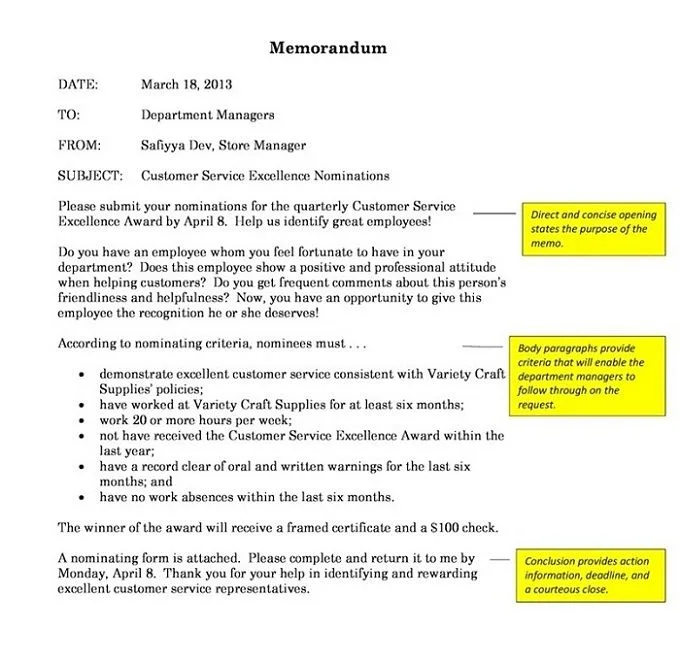
The business memo remains one of the most important forms of internal communication in organizations of every size and industry. Despite the rise of email, instant messaging, and collaboration platforms, the memo serves a unique purpose that no other format fully replaces: it communicates official decisions, policies, and directives with a level of formality and permanence that commands attention.
A well-written memo ensures that critical information reaches the right people in a clear, documented format that can be referenced, archived, and cited long after it is distributed. This comprehensive guide covers everything professionals need to know about memo writing, from the standard format and structural elements to real-world examples for the most common business scenarios.
What Is a Business Memo
A business memo, short for memorandum, is a formal written document used for internal communication within an organization. Unlike emails, which serve a wide range of communication purposes from casual check-ins to formal correspondence, memos are specifically designed to convey official information that requires documentation and institutional weight.
The Purpose of Memos in Modern Business
Memos serve several critical functions in organizations:
- Documenting official decisions that affect multiple departments or the entire organization
- Announcing policy changes that employees must acknowledge and follow
- Requesting action or approval from leadership on budgets, projects, or initiatives
- Summarizing meetings or events for those who were not present
- Creating a paper trail for compliance, legal, or regulatory purposes
- Communicating sensitive information that requires a formal tone and careful wording
When Memos Still Matter
In an era dominated by digital communication, some professionals question whether memos remain relevant. The answer is a definitive yes, and here is why. Memos carry institutional authority that emails often lack. When a department head sends a memo about a policy change, it signals that the communication has been carefully considered, officially approved, and intended for the record. An email about the same topic may be perceived as less authoritative and more easily overlooked or deleted.
Memos are also better suited for complex information that requires structured presentation. Their standardized format guides the writer toward clarity and completeness, reducing the risk of important details being buried in conversational prose.
The Standard Memo Format
Every professional memo follows a consistent structure that enables readers to quickly identify the sender, recipients, subject, and purpose. This format has remained remarkably stable over decades because it works.
The Memo Header
The header is the defining feature that distinguishes a memo from other business documents. It contains four essential elements presented in a specific order:
TO: The primary recipients who need to read and potentially act on the memo's content. List individuals by name and title, or use group designations such as "All Department Managers" or "Marketing Team."
FROM: The author or authors of the memo. Include name and title to establish authority and accountability.
DATE: The date the memo is issued. Use a complete date format such as January 15, 2026, or 15 January 2026, depending on organizational convention.
SUBJECT: A concise, descriptive line that tells the reader exactly what the memo is about. This functions like an email subject line but tends to be slightly more formal and specific.
Some organizations also include:
- CC: Individuals who receive the memo for informational purposes but are not primary recipients
- RE: Used in place of or in addition to SUBJECT in some formatting conventions
- CONFIDENTIAL: A designation placed above the header when the memo contains sensitive information
Standard Memo Template
Here is the foundational template that applies to virtually every business memo:
MEMORANDUM
TO: [Recipient name(s) and title(s)]
FROM: [Sender name and title]
DATE: [Full date]
SUBJECT: [Clear, specific subject line]
Opening paragraph: State the purpose of the memo directly. The reader should understand why they are receiving this document within the first two sentences.
Background/context paragraph(s): Provide any necessary background information, data, or context that the reader needs to understand the situation or decision. Keep this section focused and relevant.
Action items or key information: Present the specific actions required, decisions made, or information being communicated. Use bullet points or numbered lists for clarity when multiple items are involved.
Closing paragraph: Summarize the key takeaway, restate any deadlines or required actions, and provide contact information for questions or follow-up.
Memo Formatting Standards
Consistent formatting enhances readability and professionalism. The following standards apply to most organizational contexts.
Typography and Layout
- Font: Use a standard business font such as Times New Roman (12pt), Arial (11pt), or Calibri (11pt)
- Margins: Standard one-inch margins on all sides
- Spacing: Single-spaced body text with a blank line between paragraphs
- Alignment: Left-aligned text throughout; do not use justified alignment as it can create uneven spacing
- Header labels: Bold the labels (TO, FROM, DATE, SUBJECT) and follow each with a colon and tab or consistent spacing
- Length: Most memos should fit on one to two pages; if longer, consider whether a report format would be more appropriate
Heading and Section Structure
For longer memos that cover multiple topics or require detailed explanations:
- Use bold section headings to break the content into scannable segments
- Keep paragraphs to four to six sentences maximum
- Use bullet points for lists of three or more items
- Use numbered lists when sequence or priority matters
- Include a horizontal rule or extra line break between the header and the body text
Tone and Language
Business memos occupy a specific position on the formality spectrum. They are more formal than emails but less formal than legal documents or board resolutions.
- Use direct, declarative sentences. Avoid hedging language like "it might be worth considering" when the memo is announcing a decision that has already been made.
- Write in active voice. "The finance department will implement the new system" is stronger than "the new system will be implemented by the finance department."
- Avoid jargon unless the audience is exclusively composed of specialists who use the terminology daily.
- Be specific. Replace vague language with concrete details. Instead of "soon," write "by March 15." Instead of "significant increase," write "a 23 percent increase."
Formal vs. Informal Memos
Not every memo requires the same level of formality. Understanding when to adjust tone and structure helps writers match the document to the situation.
Formal Memos
Formal memos are appropriate for:
- Policy changes affecting the entire organization
- Official directives from senior leadership
- Legal, compliance, or regulatory communications
- Budget approvals and financial decisions
- Organizational restructuring announcements
- Communications that may be reviewed by external parties
Characteristics of formal memos include:
- Complete header with full names and titles
- Third-person references ("the department" rather than "we")
- No contractions
- Precise, measured language
- Signature line or initials at the bottom
- Reference numbers or filing codes if applicable
Informal Memos
Informal memos are suitable for:
- Team updates within a single department
- Meeting summaries for internal working groups
- Routine project status reports
- Requests between colleagues of similar rank
- Internal brainstorming or idea sharing
Characteristics of informal memos include:
- First names acceptable in the header
- First-person references are appropriate
- Contractions acceptable in moderation
- Slightly conversational tone while maintaining professionalism
- Shorter length and simpler structure
Matching Tone to Audience
The critical factor in choosing formality level is the audience. A memo from the CEO to all employees about a merger requires maximum formality. A memo from a team lead to their five-person team about scheduling changes can be considerably more relaxed. When in doubt, lean toward the more formal end of the spectrum; it is easier to be perceived as overly professional than to recover from a communication that readers found inappropriately casual.
Memo vs. Email - When to Use Which
The overlap between memos and emails creates frequent confusion about which format to use. Here is a clear framework for making the right choice.
Use a Memo When
- The information is official and requires documentation. Policy changes, procedural updates, and formal directives belong in memos.
- The communication needs institutional weight. If you want recipients to treat the content as authoritative and binding, a memo format signals that expectation.
- The content will be archived or referenced. Memos are easier to file, retrieve, and cite than emails buried in inboxes.
- Multiple departments or the entire organization are affected. Cross-functional communications benefit from the structure and formality of a memo.
- Legal or compliance considerations are involved. When documentation might be reviewed in an audit, legal proceeding, or regulatory inquiry, memos provide clearer records.
- The subject is complex and requires structured presentation. Memos naturally accommodate headings, sections, and detailed formatting that emails handle less gracefully.
Use an Email When
- The communication is routine or time-sensitive. Quick updates, scheduling confirmations, and day-to-day questions are better suited to email.
- A conversational tone is appropriate. Discussions, brainstorming, and informal check-ins flow more naturally in email format.
- External recipients are involved. Memos are internal documents; external communication should use email, letters, or other appropriate formats.
- Immediate response is needed. Emails are more likely to be read quickly; memos may sit unread until the recipient has time for careful review.
- The information is simple and straightforward. A single piece of information or a brief request does not warrant the formality of a memo.
The Hybrid Approach
Many organizations now distribute memos as email attachments. The email serves as a brief cover note ("Please find attached the memo regarding the updated travel policy"), while the memo itself maintains its formal structure as a PDF or Word document attachment. This approach combines the immediacy of email delivery with the formality and archivability of the memo format.
Example 1 - Policy Change Memo
MEMORANDUM
TO: All Employees
FROM: Sarah Chen, Director of Human Resources
DATE: February 3, 2026
SUBJECT: Updated Remote Work Policy - Effective March 1, 2026
Following a comprehensive review of our workplace flexibility program and feedback gathered through the company-wide survey conducted in December 2025, the Human Resources department is announcing updated guidelines for remote work arrangements effective March 1, 2026.
Summary of Changes
The revised policy introduces the following modifications to the current remote work framework:
- Hybrid eligibility expansion. All employees in roles classified as "hybrid-eligible" may now work remotely up to three days per week, increased from the previous two-day maximum.
- Core collaboration hours. All team members, whether on-site or remote, must be available during core hours of 10:00 AM to 3:00 PM in their local time zone for meetings and collaborative work.
- Home office stipend. Employees working remotely two or more days per week are eligible for an annual home office stipend of $500, effective with the first quarter reimbursement cycle.
- Performance review integration. Remote work arrangements will be reviewed as part of the standard quarterly performance evaluation process rather than requiring separate approval renewals.
What This Means for You
Employees currently approved for remote work will automatically transition to the new policy framework. No additional paperwork is required. Employees not currently participating in remote work who wish to do so should discuss eligibility with their direct supervisor and submit a request through the HR portal by February 20, 2026.
Rationale
This update reflects the organization's commitment to employee well-being and work-life balance while maintaining the collaborative culture that drives our success. The December survey indicated that 78 percent of employees view flexible work arrangements as a critical factor in job satisfaction, and productivity metrics from the current program show no decline in output associated with remote work.
Questions and Next Steps
A detailed FAQ document is available on the HR portal under "Remote Work Policy 2026." Department managers will receive a briefing packet by February 10 with guidance for implementing the changes within their teams. For questions not addressed in the FAQ, contact the HR department at hr@company.com or extension 4500.
Example 2 - Project Update Memo
MEMORANDUM
TO: Executive Leadership Team
FROM: Michael Torres, Project Manager, Digital Transformation Initiative
DATE: March 12, 2026
SUBJECT: Q1 Progress Report - Enterprise Software Migration Project
This memo provides the quarterly status update on the Enterprise Software Migration Project, currently in Phase 2 of the planned four-phase implementation. The project remains on schedule and within the approved budget, with several noteworthy milestones achieved during the first quarter.
Milestones Completed in Q1
- Data migration testing for the finance and human resources modules completed on February 28, with a 99.2 percent data integrity rate
- User acceptance testing (UAT) for Phase 1 modules signed off by all department leads as of March 5
- Training curriculum development finalized for Phase 2 end-user training sessions scheduled to begin April 1
- Vendor contract amendment executed to include enhanced security features at no additional cost, saving an estimated $45,000
Budget Status
The project has consumed $1.2 million of the approved $3.8 million total budget, representing 31.6 percent of funds against 37.5 percent of the overall timeline. The favorable variance is primarily attributable to the vendor contract renegotiation and lower-than-anticipated consulting fees during the testing phase.
| Category | Budget | Spent | Remaining |
|---|---|---|---|
| Software licensing | $1,400,000 | $700,000 | $700,000 |
| Implementation services | $1,200,000 | $310,000 | $890,000 |
| Training | $400,000 | $85,000 | $315,000 |
| Hardware/Infrastructure | $500,000 | $95,000 | $405,000 |
| Contingency | $300,000 | $10,000 | $290,000 |
Risks and Concerns
Two items require leadership awareness:
Staffing availability for Phase 2 training. The operations department has indicated that releasing staff for the scheduled three-day training sessions during April may conflict with the seasonal volume increase. A modified training schedule with shorter sessions spread over two weeks is being evaluated as an alternative.
Integration with the legacy reporting system. Preliminary testing has revealed compatibility issues between the new platform's reporting module and the legacy system used by the compliance team. The technical team is working with the vendor to develop a bridge solution expected to be ready by the end of April.
Next Steps
Phase 2 deployment is on track for the June 1 target date. The project team will present a detailed Phase 2 readiness assessment at the April leadership meeting.
Example 3 - Budget Request Memo
MEMORANDUM
TO: David Park, Chief Financial Officer
CC: Lisa Hammond, VP of Operations
FROM: Jennifer Walsh, Director of Marketing
DATE: April 8, 2026
SUBJECT: Budget Request - Q3-Q4 Digital Advertising Campaign
The Marketing department is requesting approval for an additional $175,000 in budget allocation to fund an expanded digital advertising campaign during the third and fourth quarters of 2026. This request falls outside the approved annual marketing budget and requires CFO authorization per the company's financial approval policy.
Background
The company's digital advertising performance in Q1 exceeded all projected benchmarks. The paid search campaign generated a return on ad spend (ROAS) of 4.2x against a target of 3.0x, and social media advertising delivered a cost per acquisition (CPA) that was 28 percent below the industry average. These results indicate a significant opportunity to capture additional market share by increasing investment during the historically strong Q3-Q4 buying season.
Proposed Allocation
The requested $175,000 would be distributed as follows:
- Paid search advertising (Google, Bing): $80,000
- Social media advertising (LinkedIn, Meta): $55,000
- Programmatic display advertising: $25,000
- Video advertising (YouTube, connected TV): $15,000
Projected Return
Based on Q1 performance metrics and conservative seasonal adjustment factors, the marketing team projects the following outcomes from the additional investment:
- Revenue generation: $630,000 to $735,000 in attributed revenue, representing a projected ROAS of 3.6x to 4.2x
- Lead generation: Approximately 2,100 to 2,450 marketing-qualified leads
- Brand awareness: An estimated 8.5 million additional impressions across target demographics
Risk Mitigation
The campaign will be managed with strict performance thresholds. If any channel underperforms its ROAS target for two consecutive weeks, spending on that channel will be paused and reallocated to higher-performing channels. Monthly performance reports will be submitted to the finance department throughout the campaign period.
Requested Timeline for Approval
To secure optimal advertising inventory rates for Q3, media buying commitments need to be made by May 15. The marketing team respectfully requests a decision on this budget request by May 1, 2026.
I am available to present additional supporting data or answer questions at your convenience. Please contact me at extension 3200 or jwalsh@company.com.
Example 4 - Meeting Summary Memo
MEMORANDUM
TO: Product Development Team
CC: Rachel Kim, VP of Product
FROM: Alex Reeves, Senior Product Manager
DATE: May 20, 2026
SUBJECT: Summary of Product Roadmap Planning Meeting - May 19, 2026
This memo summarizes the key discussions, decisions, and action items from the Product Roadmap Planning Meeting held on May 19, 2026, in Conference Room B from 9:00 AM to 12:30 PM.
Attendees
Alex Reeves (facilitator), Sarah Lin, James Patel, Maria Gonzalez, David Chen, Priya Sharma, Tom Henderson
Absent: Nicole Foster (on PTO; notes forwarded separately)
Key Decisions Made
The following decisions were reached by consensus during the meeting:
Q3 feature priority order. The team agreed to prioritize the three major features in the following order: (a) customer dashboard redesign, (b) API rate limiting enhancements, (c) mobile notification system overhaul.
Technical debt sprint. One full sprint in July will be dedicated exclusively to addressing the fourteen critical technical debt items identified in the April code audit. No new feature work will be scheduled during this sprint.
Beta testing program. The customer dashboard redesign will enter a closed beta with twenty enterprise clients beginning August 15, running for four weeks before general availability.
Resource allocation. Two additional front-end developers will be temporarily reassigned from the platform team to support the dashboard redesign through Q3, pending platform team lead approval.
Discussion Highlights
Customer dashboard redesign. The team reviewed three design concepts presented by Maria Gonzalez. Concept B, the modular widget-based layout, received the strongest support due to its flexibility and alignment with customer feedback requesting personalized dashboard configurations. James Patel raised concerns about performance implications of the modular approach with large data sets, which will be addressed through a dedicated performance testing phase in early July.
API rate limiting. David Chen presented the technical analysis of current rate limiting infrastructure and proposed a tiered approach based on customer plan level. The team agreed that this approach aligns with the business model and provides a natural upsell pathway for the sales team.
Mobile notification overhaul. Priya Sharma shared the results of the user research study conducted in April, which revealed that 62 percent of mobile users find current notifications excessive and poorly categorized. The redesigned system will implement user-configurable notification categories and quiet hours functionality.
Action Items
| Action Item | Owner | Deadline |
|---|---|---|
| Finalize dashboard wireframes based on Concept B | Maria Gonzalez | May 30 |
| Complete API rate limiting technical specification | David Chen | June 5 |
| Submit resource reallocation request to platform team lead | Alex Reeves | May 23 |
| Prepare beta testing recruitment outreach to enterprise clients | Priya Sharma | June 15 |
| Schedule technical debt items for July sprint | James Patel | June 20 |
| Distribute customer notification preference survey | Priya Sharma | May 27 |
Next Meeting
The follow-up roadmap review meeting is scheduled for June 16, 2026, at 9:00 AM in Conference Room B. All team members should come prepared with updated timelines for their assigned deliverables.
Please contact me at areeves@company.com or extension 2850 with any corrections to these notes or questions about the action items.
Example 5 - Organizational Change Memo
MEMORANDUM
TO: All Employees, Western Region Division
FROM: Robert Langford, Regional Vice President
DATE: June 2, 2026
SUBJECT: Organizational Restructuring - Western Region Division
I am writing to inform you of important organizational changes within the Western Region Division that will take effect on July 1, 2026. These changes are the result of a thorough strategic review conducted over the past four months and are designed to improve operational efficiency, strengthen client service delivery, and position the division for continued growth.
Overview of Changes
The Western Region Division will transition from its current functional structure, in which teams are organized by business function, to a client-centric model in which teams are organized around key client segments. This restructuring affects all departments within the division.
New Organizational Structure
Effective July 1, the division will be organized into three client segment groups:
- Enterprise Accounts Group - Led by Karen Whitfield, currently Director of Sales. This group will serve all clients with annual contracts exceeding $500,000 and will encompass dedicated sales, service, and technical support functions.
- Mid-Market Accounts Group - Led by Thomas Reed, currently Senior Manager of Client Services. This group will serve clients with annual contracts between $100,000 and $500,000.
- Growth Accounts Group - Led by Diana Morales, currently Director of Business Development. This group will focus on emerging clients and new business acquisition.
Impact on Current Roles
The restructuring will result in the following changes:
- Reporting lines. Approximately 60 percent of employees will have a new direct supervisor effective July 1. All affected employees will receive individual notifications from HR by June 15 with their specific reporting changes.
- Physical workspace. Teams will be co-located by client segment rather than by function. The facilities team will coordinate moves during the last two weeks of June. A seating plan will be distributed by June 10.
- Job titles and compensation. No positions are being eliminated as part of this restructuring. Job titles may change to reflect the new structure, but all employees will retain their current compensation and benefits without modification.
- Client assignments. Client account managers will receive their new portfolio assignments by June 20. A thirty-day transition period will allow for proper handoffs and client introductions.
Support During the Transition
The organization recognizes that structural change creates uncertainty, and we are committed to supporting all employees through this transition.
- Town hall meetings will be held on June 8 (10:00 AM) and June 10 (2:00 PM) in the main auditorium for questions and discussion. Both sessions will cover the same content; attend whichever is more convenient.
- One-on-one meetings with current supervisors will be scheduled during the week of June 9 to discuss individual role changes and address personal concerns.
- An FAQ document addressing the most common questions about the restructuring is available on the company intranet under "Western Region Restructuring 2026."
- HR office hours will be available every afternoon from 1:00 PM to 4:00 PM during the month of June for confidential conversations about the transition.
Why This Change Matters
Our clients have consistently told us that they value having a unified team that understands their business holistically, rather than interacting with separate functional departments that may not coordinate effectively.
The client-centric model ensures that every client has a dedicated team with sales, service, and technical expertise working together toward shared goals. Organizations that have made this transition report higher client satisfaction scores, improved retention rates, and stronger revenue growth per account.
I understand that change is challenging, and I appreciate the professionalism and commitment this division consistently demonstrates. I am confident that this restructuring will make us stronger and more effective in serving our clients and advancing our business.
Please direct any questions to your supervisor, the HR department, or my office directly at rlangford@company.com.
Distribution Methods for Business Memos
How a memo is distributed affects its reach, timeliness, and perceived importance.
Email Distribution
The most common distribution method in modern organizations. Memos are typically created as a formatted document and attached to a brief email that identifies the attachment and its purpose. This approach provides immediate delivery while preserving the memo's formal formatting.
Best practices for email distribution:
- Use a clear email subject line such as "Memo: Updated Remote Work Policy - Action Required"
- Keep the email body brief; the memo contains the detail
- Request read receipts for critical memos if your organization supports this feature
- Send to distribution lists rather than individual addresses when addressing large groups
Intranet or Shared Drive
For memos intended as reference documents, posting on the company intranet or a shared drive ensures ongoing accessibility. This method works well for policy memos, procedural updates, and other documents that employees may need to reference repeatedly.
Physical Distribution
While increasingly rare, some organizations and situations still warrant physical memo distribution. This is particularly common in manufacturing, healthcare, and other environments where not all employees have regular access to email or digital platforms. Physical memos should be printed on company letterhead for formality.
Combination Approach
For important communications, use multiple channels. Distribute via email for immediacy, post on the intranet for ongoing access, and display physical copies on bulletin boards in common areas for maximum visibility. This multi-channel approach ensures that the memo reaches all employees regardless of their communication habits.
Common Memo Writing Mistakes
Even experienced professionals make mistakes when writing memos. Awareness of these common pitfalls helps writers avoid them.
Burying the Lead
The single most common mistake in memo writing is failing to state the purpose in the opening paragraph. Unlike a mystery novel, a memo should not build suspense. The reader should understand why they are reading the document within the first two sentences. Background information and context are important, but they belong after the purpose statement, not before it.
Excessive Length
A memo that exceeds two pages without compelling reason signals poor editing. If the content genuinely requires more space, consider whether a report format with a cover memo would be more appropriate. Every paragraph in a memo should pass a simple test: does this information help the reader understand the purpose, make a decision, or take action? If the answer is no, the paragraph should be cut.
Unclear Action Items
When a memo requires recipients to do something, the required actions should be unmistakably clear. Specify what needs to be done, who needs to do it, and by when. Vague statements like "please give this your attention" leave readers unsure about what is actually expected of them.
Wrong Distribution
Sending a memo to too many people dilutes its impact and wastes organizational attention. Sending it to too few people creates information gaps and potential resentment. Carefully consider who genuinely needs to receive the memo as a primary recipient versus who should be copied for awareness versus who does not need it at all.
Inappropriate Tone
A memo about a minor scheduling change written in the same grave tone as a memo about layoffs creates a disconnect that undermines credibility. Similarly, a casual tone in a memo announcing significant policy changes can make the content seem unimportant. Match the tone to the gravity of the subject matter.
Missing Follow-Up Information
Every memo should answer the reader's implicit question: "What do I do if I have questions?" Include a contact name, email address, phone extension, or reference to an FAQ document. Leaving readers without a clear path for follow-up creates unnecessary confusion and can result in a flood of ad hoc inquiries to the wrong people.
Advanced Memo Writing Strategies
Beyond the fundamentals, several strategies can elevate memo writing from competent to exceptional.
The Inverted Pyramid Structure
Borrowed from journalism, the inverted pyramid presents the most important information first, followed by supporting details, and concluding with background and context. This structure respects the reality that many readers will not read the entire memo. Those who read only the first paragraph should still grasp the essential message.
Strategic Use of White Space
Dense blocks of text discourage reading. Strategic use of white space through short paragraphs, bullet points, and clear section breaks makes memos more inviting and easier to scan. A well-formatted one-page memo will be read more thoroughly than a densely packed one-page memo containing the same information.
The "So What?" Test
After drafting each section of a memo, ask "so what?" from the reader's perspective. If a section does not clearly answer that question, it either needs revision to connect the information to the reader's interests and responsibilities, or it should be removed entirely.
Anticipating Questions
The best memos preemptively address the questions readers are likely to have. Before finalizing a memo, review it from the perspective of each major audience segment and consider what they would want to know that the current draft does not cover. Including an FAQ section at the end of complex memos is an effective way to handle anticipated questions without disrupting the main narrative flow.
Revision and Review
No memo should be distributed without at least one revision pass. For high-stakes memos, have a colleague review the draft for clarity, tone, and completeness. Read the memo aloud to catch awkward phrasing and overly long sentences. Check all dates, numbers, names, and titles for accuracy. A single factual error in a memo can undermine the credibility of the entire document.
Memo Templates for Quick Reference
The following condensed templates serve as starting points for the most common memo types. Adapt them to your organization's specific formatting requirements and style conventions.
Policy Change Template
MEMORANDUM
TO: [Affected group]
FROM: [Authority figure, name and title]
DATE: [Date]
SUBJECT: [Policy name] - Effective [Date]
[One-sentence statement of what is changing and when.]
Summary of Changes:
- [Change 1]
- [Change 2]
- [Change 3]
Rationale: [Brief explanation of why the change is being made.]
Impact: [What employees need to do differently.]
Questions: [Contact information and/or reference to FAQ document.]
Project Update Template
MEMORANDUM
TO: [Stakeholders]
FROM: [Project manager, name and title]
DATE: [Date]
SUBJECT: [Project name] - [Period] Status Update
Status: [On track / At risk / Behind schedule]
Milestones completed: [List of completed milestones]
Budget status: [Summary of budget position]
Risks: [Any risks requiring stakeholder awareness]
Next steps: [Upcoming milestones and deadlines]
Budget Request Template
MEMORANDUM
TO: [Approving authority]
FROM: [Requester, name and title]
DATE: [Date]
SUBJECT: Budget Request - [Description] - $[Amount]
Request: [Clear statement of what is being requested and the total amount.]
Justification: [Business case for the expenditure.]
Proposed allocation: [Breakdown of how funds will be used.]
Expected return: [Projected outcomes or ROI.]
Timeline: [When funds are needed and when results are expected.]
Meeting Summary Template
MEMORANDUM
TO: [Meeting participants and relevant stakeholders]
FROM: [Note-taker, name and title]
DATE: [Date]
SUBJECT: Meeting Summary - [Meeting name] - [Meeting date]
Attendees: [List of attendees]
Key decisions:
- [Decision 1]
- [Decision 2]
Action items:
| Action | Owner | Deadline |
|---|---|---|
| [Item] | [Person] | [Date] |
Next meeting: [Date, time, location]
Final Thoughts on Business Memo Writing
The business memo endures as a communication format because it fulfills a need that other tools cannot fully replicate. It combines formality with accessibility, structure with flexibility, and authority with readability. Mastering memo writing is not merely an administrative skill; it is a leadership competency that shapes how decisions are communicated, how policies are understood, and how organizations function at every level.
The principles outlined in this guide apply whether the memo is a brief scheduling announcement or a comprehensive strategic directive. Clear purpose, logical structure, appropriate tone, and meticulous attention to detail are the hallmarks of effective memo writing regardless of context. Professionals who invest the time to write thoughtful, well-crafted memos distinguish themselves as clear thinkers and effective communicators, qualities that advance careers and strengthen organizations.
Write each memo with the understanding that it may be read by people beyond the intended audience, referenced months or years after its creation, and judged as a reflection of the writer's professionalism and competence. That perspective naturally elevates the quality of every memo produced.
Frequently Asked Questions
What is the difference between a memo and an email?
A memo is a formal internal document designed for official business communication within an organization, while an email is a more versatile tool used for both internal and external correspondence.
Memos carry greater institutional weight and are typically used for policy announcements, procedural changes, and formal directives that require documentation. They follow a standardized format with TO, FROM, DATE, and SUBJECT headers and are often archived as part of organizational records.
Emails, by contrast, are suited for day-to-day communication, quick questions, scheduling, and informal updates. The key distinction lies in formality and permanence: memos signal that the content requires attention and may have compliance or policy implications, whereas emails are generally treated as routine correspondence.
How long should a business memo be?
A business memo should be as concise as possible while still conveying all necessary information. Most effective memos fall between one and two pages, though the ideal length depends on the subject matter and audience. Simple announcements or policy updates may require only half a page, while detailed procedural changes or project summaries might extend to two full pages.
If a memo exceeds two pages, consider whether the content would be better served as a formal report with the memo serving as a cover summary. The guiding principle is respect for the reader’s time: every sentence should serve a clear purpose, and background information should be included only when necessary for comprehension or decision-making.
Who should be listed in the TO and CC fields of a memo?
The TO field should include only the primary recipients who need to act on or directly respond to the memo’s content. These are the individuals with decision-making authority or direct responsibility for the subject matter.
The CC field is reserved for individuals who need to be informed but are not expected to take direct action, such as senior leadership who should be aware of departmental activities, administrative staff who may need the information for record-keeping, or colleagues in related departments whose work might be indirectly affected. Avoid over-distributing memos, as sending them to unnecessary recipients dilutes their impact and can create confusion about who is responsible for follow-up actions.