
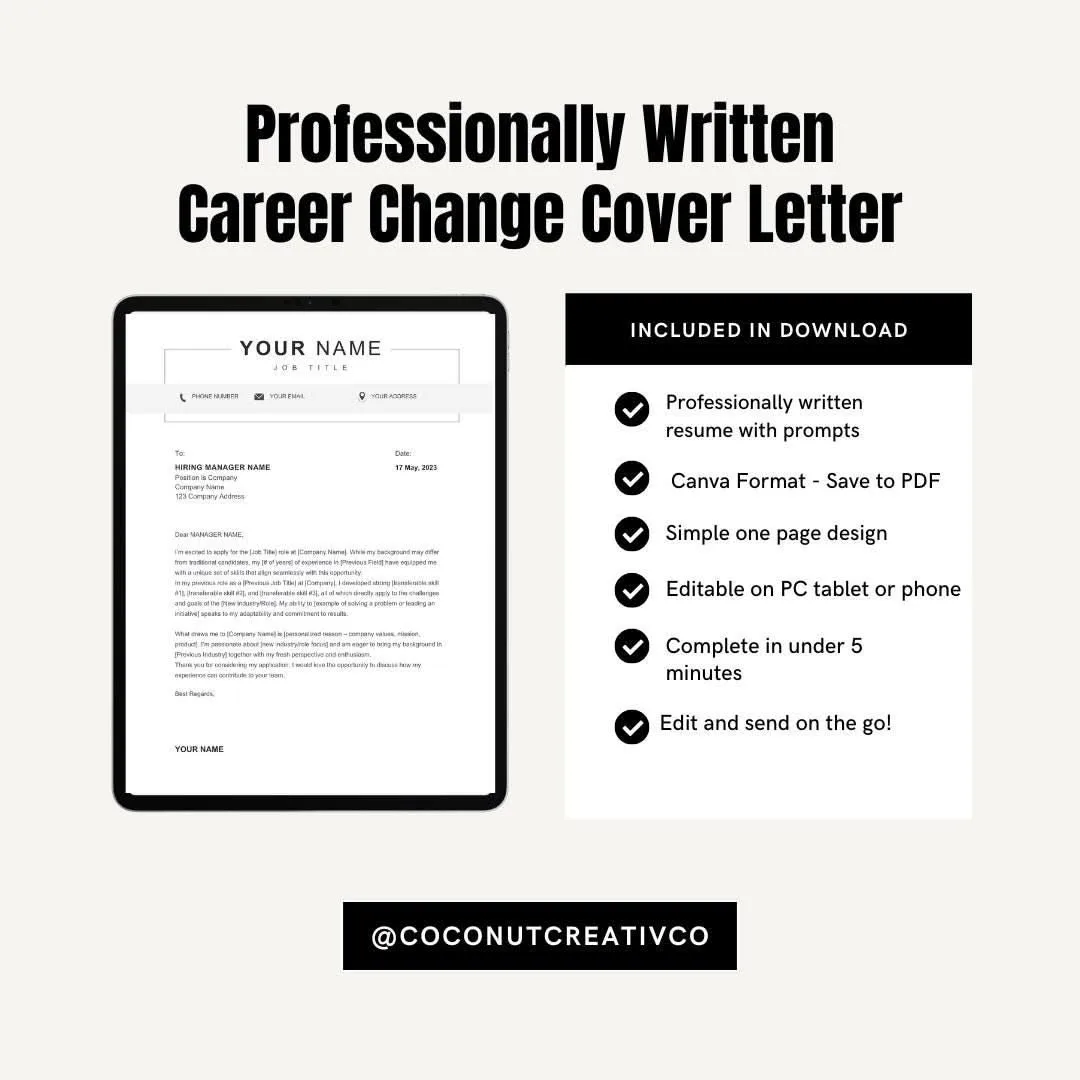
A career change cover letter is a different document from a standard cover letter, and professionals who treat them as interchangeable are often screened out before their resume is read. The standard cover letter assumes the reader can see a linear progression from the applicant's background to the target role.
The career change cover letter does the opposite - it assumes the reader will see a disconnect, and it is the letter's job to close that gap with explicit translation of transferable skills, a credible motivation narrative, and evidence that the candidate has already begun operating in the new field.
Hiring managers reading hundreds of applications for a marketing role will spend fewer than 30 seconds deciding whether to continue with a resume that shows twelve years in software engineering. The cover letter is the one place where the candidate controls that narrative.
This guide provides ten ready-to-copy cover letter templates for the most common career transition paths, including technology to marketing, teacher to corporate trainer, retail to office, military to civilian, finance to nonprofit, journalism to content strategy, hospitality to human resources, engineering to product management, academic to industry, and healthcare to technology.
Each template follows the proper business letter format, opens with a hook that acknowledges the transition rather than hiding it, and closes with a specific call to action.
The templates are supported by guidance on the structural differences between career change and standard cover letters, common mistakes that sink transition applications, a skills-translation framework, and a FAQ drawn from the questions career changers most frequently ask during the application process.
Why Career Change Cover Letters Are Different
Most cover letter advice is written for candidates whose background aligns clearly with the target role. That advice is actively harmful for career changers, because it tells you to emphasize your most recent experience, quantify achievements in your current field, and open with a summary of your expertise. All three of those moves draw attention to the gap between your background and the role.
The Narrative Gap Problem
A hiring manager looking at a career change application is asking three questions within seconds. Why is this person applying for this role? Can they actually do the job? Are they going to leave in six months when they realize the field is harder than they thought? Every structural choice in your cover letter should answer one of those three questions directly.
Transferable Skill Translation
Skills that are obvious to you are invisible to the reader. A teacher who designed a 180-day curriculum has been doing instructional design, project management, stakeholder communication, and performance measurement, but a hiring manager reading "taught ninth-grade biology" will not make those translations on your behalf. The cover letter does the translation.
The Credibility Proof Point
Career changers need at least one proof point that signals they have already begun operating in the new field. This might be a certification, a freelance project, a volunteer role, a substantial side project, or specific coursework. Without a proof point, the application reads as aspirational rather than serious.
"The career change cover letter is an exercise in frame control. If you let the reader see your last job first, they will filter your application through that lens. If you open with the transition and the motivation, they will evaluate the application on the new field's terms."
What to Include in a Career Change Cover Letter
The structural elements of a career change cover letter differ meaningfully from a standard cover letter. The table below summarizes the required sections, their purpose, and the specific content each should contain.
| Section | Purpose | Key Content |
|---|---|---|
| Opening hook | Acknowledges the transition and owns it | Direct statement of career change, clear target role |
| Motivation narrative | Answers "why this field, why now" | Specific trigger, sustained pattern, evidence of research |
| Transferable skills bridge | Translates prior experience to new field | Three to five skills with concrete examples |
| Proof of commitment | Demonstrates you have already begun the transition | Certifications, projects, freelance work, courses |
| Company-specific fit | Shows genuine interest in this employer | Reference to recent initiative, product, or value |
| Close and call to action | Requests an interview with specific flexibility | Direct ask, availability, thank you |
10+ Career Change Cover Letter Templates
Replace the bracketed fields with your own information and tailor the transferable skills and proof points to the specific role you are applying for.
Template 1: Software Engineer to Marketing
[Your Name] [Your Address] [Phone] | [Email] | [LinkedIn]
[Date]
[Hiring Manager Name] [Title] [Company Name] [Address]
Dear [Hiring Manager Name],
I am writing to apply for the Marketing Manager position at [Company]. After eight years as a software engineer at [Previous Company], I am pivoting to marketing full-time, and I am applying to [Company] because of your reputation for data-driven growth and your recent [specific initiative].
The move is not sudden. For the past two years, I have led developer marketing projects at [Previous Company], including a content series that generated [specific result] and a community program that grew to [number] members.
In the process, I discovered that the work I enjoyed most was not writing code but finding the precise message that moved a technical audience to action. I completed the [Certification Name] in [Year] and have been running a technical blog at [URL] that reaches [traffic metric] monthly.
The skills that made me a strong engineer translate directly to the marketing work you are hiring for. I am comfortable with attribution modeling, A/B testing infrastructure, and the analytical discipline required to separate signal from noise in growth data. I also understand the product deeply, because I have built it. For a company selling to technical buyers, that combination shortens the learning curve considerably.
I would welcome the opportunity to discuss how my engineering background and marketing transition fit what you are building. I am available for a conversation at your convenience and can be reached at [phone] or [email].
Sincerely,
[Your Name]
Template 2: Teacher to Corporate Trainer
[Header block]
Dear [Hiring Manager Name],
I am applying for the Corporate Trainer position at [Company]. After ten years teaching high school [subject] and leading professional development for my district, I am moving into corporate learning and development, and your organization is my top target because of your investment in [specific program or initiative].
Teaching is instructional design, curriculum development, assessment, stakeholder management, and performance coaching, all delivered to an audience that cannot be fired or reassigned. In my current role, I designed a [specific program] that improved [measurable outcome] by [percentage]. I have delivered training to [number] colleagues on [topic], and I have built and maintained a learning management system serving [number] users.
To prepare for the transition, I earned [Certification, for example, the ATD Certified Professional in Talent Development credential] and completed contract training engagements for [client or company], receiving [feedback metric]. I understand adult learning theory, how to scope training programs to business objectives, and how to measure training effectiveness with tools beyond satisfaction surveys.
I would appreciate the chance to discuss how my classroom and instructional design experience can accelerate your training programs. I am available for a conversation at your convenience.
Sincerely,
[Your Name]
Template 3: Retail Management to Office Administration
[Header block]
Dear [Hiring Manager Name],
I am writing to apply for the Office Manager position at [Company]. After six years managing high-volume retail locations, I am transitioning into office administration, and [Company] stands out because of [specific reason].
Managing a retail location with [number] employees and [dollar figure] in annual revenue requires the same core disciplines as running a busy office: scheduling, vendor management, budget control, conflict resolution, and the ability to keep multiple workflows moving simultaneously. In my current role, I reduced scheduling labor costs by [percentage] and implemented a vendor management system that cut procurement time by [percentage].
I recently completed [certification or course, for example, a Microsoft Office Specialist certification and a payroll administration course through [Provider]] to deepen my office-specific toolkit. I am proficient in [software list], comfortable with expense and travel management systems, and experienced in supporting senior leaders under tight deadlines.
I would welcome the opportunity to discuss how my retail operations experience translates to the pace and responsibilities of your office. I am available at your convenience.
Sincerely,
[Your Name]
Template 4: Military to Civilian Program Manager
[Header block]
Dear [Hiring Manager Name],
I am applying for the Program Manager position at [Company]. After [number] years of service in the United States [Branch], most recently as a [Rank and Position], I am transitioning to civilian program management, and [Company] is my top target because of your mission in [specific area].
In my most recent role, I led a team of [number] personnel executing a [dollar figure] program with measurable accountability to senior leadership. I was responsible for planning, budgeting, risk management, stakeholder coordination, and on-time delivery of [specific deliverables]. The program delivered [specific outcome] against [specific constraints], and the framework I developed was adopted across [broader context].
To support the transition, I completed the [Certification, for example, PMP or Certified Scrum Master] and have participated in [transition program, for example, SkillBridge or Veterans Career Bridge]. I have spent significant time studying [Company]'s product area and civilian project management methodologies, and I am comfortable with [specific tools such as Jira, Asana, Microsoft Project].
The discipline of military program management translates directly to the civilian context, and the ability to lead cross-functional teams under ambiguity is a strength I am eager to apply to [Company]'s challenges. I would appreciate a conversation at your convenience.
Sincerely,
[Your Name]
Template 5: Finance to Nonprofit Operations
[Header block]
Dear [Hiring Manager Name],
I am applying for the Director of Operations position at [Nonprofit Name]. After twelve years in investment banking, I am moving into nonprofit operations, and your organization's work on [specific mission] aligns with commitments I have pursued on a volunteer basis for the past [number] years.
My finance background brings an operational discipline that is often in short supply in the nonprofit sector. I built and managed a [dollar figure] portfolio, led financial modeling for [specific types of transactions], and managed teams accountable to strict reporting and compliance standards. I am comfortable with the audits, board reporting, grant compliance, and financial controls that mission-driven organizations rely on to sustain funder trust.
I have served on the board of [Nonprofit Name] since [year], where I [specific contribution], and I recently completed [Certification, for example, the Nonprofit Management Certificate from [Institution]]. I have invested significant time understanding how nonprofit operations differ from corporate finance, particularly in the areas of restricted funds, fiscal sponsorship, and the unique donor stewardship that sustains long-term funding.
I would appreciate the opportunity to discuss how my finance background and nonprofit commitment can support your operational goals. I am available at your convenience.
Sincerely,
[Your Name]
Template 6: Journalist to Content Strategist
[Header block]
Dear [Hiring Manager Name],
I am applying for the Content Strategist position at [Company]. After nine years in journalism, most recently as a [Title] at [Publication], I am transitioning to content strategy, and I am particularly drawn to [Company] because of your approach to [specific content initiative].
Journalism taught me to interview experts, translate complex subjects for general audiences, and ship copy under relentless deadlines without sacrificing clarity or accuracy. My most recent feature on [topic] generated [traffic or engagement metric], and my beat work required constant adjustment to shifting priorities from editors and readers.
Those disciplines map directly to content strategy, where the ability to produce consistently, collaborate with subject matter experts, and write for specific audience segments is foundational.
I completed the [Certification, for example, a Content Marketing Institute Certified Content Marketer credential] earlier this year and have been consulting on content programs for [client or company], where I [specific outcome]. I am comfortable with SEO fundamentals, content calendars, editorial governance, and the measurement frameworks that separate publishing for its own sake from content that drives business outcomes.
I would welcome the opportunity to discuss how my journalism background can strengthen your content program. I am available for a conversation at your convenience.
Sincerely,
[Your Name]
Template 7: Hospitality to Human Resources
[Header block]
Dear [Hiring Manager Name],
I am applying for the Human Resources Generalist position at [Company]. After seven years in hotel operations, most recently as [Title] at [Property], I am moving into HR full-time, and [Company] is my top target because of your investment in [specific HR initiative].
Hospitality leadership is applied people management at scale. I hired, onboarded, trained, scheduled, and developed teams of [number] across multiple departments, managing payroll, performance reviews, conflict resolution, and compliance with labor regulations in a union environment. The retention work I led reduced voluntary turnover by [percentage] over two years, and I developed onboarding content that became the property-wide standard.
To prepare for the transition, I completed [Certification, for example, the SHRM-CP or PHR credential] and took on HR consulting projects for [client] covering [specific scope]. I am comfortable with HRIS platforms including [list], and I understand the legal frameworks governing employee relations, wage and hour, leave administration, and investigations.
I would appreciate the opportunity to discuss how my hospitality background equips me for the practical, people-facing work your HR team handles every day. I am available at your convenience.
Sincerely,
[Your Name]
Template 8: Engineering to Product Management
[Header block]
Dear [Hiring Manager Name],
I am applying for the Product Manager position at [Company]. After six years as a software engineer at [Previous Company], I am transitioning to product management, and [Company] is my top target because of [specific product decision or direction you admire].
My engineering background gives me a practical advantage in product work. I have shipped [specific products or features] that serve [user scale], I understand system constraints and technical debt as lived experience rather than as abstractions, and I have spent the past two years as the unofficial product manager on my team, running the roadmap, writing specs, and partnering with design and analytics. In that informal PM role, I led [specific initiative] that delivered [measurable outcome].
I completed [Certification or Course, for example, the Reforge Product Management program] and have been shipping side projects that required full product lifecycle ownership, including [project]. I have studied the product management literature, from Marty Cagan to Teresa Torres, and I am comfortable with user research methods, analytics tooling, and experimentation frameworks.
I would welcome the opportunity to discuss how my engineering background and product preparation fit the work you are hiring for. I am available for a conversation at your convenience.
Sincerely,
[Your Name]
Template 9: Academic to Industry Research
[Header block]
Dear [Hiring Manager Name],
I am applying for the Senior Research Scientist position at [Company]. After completing my PhD in [Field] at [Institution] in [Year] and [number] years of postdoctoral research, I am moving from academia to industry research, and [Company] stands out because of [specific research direction or product application].
My academic work has produced [number] peer-reviewed publications, including [notable publication], and I have experience designing studies, securing funding, managing graduate students, and translating research into practical applications. The transition to industry is motivated by a desire to see my work deployed at scale, on timelines that academic environments cannot support.
I have prepared for the industry shift by collaborating with [industry partner] on [project], completing [industry-relevant certification or course, for example, a deep learning specialization], and contributing to open source tools in my field. I am comfortable moving between rigorous experimental design and the faster, business-driven rhythms of industry research.
I would appreciate the opportunity to discuss how my academic research translates to [Company]'s research agenda. I am available for a conversation at your convenience.
Sincerely,
[Your Name]
Template 10: Healthcare Clinical to Health Technology
[Header block]
Dear [Hiring Manager Name],
I am applying for the Clinical Product Specialist position at [Company]. After [number] years as a [Clinical Role, for example, Registered Nurse] in [Setting], I am transitioning to health technology, and [Company] is my top target because of your work on [specific product area].
Clinical practice gave me direct exposure to the workflows, documentation burdens, and decision points your product is designed to address. I know what clinicians actually do in the ten minutes between patients, which features save time versus which ones look good in a demo, and how to communicate with clinical users in terms they trust. That field context is hard to acquire without having done the work.
I completed [Certification, for example, a health informatics certificate or a clinical informatics credential] and have been consulting with [organization or startup] on clinical workflow mapping and product feedback. I am comfortable with the regulatory environment around health data, including HIPAA, and I understand the adoption dynamics that determine whether a health technology product succeeds inside a health system.
I would welcome the opportunity to discuss how my clinical background fits your product team. I am available for a conversation at your convenience.
Sincerely,
[Your Name]
Template 11: Sales to Customer Success
[Header block]
Dear [Hiring Manager Name],
I am applying for the Customer Success Manager position at [Company]. After [number] years in enterprise sales at [Previous Company], I am shifting to customer success, and [Company] is my target because of your customer-centric approach and [specific initiative].
The skills that made me successful in sales translate directly to post-sale customer work: relationship ownership, executive presence, the ability to navigate complex buying committees, and the discipline of managing a book of accounts against measurable outcomes. In my most recent role, I managed [dollar figure] in annual recurring revenue with a [retention metric] rate, and I led expansion within [number] enterprise accounts.
The motivation for the shift is straightforward. The work I enjoyed most was not closing deals but helping customers realize value after the contract was signed. I completed [Certification or Course, for example, the Gainsight Pulse+ customer success training] and have been shadowing customer success leaders in my network to understand the daily rhythm of CSM work, which differs meaningfully from sales.
I would appreciate the opportunity to discuss how my sales background and customer success preparation fit your team. I am available for a conversation at your convenience.
Sincerely,
[Your Name]
Common Mistakes Career Changers Make
A well-drafted cover letter can be sunk by predictable mistakes. The patterns below are the most frequent.
Apologizing for the Transition
Language like "although I lack direct experience" or "despite my non-traditional background" primes the reader to see the gap as a deficiency. Own the transition directly. The motivation narrative is an asset, not a liability, when written with confidence.
Generic Motivation
"I have always been interested in marketing" is a dead sentence. Specific motivation, rooted in concrete experiences and sustained activity, is the only kind of motivation that reads as credible. If you cannot point to three things you have done in the past year that are consistent with the transition, the hiring manager will assume the interest is superficial.
Burying the Proof Points
Certifications, freelance projects, and relevant side work are load-bearing elements. They belong in the body of the letter, not in a footnote on the resume.
Ignoring the Specific Company
A generic career-change cover letter sent to twelve companies will be rejected by all twelve. The reference to the specific employer, their recent work, and the fit to your transition is not optional.
"Hiring managers are not looking for reasons to hire career changers. They are looking for reasons to screen them out quickly. Every sentence in the cover letter should close one of those exit doors."
Translating Transferable Skills
The single most important work you will do before writing the cover letter is mapping the skills from your current field to the target role. The table below provides a framework and examples.
| Current Skill | Translated Skill | Example Phrasing |
|---|---|---|
| Classroom teaching | Instructional design, stakeholder communication | "Designed and delivered a 180-day curriculum for 150 learners annually" |
| Software engineering | Systems thinking, experimentation | "Built attribution and A/B testing infrastructure that shipped 40+ tests" |
| Retail management | Operations, scheduling, vendor management | "Managed $4M revenue location with 35 staff and 20+ vendors" |
| Military leadership | Program management, cross-functional coordination | "Led 75-person team executing $12M program under operational constraints" |
| Clinical practice | User workflows, compliance, decision support | "Delivered patient care in 15-minute visits while documenting under strict protocols" |
"Before you write the letter, sit with the job description and your resume side by side for 30 minutes. For every responsibility in the JD, find the closest parallel in your background. The letter is that mapping translated into prose."
Professional Considerations
Career change cover letters are read through a different lens than standard applications. A few professional considerations shape how recruiters and hiring managers weigh the application.
Applicant Tracking System Parsing
Many companies screen resumes through applicant tracking systems that look for keywords from the job description. The cover letter is your opportunity to supply those keywords in full sentences, which carries more weight with both the ATS and the human reader than a keyword list.
Internal Referrals
Career change applications benefit disproportionately from internal referrals, because a referral gives the hiring manager a reason to read the application with an open mind. When possible, identify an internal contact before applying and reference the contact in the letter.
Salary Expectations
Career changers should be prepared for the possibility of a salary step-down at the entry into the new field. The cover letter is not the place to address compensation, but the internal preparation to discuss it candidly in the interview is part of the transition.
Interview Preparation
The strongest cover letter is one that generates the questions you want to answer in the interview. Frame your motivation and proof points in the letter in ways that invite the interviewer to ask follow-up questions you are prepared for.
Frequently Asked Questions
How do I address the lack of direct experience in my cover letter?
Do not address it as a deficiency. Address it as context. Lead with the transition itself, then immediately pivot to the transferable skills and proof points that demonstrate you can do the job. The hiring manager already knows you do not have direct experience - they read your resume. The question is whether you have a credible path into the role, and the cover letter is where you answer that.
Should I explain why I am leaving my current field?
Briefly, and without negativity. A single sentence that names the sustained interest or experience that led you to the new field is sufficient. Long explanations of dissatisfaction with your current job read as venting and raise questions about whether you will be equally dissatisfied in the new role. The strongest framing focuses on what draws you toward the new field, not what pushes you away from the current one.
How long should a career change cover letter be?
A single page, three to four paragraphs, 300 to 400 words. Career change letters carry more informational load than standard letters, but going over one page signals that you are compensating for weakness with volume. Every sentence should be doing work.
Do I need a certification before applying?
A certification is not required, but some form of proof point is. The proof can be a certification, a freelance project, a significant volunteer role, a published piece of work, or substantial coursework. What matters is evidence that you have already begun operating in the new field rather than aspiring to it abstractly.
Should I mention salary expectations or flexibility?
No. The cover letter is not the place for compensation discussions. If the application requires a stated salary expectation, put it in the requested field, not in the letter itself. Save the compensation conversation for the interview stage, when you have leverage based on fit.
How do I handle a cover letter for a role that requires years of experience I do not have?
If the gap is severe, for example, applying for a senior role when your transition started 18 months ago, reconsider whether the role is realistic. If the gap is narrow, frame your transferable experience in terms that satisfy the years requirement. Twelve years of engineering plus two years of product work is a credible basis for applying to a senior product manager role. Two years of engineering plus a weekend certificate is not.
Conclusion and Next Steps
A career change cover letter does work that no other document in your application can do. The resume shows what you have done, but the cover letter explains why the hiring manager should read it. The templates in this guide are starting points, not finished letters. Before sending any application, spend time on the specific company, the specific role, and the specific translation of your experience into the language of the new field.
The career change process is a multi-month effort, and the cover letter is one component of a larger strategy that includes portfolio building, certification, networking, and informational interviews. Invest in all of them, and the letter will carry its share of the load.
The hiring managers who reject career change applications are not doing so because they dislike career changers - they are doing so because most career change applications do not make a credible case. The letter is where you make that case, in plain language, with specific evidence, and with the confidence that comes from knowing exactly why you are applying and exactly what you will do when hired.
Frequently Asked Questions
How do I address the lack of direct experience in my cover letter?
Do not address it as a deficiency. Address it as context. Lead with the transition itself, then immediately pivot to the transferable skills and proof points that demonstrate you can do the job. The hiring manager already knows you do not have direct experience, because they read your resume.
The question is whether you have a credible path into the role, and the cover letter is where you answer that.
The strongest career change letters do not mention the lack of direct experience at all. They simply demonstrate, through the motivation narrative and the proof points, that the candidate has already been doing the work in adjacent contexts.
Should I explain why I am leaving my current field?
Briefly, and without negativity. A single sentence that names the sustained interest or experience that led you to the new field is sufficient. Long explanations of dissatisfaction with your current job read as venting and raise questions about whether you will be equally dissatisfied in the new role.
The strongest framing focuses on what draws you toward the new field, not what pushes you away from the current one.
Hiring managers are looking for candidates who are moving toward something, not away from something, because the former demonstrates positive motivation while the latter raises concerns about resilience and judgment.
How long should a career change cover letter be?
A single page, three to four paragraphs, 300 to 400 words. Career change letters carry more informational load than standard letters, but going over one page signals that you are compensating for weakness with volume. Every sentence should be doing work.
If you find yourself at 500 words, look for sentences that repeat information already in the resume, sentences that explain background rather than demonstrate fit, and sentences that apologize for the transition rather than own it.
Cut those first. The best career change cover letters are disciplined exercises in saying exactly the right things in exactly the right order.
Do I need a certification before applying?
A certification is not required, but some form of proof point is. The proof can be a certification, a freelance project, a significant volunteer role, a published piece of work, or substantial coursework. What matters is evidence that you have already begun operating in the new field rather than aspiring to it abstractly.
A six-month freelance engagement with measurable outcomes is generally stronger than a certification, because it demonstrates applied work.
A certification is generally stronger than a statement of interest, because it demonstrates committed learning. The weakest version of a career change application lists interests without any activity behind them.
Should I mention salary expectations or flexibility?
No. The cover letter is not the place for compensation discussions. If the application requires a stated salary expectation, put it in the requested field, not in the letter itself. Save the compensation conversation for the interview stage, when you have leverage based on fit.
Career changers sometimes volunteer a salary step-down in the cover letter as a signal of seriousness, but this almost always hurts the application by anchoring the offer low before the value case is made.
The correct approach is to land the interview first, then handle compensation as a separate conversation at the appropriate stage.
How do I handle a cover letter for a role that requires years of experience I do not have?
If the gap is severe, for example, applying for a senior role when your transition started 18 months ago, reconsider whether the role is realistic. If the gap is narrow, frame your transferable experience in terms that satisfy the years requirement. Twelve years of engineering plus two years of product work is a credible basis for applying to a senior product manager role.
Two years of engineering plus a weekend certificate is not. Job descriptions often state years requirements that are aspirational rather than strict, but the test is whether a reasonable hiring manager would look at your combined experience and feel the requirement is effectively met. If yes, apply with confidence. If no, target a role one level down.