
Asking for feedback is one of the most powerful yet underutilized habits in professional development. The professionals who advance fastest are not necessarily the most talented - they are the ones who systematically seek input, identify blind spots, and iterate on their performance. This guide provides feedback request email templates for the situations that matter most, from manager check-ins to peer reviews and post-project debriefs.
Yet most people either never ask for feedback or ask so vaguely that the responses they receive are useless. The difference between "How did I do?" and a well-crafted feedback request email is the difference between hearing "Fine, good job" and receiving actionable insights that accelerate your growth.
This guide provides ten professional templates for requesting feedback in every common workplace scenario, along with strategies for framing your request in ways that make people comfortable giving you honest, constructive responses.
Why People Avoid Giving Honest Feedback
Before you can request feedback effectively, you need to understand why most people default to polite but unhelpful responses. This understanding will inform how you craft your request.
The Psychological Barriers
Fear of damaging the relationship. Most people worry that critical feedback will create tension, especially with colleagues they interact with daily. They default to positive generalities because it feels safer.
Uncertainty about what you actually want. When someone asks "What do you think?" they might want validation, genuine critique, or something in between. Without clarity, the safest response is vague approval.
Cognitive effort. Providing thoughtful feedback requires time and mental energy. If you make it difficult or open-ended, busy people will give you a quick "looks good" and move on.
Past negative experiences. Many people have had the experience of giving honest feedback only to have the recipient become defensive, argumentative, or retaliatory. Once burned, most people avoid candor entirely.
How Your Request Can Overcome These Barriers
Your feedback request email should directly address each barrier:
- Make it specific so people know exactly what you want feedback on.
- Signal genuine openness by referencing your growth goals or past changes you have made based on feedback.
- Make it easy by asking targeted questions rather than open-ended ones.
- Offer anonymity or privacy when the relationship dynamic might inhibit candor.
The Anatomy of an Effective Feedback Request
Structure That Works
Every effective feedback request includes these elements:
Context. Remind the person of what you are asking feedback about. Do not assume they remember the details of a presentation you gave two weeks ago or a proposal they reviewed last month.
Specific questions. Instead of "What did you think?" ask "What is one thing I could improve about [specific aspect]?" Specificity gives the person permission to be critical about a defined area.
Why you are asking them. People are more likely to invest effort when they understand why their particular perspective matters. "I am asking you because you have deep experience in client presentations" is more compelling than a generic request.
How the feedback will be used. Knowing that their input will be part of a development plan or project revision, rather than a casual curiosity, motivates more thoughtful responses.
Response format and timeline. Tell people how to respond (email, quick call, anonymous form) and when you need it by.
Template 1 - Requesting Feedback from Your Manager
This is the highest-stakes feedback request because it directly affects your performance reviews, career trajectory, and daily working relationship.
The Template
Subject: Feedback Request - [Your Name]'s Performance and Development
Dear [Manager's Name],
I wanted to reach out to request your feedback on my performance over the past [time period, e.g., quarter, six months]. I take my professional development seriously, and your perspective is the most valuable input I receive because you see my work in the full context of the team's goals and priorities.
I would appreciate your candid thoughts on the following areas:
Quality of work: Are there areas where the quality of my deliverables could be improved? Are there things I consistently do well that I should continue to emphasize?
Communication and collaboration: How effective am I in communicating with you, with the team, and with cross-functional stakeholders? Is there anything I could adjust in my communication style?
Priorities and focus: Am I spending my time on the right things? Are there areas where I should be investing more or less effort?
Growth opportunities: What skills or experiences would you recommend I develop to prepare for [the next level / expanded responsibilities / my career goals]?
Blind spots: Is there anything about my performance or behavior that I might not be aware of but should address?
I am not looking for a formal review - just your honest observations. I am fully open to constructive criticism and view it as essential to my growth. A brief email response, a few bullet points, or a 15-minute conversation would all be welcome formats.
If a quick meeting would be easier, I am happy to put time on the calendar at your convenience.
Thank you for your time and your ongoing mentorship.
Best,
[Your Name]
Why This Template Works
Asking five specific questions rather than a single vague request makes it easy for your manager to structure their response. The explicit invitation for criticism, including the question about blind spots, signals that you are genuinely open to hearing difficult truths. Offering multiple response formats respects your manager's time and preferences.
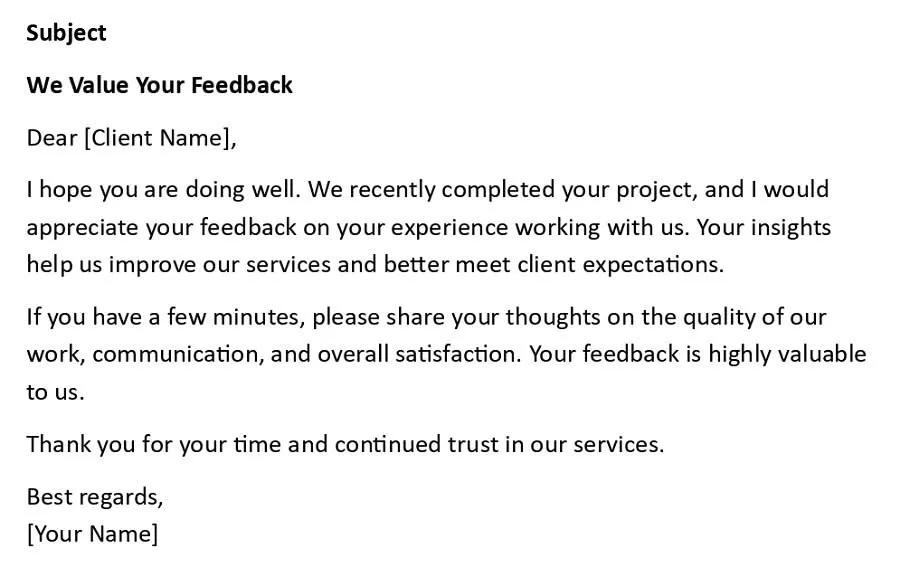
Template 2 - Requesting Client Feedback After a Project
Client feedback is essential for improving service delivery and strengthening the business relationship. This template balances professionalism with genuine interest in improvement.
The Template
Subject: Your Feedback on the [Project Name] Engagement
Dear [Client's Name],
Now that the [project name] has been delivered and [has been live for X weeks / the initial results are in / the transition is complete], I wanted to take a moment to thank you for the opportunity to work together and to ask for your feedback on the experience.
Your perspective as the client is invaluable in helping us improve, and I want to make sure we are delivering the level of service and quality that [client's company name] deserves.
I would appreciate your candid thoughts on:
Deliverable quality: Did the final output meet your expectations? Were there areas where the quality exceeded or fell short of what you envisioned?
Communication and responsiveness: How well did we keep you informed throughout the project? Were there points where you wanted more or less communication?
Timeline and process: Did the project progress at an appropriate pace? Were there any bottlenecks or process friction points that we could improve?
Overall experience: On a scale of 1 to 10, how would you rate your overall experience working with [me/our team]? What would it take to move that number closer to 10?
Would you work with us again? I want to be direct about this because it is the most important question. If there are any hesitations, I would rather hear them now and address them than have them go unspoken.
A brief email reply, a quick phone call, or even a short meeting would all be welcome. I am also happy to send a more structured survey if you prefer that format.
Thank you for your partnership on this project. Regardless of the feedback, I valued the collaboration.
Warm regards,
[Your Name]
[Title]
[Phone]
Why This Template Works
The direct question about whether they would work with you again cuts through politeness and gets to the core issue. The 1-to-10 scale provides a concrete framework that is easy to respond to. Offering multiple response formats accommodates different client preferences and communication styles.
Template 3 - Requesting 360-Degree Feedback from Team Members
Multi-source feedback is most valuable when it comes from the people who work alongside you daily. This template is designed for peer or cross-functional feedback.
The Template
Subject: Your Input Requested - Quick Feedback on Working with Me
Hi [Colleague's Name],
I am in the process of gathering feedback from the people I work with most closely as part of my professional development plan. Your perspective matters to me because [specific reason, e.g., we collaborate weekly on the analytics pipeline, you have seen my presentation style in multiple client meetings, we have worked together on cross-functional projects for the past year].
I would appreciate your honest thoughts on any or all of the following:
Collaboration: What is it like to work with me on shared projects? What do I do well, and what could I improve?
Communication: Is there anything about how I communicate - in meetings, over email, in Slack - that could be more effective?
Reliability: Do I follow through on commitments? Are there areas where my reliability could improve?
One thing to change: If you could change one thing about working with me, what would it be?
Please be candid. I genuinely want constructive criticism, not just reassurance. I have received tough feedback before and acted on it - for example, [brief real example of feedback you received and changed based on, e.g., I was told my status updates were too detailed, so I switched to a bullet-point format that people found much easier to scan]. I am looking to continue that pattern.
A few sentences via email or a 10-minute coffee chat would both work. Whatever is easiest for you. And there is no need to rush - anytime in the next two weeks is fine.
Thank you,
[Your Name]
Why This Template Works
Sharing a concrete example of previous feedback you acted on is the single most effective way to signal genuine openness. It proves you will not be defensive and that their effort will lead to real change. The "one thing to change" question is particularly powerful because it gives explicit permission for critical feedback while limiting the scope so it feels manageable.
Template 4 - Requesting Feedback from a Mentor
Mentor feedback differs from manager or peer feedback because the relationship is built on development. This template leverages that dynamic.
The Template
Subject: Seeking Your Guidance - Career Feedback
Dear [Mentor's Name],
I hope you are well. I always value our conversations, and I am reaching out because I am at a point in my career where I would benefit from your honest assessment.
Where I am:
[Brief paragraph about your current role, responsibilities, and recent developments. E.g., "I have been in my current role as Senior Analyst for 18 months. I recently took on managing a small team of three and have been leading the quarterly business review process for our division."]
Where I want to go:
[Brief paragraph about your goals. E.g., "My goal is to move into a Director-level role within the next two to three years. I believe my analytical skills are strong, but I know I need to develop more strategic and leadership capabilities."]
What I would like your feedback on:
Based on what you know of my strengths and weaknesses, what are the biggest gaps I need to close to reach my goal?
Are there experiences or projects I should be seeking out to build the skills I am missing?
Is there anything about how I present myself professionally - my communication, my executive presence, my personal brand - that could be holding me back?
Am I being realistic about my timeline and goals? If not, what adjustments would you suggest?
I know these are big questions, and I do not expect you to address all of them. Whatever you have time and energy to share would be helpful. I am happy to discuss over coffee, a phone call, or even email if that is easier for your schedule.
Thank you for continuing to invest in my development. It means more than you know.
Gratefully,
[Your Name]
Why This Template Works
Mentors are most helpful when they understand both where you are and where you want to go. This template provides that context clearly. The questions are forward-looking and career-oriented, which aligns with the mentoring relationship's purpose. Acknowledging the size of the ask and offering flexibility on format shows respect for the mentor's time.
Template 5 - Requesting Feedback After a Presentation
Presentations are visible, high-stakes moments where feedback can produce immediate improvements. This template should be sent within 24 to 48 hours of the presentation.
The Template
Subject: Quick Feedback on [Presentation Name/Topic]?
Hi [Name],
Thank you for attending my presentation on [topic] at [meeting/event] on [date]. I am working on improving my presentation skills and would value your perspective.
I would appreciate your honest take on any of the following:
Content:
- Was the information organized logically? Were there points that felt unclear or unnecessary?
- Did the level of detail feel right, or was there too much or too little?
- Were the key takeaways clear?
Delivery:
- How was my pacing? Did I speak too quickly, too slowly, or at a good rhythm?
- Was my energy and engagement level appropriate for the audience?
- Were there any verbal tics or habits you noticed (e.g., filler words, reading from slides)?
Visual aids:
- Were the slides supportive of the content, or did they distract?
- Was the information on the slides easy to read and understand?
Overall impact:
- On a scale of 1 to 10, how engaging was the presentation?
- What is the one thing I should change for next time?
Even a one-line response would be helpful. I am genuinely trying to improve and appreciate candid input.
Thanks,
[Your Name]
Why This Template Works
Presentation feedback is most useful when it is specific to the distinct elements of presenting: content, delivery, and visuals. Breaking the request into categories helps the respondent focus on what they noticed most. The 1-to-10 scale and "one thing to change" question are quick to answer, which increases response rates.
Template 6 - Requesting Feedback After a Failed Project
Seeking feedback after a failure demonstrates exceptional professional maturity. It also turns a setback into a growth opportunity.
The Template
Subject: Learning from [Project Name] - Your Perspective Requested
Dear [Name],
As you know, the [project name] did not achieve the results we were aiming for. I have been reflecting on what happened and what I could have done differently, and I would value your perspective as someone who [was involved in the project / observed the process / has experience with similar initiatives].
I am not looking for reassurance or someone to share the blame. I genuinely want to understand what went wrong and what I can learn from it. Specifically:
Planning and scoping: In retrospect, were there warning signs during the planning phase that I missed or underestimated?
Execution: Were there decisions I made during the project that you disagreed with at the time but did not raise? If so, I want to hear about them so I can be more receptive to dissenting views in the future.
Communication: Did I communicate effectively throughout the project, or were there gaps that contributed to the outcome?
Leadership: How did I handle the pressure as things started going off track? Was there anything about my leadership approach that made the situation worse?
What would you have done differently? If you had been leading this project, what would you have changed?
I recognize this is an uncomfortable topic, and I appreciate your willingness to engage with it honestly. I have already identified several things I plan to do differently next time, but I know my self-assessment has blind spots.
Thank you for your candor. I promise it will be received constructively.
Best,
[Your Name]
Why This Template Works
Acknowledging the failure directly and taking ownership creates a safe space for honest feedback. The explicit statement that you are not looking for reassurance or blame-sharing removes the two most common default responses to failed projects. Asking "What would you have done differently?" invites constructive alternatives rather than just criticism.
Template 7 - Requesting a Testimonial
Testimonials serve a different purpose than feedback - they are external-facing endorsements. This template requests one while making it easy for the person to write.
The Template
Subject: Would You Be Willing to Provide a Brief Testimonial?
Dear [Client/Colleague/Partner's Name],
I hope this message finds you well. I am updating my [website, portfolio, LinkedIn profile, proposal materials], and I would be grateful if you would be willing to provide a brief testimonial about your experience working with me.
I know writing testimonials from scratch can be daunting, so to make it easier, here are a few prompts you might consider:
- What was the project or situation you worked with me on?
- What specific results or value did I deliver?
- What stood out about the way I [worked, communicated, solved problems, managed the project]?
- Would you recommend working with me to others? Why?
A testimonial of three to five sentences would be ideal, but even one or two sentences would be valuable. Here is an example of the tone and length I am looking for:
"[Your Name] led our [project type] with exceptional [quality]. Their [specific skill] resulted in [specific outcome]. I would not hesitate to recommend them for [type of work]."
Feel free to adjust, expand, or completely rewrite that - it is just a starting point. I want the testimonial to reflect your genuine experience.
If you are comfortable with this, please send it via email and let me know how you would like to be credited (full name, title, company, or anonymous).
Thank you for considering this, and thank you for the positive working relationship.
Best regards,
[Your Name]
Why This Template Works
Providing prompts and an example dramatically increases the likelihood of receiving a testimonial because it reduces the cognitive burden. Asking how they want to be credited shows respect for their privacy and professional boundaries. The example template gives them something to react to, which is always easier than starting from a blank page.
Template 8 - Exit Interview Follow-Up Feedback Request
After leaving a company, you can sometimes get more candid feedback from former colleagues and managers who no longer have a professional stake in the relationship.
The Template
Subject: Catching Up - and a Candid Feedback Request
Hi [Former Manager/Colleague's Name],
I hope you are doing well at [company name]. It has been [timeframe] since I moved on to [current company/situation], and I have been reflecting on my time at [former company] with appreciation.
Now that some time and distance have passed, I wanted to ask you something I probably should have asked while we were working together. I am looking for genuinely candid feedback about my performance and professional presence during my time on the team.
Now that we are no longer in a manager-report dynamic [or working side by side], I am hoping you might feel more comfortable being direct. Some things I am curious about:
- What was I genuinely good at, and what was I not as good at as I might have thought?
- Was there feedback you held back during my time there that might be useful for me to hear now?
- How was I perceived by others on the team or in the organization? Were there reputation issues I should have been aware of?
- If you were coaching me today, what would you tell me to focus on?
I promise to receive whatever you share with gratitude and without defensiveness. This is purely a learning exercise for me as I continue to grow in my career.
If this feels like too much to put in an email, I would happily buy you coffee or jump on a call.
Thank you - and thank you for the time we worked together.
Warmly,
[Your Name]
Why This Template Works
The explicit acknowledgment that the professional dynamic has changed opens the door for a level of candor that was impossible while working together. Asking about perception and held-back feedback targets the most valuable information - the things you could not have accessed through normal channels. The promise of no defensiveness is critical given that this conversation is happening outside the typical feedback framework.
Template 9 - Requesting Peer Review of Work Product
Before submitting an important deliverable, getting a peer review can catch issues you missed and improve overall quality.
The Template
Subject: Peer Review Request - [Document/Project Name]
Hi [Colleague's Name],
I am finalizing [document/proposal/report/design] for [client/stakeholder/meeting], and I would really value a fresh set of eyes on it before submission. I am reaching out to you specifically because [specific reason, e.g., you have strong analytical skills, you know this client well, you have experience with this type of deliverable, you tend to catch things others miss].
The document is attached [or linked here: URL]. It is [X pages/slides/sections] and should take approximately [estimated time] to review.
What I am looking for:
- Accuracy: Are there any factual errors, inconsistencies, or unsupported claims?
- Clarity: Are there sections that are confusing, poorly organized, or could be communicated more effectively?
- Completeness: Is anything important missing? Are there questions the reader would have that the document does not address?
- Tone and audience fit: Is the tone appropriate for [the intended audience]? Does it strike the right balance between [technical and accessible / formal and conversational / thorough and concise]?
- Your honest reaction: When you finish reading, what is your overall impression? Does it accomplish what it sets out to do?
If you can provide feedback by [date], that would be ideal. I am submitting the final version on [date].
No need for a detailed line-by-line markup unless you want to - even high-level observations in a quick email would be incredibly helpful.
Thank you for taking the time. I am happy to reciprocate anytime you have something you would like reviewed.
Best,
[Your Name]
Why This Template Works
Telling them exactly what to look for prevents the common problem of reviewers not knowing what kind of feedback is expected. Estimating the time commitment shows respect for their schedule and helps them decide if they can accommodate the request. Offering reciprocity makes it a collaborative exchange rather than a one-way favor.
Template 10 - Requesting Feedback on a Proposal or Idea
Before formally pitching an idea or submitting a proposal, getting input from a trusted colleague can help you strengthen your case and anticipate objections.
The Template
Subject: Want Your Take on Something Before I Pitch It
Hi [Name],
I am putting together a proposal for [brief description of the idea, e.g., restructuring our client onboarding process, implementing a new project management tool, creating a mentorship program for junior staff] and would love your input before I present it to [decision-maker/leadership/the team].
I am reaching out to you because [specific reason, e.g., you have the most experience with our current onboarding process, you are the most technically savvy person on the team, you tend to think critically about proposals in ways that make them stronger].
Here is the summary version:
The problem: [One to two sentences about what you are trying to solve.]
The proposed solution: [Two to three sentences about your idea.]
The expected impact: [One to two sentences about the outcomes you anticipate.]
The investment required: [Time, money, resources needed.]
The full proposal is [attached / linked here].
What I would like your feedback on:
- Does the problem statement resonate? Am I framing the issue in a way that will land with [decision-maker]?
- Is the solution compelling? Are there obvious alternatives I have not considered?
- Where is it weakest? If you were going to poke holes in this proposal, where would you start?
- What objections should I anticipate? Based on your knowledge of [the organization/the decision-maker/the team], what concerns will come up?
- Would you support this? If this came across your desk, would you approve it? Why or why not?
Even a five-minute read-through and a few bullet points in reply would be hugely valuable. I want to make sure this proposal is as strong as possible before it is formally presented.
Thank you for your time and insight.
Best, [Your Name]
Why This Template Works
Providing a summary version shows respect for the reviewer's time while the full document is available for those who want depth. The question "Where is it weakest?" invites exactly the kind of critical feedback that improves proposals. Asking "Would you support this?" forces the reviewer to take a position, which produces the most honest response.
How to Act on Feedback You Receive
Requesting feedback is only valuable if you do something with it. Here is a systematic approach.
Step 1 - Receive Without Defending
When feedback arrives, your only response should be gratitude. Do not explain, justify, argue, or add context. Even if the feedback feels unfair, say "Thank you for being honest. I appreciate you taking the time to share this." You can process and evaluate the feedback later. In the moment, your goal is to make the person glad they were candid.
Step 2 - Identify Patterns
A single piece of feedback from one person might be idiosyncratic. But if three different people mention that your emails are too long, that your meeting facilitation is disorganized, or that you interrupt others, that is a pattern you need to address. Look for themes across all feedback sources before deciding where to focus.
Step 3 - Prioritize
You cannot address every piece of feedback simultaneously. Choose the one or two themes that would have the highest impact on your effectiveness and start there. Criteria for prioritization include frequency of mention, impact on career goals, and feasibility of change.
Step 4 - Create Specific Action Items
"Be more concise" is not an action item. "Limit all non-technical emails to under 200 words and use bullet points for any message with more than two key points" is an action item. Translate feedback themes into specific, measurable behavioral changes.
Step 5 - Close the Loop
Follow up with your feedback providers after you have implemented changes. "You mentioned that my meeting agendas were vague. I have been using a more structured format for the past month. Have you noticed an improvement?" This closes the loop, demonstrates that you took their input seriously, and encourages them to be candid again in the future.
When and How Often to Request Feedback
Regular Check-Ins
From your manager: Request formal feedback at least quarterly, with informal check-ins monthly. Do not wait for annual performance reviews.
From peers: Once or twice per year for general feedback, plus specific requests after collaborative projects or significant interactions.
From clients: After every major project delivery or at defined milestones during longer engagements.
From mentors: During scheduled mentoring sessions, typically monthly or quarterly depending on the relationship.
Triggered Requests
In addition to regular cadence, request feedback after specific events:
- After a major presentation, pitch, or speaking engagement
- After completing a significant project or deliverable
- After a failed initiative or missed target
- After your first 30, 60, or 90 days in a new role
- After a significant change in your responsibilities
- Before a performance review to identify blind spots early
Tools and Formats for Collecting Feedback
Anonymous Surveys
When you suspect people will not be candid in direct communication, anonymous surveys can unlock honest feedback. Tools like Google Forms, SurveyMonkey, or Typeform allow you to create brief surveys with both rating scales and open-ended questions. Share the anonymous link and make clear that responses cannot be traced back to individuals. The trade-off is that you cannot ask follow-up questions, so make your survey questions as specific as possible.
Structured One-on-One Conversations
For feedback that requires nuance and depth, a dedicated conversation is often the best format. Schedule a 15 to 30 minute meeting with the specific topic of feedback. Share your questions in advance so the person can prepare. During the conversation, listen more than you speak. Take notes. Ask "Can you give me a specific example?" when feedback is vague. Resist the urge to explain or defend at any point during the conversation.
Written Feedback via Email
Email feedback has the advantage of being documented and allowing the respondent to choose their own timing. It works best when you ask specific, targeted questions rather than open-ended ones. The templates in this guide are designed for this format.
Real-Time Feedback Mechanisms
For ongoing projects or regular interactions, consider establishing a lightweight feedback mechanism. This could be as simple as a shared document where team members can add observations throughout a project, or a brief retrospective meeting at the end of each sprint or milestone. Real-time feedback captures details that are lost in retrospective requests.
Combining Multiple Formats
The most comprehensive feedback comes from combining formats. Use anonymous surveys for broad team feedback, one-on-one conversations for depth from key individuals, and email for specific questions to people with limited availability. Triangulating across formats reveals consistent patterns that any single method might miss.
Final Thoughts
The ability to request and act on feedback is a career multiplier. It accelerates your development, strengthens your professional relationships, and builds a reputation as someone who is committed to continuous improvement. The templates in this guide give you a starting point for every common scenario, but the most important element is not the exact words you use - it is the genuine intention behind them.
People can tell the difference between someone who asks for feedback as a formality and someone who truly wants to grow. Be the latter, and the quality of feedback you receive will reflect that sincerity. Start with one template this week, send it to someone whose perspective you value, and commit to acting on what you learn.
Frequently Asked Questions
How do you ask for honest feedback without making people uncomfortable?
The key to getting honest feedback is making the request specific and low-stakes. Instead of asking ‘How did I do?’ which puts people on the spot, ask targeted questions like ‘What is one thing I could improve about my presentation delivery?’
Specificity gives the respondent permission to be critical about a defined area rather than making a general judgment about you as a person.
Offer multiple response channels, such as email, anonymous survey, or a brief conversation, so people can choose their comfort level.
Emphasize that you genuinely want constructive criticism by sharing an example of feedback you previously received and acted on. Avoid defensive language in your request, and never argue with or justify yourself when feedback is given, as this guarantees you will never receive honest feedback again.
When is the best time to request feedback after completing a project?
Request feedback within one to two weeks of project completion. This window ensures the experience is still fresh in everyone’s mind while allowing enough time for initial emotions to settle and outcomes to become visible.
For presentations or meetings, request feedback within 24 to 48 hours while details are still vivid. For larger projects, waiting until measurable results are available, typically one to four weeks, allows reviewers to provide more substantive input.
Avoid requesting feedback during high-stress periods like end-of-quarter rushes or immediately before holidays.
If you are requesting client feedback, time your request to coincide with the delivery of final deliverables or the resolution of any outstanding issues. Never ask during an active dispute or complaint resolution process.
What should you do with feedback once you receive it?
First, acknowledge and thank every person who provided feedback, regardless of whether you agree with their assessment. This encourages future honesty. Next, identify patterns across multiple responses rather than fixating on any single comment.
Create an action plan that addresses the most frequently mentioned areas for improvement, with specific and measurable goals. Share your action plan with the feedback providers when appropriate, as this demonstrates you took their input seriously and closes the feedback loop.
Schedule a follow-up check-in after implementing changes to assess progress. Document feedback trends over time to track your development. Most importantly, resist the urge to explain or defend yourself. Even if feedback feels unfair, there is usually a perception gap worth understanding.