
Starting a new role is both exciting and nerve-wracking, and one of the first professional challenges you face is crafting the right introduction email. Whether you are a new manager meeting your direct reports, an employee joining a department, or someone facilitating an introduction between colleagues, the words you choose in that first message shape how people perceive you.
A strong introduction email establishes credibility, signals approachability, and sets the foundation for productive working relationships. This comprehensive guide provides ten copy-paste templates for every introduction scenario, along with expert guidance on tone, timing, and content so you can make a lasting positive first impression.
Why Your Introduction Email Matters More Than You Think
First impressions in the workplace are formed quickly and tend to stick. Research in organizational psychology consistently shows that initial perceptions of competence and warmth influence how colleagues interact with you for months afterward. Your introduction email is often the very first data point your new team has about you as a person, not just a name on an org chart.
A well-crafted introduction email accomplishes several things simultaneously. It demonstrates that you are thoughtful and professional. It gives your new colleagues enough context to understand your background and expertise. It signals that you are approachable and interested in building relationships. And it sets expectations for how you communicate - your tone, your level of formality, and your attention to detail.
Conversely, a poorly written or missing introduction email can create an information vacuum that people fill with assumptions. If you never introduce yourself, colleagues may perceive you as aloof or uninterested. If your email is too long and self-congratulatory, people may brace themselves for a difficult personality. If it is too brief or generic, you miss an opportunity to start building rapport from day one.
The Psychology of First Impressions in Professional Settings
People evaluate new colleagues on two primary dimensions: competence and warmth. Your introduction email needs to demonstrate both. Competence comes through in your professional background, relevant experience, and clear writing. Warmth comes through in your expressed enthusiasm for joining the team, your interest in getting to know people, and your willingness to be a little vulnerable by sharing something personal.
The balance between these two dimensions shifts depending on your role. A new manager should lean slightly more toward warmth to ease any anxiety the team might feel about new leadership. A new individual contributor should lean slightly more toward competence to establish credibility among peers. Either way, both elements need to be present.
What to Include in Your Introduction Email
Every effective introduction email contains five core elements, regardless of the specific scenario.
Your Name and Role
This seems obvious, but be specific. Do not just say "I am the new marketing person." State your full name, your exact title, and where you sit in the organization. If your role is new, briefly explain why it was created.
Relevant Professional Background
Share two to three highlights from your career that are relevant to your new role. This is not a resume recitation. Choose experiences that help your new team understand what you bring to the table and how you can contribute. If you are joining a product team, mention your product experience. If you are managing a sales team, reference your sales leadership background.
A Personal Touch
Include one or two sentences about yourself outside of work. This could be a hobby, where you are from, your family, or something you are passionate about. This element humanizes you and gives colleagues natural conversation starters when you meet in person or on video calls.
Your Communication Preferences
Especially important for managers, but useful for anyone. Let people know how you prefer to communicate - whether you favor Slack messages over email, whether you keep your calendar open for impromptu chats, or whether you prefer scheduled meetings. This reduces friction in early interactions.
An Invitation to Connect
Close with a genuine invitation for people to reach out. Suggest a specific action, such as "I would love to grab coffee this week" or "Please do not hesitate to send me a message on Slack to say hello." Vague closings like "looking forward to working with you" are fine but less effective than a concrete next step.
What to Keep Private in Your Introduction Email
Not everything belongs in an introduction email, even if you are trying to be open and authentic.
Salary and compensation details. Never reference your pay, equity, or benefits in a team introduction.
Reasons for leaving your previous role. Even if you left on great terms, this information is unnecessary and can invite speculation.
Strong opinions about the company or team. You have not earned the credibility to critique processes or suggest changes on day one.
Detailed personal struggles. While a personal touch is important, keep it light. Save deeper personal sharing for one-on-one relationships that develop over time.
Political or religious views. These are divisive topics that have no place in a professional introduction.
Negative comments about predecessors. If you are replacing someone, never reference them negatively, even implicitly.
Timing Your Introduction Email for Maximum Impact
The timing of your introduction email affects how it is received. Here are the guidelines that experienced professionals follow.
For New Employees and Managers
Send your introduction email on your first day, ideally mid-morning between 9:30 and 11:00 AM in your team's primary time zone. By mid-morning, most people have cleared their urgent overnight emails and are in a receptive headspace. Avoid sending before business hours or after 5:00 PM, as this can signal workaholism or set uncomfortable expectations.
For Third-Party Introductions
When introducing two contacts to each other, send the email during standard business hours on a Tuesday, Wednesday, or Thursday. Monday mornings are too hectic, and Friday afternoons mean the email sits unread over the weekend, losing momentum.
For Remote and Global Teams
If your team spans multiple time zones, aim for a window that overlaps with the majority of team members' working hours. If that is not possible, choose the time zone where most of your direct collaborators are located. Acknowledge the time zone challenge in your email - it shows awareness and consideration.
Template 1: New Manager Introducing Themselves to Their Team
Subject: Excited to Join the Team - Introduction from [Your Name]
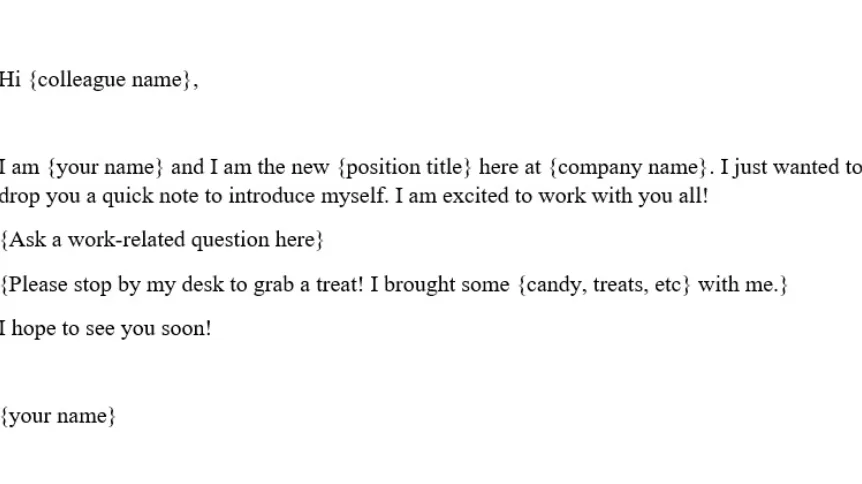
Hello everyone,
I am [Your Name], and I am thrilled to be joining [Company Name] as your new [Title]. My first day is [Date], and I wanted to reach out before then to introduce myself and share a bit about my background.
I have spent the last [Number] years in [Industry/Field], most recently at [Previous Company] where I led a team of [Number] focused on [Key Responsibility]. Before that, I worked at [Earlier Company] where I [Notable Achievement]. What drew me to [Company Name] was [Specific Reason - the product, the mission, the team's reputation], and I am genuinely excited about the work ahead.
A few things about how I like to work: I believe in open communication, regular one-on-ones, and creating an environment where everyone feels comfortable sharing ideas and concerns. I plan to spend my first few weeks listening and learning - understanding how the team operates, what is working well, and where I can be most helpful. I am not coming in with a predetermined agenda to change things. I want to understand the current state before forming any opinions.
On a personal note, I live in [City] with [Family Detail if Comfortable]. Outside of work, I am passionate about [Hobby/Interest]. I also [Fun Fact About Yourself].
I will be scheduling introductory one-on-one meetings with each of you during my first two weeks. In the meantime, please feel free to reach out to me anytime at [Email] or [Slack Handle]. I am looking forward to getting to know each of you.
Best regards, [Your Name]
Template 2: New Employee Introducing Themselves to the Team
Subject: Hello from [Your Name] - New [Title] on the Team
Hi team,
My name is [Your Name], and I am excited to be joining [Team Name] as a [Title] starting [Date]. [Manager's Name] suggested I reach out to introduce myself, and I was happy to take the opportunity.
A bit about my background: I come from [Previous Company/Industry] where I spent [Number] years working on [Relevant Work]. I have experience in [Skill 1], [Skill 2], and [Skill 3], and I am looking forward to applying that knowledge here while also learning from all of you. I was particularly drawn to this role because [Specific Reason Related to the Team's Work].
Outside the office, I am a big fan of [Hobby 1] and [Hobby 2]. I am originally from [City/Region], and I recently [Relevant Personal Update if Comfortable Sharing, such as "moved to the area" or "became a parent"].
I know there is a lot to learn in the first few weeks, and I appreciate your patience as I get up to speed. I would love to set up brief introductory chats with anyone who has time. Feel free to grab me in the hallway, send me a message on Slack at [Handle], or drop me an email anytime.
Looking forward to working with all of you.
Cheers, [Your Name]
Template 3: Introducing Two Professional Contacts
Subject: Introduction - [Person A Name] and [Person B Name]
Hi [Person A] and [Person B],
I wanted to connect the two of you because I think you would benefit from knowing each other.
[Person A Name] is [Title] at [Company]. [He/She/They] specializes in [Area of Expertise] and recently [Notable Achievement or Current Project]. [Person A], I mentioned to [Person B] that you have been exploring [Specific Topic or Need].
[Person B Name] is [Title] at [Company]. [He/She/They] has deep experience in [Area of Expertise] and [Relevant Accomplishment]. [Person B], I thought your work in [Specific Area] would be directly relevant to what [Person A] is working on.
I will let the two of you take it from here. I think a conversation would be mutually valuable, whether that is a quick coffee or a 20-minute video call.
Best, [Your Name]
Why this works: This template provides enough context about each person that they understand the value of connecting without having to do additional research. It gives both parties a clear reason to engage and suggests a low-commitment next step.
Template 4: Self-Introduction to a New Department
Subject: Introduction - [Your Name], New [Title] in [Department]
Hello [Department Name] team,
I am writing to introduce myself as the newest member of the [Department] team. My name is [Your Name], and I am joining as [Title], reporting to [Manager's Name]. My first day is [Date].
I am coming to [Company Name] from [Previous Company] where I served as [Previous Title] for [Duration]. In that role, I was responsible for [Key Responsibilities], and I am most proud of [Specific Achievement with Metrics if Possible]. Before that, I spent [Duration] at [Earlier Company] in [Role], which gave me a strong foundation in [Relevant Skill Area].
What attracted me to this opportunity was [Specific Element - the department's recent work, the company's direction, a specific project]. I am particularly excited to contribute to [Specific Initiative or Area] and to learn from a team that has such a strong reputation in [Area].
I want to be transparent about my approach: I plan to spend the first month absorbing as much as I can about how the department operates, the projects in flight, and the team dynamics before jumping to conclusions or suggestions. I value collaboration and believe that the best ideas come from diverse perspectives, so I am eager to hear your insights and experiences.
A little about me personally: I am based in [City], and when I am not working, you can find me [Hobby 1] or [Hobby 2]. I am also an avid [Interest], so if anyone shares that passion, I would love to chat.
Please feel free to reach out to me at [Email] or connect with me on [Slack/Teams] at [Handle]. I plan to schedule brief meet-and-greet conversations with as many of you as possible over the coming weeks.
Thank you for the warm welcome, and I look forward to being part of this team.
Warm regards, [Your Name]
Template 5: Introducing a Replacement to Your Team
Subject: Introducing [New Person's Name] - Your New [Title]
Hi team,
I am pleased to introduce [New Person's Name], who will be joining us as [Title] on [Start Date]. [He/She/They] will be taking over [Specific Responsibilities or Role Description] as I [Transition to New Role/Depart the Company].
[New Person's Name] brings [Number] years of experience in [Relevant Field], most recently at [Previous Company] where [he/she/they] [Key Achievement]. [His/Her/Their] background in [Specific Skill Area] and [Another Skill Area] makes [him/her/them] an excellent fit for this role and our team.
I have been working closely with [New Person's Name] over the past [Timeframe] to ensure a smooth transition. [He/She/They] is already familiar with [Specific Projects or Processes] and is eager to dive in.
Here is what to expect in the coming weeks:
- [Date Range]: I will be completing handover documentation and introducing [New Person] to key stakeholders.
- [Date]: [New Person's Name] officially starts and will begin scheduling introductory meetings.
- [Date]: I will be available for questions through [Final Date], after which [New Person] will be your primary point of contact.
Please join me in welcoming [New Person's Name] to the team. I know [he/she/they] will be a tremendous asset.
[New Person], I will let you add a few words below.
Best, [Your Name]
[New Person's addition:]
Thank you, [Outgoing Person's Name], for the kind introduction.
Hi everyone - I am [Name], and I am honored to be joining this team. I have heard great things about the work you have been doing on [Specific Project], and I am looking forward to contributing. I plan to reach out to each of you individually over the next couple of weeks to introduce myself properly and learn about your work.
In the meantime, feel free to reach me at [Email] or [Slack Handle].
Looking forward to meeting all of you.
Best, [New Person's Name]
Template 6: Team Restructure Announcement with Introductions
Subject: Team Update - New Structure and Introductions
Hi everyone,
I want to share some updates about our team structure that take effect on [Date]. These changes are designed to [Reason - better align with our goals, improve collaboration, support our growth], and I want to make sure everyone has clarity on what is changing and what stays the same.
Here is the new structure:
[Sub-Team or Function 1] - Led by [Name], [Title] This group will focus on [Responsibilities]. Team members: [Names].
[Sub-Team or Function 2] - Led by [Name], [Title] This group will focus on [Responsibilities]. Team members: [Names].
[Sub-Team or Function 3] - Led by [Name], [Title] This group will focus on [Responsibilities]. Team members: [Names].
For those of you who are joining a new sub-team, your new team lead will be reaching out to schedule introductory conversations this week. Please bring any questions or concerns to those meetings - there are no wrong questions during a transition.
A few important things that are not changing:
- Your reporting relationship to [Name] remains the same.
- Current projects will continue without interruption.
- Our team's overall mission and goals remain [Brief Statement].
I know change can feel unsettling, even when it is positive. I am committed to making this transition as smooth as possible. I will be holding an open Q&A session on [Date] at [Time] for anyone who wants to discuss the changes in more detail.
Thank you for your flexibility and professionalism as we make this shift.
Best, [Your Name]
Template 7: New Hire Welcome from Team Lead
Subject: Welcome to the Team, [New Hire's Name]
Hi [New Hire's Name],
On behalf of the entire [Team Name] team, I want to officially welcome you to [Company Name]. We are genuinely excited to have you join us, and I want to make sure your first few days are as smooth and enjoyable as possible.
Here is what you can expect in your first week:
Day 1 ([Date]):
- Arrive at [Time] at [Location/Log in to Video Platform].
- [HR Contact Name] from HR will guide you through orientation from [Time] to [Time].
- I will meet you at [Time] for a welcome lunch with the team at [Restaurant/Virtual Lunch].
- Afternoon: Workstation setup and initial systems access.
Days 2-3:
- One-on-one meetings with each team member (I will send calendar invites).
- Overview of current projects and priorities.
- Introduction to our tools: [List Key Tools - Jira, Slack, Confluence, etc.].
Days 4-5:
- Deep dive into your primary project: [Project Name].
- Meeting with your onboarding buddy, [Buddy Name], who will be your go-to person for questions.
- End-of-week check-in with me to discuss how the first week went.
A few practical notes:
- Dress code: [Description].
- Parking: [Instructions].
- Lunch: [Team norms - e.g., "We usually order in on Tuesdays" or "There is a great cafeteria on the second floor"].
Your onboarding buddy [Buddy Name] ([Email]) is an excellent resource for the "how do I...?" questions that come up in the first few weeks. Do not hesitate to reach out to [him/her/them].
I will also be scheduling a 30-minute one-on-one with you on your second day to learn more about your goals and discuss how we can set you up for success.
Welcome aboard - we are glad you are here.
Best, [Your Name] [Title]
Template 8: Introduction After Acquisition or Merger
Subject: Introducing Myself - Looking Forward to Working Together
Hello [Team/Department Name],
My name is [Your Name], and I have been serving as [Title] at [Acquiring/Merging Company] for the past [Duration]. With the recent [acquisition/merger], I am going to be working closely with your team on [Specific Area], and I wanted to take a moment to introduce myself and share some context.
I understand that mergers and acquisitions come with uncertainty, and I want to be straightforward with you. My role in this transition is to [Specific Responsibility - e.g., "integrate our product development processes," "align our sales territories," "unify our customer support systems"].
I am not here to make sweeping changes without understanding what has made your team successful. My priority over the next [Timeframe] is to listen, learn, and understand your current workflows, strengths, and challenges.
A bit about my background: I joined [Company] [Duration] ago after spending [Number] years at [Previous Company]. My expertise is in [Area], and the project I am most proud of is [Brief Description]. I have been through [Number] integration processes before, and the most important lesson I have learned is that the people who know the work best are the ones already doing it.
Here is what you can expect from me in the coming weeks:
- I will be scheduling 30-minute introductory calls with each team lead and key contributors.
- I will attend your regular team meetings as an observer before making any recommendations.
- I will share a transition plan by [Date] that incorporates your input and feedback.
I know this is a period of change, and I respect that. If you have questions, concerns, or ideas, my door is always open. You can reach me at [Email], [Phone], or [Slack Handle]. I respond to all messages within 24 hours.
Looking forward to getting to know each of you.
Sincerely, [Your Name] [Title], [Company]
Template 9: Remote Team Introduction
Subject: Hello from [City/Time Zone] - [Your Name] Joining [Team Name]
Hi team,
I am [Your Name], and I am joining [Team Name] as [Title] starting [Date]. Since we are a distributed team, I wanted to introduce myself and share some details that will help us work together effectively.
About me professionally: I have [Number] years of experience in [Field], most recently at [Company] where I [Key Responsibility]. My strengths are in [Skill 1], [Skill 2], and [Skill 3]. I am particularly excited about contributing to [Specific Project or Goal] here at [Company].
Logistics and availability:
- I am based in [City], [Time Zone].
- My core working hours are [Start Time] to [End Time] [Time Zone], with some flexibility on either end.
- I am generally available for meetings between [Window] [Time Zone].
- I check messages throughout the day but may have delayed responses outside of core hours.
Communication preferences:
- For quick questions: [Slack/Teams] at [Handle] - I aim to respond within [Timeframe].
- For detailed discussions: Email at [Address] or schedule a video call.
- For urgent issues: [Phone/Text at Number].
- I prefer [Video On/Off] for meetings and [Specific Tool] for collaborative work.
About me personally: I live in [City] with [Family/Pets if Comfortable]. I am passionate about [Hobby 1] and spend most of my weekends [Activity]. I am a morning person, so if you see messages from me at dawn, please know I do not expect immediate responses.
I have set up virtual coffee chats over the next two weeks to meet everyone individually. You should see calendar invites soon. If the time does not work, please suggest an alternative - I want to make sure we connect.
Looking forward to being part of this team, even from [Number of Miles/Kilometers] away.
Best, [Your Name]
Template 10: Introduction to Cross-Functional Team
Subject: Introduction - [Your Name] from [Department], Joining [Project/Initiative Name]
Hi [Project Team Name],
I am [Your Name] from the [Department] team, and I will be joining the [Project/Initiative Name] as [Your Role on the Project - e.g., "the engineering representative," "the marketing lead," "the finance liaison"]. [Project Lead's Name] asked me to introduce myself and share what I will be contributing to this initiative.
What I bring to this project: In my role as [Title] in [Department], I focus on [Key Responsibilities]. For this project, I will be responsible for [Specific Contributions], including [Task 1], [Task 2], and [Task 3]. I have relevant experience from [Previous Project or Experience] that I think will be directly applicable here.
What I need from the team: To do my part effectively, I will need [Specific Inputs - e.g., "access to customer research findings," "regular updates on the development timeline," "alignment on budget constraints"]. I want to be upfront about what I need so we can establish good workflows from the start.
My availability for this project: I am allocating approximately [Number] hours per week to this initiative. I am available for standing meetings on [Days/Times] and can be flexible for ad hoc discussions. The best way to reach me is [Contact Method].
About me: I have been at [Company] for [Duration] and have worked on cross-functional projects including [Example 1] and [Example 2]. I find that the best cross-functional work happens when everyone is transparent about their priorities, constraints, and timelines, so I will always aim to be direct and clear in my communication.
I have reviewed the project brief and the materials [Project Lead] shared, and I am already impressed by the progress the team has made. Looking forward to contributing.
Best, [Your Name] [Title], [Department]
How to Adjust Your Tone for Different Audiences
The foundation of every introduction email is the same, but the tone should shift depending on your audience. Getting this right is the difference between an email that resonates and one that falls flat.
Writing to Your Direct Reports (as a New Manager)
When you are the new boss, your team is likely experiencing some anxiety. They may wonder if their jobs are secure, if processes will change, or if they will lose autonomy. Your tone should prioritize reassurance and openness.
Use language that emphasizes listening before acting: "I plan to spend my first few weeks understanding how the team works before making any suggestions." Avoid language that implies authority or change: "I have a lot of ideas for how we can improve" will set off alarm bells, even if your intentions are good.
Writing to Your Peers (as a New Team Member)
When joining as a peer, your tone should be confident but not boastful. You want to establish credibility without appearing competitive. Focus on what you can contribute to the team's existing work rather than what you have accomplished individually. Use collaborative language: "I am looking forward to learning from your expertise in [area]" rather than "I am bringing [number] years of experience to elevate the team."
Writing to Senior Leadership
If you are introducing yourself to people above you in the organization, be concise and focused on business value. Senior leaders receive many emails and appreciate brevity. Lead with your role and what you will be working on. Skip the personal details unless the culture strongly supports it. Close with a specific question or request rather than a generic pleasantry.
Writing to External Contacts
When introducing yourself to clients, vendors, or partners, lead with the relationship context. Explain what is changing and what is staying the same. Reassure them that the transition will not disrupt their experience. Provide your direct contact information and availability prominently.
Common Mistakes to Avoid
Even experienced professionals make avoidable errors in introduction emails. Here are the most common pitfalls and how to sidestep them.
Being Too Generic
"Hi, I am [Name] and I am excited to join the team. Looking forward to working with everyone." This tells your new colleagues nothing useful. Every introduction email should include at least one specific detail that makes it distinctly yours.
Writing a Novel
If your introduction email exceeds 400 words for an individual introduction or 600 words for a manager introduction with logistics, you are writing too much. Trim ruthlessly. Save the stories for face-to-face conversations.
Failing to Proofread
Your introduction email is your first writing sample. Typos, grammatical errors, or incorrect names signal carelessness. Read it aloud before sending. Have someone you trust review it if possible.
Forgetting the Call to Action
Every introduction email should end with a clear next step. "Feel free to reach out" is acceptable but weak. "I would love to schedule a 15-minute coffee chat this week - please grab time on my calendar at [Link]" is much stronger.
Sending to the Wrong Distribution List
Confirm the correct email list or group before sending. Introducing yourself to the wrong team or accidentally including people from outside the organization is an embarrassing but preventable mistake.
Ignoring Cultural Norms
If your new company has a casual culture, an overly formal email will feel stiff and out of place. If the culture is traditional, a casual email may undermine your credibility. When in doubt, ask HR or your hiring manager about communication norms before you send your introduction.
Following Up After Your Introduction Email
Sending the introduction email is just the beginning. What you do in the days and weeks that follow determines whether the positive first impression turns into genuine professional relationships.
Respond Promptly to Replies
When colleagues respond to your introduction email, reply within a few hours. Even a brief "Thank you for the warm welcome, [Name]. Looking forward to connecting" shows that you value their response.
Schedule One-on-One Meetings
Within your first two weeks, try to have a brief one-on-one conversation with every person you will work with regularly. These do not need to be long - 15 to 20 minutes over coffee or a video call is sufficient. Come prepared with a few questions about their role, their current projects, and how they prefer to collaborate.
Send a Follow-Up Note After Group Introductions
If your introduction was part of a group email or team meeting, consider sending brief individual messages to key collaborators. A simple "I appreciated your question about [topic] during the team meeting. I would love to discuss that further" shows attentiveness and initiative.
Keep a Connection Tracker
During your first month, keep a simple list of who you have met, what you discussed, and any follow-up actions. This prevents conversations from falling through the cracks and helps you build relationships systematically rather than haphazardly.
Adapting Templates for Specific Industries
While the core structure of an introduction email remains consistent across industries, certain fields have norms that should influence your approach.
Technology and Startups
Tech environments often favor brevity and informality. You can skip formal salutations and use a conversational tone. Mentioning specific technologies you work with or open-source projects you contribute to can be effective icebreakers. Include your GitHub profile or portfolio link if relevant.
Finance and Legal
These industries tend toward formality. Use full titles, maintain a professional tone throughout, and keep personal details minimal. Credentials and certifications carry significant weight, so mention them naturally within your professional background.
Healthcare
Introduction emails in healthcare settings should reference your clinical specialties, certifications, and patient population experience. Colleagues need to know your qualifications to collaborate effectively. Privacy considerations are heightened, so be especially careful about what you share.
Education
Academic introductions often include your educational background more prominently than other industries. Mentioning your research interests, teaching philosophy, or publications can help colleagues identify collaboration opportunities.
Creative Industries
In advertising, design, media, and similar fields, your introduction email can be slightly more creative in tone and structure. Including a link to your portfolio or recent work is expected and appreciated. Just ensure creativity does not come at the expense of clarity.
Final Thoughts on Making a Strong First Impression
Your introduction email is one small piece of a much larger onboarding puzzle, but it is a piece that you have complete control over. Take the time to craft it thoughtfully, personalize it for your specific audience, and send it at the right moment. Then follow through with the genuine curiosity and openness you expressed in the email. The best introduction emails are not just well-written messages - they are accurate previews of the kind of colleague you will be.
Remember that everyone on your new team was once the new person too. They understand the uncertainty that comes with starting fresh, and most people are genuinely happy to welcome a new colleague. Your introduction email simply makes it easier for them to do so.
How to End an Email with Just Your Name?
Ending an email with just your first name is appropriate only in ongoing internal threads with colleagues who know you - never for first contact, external correspondence, or any formal context. Formal emails require a sign-off ('Best regards,'), a blank line, your full name, title, and contact details.
The introduction email templates in this guide use full signature blocks because they produce cleaner, more trustworthy introductions than name-only closings. If you want a warm, brief internal close, 'Best, [Firstname]' or 'Thanks, [Firstname]' covers that without dropping the sign-off. The one-word name close works in texting, not in professional email.
Frequently Asked Questions
How long should an introduction email to a new team be?
An effective introduction email should be between 150 and 250 words. This length gives you enough space to share your name, role, relevant background, and a personal touch without overwhelming recipients. People skim emails, especially group messages, so brevity works in your favor.
Open with your name and new position, follow with two to three sentences about your professional background, add one line about a personal interest or what excites you about the role, and close with an invitation to connect.
If you are a manager introducing yourself to a large team, you can stretch to 300 words to include your leadership philosophy and availability. Avoid attaching your full resume or listing every accomplishment. Save deeper conversations for one-on-one meetings.
When is the best time to send an introduction email to a new team?
Send your introduction email on your first day or within the first 24 hours of starting. The ideal window is mid-morning, between 9:30 and 11:00 AM in your team’s primary time zone, when most people are actively checking email but have cleared their early-morning backlog. Avoid sending on Friday afternoons or Monday mornings when inboxes are already crowded.
If you are a manager, coordinate with HR or your predecessor so your email does not conflict with an official announcement. For remote teams spanning multiple time zones, aim for a window that overlaps with the majority of your team’s working hours. If you are being introduced by someone else, confirm the timing with them so you can follow up promptly with your own message.
What should you avoid saying in a team introduction email?
Avoid oversharing personal details such as your home address, salary, reasons for leaving your last job, or negative comments about previous employers. Do not make promises about changes you plan to implement, especially as a new manager, because this can create anxiety before you have assessed the situation.
Skip jargon-heavy descriptions of your credentials that may come across as boastful.
Avoid humor that could be misinterpreted in writing, particularly sarcasm or cultural references that may not translate across a diverse team.
Do not use an overly casual tone with slang or abbreviations in your first communication, even if the company culture is relaxed. Finally, never CC people outside the intended team without permission, and do not reply-all to an existing thread to introduce yourself.