
The first email a client receives from you sets the tone for the entire relationship. It tells the client, within a few seconds, whether the person writing is a thoughtful partner who understands their situation or another account manager sending another generic note. A strong introduction email does more than exchange names and titles.
It frames the nature of the working relationship, signals the level of attention the client can expect, and earns the first small increment of trust that every subsequent interaction builds on. A weak one, by contrast, gets filed away without response and becomes the reason your next message has to work twice as hard to land.
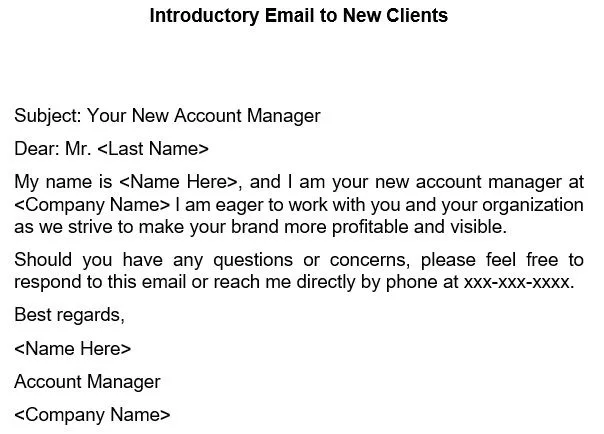
This guide provides 10 carefully written introduction email templates for the most common scenarios, from a brand new account manager greeting, to an account takeover, to first outreach and post meeting follow up, each paired with the thinking behind why it works.
What Makes a Client Introduction Email Actually Work
An introduction email is not a business card. It is the opening move in a relationship that you want to last years, and the quality of that opening shapes everything that follows. A good introduction email has three jobs to do, all of them quietly, all of them in the first 150 words.
Job One - Establish Who You Are and Why You Are the Right Person
Clients are busy. Before they commit any attention to a relationship, they want to know that the person writing is credible, aligned with their needs, and worth the time it will take to engage. This is not about listing credentials. It is about landing a single clear impression of competence and care.
Job Two - Demonstrate That You Understand Their Context
A generic introduction signals that the sender sees the client as interchangeable. A specific introduction signals that the sender has done their homework and sees the client as a particular business with a particular situation. The difference is often a single sentence, but that sentence is the one the client remembers.
Job Three - Make the Next Step Easy
An introduction email that ends with let me know if I can be of any help places the burden of action on the client. An introduction email that ends with a specific, low friction next step removes that burden. The best introductions offer a clear path forward without demanding a large time commitment up front.
The Structure Behind Every Great Introduction Email
Every template in this guide follows a variation of the same underlying structure.
Element One - A Specific, Human Subject Line
A subject like Introduction from [Your Name] at [Company] is technically accurate but adds no value. A subject like Introduction and Initial Thoughts Ahead of Our Partnership or Taking Over the [Account] Relationship From [Previous Manager] gives the client a reason to open.
Element Two - A Personalized Opening
The opening line should reference something true and specific about the client. A recent product launch, a known strategic priority, a shared connection, a detail from a previous conversation. This is the sentence that separates you from every other first email the client will receive this month.
Element Three - A Short Self Introduction
Two to three sentences that name your role, your relationship to the account, and the one reason the client should care that you are the one writing. Resist the urge to expand this section beyond what is strictly necessary.
Element Four - A Statement of Intent
One or two sentences that describe how you see the relationship working. This is where you set expectations for responsiveness, communication style, and the kind of partner you plan to be.
Element Five - A Concrete Next Step
A short, specific ask that moves the relationship forward. A 20 minute introduction call, a confirmation of the right points of contact, a request for a document. The call to action should be easy to say yes to.
Element Six - A Professional Close
A close that matches the tone of the rest of the email. Warm but not familiar, professional but not stiff.
What to Avoid in a Client Introduction Email
The Corporate Monologue
A first email that spends three paragraphs describing your company, its history, and its offerings shifts the focus away from the client before the relationship has begun. If the client wants that context, they will ask, and you can send it as a separate attachment or follow up.
The Apologetic Opening
Starting with a phrase like I know you are very busy, but if you could spare a moment positions the email as an interruption rather than a contribution. You do not need to apologize for introducing yourself.
The Vague Next Step
Let me know how I can help is a common closing, and a weak one. It asks the client to do the work of figuring out what to ask for. Replace it with a specific invitation.
The False Familiarity
Jumping straight to a first name basis, using emojis, or adopting a casual tone with a client you have never met can read as presumptuous. Match the register the client has signaled through prior communication.
The Over Personalized Opening
Referencing something highly personal or obscure from the client's LinkedIn profile can read as surveillance rather than research. Stick to publicly relevant context that the client would expect to be known.
Template 1 - New Account Manager Introduction
Subject: Introduction from Your New Account Manager at [Your Company]
Greeting: Dear [Client's First Name],
Body: I hope this message finds you well as [reference a current client context, for example you close out the quarter or you head into your product launch in October]. I am [Your Full Name], and I am the new account manager for [Client's Company] at [Your Company], taking over from [Previous Manager's Name].
I have spent the past [period, for example two weeks] reviewing the history of our work together, and I wanted to introduce myself personally before any more formal updates come through our regular channels. My priority over the next [period] is to understand the parts of our relationship that are working well and the parts that you would like to see sharpened.
I would like to schedule a 25 minute introduction call next week. I have availability on [Day] at [Time] and [Day] at [Time]. If neither works, please suggest a time that fits your schedule and I will adjust. If a call is not the best starting point, a written overview from you of how you see the relationship today would be equally useful.
Closing: Warm regards, [Your Full Name] [Title] [Your Company] [Direct Phone Number]
Template 2 - Taking Over an Account from a Departing Colleague
Subject: Taking Over the [Client Company] Relationship From [Previous Manager's Name]
Greeting: Dear [Client's First Name],
Body: I am writing to introduce myself and to make the transition from [Previous Manager's Name] as smooth as possible on your end. My name is [Your Full Name], and as of [date], I will be the primary point of contact for [Client's Company] at [Your Company].
[Previous Manager's Name] and I have spent significant time together going through the history of our work, and I have a clear picture of the current priorities, the open items, and the context behind the key decisions. You should not notice any change in responsiveness or continuity, and anything already in flight will continue without disruption.
A few practical points for your reference:
- My direct phone number is [Number], and my email is [Email]. I aim to respond to all messages within one business day.
- The open items I am already tracking are [briefly list, for example the renewal conversation, the integration work with your IT team, and the scheduled Q4 review].
- [Previous Manager's Name] remains available this week for any handoff questions that are easier to address directly with them.
I would welcome a short call at your convenience, ideally in the next two weeks, to make sure I have the full picture from your side. Please let me know a few times that work, and I will hold them.
Closing: Sincerely, [Your Full Name]
Template 3 - First Outreach to a Prospective Client
Subject: Introduction and a Quick Question About [Relevant Area]
Greeting: Dear [Prospect's First Name],
Body: I recently came across [specific signal, for example your company's announcement about expanding into the Southeast Asia market, your recent hire of a new VP of Operations, or your published case study on supply chain transformation], and it prompted me to reach out directly.
I lead [relevant part of your business] at [Your Company], where we work with [brief, specific description of your client base, for example mid market logistics companies scaling into new regions]. Based on the direction [Prospect's Company] appears to be heading, there may be a natural fit between what you are building and the kind of work we do.
Rather than send a pitch in a first email, I would rather ask a direct question. Who on your team is the right person to speak with about [specific topic, for example your plans for inventory visibility across new markets]? If that is you, I would welcome a brief 20 minute call at your convenience.
Happy to share any background that would be useful before a conversation.
Closing: Best regards, [Your Full Name]
Template 4 - Post Meeting Introduction for a Contact You Met Briefly
Subject: Following Up From [Event Name] - Great to Meet You
Greeting: Hi [Contact's First Name],
Body: It was a pleasure meeting you at [event or location] yesterday. I enjoyed our conversation about [specific topic you discussed, for example the challenges of scaling customer success during rapid product growth], and I wanted to continue the thread we started.
As I mentioned in person, my team at [Your Company] works with [specific description of your clients, for example Series B and C companies building customer success functions from the ground up]. The particular aspect of our conversation that stayed with me was [specific idea or question raised, for example your question about measuring customer health before you have a data infrastructure to support it], and I have a few perspectives that might be worth sharing.
I would welcome a 25 minute follow up call to continue the discussion. If that would be useful, I am open on [Day] at [Time] and [Day] at [Time]. If the timing is not right for a broader conversation, I would be happy to send a short written summary of the ideas I had in mind instead.
Closing: Looking forward to continuing the conversation, [Your Full Name]
Template 5 - Introduction After a Warm Referral
Subject: Introduction From [Referrer's Name]
Greeting: Dear [Contact's First Name],
Body: [Referrer's Name] suggested I reach out to you directly, and I appreciate the introduction. They mentioned that [context of the referral, for example you are currently evaluating options for your content production workflow, or that you have been working on the rollout of your new analytics platform].
My name is [Your Full Name], and I lead [your relevant function] at [Your Company]. The overlap that [Referrer's Name] identified is [specific reason for the referral, for example the work we have done with [similar company] on the same kind of transition you are considering]. Rather than make assumptions about what would be most useful, I would rather hear directly from you about where things stand and what a good next step would look like.
If a short introductory call makes sense, I am flexible on timing over the next two weeks. If it would be more useful to see some relevant background first, I can send a one page summary of the work I think is most relevant to your situation.
Closing: With thanks, [Your Full Name]
Template 6 - Introduction When You Are New to a Firm
Subject: New to [Your Company], Pleased to Be Working With You
Greeting: Dear [Client's First Name],
Body: As of [date], I joined [Your Company] as [Title], and one of the first items on my list was to introduce myself to the clients I will be working with directly. [Client's Company] is a relationship I have been looking forward to, and I wanted to send a note before any formal check ins.
My background is in [brief, relevant summary, one or two sentences, for example 12 years of client side work in digital transformation, most recently at [previous firm], where I focused on mid market retailers navigating the move to subscription models]. The reason I joined [Your Company] was [honest, short reason, for example the team's focus on long horizon partnerships rather than transactional engagements].
My goal over the first 30 days is to listen. I would welcome a 30 minute introduction call at your convenience, where I can learn directly from you about how the relationship has been working and where you see the greatest opportunity to deepen it.
Please share a few times that work, and I will find a way to make at least one of them.
Closing: Warm regards, [Your Full Name]
Template 7 - Introduction to a New Contact Within an Existing Client
Subject: Introduction From Your [Your Company] Team
Greeting: Hi [New Contact's First Name],
Body: Welcome to [Client's Company], and congratulations on the new role. [Existing contact's name] mentioned that you will be the primary point of contact for [specific area of the relationship, for example the ongoing work on the analytics platform], and I wanted to introduce myself directly.
My name is [Your Full Name], and I lead the [Your Company] side of the partnership with [Client's Company]. The relationship has been active for [duration], and the current focus areas are [brief, specific list, for example the monthly reporting cadence, the integration work with your data warehouse, and the upcoming training for your analyst team].
I have attached a short onboarding summary that covers the structure of our engagement, the main contacts on our side, and the current open items. The fastest path to getting you up to speed would be a 30 minute call, and I would be glad to schedule that at your convenience. Please share a few times that work, or let me know if you would prefer to start with the written summary and schedule once you have reviewed it.
Closing: Glad to be working with you, [Your Full Name]
Template 8 - First Email After a Contract Is Signed
Subject: Welcome Aboard - Starting the [Project or Engagement Name]
Greeting: Dear [Client's First Name],
Body: Now that the paperwork is done, I wanted to send a proper welcome and an outline of what to expect in the first few weeks of our engagement.
I am [Your Full Name], and I will be your primary contact for [Project or Engagement Name]. My role is to make sure the work moves forward on the timeline we agreed on, to flag any risks early, and to be the single point of contact whenever something needs attention on our side.
Here is what is happening in the first two weeks:
- This week, I will share the kickoff document with the full scope, timelines, and the list of items we need from your team to begin.
- Next week, we will hold a 45 minute kickoff call with [specific attendees, for example the project leads on both sides] to align on the first milestone.
- By the end of week two, we will have a shared working channel set up and the first deliverables underway.
If there is anything I should know before the kickoff, such as an internal stakeholder I should be aware of or a sensitivity I should respect, please let me know directly. The more context you share up front, the smoother the first phase will run.
Closing: Looking forward to getting started, [Your Full Name]
Template 9 - Reintroduction After a Long Period of Inactivity
Subject: Reconnecting After Some Time - Hope You Are Well
Greeting: Hi [Client's First Name],
Body: It has been a while since we last worked together, and I wanted to reach out not with a pitch but with a genuine check in. The last time we spoke was [timeframe or context, for example when we wrapped up the [project name] engagement in late 2023], and I have thought about the relationship more than once since then.
A lot may have changed on your side in the interim. If you are open to it, I would welcome a short conversation to catch up on where [Client's Company] is today and where you see the next phase going. If there is nothing to discuss at the moment, that is completely understandable, and you can consider this note simply a reminder that you have a thoughtful partner here whenever the timing is right.
If a catch up call would be useful, I am open on [Day] and [Day] next week. If you would prefer email, I am happy to start there and see where it leads.
Closing: Warm regards, [Your Full Name]
Template 10 - Introduction Before a Scheduled Meeting
Subject: Looking Forward to Our Meeting on [Date]
Greeting: Dear [Client's First Name],
Body: I wanted to send a short note ahead of our meeting on [date] to introduce myself properly and to make sure our time together is as useful as possible.
My name is [Your Full Name], and I will be leading the discussion from our side. My background is in [brief relevant context, for example partnering with operations leaders on workflow redesign], and I have spent the past few days reviewing [specific preparation, for example the materials your team shared last week and the public context I could find about your current priorities].
To make the meeting productive, here is what I am planning to cover:
- A 5 minute grounding on the current state of our engagement and any open questions.
- A 15 minute discussion of the priorities you flagged in our last exchange, specifically [topic].
- A 10 minute close on next steps and who owns what.
If there is anything you would like added to the agenda, or if you would prefer a different structure, please let me know before [date or time] and I will adjust. If the meeting should focus primarily on one topic, I am happy to narrow accordingly.
Closing: See you on [date], [Your Full Name]
How to Tailor These Templates to Your Situation
A template is only as good as the thought that goes into customizing it. The difference between an introduction that feels generic and one that feels personal is usually the investment of five minutes of research and the willingness to cut anything that does not apply.
Research Before Writing
Before you adapt any of these templates, spend at least five minutes on the client's public presence. Read their most recent announcement, their LinkedIn page, their press release archive. Find one or two genuinely specific details that you can reference naturally. This is the single highest leverage activity you can do before sending a first email.
Cut Anything That Does Not Add Value
Every sentence in the template should earn its place. If a line in the template does not apply to your situation, cut it. If a phrase does not sound like something you would actually say, rewrite it. A short, specific email always outperforms a long, generic one.
Match the Client's Register
Some clients operate in formal, written heavy environments. Others operate in fast, casual channels. Your first email should sit slightly on the more formal side of their register, then calibrate based on how they respond.
Set Up Your Follow Up System
Before you send the introduction, decide when you will follow up if you do not hear back. A polite, single follow up seven to ten days after the first email is standard practice and is often the email that actually gets the reply. Build the follow up into your calendar the moment you send the first message.
The Long View on Client Introductions
Every client relationship that lasts years started with a single first email. The introduction you send today will be part of the implicit story the client tells themselves about how professional, thoughtful, and attentive their partners are. It is worth investing ten extra minutes up front to write it well.
The most successful account managers and client facing professionals do not treat introduction emails as a formality to clear. They treat them as a quiet but meaningful opportunity to set a standard. Every one of your clients will eventually face a moment when they have to choose between keeping you and trying a competitor, and the impression you made in the first email is one of the small, stacked factors that shape that decision.
Write every introduction email as if it will still be on the client's mind a year from now, because more often than you would expect, it will be.
Frequently Asked Questions
How long should an introduction email to a client be?
A first introduction email to a client should almost always be between 120 and 220 words. The goal is to communicate who you are, why you are writing, and what the client can expect next, without demanding more than a minute of their reading time.
Longer introductions are only appropriate when you are taking over a large, complex account and the client genuinely needs continuity information up front, or when you are introducing a new service with details they asked for. Shorter introductions, under 100 words, can work in very warm contexts where the client has been expecting your email, but they often feel abrupt in cold or semi cold situations.
The most common mistake is packing the first email with too much product information, pricing detail, or background about your company, which shifts the focus from the relationship to a sales pitch before rapport has been built.
What is the single most important element of a great client introduction email?
The single most important element is making the email feel client centered rather than sender centered. An introduction email that starts with three sentences about you, your role, and your company will read as a corporate formality regardless of how well written it is.
An introduction that opens by referencing something specific about the client, such as a recent milestone, a known priority, or a shared context, immediately signals that you have done your homework and that this is the beginning of a real working relationship rather than a generic touch point.
Everything else, including the tone, length, and call to action, is secondary to that first positioning decision. If you can only improve one sentence in your introduction email, improve the one that makes the client feel that this message was written for them specifically.
Should I ask for a meeting in my first introduction email to a client?
In most cases, yes, but the ask should be framed as a low commitment next step rather than a demand on their time. A specific, short, time boxed meeting request, such as a 20 minute introduction call next week or a brief check in to align on the current state of the account, is almost always more effective than an open ended let me know when you are free.
The best practice is to offer two or three specific time options in the email, or to suggest a short window and invite the client to propose an alternative.
If you are reaching out cold to a prospective client, it can be more effective to ask a simple question first, such as who on their team oversees the relevant area, before jumping to a meeting request. If you are taking over an existing account, a meeting request is almost always appropriate, and should be framed as continuing the relationship rather than starting from scratch.