
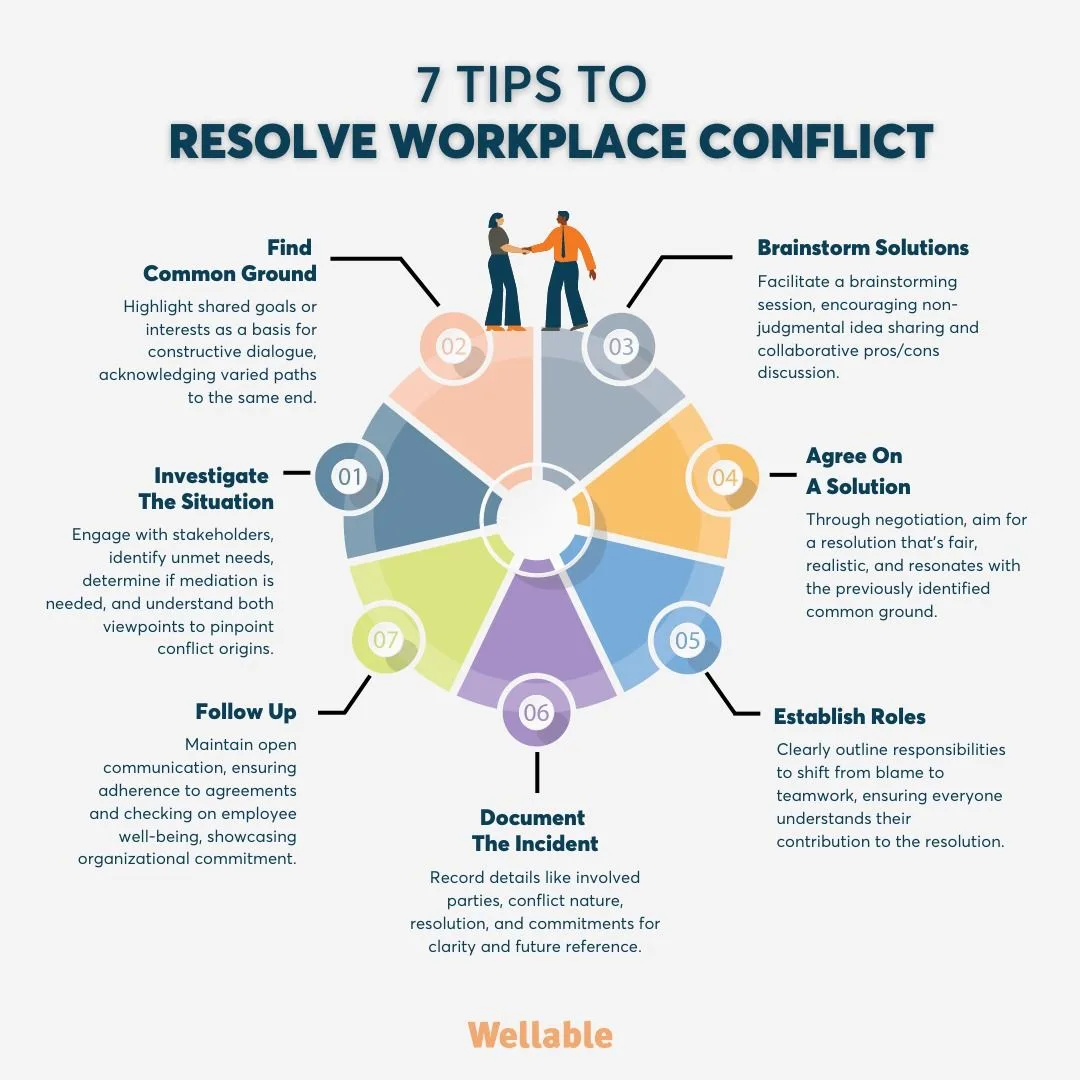
Workplace conflict is not a sign of dysfunction. It is an inevitable byproduct of bringing together people with different perspectives, priorities, communication styles, and professional goals. The organizations that thrive are not the ones that avoid conflict but the ones that resolve it effectively and learn from it. This page covers Conflict Resolution at Work with practical examples throughout.
Yet most professionals receive zero formal training in conflict resolution, leaving them to navigate disagreements with instinct, avoidance, or escalation. This guide provides proven frameworks, specific scripts for the most common workplace conflicts, step-by-step resolution processes, and strategic approaches to mediation, documentation, and prevention. Every technique presented here has been tested in real professional environments and refined for practical application.
Understanding the Thomas-Kilmann Conflict Modes
Before resolving any conflict, it helps to understand the five fundamental approaches people take when disagreements arise. The Thomas-Kilmann Conflict Mode Instrument (TKI), developed by Kenneth Thomas and Ralph Kilmann, maps conflict behavior along two dimensions: assertiveness (the degree to which you pursue your own interests) and cooperativeness (the degree to which you attempt to satisfy the other person's interests).
Competing (High Assertiveness, Low Cooperativeness)
The competing mode prioritizes your own position at the expense of the other party's interests. This approach uses power, authority, or persistence to win the argument. It is appropriate in genuine emergencies where quick, decisive action is needed, when you must enforce non-negotiable safety or ethical standards, or when you are certain you are right on a critical issue and the consequences of being wrong are severe.
When competing becomes destructive: When used as a default approach, competing creates adversarial relationships, discourages open communication, and causes others to stop raising concerns because they expect to be overruled.
Accommodating (Low Assertiveness, High Cooperativeness)
Accommodating means yielding to the other party's position, prioritizing the relationship over your own interests. This is appropriate when the issue matters significantly more to the other person than to you, when preserving harmony is more important than the specific outcome, or when you recognize that you are wrong.
When accommodating becomes destructive: Habitual accommodation leads to resentment, loss of respect from others who interpret yielding as weakness, and a pattern where the accommodator's needs are systematically overlooked.
Avoiding (Low Assertiveness, Low Cooperativeness)
Avoiding means sidestepping the conflict entirely, neither pursuing your own interests nor addressing the other party's. This is appropriate when the issue is trivial, when emotions are too high for productive conversation and a cooling-off period is needed, or when someone else is better positioned to resolve the conflict.
When avoiding becomes destructive: Chronic avoidance allows problems to fester and grow. Issues that could be resolved in a five-minute conversation when small become entrenched conflicts that require formal mediation when left unaddressed.
Compromising (Moderate Assertiveness, Moderate Cooperativeness)
Compromising involves both parties giving up something to reach a mutually acceptable middle ground. This is appropriate when the goal is important but not worth the disruption of a more assertive approach, when time pressure demands a workable solution quickly, or when two equally powerful parties are at an impasse.
When compromising becomes destructive: Compromise can produce outcomes that neither party is satisfied with. When both sides give up important elements, the result may be a watered-down solution that fails to address the root problem.
Collaborating (High Assertiveness, High Cooperativeness)
Collaborating involves working with the other party to find a solution that fully satisfies both sets of interests. This requires open communication, creative problem-solving, and a willingness to invest time in understanding the other party's underlying needs.
When collaborating is ideal: When the issue is too important for compromise, when the relationship matters enough to invest time and energy, when there is potential for a creative solution that serves both parties better than either original position, and when you want to build trust and precedent for future conflict resolution.
When collaborating is impractical: When time is critically limited, when one party is acting in bad faith, or when the power imbalance is too severe for genuine collaboration.
Choosing Your Mode
The most effective conflict navigators are not locked into a single mode. They assess each situation and consciously select the approach most likely to produce a good outcome. Ask yourself:
- How important is this issue to me, and how important is it to the other person?
- How important is this relationship to me?
- How much time and energy is available for resolution?
- What is the power dynamic between us?
- What are the consequences of not resolving this conflict?
When to Address Conflict vs. When to Let Go
Not every workplace friction requires formal resolution. Developing judgment about when to engage and when to release is a critical professional skill.
Address the Conflict When
- The issue affects work quality or team performance in measurable ways
- The behavior is recurring, creating a pattern rather than a one-time occurrence
- The conflict is escalating rather than dissipating naturally over time
- Your emotional response is growing, which signals that avoidance is not working
- Other team members are affected or beginning to take sides
- The issue involves ethics, safety, or compliance where silence implies acceptance
- The relationship is important enough to invest the effort required for resolution
Let It Go When
- The issue is genuinely trivial and your reaction is disproportionate to the situation
- The other person is having an obviously bad day and the behavior is clearly out of character
- You contributed to the problem and honest self-reflection suggests the other person's response was reasonable
- The situation will resolve itself due to organizational changes, project completion, or natural evolution
- The emotional cost of engaging exceeds the potential benefit of resolution
- You are seeking to be right rather than to solve a problem, which is a sign that ego rather than principle is driving the conflict
The CLEAR Framework - A Step-by-Step Resolution Process
When a conflict warrants direct action, the CLEAR framework provides a structured approach that keeps the conversation productive and solution-oriented.
C - Center Yourself
Before initiating any conflict conversation, manage your own emotional state. Approaching a conflict while angry, frustrated, or anxious dramatically increases the likelihood of escalation.
Centering techniques:
- Identify the specific outcome you want from the conversation
- Write down the facts of the situation separate from your interpretation and emotional reaction
- Consider the other person's perspective honestly, even if you disagree with it
- Choose a time and place where both parties can speak freely without audience or time pressure
- Decide your walk-away point: what will you do if the conversation does not produce resolution?
L - Lead with Observation
Begin the conversation with a factual, observable description of the situation. Avoid interpretation, judgment, or attribution of intent.
Observation vs. judgment examples:
| Judgment (Avoid) | Observation (Use) |
|---|---|
| "You never listen to my ideas." | "In the last three team meetings, I shared proposals that were not discussed before the meeting moved to other topics." |
| "You're taking credit for my work." | "The presentation to the board included the market analysis I developed, and my name was not on the contributor list." |
| "You're always late with deliverables." | "The last two project milestones were delivered three and five days past the agreed deadline." |
Leading with observation defuses defensiveness because the other person cannot reasonably argue with verifiable facts. They can, however, argue with your interpretation of those facts, which is why keeping interpretation out of the opening statement matters.
E - Express Impact
After stating the observation, describe the impact the situation has on you, your work, or the team. Use "I" statements rather than "you" accusations.
Impact statement examples:
- "When deadlines shift without advance notice, I end up having to rearrange client commitments, which puts those relationships at risk."
- "When decisions about the project direction are made without including me, I lose context that I need to do my part of the work effectively."
- "When feedback on my proposals happens publicly rather than privately, it makes it harder for me to maintain credibility with the team."
A - Ask and Listen
After expressing impact, invite the other person's perspective. This is not a rhetorical gesture but a genuine opening for dialogue. The other person's perspective will almost certainly contain information you did not have, context you were not aware of, or legitimate concerns that deserve consideration.
Opening questions:
- "I'd like to understand your perspective on this. What's your experience been?"
- "Am I missing context that would help me see this differently?"
- "How does this look from your side?"
Then listen. Genuinely. Use active listening techniques: paraphrase, reflect, clarify. Resist the urge to rebut or defend until the other person has fully shared their perspective.
R - Resolve Together
Once both perspectives are understood, shift to collaborative problem-solving. The goal is to find a solution that addresses both parties' core interests.
Resolution approaches:
- Brainstorm multiple options before evaluating any of them
- Focus on interests (the "why" behind each person's position) rather than positions (the specific outcome each person initially demanded)
- Agree on specific, observable behavioral changes rather than vague commitments
- Set a follow-up date to assess whether the agreed solution is working
- Document the agreement, especially in complex or recurring conflicts
Scripts for Common Workplace Conflicts
The following scripts provide language frameworks for addressing the most frequent sources of workplace conflict. Adapt the specific wording to fit your personality, your relationship with the other person, and your organizational culture.
Script 1 - Credit Stealing
Situation: A colleague presented your work as their own in a meeting with leadership.
Script: "I wanted to talk with you about the presentation to the leadership team last Tuesday. The competitive analysis section that was presented, I developed that over the past three weeks. When it was presented without attribution, it meant that my contribution was not visible to the people who influence my career growth. I am sure that was not intentional, but I need to ask that we establish a practice of crediting individual contributions in shared presentations. How does that sound to you?"
If they become defensive: "I am not suggesting you did this deliberately. I just want to make sure we have a system going forward so that everyone's contributions are visible. What would work for you?"
Script 2 - Workload Unfairness
Situation: You are consistently assigned more work than colleagues in similar roles.
Script: "I want to discuss how work is being distributed on the team. Over the past quarter, I have been assigned to lead four major projects compared to the team average of two. I want to contribute at a high level, and I am concerned that the current load is not sustainable without impacting quality. Can we look at the distribution together and discuss how to balance it more evenly?"
If the response is "You're just better at it": "I appreciate the confidence, and I want to keep delivering strong work. That is exactly why I am raising this. If I am stretched too thin, the quality of everything suffers. Can we prioritize which two projects are most critical and explore how to distribute the others?"
Script 3 - Personality Clash
Situation: You and a colleague have fundamentally different working styles that create ongoing friction.
Script: "I think we work differently in some important ways, and I want to make sure those differences do not get in the way of us being effective together. For example, I tend to prefer having detailed plans before starting work, and you seem to prefer a more flexible, iterative approach. Neither way is wrong, but I think the friction between our styles is creating unnecessary tension. Can we talk about how to work together in a way that respects both approaches?"
Proposed solutions to offer: "One option could be that we align on the deliverable and deadline upfront but leave the process flexible. Another could be that we divide the work so that each of us can use our preferred approach on our own portions. What would work best for you?"
Script 4 - Micromanagement
Situation: Your manager monitors your work at an excessive level of detail, requesting constant updates and approving minor decisions.
Script: "I value the attention you give to our team's work, and I want to talk about how we communicate about progress. Currently, I provide updates several times a day and seek approval on most decisions, including routine ones.
I believe I could deliver better results with more autonomy on day-to-day execution while keeping you informed on key milestones and decisions that genuinely need your input. Would you be open to trying a weekly check-in format where I bring you the important decisions and flag any risks, rather than the current real-time approach?"
If they resist: "I understand you want to stay close to the work. What if we tried this approach for two weeks as a pilot? If the results or communication quality drops, we go back to the current system. This way, we can test it with a safety net."
Script 5 - Remote Misunderstandings
Situation: A conflict has developed through misinterpreted messages in Slack, email, or other text-based communication.
Script: "I think our recent exchange over email may have come across differently than either of us intended. Text communication strips out tone and context, and I want to make sure we are actually on the same page rather than reacting to what we each interpreted. Can we hop on a quick call to talk through this directly? I think five minutes of conversation will clear up what might take twenty more emails to resolve."
During the call: "Here is what I understood from your message: [paraphrase]. Is that what you meant? And here is what I was trying to communicate: [clarify]. I think the disconnect was [specific point]. Does that track?"
Mediation Basics - When Two Parties Need a Third
When direct conversation fails to resolve a conflict, structured mediation by a neutral third party can break the impasse. This does not necessarily require a professional mediator. A trusted colleague, manager, or HR representative can serve as mediator if they are genuinely neutral and skilled in the process.
The Mediator's Role
A mediator does not judge, decide, or impose solutions. The mediator:
- Creates a safe environment for both parties to speak openly
- Ensures each person has equal opportunity to share their perspective
- Identifies common ground and shared interests
- Reframes destructive language into productive terms
- Guides the conversation toward solutions rather than allowing it to loop in grievances
- Documents agreements and follow-up commitments
Basic Mediation Structure
Step 1 - Opening statement: The mediator explains the process, sets ground rules (no interrupting, no personal attacks, commitment to finding a solution), and establishes confidentiality expectations.
Step 2 - Individual statements: Each party shares their perspective uninterrupted. The mediator may ask clarifying questions but does not allow the other party to respond until both statements are complete.
Step 3 - Issue identification: The mediator summarizes the key issues raised by both parties and identifies areas of overlap, shared concerns, and genuine disagreements.
Step 4 - Dialogue: The mediator facilitates a structured conversation focused on the identified issues. The goal is mutual understanding, not agreement on who was right.
Step 5 - Solution generation: Both parties brainstorm possible solutions. The mediator ensures that proposed solutions address both parties' core concerns.
Step 6 - Agreement: The parties agree on specific actions, timelines, and follow-up mechanisms. The mediator documents the agreement.
Step 7 - Follow-up: The mediator checks in with both parties at agreed intervals to assess whether the resolution is holding.
Documenting Workplace Conflicts
Documentation serves two purposes: it creates accountability for resolution commitments, and it provides a record if the conflict escalates to formal processes. Documentation does not need to be legalistic. It needs to be clear, factual, and contemporaneous.
What to Document
- Date, time, and location of each significant incident
- Who was present and who was directly involved
- What happened, described in observable, factual terms without interpretation
- What was said, quoted as accurately as possible
- Impact on work, team, or clients
- Actions taken to address the situation and the outcomes of those actions
- Any witnesses who can corroborate the account
How to Document
Documentation is what turns a disputed recollection into a record, so write it while the details are still sharp rather than reconstructing them weeks later. Keep entries factual and dated, describing what was said and done rather than how it felt. The practices below produce notes that hold up if the conflict later reaches HR or a manager.
- Write documentation as close to the time of the incident as possible, while memory is fresh
- Use email to yourself or a personal notes application with dated entries
- Keep documentation factual: "At 2:15 PM on March 12, during the project review meeting, [name] stated that the delay was caused by my team, which contradicts the timeline documented in the project tracker" rather than "They lied about us in the meeting"
- Save relevant emails, chat messages, and other written communications
- Store documentation in a personal, secure location rather than on company systems where it could be accessed or deleted
When Documentation Becomes Critical
- When you have attempted direct resolution and the behavior continues
- When the conflict involves potential policy violations or legal issues
- When you are considering escalating to HR or management
- When the conflict could affect your performance review, job security, or career progression
- When there is a pattern of behavior that may not be apparent from any single incident
Involving HR - When, How, and What to Expect
Escalating a conflict to Human Resources is a significant step that many professionals either take too early (before attempting direct resolution) or too late (after the situation has caused substantial damage). Understanding when and how to involve HR ensures the best possible outcome.
When HR Involvement Is Necessary
- The conflict involves harassment, discrimination, or retaliation
- Direct resolution and informal mediation have been attempted and failed
- There is a significant power imbalance that prevents fair direct resolution
- Company policy or legal compliance is at issue
- The conflict poses a risk to organizational reputation or client relationships
- Safety concerns are present
How to Approach HR
Prepare before the meeting. HR will ask what happened, when, and what you have already tried, so arriving with dates, specifics, and your documented record makes the conversation far more productive than a general complaint. Decide in advance what outcome you are asking for. The checklist below covers what to bring and how to frame the discussion.
- Organize your documentation chronologically
- Write a brief summary of the situation, what you have already tried, and what outcome you are seeking
- Be prepared to describe the business impact, not just the personal impact
During the meeting:
- Present facts, not feelings. HR needs to assess the situation against policy and legal standards
- Be specific about what you are asking for: mediation, investigation, policy enforcement, or simply guidance
- Ask about the process: what happens next, what the timeline looks like, and what confidentiality protections exist
- Understand that HR represents the organization's interests, which may or may not align perfectly with your personal interests
After the meeting:
- Follow up with an email summarizing what was discussed and any commitments made
- Continue documenting if the situation is ongoing
- Do not discuss the HR involvement with colleagues unless advised to do so
Conflict Prevention Strategies
The most effective conflict resolution is the conflict that never needs resolving. Prevention strategies reduce the frequency and severity of workplace conflicts before they begin.
Clarity in Roles and Responsibilities
A significant percentage of workplace conflicts stem from ambiguity about who is responsible for what. When two people both believe they own a decision, or when no one is clearly accountable for a deliverable, friction is inevitable. Prevention means investing time in creating clear role definitions, decision-making frameworks (such as RACI matrices), and escalation paths for disagreements.
Communication Norms and Agreements
Teams that establish explicit communication agreements experience fewer conflicts than those operating on unspoken assumptions. Effective agreements address:
- Response time expectations: How quickly should messages be acknowledged?
- Channel selection: Which topics belong in email vs. chat vs. meeting vs. phone call?
- Feedback protocols: How is feedback given and received? In what format and setting?
- Decision-making process: How are decisions made? Who has veto power? What constitutes consensus?
- Conflict escalation path: When direct resolution fails, what is the next step?
Regular Check-Ins
Many conflicts grow silently because there is no natural opportunity for concerns to surface. Regular one-on-one and team check-ins that explicitly invite honest feedback create release valves that prevent pressure from building to the point of rupture.
Useful check-in questions:
- "Is there anything creating friction for you right now that we should address?"
- "How is our working relationship? Is there anything I could do differently?"
- "Are there any team dynamics that are concerning you?"
Building Relational Capital
People who have invested in positive relationships with colleagues can weather conflict more effectively than those operating on purely transactional terms. Relational capital, the accumulated goodwill from consistent positive interactions, provides a buffer that keeps disagreements from escalating into personal conflicts.
Building relational capital does not require forced social interaction. It means:
- Following through on commitments consistently
- Giving credit generously
- Offering help proactively when you see someone struggling
- Expressing genuine appreciation for good work
- Being transparent about your own mistakes and limitations
Organizational Culture and Leadership
Leaders set the conflict culture of their organizations. When leaders model open, respectful disagreement and respond to conflict with curiosity rather than blame, they create environments where conflict becomes a source of improvement rather than a source of dysfunction. When leaders avoid conflict, punish dissent, or play favorites in disputes, they create cultures where conflict festers underground and eventually erupts in destructive ways.
Moving Forward After Conflict Resolution
Resolution is not the end of the process. The period after a conflict has been addressed is critical for rebuilding trust and ensuring the solution holds.
Rebuilding Trust
Trust damaged by conflict does not return automatically upon resolution. It rebuilds through consistent behavior over time. After resolution:
- Follow through meticulously on every commitment you made during the resolution process
- Resist the temptation to rehash the conflict or bring it up in future disagreements
- Look for opportunities to demonstrate goodwill toward the other person
- Give the relationship time and space to heal without forcing premature closeness
Monitoring the Agreement
The follow-up meeting agreed upon during resolution is not optional. It is the mechanism that ensures the solution is working and provides an opportunity for course correction if it is not. During follow-up:
- Review the specific commitments each party made
- Assess honestly whether those commitments have been kept
- Identify any new issues that have emerged
- Adjust the agreement if necessary based on practical experience
Learning from the Conflict
Every workplace conflict contains information about systems, relationships, and communication patterns that can prevent future disputes. After the emotional charge has dissipated, reflect on:
- What structural or process issues contributed to the conflict?
- What could I have done differently at an earlier stage?
- What did I learn about the other person's perspective or priorities?
- What does this conflict reveal about team dynamics or organizational culture?
Remote and Hybrid Work Conflicts
The growth of remote and hybrid work has introduced new categories of workplace conflict that did not exist in traditional office settings. Understanding these unique dynamics is essential for modern professionals.
The Visibility Conflict
Remote workers often feel overlooked for promotions, high-profile assignments, and leadership opportunities compared to colleagues who are physically present in the office. This creates resentment toward both the organization and the in-office colleagues perceived as benefiting from proximity bias.
Resolution approach: Address the structural issue rather than treating symptoms. Advocate for clear, documented performance criteria that apply equally regardless of work location. Propose asynchronous methods of showcasing work, such as written updates, recorded presentations, or shared dashboards.
If the issue persists, have a direct conversation with your manager: "I want to make sure my contributions are visible regardless of where I work. Can we discuss how to ensure that location does not affect opportunity?"
The Availability Conflict
Differences in work schedules, time zones, and response expectations create friction in distributed teams. One team member expects immediate responses to messages. Another checks messages twice a day. Neither has communicated their expectations, and both are frustrated.
Resolution approach: Establish team communication agreements that specify expected response times by channel (immediate for direct messages about urgent issues, within four hours for email, within one business day for non-urgent requests). Clarify what constitutes "urgent" so the definition is shared rather than individual.
The Meeting Fatigue Conflict
Hybrid teams often default to scheduling more meetings to compensate for lost hallway conversations, creating meeting overload that reduces productivity and increases stress. When some team members resist additional meetings while others insist they are necessary, conflict emerges.
Resolution approach: Conduct a team meeting audit. Categorize each recurring meeting as essential (decision-making, client-facing), valuable (brainstorming, team-building), or replaceable (status updates that could be async). Eliminate or convert the replaceable category and protect focus time blocks that are meeting-free.
The Communication Style Conflict in Text-Based Work
Without vocal tone and body language, written communication in Slack, Teams, and email is frequently misinterpreted. A brief, factual message intended as efficient is read as curt or dismissive. Feedback that would sound constructive in person reads as harsh in text.
Resolution approach: Establish team norms for written communication. Agree that tone should be assumed positive unless explicitly stated otherwise. For feedback and sensitive topics, default to video calls rather than text. When you feel triggered by a written message, wait 30 minutes before responding and consider whether you might be reading tone that was not intended.
Conflict Resolution Across Organizational Levels
Conflicts do not respect organizational hierarchies, but the power dynamics of hierarchy significantly affect how conflicts should be approached.
Conflict with a Peer
Peer conflicts are the most straightforward to address because the power dynamic is relatively balanced. Use the CLEAR framework directly. The key risk with peer conflicts is avoidance, since there is no formal obligation to resolve the issue and it is easy to simply minimize contact with the person. But avoidance in a team context inevitably affects collaboration and team outcomes.
Conflict with a Direct Report
When you are the person with more positional power, you carry additional responsibility for creating safety in the conflict resolution process. The direct report may fear retaliation, may agree with you to avoid confrontation, or may not feel safe expressing their genuine perspective. Counter these dynamics by:
- Explicitly stating that you want their honest perspective and that there will be no negative consequences for disagreeing
- Asking open-ended questions rather than leading questions that telegraph your preferred answer
- Listening first and sharing your perspective second
- Following up privately to ensure the resolution feels fair from their perspective
Conflict with a Manager or Senior Leader
Conflicts with someone who has authority over you require strategic navigation. The power imbalance means that direct confrontation carries more risk, but that does not mean conflict should be avoided entirely.
Strategies for upward conflict resolution:
- Focus exclusively on the impact on work outcomes rather than personal feelings
- Use questions rather than statements to raise concerns: "Can you help me understand the reasoning behind this decision?" rather than "I disagree with this decision"
- Propose alternatives rather than simply objecting
- Build allies by discussing your concerns with trusted peers who might share them and who can provide additional perspectives or support
- Document carefully if the conflict involves policy violations or if there is risk of retaliation
- If direct resolution fails, consider whether HR, an ombudsperson, or a skip-level manager is the appropriate next step
Cross-Departmental Conflict
Conflicts between teams or departments often stem from competing priorities, different metrics, or misaligned incentives rather than interpersonal issues. Resolving these conflicts requires escalating to a level where both departments' priorities can be balanced. The most effective resolution involves a shared understanding of organizational priorities, clear decision-making authority, and metrics that reward collaboration rather than departmental optimization at the expense of others.
The Emotional Dimensions of Workplace Conflict
Every workplace conflict has both a substantive dimension (the actual issue in dispute) and an emotional dimension (how the people involved feel about it). Addressing only the substantive dimension while ignoring the emotional dimension produces fragile resolutions that collapse under the next pressure.
Recognizing Emotional Triggers
Common emotional triggers in workplace conflict include:
- Feeling disrespected: When someone perceives that their contribution, expertise, or status is being undervalued
- Feeling excluded: When someone is left out of decisions, meetings, or communications that affect their work
- Feeling controlled: When someone perceives that their autonomy is being restricted unnecessarily
- Feeling unheard: When someone has raised concerns repeatedly without seeing evidence that those concerns were taken seriously
- Feeling unfairly treated: When someone perceives that standards, opportunities, or consequences are applied inconsistently
Understanding which emotional trigger is driving a conflict helps you address the root cause rather than just the surface behavior.
Managing Your Own Emotions During Conflict
The most important emotional management technique in conflict is the pause. When you feel a strong emotional reaction during a conflict conversation, your amygdala has activated a fight-or-flight response that compromises your ability to think clearly, listen accurately, and respond constructively. A pause of even five seconds allows the prefrontal cortex to re-engage and restore rational processing.
Techniques for managing emotions during conflict:
- Name the emotion internally: "I am feeling defensive right now" reduces the emotion's intensity
- Focus on breathing: One deep breath activates the parasympathetic nervous system
- Shift to curiosity: Ask yourself "What is driving their perspective?" instead of "How can I win this argument?"
- Request a break if needed: "This is an important conversation. I want to give it my full attention. Can we take five minutes and come back?"
Conflict is expensive in terms of time, energy, and relationship capital. Extracting the maximum learning from each conflict ensures that the cost is not wasted. The goal is not to eliminate conflict from the workplace, which is neither possible nor desirable, but to develop the skills, systems, and relationships that transform conflict from a destructive force into a catalyst for improvement and deeper understanding.
Frequently Asked Questions
When should I involve HR in a workplace conflict?
Involve HR when the conflict involves harassment, discrimination, threats, or any behavior that violates company policy or legal standards. These are not situations to resolve privately. HR should also be brought in when direct conversation and mediation have already failed, or when the conflict is measurably affecting team performance or client relationships. Earlier involvement is better than waiting until positions have hardened.
HR should also be brought in when direct conversation and mediation have failed to produce resolution after genuine attempts, when the conflict involves a significant power imbalance such as a dispute with a direct supervisor, or when the situation is escalating rather than improving over time.
Additionally, involve HR when the conflict is affecting team performance or client relationships in measurable ways, or when one party refuses to engage in good-faith resolution efforts. Document all incidents and your resolution attempts before approaching HR, as this context helps them assess the situation accurately and take appropriate action.
How do I address a coworker who takes credit for my work?
Address credit-stealing directly but diplomatically, and start before the next incident rather than after it. Establish a documentation habit by sending summary emails after collaborative work that clearly outline individual contributions, which creates a record without confronting anyone. When the situation does occur, raise it privately: describe the specific instance, explain the effect on your visibility with leadership, and propose how attribution should work going forward.
When the situation occurs, have a private conversation using this framework: describe the specific instance without accusation, explain the impact on you, and propose a solution. For example, say something like: ‘In yesterday’s presentation, the client dashboard project was presented without mentioning my analysis work.
When my contributions are not acknowledged, it affects my visibility with leadership. Going forward, can we agree to credit individual contributions when presenting team work?’ If the behavior continues after a direct conversation, escalate to your shared manager with documented evidence of your contributions.
What is the best approach when two team members are in constant conflict?
As a manager or peer, start by meeting individually with each person to understand their perspective without the other present. Listen for the root cause, which is often a values difference, role ambiguity, or communication style mismatch rather than a personal dislike.
Then facilitate a structured conversation between both parties using a clear framework: each person describes the situation from their perspective without interruption, each person states what they need going forward, and both parties agree on specific behavioral commitments.
Set a follow-up meeting two weeks later to assess progress. If the conflict stems from structural issues like overlapping responsibilities or unclear reporting lines, address those organizational problems directly rather than treating the symptoms as interpersonal drama.