
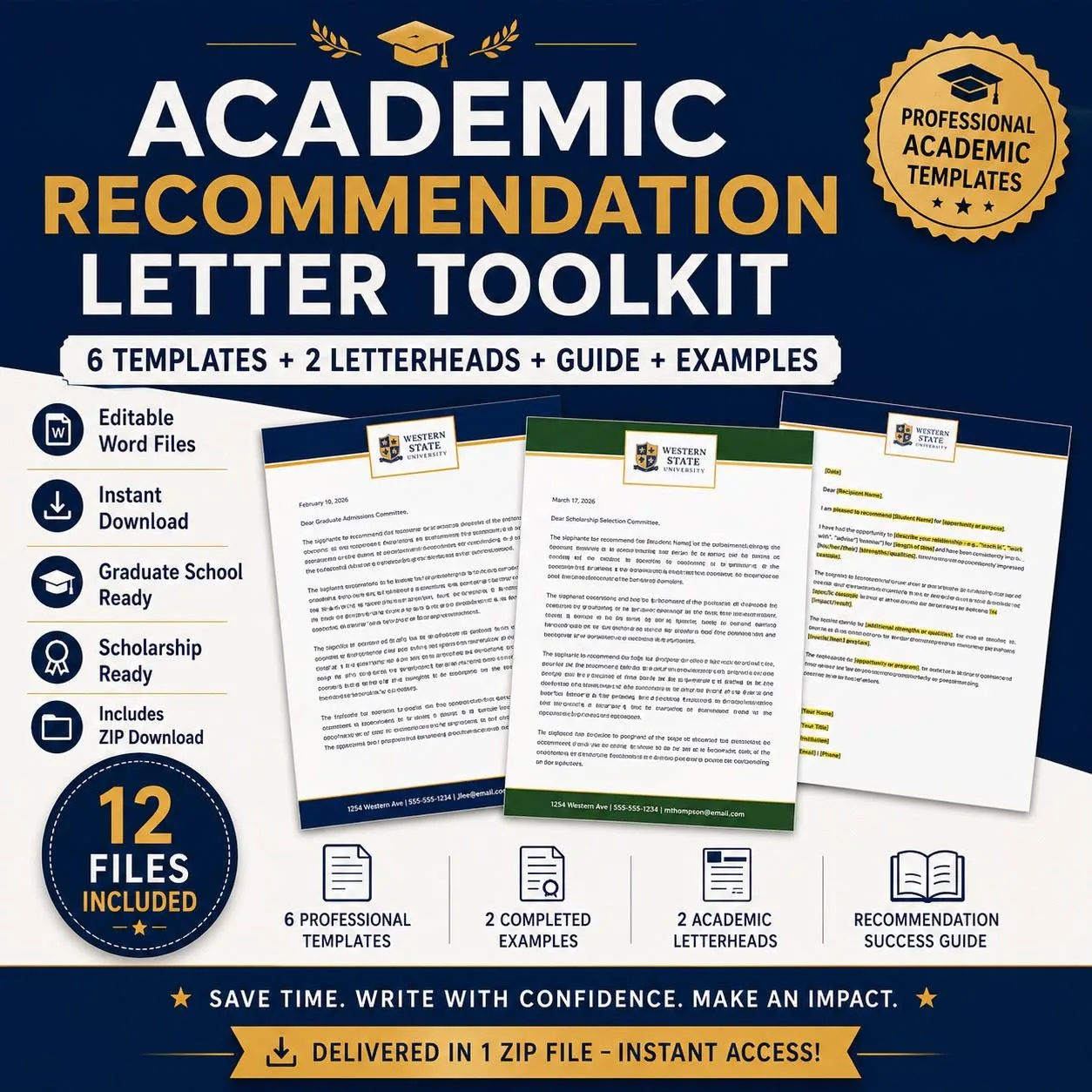
The graduate school recommendation letter is one of the most consequential documents an admissions committee reads, and it is also one of the most variable in quality. A strong letter of recommendation can move a borderline application into the admit pile and convert an admit into a fellowship candidate.
A weak letter, even one written by a well-known scholar, signals that the candidate did not stand out enough for the recommender to engage seriously, and admissions committees read that signal as clearly as the words on the page.
The difference between the two is rarely about the reputation of the recommender. It is about the structure of the letter, the specificity of the examples, the direct comparison to peer cohorts, and the alignment between what the candidate will be evaluated on and what the letter actually says.
This guide provides ten ready-to-copy recommendation letter templates for the most common graduate school scenarios, including MBA programs, PhD research programs, medical school, law school, master's in engineering, master's in public policy, dual-degree programs, non-traditional applicants, international students, and industry-to-academia transitions.
Each template follows the structural conventions that admissions committees have come to expect, opens with an explicit statement of the recommender's relationship to the candidate, moves through concrete evidence in a predictable order, closes with an unambiguous recommendation, and respects the tone calibration that distinguishes strong letters from generic ones.
The templates are paired with guidance on structure, comparative language, common mistakes, and a FAQ drawn from the questions recommenders most frequently ask when asked to write for a student or employee.
What Makes a Strong Graduate School Recommendation Letter
Admissions committees read thousands of letters each cycle, and they develop a sharp eye for the patterns that distinguish a genuine endorsement from a perfunctory one. Three elements separate the letters that move the needle from the letters that do not.
Specific Evidence Rather Than General Praise
"Sarah is brilliant and hardworking" is background noise. "Sarah was one of three students out of 180 in my Advanced Econometrics course to earn an A, and the paper she produced on heterogeneous treatment effects became the model I now assign as a reference in the following semester" is evidence. Committees weight specific, verifiable, memorable evidence far more heavily than adjectives.
Explicit Comparative Framing
Strong letters place the candidate in an explicit peer context. Phrases such as "among the top five students I have taught in the past ten years" or "stronger than 90 percent of candidates we have extended offers to at this level" give the committee a calibration point. Vague superlatives like "one of the best" do not.
Alignment to the Program
The letter should speak to the specific capabilities the target program will develop and expect. A PhD program wants evidence of research ability, intellectual independence, and the stamina for long projects. An MBA program wants evidence of leadership, impact under ambiguity, and the ability to influence people who do not report to the candidate. A generic letter that ignores these differences reads as a template that was not customized, and committees notice.
"Admissions committees are pattern-matching machines. The letters that move candidates into the admit pile do three things in the first paragraph: they establish the recommender's credibility, they establish the depth of the relationship with the candidate, and they signal the specificity that the rest of the letter will deliver."
What to Include in a Graduate School Recommendation Letter
The table below outlines the structural elements that belong in a strong letter, the purpose each serves, and the typical placement.
| Element | Purpose | Typical Placement |
|---|---|---|
| Recommender identification and credibility | Establishes authority | Opening paragraph |
| Context of relationship with candidate | Establishes the basis for evaluation | Opening paragraph |
| Specific examples of capability | Provides verifiable evidence | Body paragraphs |
| Comparative framing | Calibrates the evaluation | Body and closing |
| Character and interpersonal qualities | Addresses fit | Body paragraph |
| Address of program-specific criteria | Demonstrates tailoring | Body paragraph |
| Explicit recommendation | Removes ambiguity | Closing paragraph |
| Contact information | Invites follow-up | Signature block |
10+ Graduate School Recommendation Letter Templates
Replace bracketed fields with the specific candidate and program details. Each template is designed as a full one-to-two-page letter, consistent with the expectations of most graduate programs.
Template 1: MBA Program (Employer)
[Recommender Letterhead]
[Date]
Admissions Committee [Program Name] [Institution] [Address]
Dear Members of the Admissions Committee,
I am writing to offer my strongest recommendation for [Candidate Name] for admission to the [Program] MBA program. I am [Title] at [Company], and I have had the privilege of supervising [Candidate] directly for [Number] years as [his/her/their] [Title].
[Candidate] stands out in a cohort of high performers for three reasons. First, [he/she/they] consistently operate at the strategic level while still delivering on the operational details that matter. On the [Project Name] engagement, [Candidate] led a cross-functional team of [Number] stakeholders to deliver [Specific Outcome] ahead of schedule and under budget, then designed the follow-on program that has since generated [Dollar Figure or Metric] for the business.
Second, [Candidate] has a rare ability to lead people who do not report to [him/her/them]. During the [Company Initiative], [he/she/they] convinced senior leaders across [Number] business units to commit resources to a program that had no official mandate, based on the strength of the analysis and the credibility [he/she/they] had built over the prior two years.
Third, [Candidate] combines commercial judgment with intellectual curiosity. [He/She/They] read broadly, ask better questions than [his/her/their] peers, and have the rare discipline to change [his/her/their] mind when the evidence supports it.
Among the [Number] direct reports I have had in my career, [Candidate] is in the top three. I am confident [he/she/they] will thrive in the [Program] environment and will contribute substantially to [his/her/their] cohort. I recommend [Candidate] without reservation and am available to discuss [his/her/their] candidacy further at [Phone] or [Email].
Sincerely,
[Recommender Name] [Title] [Company]
Template 2: PhD Research Program (Faculty)
[Recommender Letterhead]
[Date]
Admissions Committee [Program Name] [Institution]
Dear Members of the Admissions Committee,
I am pleased to offer my strongest possible recommendation for [Candidate Name]'s application to the PhD program in [Field] at [Institution]. I am [Rank] of [Field] at [Institution], and I have known [Candidate] since [Year], initially as a student in my [Course] and subsequently as a research assistant in my lab.
[Candidate]'s capacity for independent research distinguishes [him/her/them] from the vast majority of undergraduate and master's students I have mentored. In the [Project Name] project, [he/she/they] identified a gap in the literature on [specific topic], proposed a methodological approach that I had not considered, and executed the analysis with a level of rigor that produced a manuscript now under review at [Journal].
The work required [Candidate] to learn [Technique or Method] from the ground up, which [he/she/they] accomplished in approximately [Timeframe] with minimal supervision.
Beyond technical competence, [Candidate] has the intellectual temperament that long research careers require. [He/She/They] tolerate ambiguity, reframe problems productively when an initial approach fails, and engage generously with the work of others in lab meetings and seminars. [Candidate] presented [his/her/their] work at [Conference] and fielded questions from senior scholars with the poise of a second-year graduate student.
Among the undergraduate research assistants I have mentored in [Number] years on the faculty, [Candidate] is in the top [Percentage]. I recommend [him/her/them] for admission to your program without reservation, and I encourage the committee to consider [him/her/them] for fellowship support. I am happy to discuss [Candidate]'s work in more detail at [Phone] or [Email].
Sincerely,
[Recommender Name], [Degree] [Title] [Department and Institution]
Template 3: Medical School (Clinical Supervisor)
[Recommender Letterhead]
[Date]
Admissions Committee [Medical School Name]
Dear Members of the Admissions Committee,
I am writing in strong support of [Candidate Name]'s application to [Medical School Name]. I am [Title], [Specialty], at [Institution], and I supervised [Candidate] during [his/her/their] [Number]-month clinical shadowing rotation in our [Department] from [Start Date] to [End Date].
During the rotation, [Candidate] demonstrated the combination of clinical curiosity, interpersonal warmth, and intellectual rigor that characterizes the students who go on to become strong physicians. Three episodes stand out.
First, during a difficult end-of-life conversation with a family in our ICU, [Candidate] quietly observed, then followed up with me afterward to discuss both the clinical and ethical dimensions of what [he/she/they] had witnessed. [His/Her/Their] questions reflected a maturity of thought that I rarely see in pre-medical students.
Second, [Candidate] independently researched [Topic] after observing a case and returned the following week with a one-page summary of the relevant literature that was accurate and usefully scoped.
Third, [Candidate] connected easily with patients from a wide range of backgrounds, including a Spanish-speaking family for whom [he/she/they] served as an informal interpreter, which they later told me made a meaningful difference in their hospital experience.
Among the pre-medical students I have supervised in the past decade, [Candidate] is in the top tier. [He/She/They] combine the intellectual qualities of strong medical students with the interpersonal skills that predict durable careers in medicine. I recommend [Candidate] for admission without reservation.
Sincerely,
[Recommender Name], MD [Title] [Institution]
Template 4: Law School (Employer or Mentor)
[Recommender Letterhead]
[Date]
Admissions Committee [Law School Name]
Dear Members of the Admissions Committee,
I am pleased to write in strong support of [Candidate Name]'s application to [Law School]. I am [Title] at [Organization], where [Candidate] has served as [Role] for [Number] years.
The skills that predict success in law school and legal practice, analytical rigor, written precision, and the capacity to hold multiple arguments in mind simultaneously, are qualities [Candidate] has demonstrated repeatedly in our organization.
On the [Project Name] matter, [Candidate] drafted the framework memo that our team used to navigate a complex [Regulatory or Policy] question, reviewed thousands of pages of [Materials], and produced a final recommendation that was adopted by [Senior Leadership]. The memo demonstrated the ability to construct a disciplined argument, anticipate counterarguments, and support each claim with specific evidence.
Beyond analytical work, [Candidate] has the ethical seriousness that strong lawyers share. On [Specific Occasion], [he/she/they] identified a conflict that others on the team had overlooked, raised it with leadership, and proposed a course of action that preserved both the client relationship and the integrity of the process.
Among the [Number] professionals I have supervised at [Candidate]'s level, [he/she/they] are in the top three. I recommend [Candidate] to your program with enthusiasm and without reservation.
Sincerely,
[Recommender Name] [Title]
Template 5: Master's in Engineering (Faculty)
[Recommender Letterhead]
[Date]
Admissions Committee [Program Name]
Dear Members of the Admissions Committee,
I am writing to recommend [Candidate Name] for admission to the Master's in [Engineering Field] program at [Institution]. I am [Rank] of [Field] at [Institution], and I have worked with [Candidate] in two contexts: as a student in my [Course] course and as a participant in the [Design Team or Capstone Project] that I advise.
[Candidate] approaches engineering problems with both the analytical rigor and the hands-on intuition that characterize strong graduate students. In my [Course] course, [he/she/they] earned the highest grade in a cohort of [Number], producing final project work on [Topic] that I have since used as a reference example for subsequent semesters.
On the [Capstone or Design] project, [Candidate] led the [Subsystem] team, diagnosed a recurring [Technical Problem] that had stumped the full team for weeks, and implemented a solution that [Outcome].
[Candidate]'s written and oral communication are unusually strong for an engineer at [his/her/their] level. [His/Her/Their] technical reports read cleanly, and [he/she/they] defended the design decisions in the capstone review with clarity and composure.
Among the engineering students I have taught in my [Number] years of faculty service, [Candidate] is in the top ten percent. I recommend [him/her/them] for admission with enthusiasm.
Sincerely,
[Recommender Name], PhD [Title] [Department and Institution]
Template 6: Master's in Public Policy (Employer)
[Recommender Letterhead]
[Date]
Admissions Committee [Program Name]
Dear Members of the Admissions Committee,
I am writing to offer my enthusiastic recommendation for [Candidate Name]'s application to the Master of Public Policy program at [Institution]. I am [Title] at [Organization], where I have supervised [Candidate] directly for [Number] years.
Public policy work demands a combination of analytical skill, stakeholder navigation, and sustained execution, and [Candidate] is exceptional on all three dimensions.
On the [Policy Initiative], [Candidate] built the analytical model that our coalition used to quantify the impact of the proposed regulation on [Affected Population], coordinated input from [Number] stakeholders with competing priorities, and drafted the briefing materials that were ultimately presented to [Official or Body]. The initiative resulted in [Specific Outcome].
What distinguishes [Candidate] from equally analytical peers is [his/her/their] ability to translate quantitative findings into narratives that policy audiences can act on. [He/She/They] understand that the best analysis is useless if it cannot be communicated to the people who must act on it, and [Candidate] consistently bridges that gap.
Among the policy professionals I have supervised in my [Number]-year career, [Candidate] is in the top five. I recommend [him/her/them] for admission without reservation.
Sincerely,
[Recommender Name] [Title]
Template 7: Dual-Degree Program (Faculty)
[Recommender Letterhead]
[Date]
Admissions Committee [Dual Degree Program]
Dear Members of the Admissions Committee,
I am pleased to recommend [Candidate Name] for admission to the dual-degree program in [Discipline 1] and [Discipline 2] at [Institution]. As [Title] in [Department], I have worked with [Candidate] since [Year] in both research and coursework contexts.
Dual-degree students succeed when they can operate fluently across the languages of two disciplines, and [Candidate] has already demonstrated that capacity. [His/Her/Their] undergraduate thesis on [Topic] drew equally on [Methods from Discipline 1] and [Frameworks from Discipline 2], producing a level of integration that is rare even in graduate work.
The committee that reviewed the thesis noted that [Candidate] had identified connections between the two fields that our department had not emphasized in its curriculum.
Beyond intellectual breadth, [Candidate] has the work ethic and intellectual stamina that dual-degree programs require. [He/She/They] completed the thesis while [other demanding commitment], and [he/she/they] did not sacrifice quality in either direction.
[Candidate] is in the top three students I have advised in [Number] years. I recommend [him/her/them] without reservation for admission to the dual-degree program.
Sincerely,
[Recommender Name], [Degree]
Template 8: Non-Traditional Applicant (Employer)
[Recommender Letterhead]
[Date]
Admissions Committee [Program Name]
Dear Members of the Admissions Committee,
I am writing to recommend [Candidate Name] for admission to the [Program] at [Institution]. [Candidate] is applying to graduate school after [Number] years of professional experience, and the committee should read [his/her/their] application through the lens of what that experience has built rather than through the lens of traditional academic preparation alone.
I am [Title] at [Company], and I have worked with [Candidate] for [Number] years, most recently as [his/her/their] direct supervisor. In that time, [Candidate] has developed the analytical and leadership capabilities that the [Program] is designed to further develop.
Specifically, [Candidate] led [Major Initiative] that required [he/she/they] to learn [Discipline or Framework] in depth, build [Analytical Artifact], and convince [Stakeholders] to act on the findings. The initiative delivered [Outcome], and the framework [Candidate] developed has since been adopted across [Broader Scope].
The discipline of returning to graduate school after [Number] years of professional work is significant, and [Candidate] has prepared for the transition thoughtfully. [He/She/They] completed [Preparatory Coursework], engaged with the literature in [Field], and have clear, specific goals for what [he/she/they] intend to learn in the program.
Among professionals I have supervised, [Candidate] is in the top tier, and I believe [his/her/their] combination of professional experience and academic preparation will make [him/her/them] a valuable member of the cohort.
Sincerely,
[Recommender Name] [Title]
Template 9: International Student Applicant (Faculty)
[Recommender Letterhead]
[Date]
Admissions Committee [Program Name]
Dear Members of the Admissions Committee,
I am writing in strong support of [Candidate Name]'s application to [Program Name]. I am [Title] at [Institution Name] in [Country], and I have taught and supervised [Candidate] in [Context] since [Year].
[Candidate] has distinguished [himself/herself/themselves] in one of the most competitive undergraduate programs in [Country]. Admission to our program requires a score in the top [Percentage] on the national entrance examination, and [Candidate] was admitted with a score in the top [Percentage]. Across [his/her/their] program of study, [Candidate] earned a GPA of [Figure] on a [Scale] scale, placing [him/her/them] in the top [Percentage] of [his/her/their] cohort.
In addition to academic strength, [Candidate] has produced research work that meets international standards. [His/Her/Their] thesis on [Topic] was awarded [Recognition], and a revised version is currently under review at [Journal]. [Candidate] has also presented [his/her/their] research at [Conference], where [he/she/they] engaged with scholars from multiple countries in English.
To give context for international calibration, I have advised roughly [Number] students in my career, many of whom have gone on to graduate study at leading programs in the United States, United Kingdom, and elsewhere. [Candidate] is among the top [Number] of those students by any measure I can identify.
I recommend [Candidate] for admission to [Program] with my highest confidence.
Sincerely,
[Recommender Name], PhD [Title] [Department and Institution]
Template 10: Industry-to-Academia Transition (Manager)
[Recommender Letterhead]
[Date]
Admissions Committee [Program Name]
Dear Members of the Admissions Committee,
I am writing to recommend [Candidate Name] for admission to the PhD program in [Field] at [Institution]. [Candidate] is leaving a successful industry career to pursue doctoral research, and I want to give the committee the industry perspective on why that decision is credible.
I am [Title] at [Company], where [Candidate] has worked as [Role] for [Number] years.
During that time, [he/she/they] led technical work on [Project or Product] that generated [Outcome] and published [Number] internal research reports that circulated among our research community.
[Candidate]'s work consistently exhibited the qualities that distinguish research-minded engineers and scientists from strong execution-focused peers: intellectual curiosity that extends beyond the immediate deliverable, a willingness to tackle open-ended problems, and an unusual capacity to communicate technical work clearly to both technical and non-technical audiences.
[Candidate] has been preparing for this transition deliberately. [He/She/They] have published [Papers or Patents], collaborated with academic researchers at [Institution], and have a specific research agenda that builds on but extends beyond what [he/she/they] could pursue in the industry environment.
Industry career professionals who transition successfully to PhD programs share a combination of research capability and intrinsic motivation that is hard to fake. [Candidate] has both. I recommend [him/her/them] without reservation.
Sincerely,
[Recommender Name] [Title]
Template 11: Short Letter for Strong Candidate (Professor, Limited Context)
[Recommender Letterhead]
[Date]
Admissions Committee
Dear Members of the Admissions Committee,
I am writing in support of [Candidate Name]'s application to [Program]. I taught [Candidate] in [Course] in [Year], a class of [Number] students, where [he/she/they] earned one of the top three grades in the cohort.
While I do not have the depth of relationship that would allow me to speak to [Candidate]'s full range of qualities, I can confirm that [his/her/their] analytical ability, written communication, and engagement in class discussion place [him/her/them] among the strongest undergraduates I have taught. [His/Her/Their] final paper on [Topic] was among the two or three best in that cohort.
Based on that work, I recommend [Candidate] for admission to your program. I am confident [he/she/they] will be prepared for graduate-level coursework and research.
Sincerely,
[Recommender Name]
Common Mistakes in Recommendation Letters
Even well-intentioned recommenders undermine candidates with a handful of recurring errors.
Generic Praise
A letter filled with adjectives like "brilliant," "hardworking," and "exceptional" but no specific examples reads as boilerplate. Committees assume the recommender did not know the candidate well enough to write substantively.
Focus on Character Without Evidence of Capability
Character matters, but graduate programs are fundamentally evaluating whether the candidate can do the work. A letter that dwells on personal qualities without addressing academic or research capability fails the primary test.
Uncalibrated Superlatives
"One of the best students I have ever taught" is strong only if followed by a specific comparative frame. Without it, committees cannot distinguish between a once-a-decade student and a student who was best in a particular semester.
Length Mismatch With Relationship Depth
A three-page letter from a professor who met the candidate twice reads as inflated. A half-page letter from a long-term advisor reads as disengaged. Match the length to the depth.
Failing to Address Weaknesses
Committees find unmitigated praise suspicious. A candid acknowledgment of a weakness, followed by evidence of the candidate's awareness and response, actually strengthens the letter's credibility.
"The strongest letters are built around two or three vivid examples that stay with the reader long after the letter is closed. Committees remember stories about candidates, not adjectives."
Comparative Language Calibration
Admissions committees rely on comparative language to interpret letters. The table below shows the rough calibration committees apply when reading common phrases.
| Phrase | Implied Calibration |
|---|---|
| "One of the very best I have ever taught" | Top 1-2 percent in recommender's career |
| "Among the top five in the past decade" | Top 2-5 percent |
| "Among the strongest I have supervised" | Top 5-10 percent |
| "In the top 10 percent" | Top 10 percent |
| "A strong student" | Top 25 percent |
| "A solid student" | Average to above average |
| "Performed well in my course" | Background language, weak signal |
"Recommenders do candidates no favors by using uncalibrated superlatives. Committees discount vague praise and reward specific comparison, because specific comparison is the only language that communicates information across recommenders."
Tone, Length, and Format
Recommendation letters should be one to two pages, single-spaced, on institutional letterhead. The opening paragraph should establish the recommender's credentials and the depth of the relationship. Body paragraphs should deliver two or three specific examples with explicit evaluative framing. The closing should deliver an unambiguous recommendation and offer to be available for follow-up.
Formality matters. Letters should use the candidate's full name in the opening, avoid first-name references throughout, and close with a professional salutation. Avoid humor, informal asides, and any language that could be read as flippant or dismissive.
Frequently Asked Questions
How long should a graduate school recommendation letter be?
One to two pages, single-spaced. Less than a page suggests limited engagement with the candidate. More than two pages suggests inflation or lack of editing discipline. Aim for two pages when you have the depth of relationship to fill them substantively, and aim for one focused page when your context is more limited.
Should I write the same letter for multiple programs?
Partially. The core evidence about the candidate's capabilities can be reused, but the letter should be customized to each program's emphasis. PhD programs want evidence of research ability. Professional programs want evidence of leadership, impact, and practical judgment. A letter that reads as program-specific carries more weight than a letter that appears recycled.
What if the candidate asks me to write a letter I cannot write enthusiastically?
Be honest with the candidate. A lukewarm letter from a professor or employer damages the application more than no letter at all, because committees read damning-with-faint-praise patterns accurately. If you cannot write enthusiastically, tell the candidate that a different recommender would serve them better, and frame the conversation as advice rather than rejection.
Should I share the letter with the candidate?
Generally no. Most graduate programs prefer confidential letters, and candidates typically sign a waiver acknowledging they will not see the letter. Confidential letters carry more weight because committees know the recommender was not constrained by the candidate's ability to read the content.
Can I submit the same letter for an MBA and a PhD?
Not effectively. The two programs evaluate different qualities, and a letter that emphasizes research independence will not land well with an MBA committee, while a letter emphasizing leadership and commercial impact will not land well with a PhD committee. Substantially separate letters are the correct approach.
What if I barely remember the candidate?
Either decline, or write a short letter that is honest about the limited context while highlighting the specific evidence you do have. A candid half-page letter from a recommender who taught the candidate two years ago in a large class is better than a padded letter that suggests familiarity that does not exist.
Conclusion and Next Steps
A strong graduate school recommendation letter is a disciplined exercise in specific evidence, comparative framing, and program-aligned emphasis. The templates in this guide are starting points, not substitutes for the two or three vivid examples that only you can provide.
Before sending any letter, reread it with three questions in mind: does the opening establish credibility and depth of relationship, do the body paragraphs offer specific evidence rather than general praise, and does the close deliver an unambiguous recommendation.
Candidates remember the recommenders who wrote strong letters for decades, and admissions committees remember the recommenders whose letters consistently predict student success. Investing the time to write a letter that actually helps the candidate is both an act of generosity and a long-term contribution to the recommender's own standing in the field.
Frequently Asked Questions
How long should a graduate school recommendation letter be?
One to two pages, single-spaced. Less than a page suggests limited engagement with the candidate. More than two pages suggests inflation or lack of editing discipline. Aim for two pages when you have the depth of relationship to fill them substantively, and aim for one focused page when your context is more limited.
Admissions committees reading hundreds of letters actually appreciate a tight, well-structured letter that makes its case efficiently, and a disciplined two-page letter often outperforms a three-page letter that dilutes strong evidence with filler.
Should I write the same letter for multiple programs?
Partially. The core evidence about the candidate’s capabilities can be reused, but the letter should be customized to each program’s emphasis. PhD programs want evidence of research ability. Professional programs want evidence of leadership, impact, and practical judgment.
A letter that reads as program-specific carries more weight than a letter that appears recycled. Customization does not mean rewriting the letter from scratch for each program.
It means adjusting the opening, the comparative framing, and one or two key examples to align with what the target program evaluates, which typically takes 15 to 20 minutes per program.
What if the candidate asks me to write a letter I cannot write enthusiastically?
Be honest with the candidate. A lukewarm letter from a professor or employer damages the application more than no letter at all, because committees read damning-with-faint-praise patterns accurately. If you cannot write enthusiastically, tell the candidate that a different recommender would serve them better, and frame the conversation as advice rather than rejection.
Most candidates appreciate the honesty and will seek a stronger advocate.
The short-term discomfort of the conversation is far less harmful to the candidate than a weak letter that sinks the application.
Should I share the letter with the candidate?
Generally no. Most graduate programs prefer confidential letters, and candidates typically sign a waiver acknowledging they will not see the letter. Confidential letters carry more weight because committees know the recommender was not constrained by the candidate’s ability to read the content.
If a candidate insists on reviewing the letter, that insistence itself is a flag worth discussing, because it often signals that the candidate is uncertain about the strength of the endorsement.
A brief conversation with the candidate about what you plan to emphasize is usually the right middle ground.
Can I submit the same letter for an MBA and a PhD?
Not effectively. The two programs evaluate different qualities, and a letter that emphasizes research independence will not land well with an MBA committee, while a letter emphasizing leadership and commercial impact will not land well with a PhD committee. Substantially separate letters are the correct approach.
The opening and closing can share structural elements, but the body paragraphs should feature different examples and different emphases.
The investment is meaningful but worthwhile, because a letter that is clearly tailored to the target program signals both to the committee and to the candidate that the recommender engaged seriously with the application.
What if I barely remember the candidate?
Either decline, or write a short letter that is honest about the limited context while highlighting the specific evidence you do have. A candid half-page letter from a recommender who taught the candidate two years ago in a large class is better than a padded letter that suggests familiarity that does not exist.
The opening should acknowledge the limited context, the body should deliver the specific evidence you remember, and the closing should offer a recommendation calibrated to what you actually observed. Committees respect honest calibration far more than inflated claims that collapse under scrutiny.