
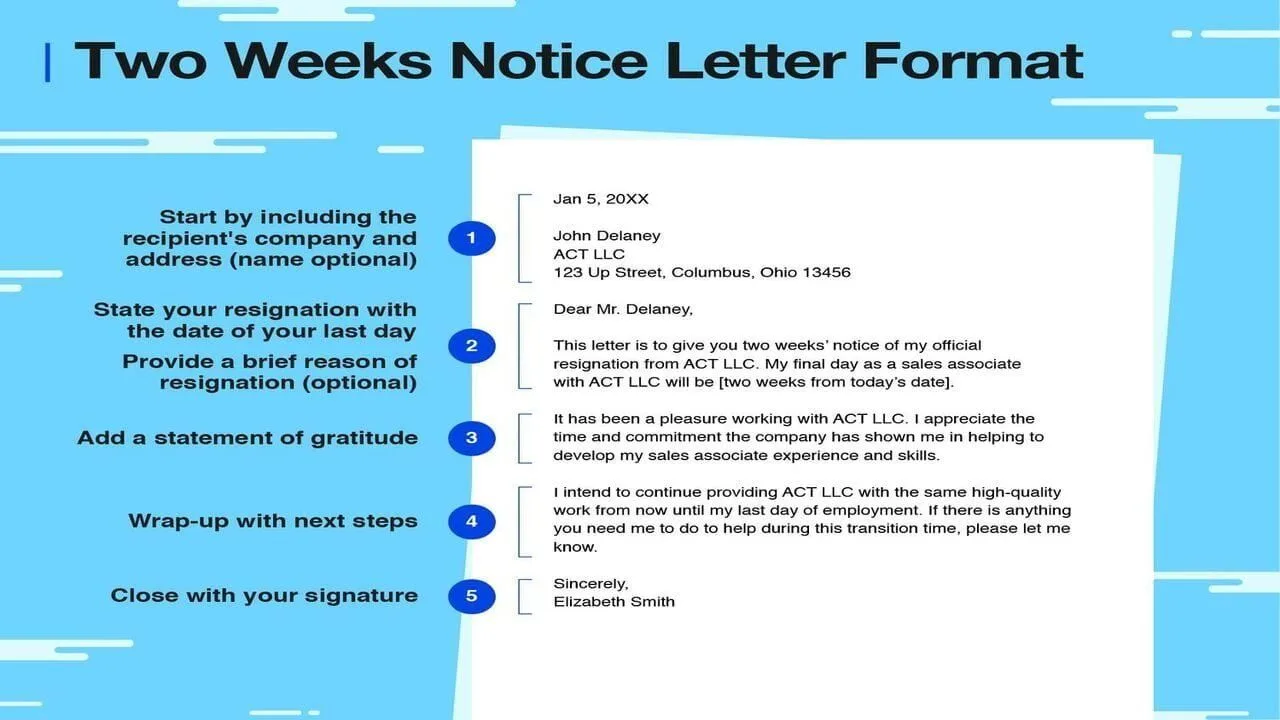
Writing a two weeks notice email is a professional milestone that most people will cross several times in their career, and yet it is the kind of email that almost nobody writes frequently enough to feel confident about. The stakes are real.
The email you send becomes part of your permanent personnel file, circulates among leaders who may cross paths with you again, and often shapes the reference your future employers receive. A rushed or emotional resignation email can shrink a ten-year positive relationship to a single awkward paragraph. A measured, warm, clearly worded resignation email can turn a departure into an open door.
This guide collects twelve resignation email templates covering every realistic scenario - a standard amicable departure, a short-notice situation where two weeks is not possible, a move for a better opportunity, a relocation, a health-related departure, a resignation after a promotion was denied, a resignation from a toxic situation, and several more. Each template is ready to copy, adjust the details, and send.
What a Good Resignation Email Actually Does
Before the templates, a short orientation. A two weeks notice email is not a venue for feedback, a last chance to vent, or a place to negotiate. It serves four specific purposes and nothing more.
- Formally notifies the employer of the intention to resign
- States the last working day clearly and unambiguously
- Offers a professional commitment to transition responsibilities well
- Creates a written record for HR and the personnel file
Any content beyond those four goals is either unnecessary or actively harmful to your interests. Save feedback for the exit interview. Save celebration for private conversations with friends. The resignation email itself should be short, gracious, and operational.
The resignation email is a door-shaping document. How you write it determines whether the door stays open, cracks open, or closes entirely behind you. The professionals who keep doors open their whole career write resignation emails that are short, specific, and free of emotion that belongs in a diary instead of an inbox.
The Three Rules That Apply to Every Resignation Email
Regardless of tone, industry, or circumstance, three rules hold:
- Tell your direct manager in a live conversation before sending the email
- State your last working day as a calendar date, not as a vague phrase
- Close with genuine thanks, even if you have to work to find something genuine
Tone Calibration Across Scenarios
Use the table below to match the tone of your resignation email to the reality of your situation. A formal resignation letter to a conservative employer is not the right shape for a two-year startup role, and vice versa.
| Scenario | Recommended Tone | Notice Length | Reason to Share |
|---|---|---|---|
| Standard departure, good relationship | Warm and grateful | 2 to 4 weeks | Brief, positive or neutral |
| Moving to a competitor | Formal and neutral | 2 weeks minimum | Do not name the employer |
| Relocation (family or personal) | Warm and grateful | 2 to 4 weeks | Honest, brief |
| Health reasons | Neutral and private | Short is acceptable | General terms only |
| Short notice (emergency) | Apologetic and brief | Whatever is possible | Honest but brief |
| Toxic environment | Cool and professional | 2 weeks | Do not share reason |
| After a promotion denial | Professional and brief | 2 weeks | Do not share reason |
| Retirement | Warm and reflective | 4 to 12 weeks | Full context welcome |
| Career change | Warm and grateful | 2 to 4 weeks | Brief, positive |
| Ending a contract role | Professional and short | Per contract | Reference contract |
Template 1: Standard Two Weeks Notice - Amicable Departure
Use this when you are leaving in good standing, your relationship with your manager is positive, and you want to preserve the bridge.
Subject: Resignation - [Your Full Name]
Dear [Manager First Name],
I am writing to formally notify you of my resignation from my position as [Your Title] at [Company Name]. My last working day will be [Last Working Day, Full Date], which provides two weeks of notice from today.
I want to say clearly that my time at [Company Name] has been genuinely meaningful. I have grown both professionally and personally, and I am grateful for the opportunities, mentorship, and trust I have received here.
Over the next two weeks, I am committed to ensuring a smooth transition. I will document my current projects, update any open items in our shared tools, and work with you to identify the right handoff paths. If there is anything specific you would like me to prioritize during the notice period, please let me know.
Thank you for your support. I hope to stay in touch.
Best regards, [Your Full Name]
Template 2: Short Notice Resignation - Less Than Two Weeks Possible
Use this when circumstances do not allow a full two weeks of notice. Be honest, apologetic, and offer concrete help to minimize disruption.
Subject: Resignation - [Your Full Name]
Dear [Manager First Name],
I am writing to let you know, with real regret about the timing, that I need to resign from my position as [Your Title]. Due to [Brief, honest reason - a family emergency, a health issue, an opportunity with an immediate start date], my last working day will need to be [Date], which is [Number] days from today.
I understand this is shorter than the standard notice period, and I am sorry for the additional burden it creates. To make the transition as smooth as possible in the time available, I will:
- Complete [Specific in-flight task] before my last day
- Document all current projects and shared [Specific tools or accounts]
- Be available for up to [Number] hours of transition support in the week after my departure if that would be useful
Thank you for your understanding, and for the opportunities I have had here. I hope we can stay in contact.
Respectfully, [Your Full Name]
Template 3: Resignation for a Better Opportunity
Use this when you are leaving for another role and want to be honest without sharing unnecessary detail.
Subject: Resignation - [Your Full Name]
Dear [Manager First Name],
Please accept this email as formal notice of my resignation from my position as [Your Title] at [Company Name]. My final day will be [Last Working Day, Full Date].
I have accepted a role that is a strong fit for the direction I want to take my career. It was a difficult decision given how much I have valued my time here and the people I have worked with.
Over the next two weeks I will focus on transitioning my responsibilities as cleanly as possible. I have already started drafting handoff documents for [Key Projects] and will align with you on priorities for the remainder of the notice period.
Thank you for the opportunities, the trust, and the mentorship you have offered during my time on the team.
With gratitude, [Your Full Name]
Template 4: Resignation for Relocation
Use this when you are leaving because you or your family is moving.
Subject: Resignation - [Your Full Name]
Dear [Manager First Name],
I am writing to let you know that I am resigning from my position as [Your Title], effective [Last Working Day, Full Date]. Due to [Family, Personal] circumstances, my household will be relocating to [City or region, if you are comfortable sharing], and after careful consideration I have decided not to pursue remote continuation of my role.
I want you to know that this decision is about geography, not about the company or the team. My time at [Company Name] has been one of the most meaningful chapters of my career, and I will carry forward what I have learned here into whatever comes next.
Over the next two weeks I will prioritize a complete transition. I have already begun documenting [Specific items], and I am happy to propose a handoff plan for your review.
Thank you for everything.
Warmly, [Your Full Name]
Template 5: Resignation for Health Reasons
Use this when health circumstances are requiring you to leave. Keep details general and preserve privacy.
Subject: Resignation - [Your Full Name]
Dear [Manager First Name],
After careful reflection, I am resigning from my role as [Your Title] at [Company Name], effective [Last Working Day, Full Date], in order to address a health matter that requires my full attention.
I am grateful for my time here and for the support I have received from you and the broader team. I have given serious thought to whether a leave of absence or reduced schedule could work, and I have concluded that a clean exit is the right path for me and for the team.
During the next two weeks I will document my current work and hand off responsibilities to the people you identify. If you would prefer I wrap up sooner, I can accommodate that as well.
Thank you for your understanding and your leadership.
Sincerely, [Your Full Name]
Template 6: Grateful Resignation After a Long Tenure
Use this when you have spent several years or more at the company and the relationship has been genuinely formative.
Subject: Resignation - [Your Full Name]
Dear [Manager First Name],
After [Number] years at [Company Name], I am writing to formally notify you of my resignation from my position as [Your Title]. My last working day will be [Last Working Day, Full Date].
It is hard to capture how much this chapter has meant to me. When I joined in [Year], I was [Role or level at joining]. The opportunities I have been given, the colleagues I have worked with, and the trust I have received have shaped me in ways I will continue to appreciate long after I leave.
The decision to move on is about pursuing [A short, honest description of what is drawing you forward]. It is not a reflection of anything lacking here.
Over the next two weeks, and in any reasonable time after that, I am committed to ensuring a smooth transition. I have begun preparing transition documents for [Key Projects] and I will work with you to sequence the handoff in whatever order is most useful for the team.
Thank you, deeply. I hope our paths cross again.
With gratitude, [Your Full Name]
Template 7: Formal Resignation for a Corporate or Regulated Environment
Use this when you work in law, finance, healthcare, or government where formal written resignation is expected.
Subject: Notice of Resignation - [Your Full Name]
Dear [Manager First Name],
Please accept this letter as formal notice of my resignation from my position as [Your Title] at [Company Name]. In accordance with [Reference to contract clause if applicable, or the standard two weeks notice], my final day of employment will be [Last Working Day, Full Date].
I will ensure that all matters currently under my responsibility are properly documented, transitioned, or closed by my final day. I will coordinate with [Relevant Manager Name or HR Contact] to confirm the return of company property, the transfer of access credentials, and any other administrative matters required by [Company Name] policy.
I am grateful for the opportunity to have served in this role and for the professional experience I have gained during my tenure. Please let me know how you would like to structure the transition, and I will align accordingly.
Respectfully, [Your Full Name] [Employee ID, if applicable]
Template 8: Resignation After a Promotion or Role Denial
Use this when you are leaving because an internal opportunity did not materialize. Do not mention that reason in the email.
Subject: Resignation - [Your Full Name]
Dear [Manager First Name],
I am writing to formally notify you of my resignation from my position as [Your Title] at [Company Name]. My last working day will be [Last Working Day, Full Date].
I am grateful for the experience and growth I have had here. After careful consideration, I have decided that it is the right time for me to pursue the next chapter of my career in a different setting.
I am committed to leaving the team in as strong a position as possible. Over the next two weeks I will focus on transition documentation, handoffs, and any specific priorities you identify.
Thank you for the time I have spent on this team.
Best regards, [Your Full Name]
Template 9: Resignation from a Difficult or Toxic Situation
Use this when the working environment has been unhealthy but you still want to leave cleanly. Resist the urge to explain; protect your own future.
Subject: Resignation - [Your Full Name]
Dear [Manager First Name],
This email is my formal notice of resignation from my position as [Your Title] at [Company Name], effective [Last Working Day, Full Date].
I will complete the outstanding work on my plate to the best of my ability within the notice period and will coordinate with you on handoff priorities. I will also work with HR on any administrative requirements, the return of equipment, and the closure of accounts.
I wish the team well going forward.
Regards, [Your Full Name]
Template 10: Resignation Sent Simultaneously to HR and Manager
Use this when company policy requires HR to be copied on any resignation notice, or when you want the HR record to be created immediately.
Subject: Resignation - [Your Full Name]
Dear [Manager First Name] and [HR Contact Name],
Please accept this email as formal notice of my resignation from my position as [Your Title] at [Company Name]. My last working day will be [Last Working Day, Full Date].
I have shared this news with [Manager First Name] directly, and I am copying [HR Contact Name] to ensure the HR record is created in alignment with company policy.
I am committed to a professional transition. During the notice period I will:
- Document all active projects and shared accounts
- Coordinate handoffs with [Manager First Name] and the team
- Complete any HR off-boarding steps on schedule
- Return all company equipment on or before my last day
Thank you for the opportunity to be part of [Company Name].
Sincerely, [Your Full Name]
Template 11: Resignation from a Remote Role
Use this when the entire relationship has been remote and logistics like equipment return need to be addressed up front.
Subject: Resignation - [Your Full Name]
Dear [Manager First Name],
I am writing to give formal notice of my resignation from my position as [Your Title]. My last working day will be [Last Working Day, Full Date].
Since my role has been fully remote, I wanted to address logistics up front:
- I will return my [Laptop Model], [Monitor], and any other company-issued equipment via prepaid shipping arranged with IT. I will coordinate with [IT Contact] on the return label and timing.
- I will close out access to shared accounts, cloud documents, and messaging platforms under the guidance of [HR or IT Contact].
- I will be available on my usual hours and time zone until my last day for transition support.
I have enjoyed my time on the team and I am grateful for the trust that comes with remote work. Please let me know how I can make the transition as smooth as possible.
Thank you, [Your Full Name]
Template 12: Resignation with a Request for Extended Transition Help
Use this when you are willing and able to help the company beyond the standard notice period, either as a contractor or in a consulting capacity.
Subject: Resignation - [Your Full Name]
Dear [Manager First Name],
I am writing to formally notify you of my resignation from my position as [Your Title] at [Company Name], with my last working day as an employee being [Last Working Day, Full Date].
Given the scale of what I currently own, I want to offer an option beyond the standard notice period. If it would be helpful, I am willing to continue in a limited consulting or hourly capacity for up to [Number] weeks after my last day to complete the [Specific project or handoff], at a mutually agreed rate and scope.
If that is not useful for the team, no concern at all. In that case I will focus the next two weeks entirely on documentation and clean handoff.
Thank you for the opportunities and the experience I have had here. I hope we can stay in touch.
Best, [Your Full Name]
Timing and Sequencing Checklist
Resignation emails are rarely a single-email process. Use the checklist below as a reference sequence.
| Step | Timing | Who | Channel |
|---|---|---|---|
| Decision finalized and offer accepted (if any) | Day 0 | You | Private |
| Live conversation with manager | Day 0 or 1 | You and manager | Video or in-person |
| Resignation email sent | Within hours of the conversation | You | |
| HR notification (if not copied) | Same day | Manager or you | |
| Team announcement | Day 1 to 3 | Manager | Meeting or email |
| Handoff documentation begins | Week 1 | You | Shared drive or wiki |
| Final 1:1 with manager | Week 2 | You and manager | Video or in-person |
| Equipment return and access closure | Final day | You, HR, IT | Coordinated |
| Exit interview | Final day or week after | You and HR | Video or in-person |
A resignation is a project with its own critical path. Treating it as a single email is what causes the last two weeks to go poorly. Treating it as a sequence of communications, each written for a specific audience and outcome, is what makes the final weeks feel clean for everyone involved.
Things to Avoid in Every Resignation Email
A short list of patterns that reliably damage departing employees, even when the intent is good.
- Naming your new employer or sharing your new compensation
- Criticizing colleagues, clients, or leadership in the written record
- Using humor that could be misread
- Attaching lengthy explanations of your reasons
- Copying people who do not need to be copied
- Promising things you cannot deliver, such as on-call availability after departure
- Writing while emotional - always draft, wait at least one night, and reread before sending
The most expensive line in any resignation email is the one you wrote in frustration at 11 PM. Sleep on every resignation email before you send it. Your future self - asking for a reference, running into an old colleague, joining a new board - will thank you.
FAQ
Do I still owe two weeks if my relationship with the company is strained? Professionally, yes. Legally in most US states, no. Offering two weeks even in a difficult situation signals maturity and protects your reference network.
Should I resign by phone, video, or in person? The first conversation should be in person if possible, by video if remote, and by phone only if no other option exists. Email alone is a last resort.
Can I rescind a resignation after sending the email? Sometimes, but it creates long-lasting discomfort in the relationship. Only submit a resignation when you are certain.
What if my manager pressures me to extend the notice period? You are not obligated to extend, but consider the request seriously if it is reasonable and the relationship matters.
Will I burn a bridge if I leave for a competitor? Not if you resign professionally, decline to discuss the new role, and honor any non-compete or confidentiality terms in your contract.
Closing
A resignation email is never the most important moment in your career, but it is almost always one of the most remembered ones. The twelve templates above cover the scenarios most professionals will face at some point. Pick the closest match, personalize the specifics, and keep the tone short and gracious. The last email you send about a job should reflect the best version of you, not the version who is ready to be done.
Author: Kalenux Team
Frequently Asked Questions
Is two weeks notice legally required in the United States?
No. In the vast majority of US states, employment is at-will, which means both employers and employees can end the relationship at any time without legal notice. Two weeks is a cultural and professional norm, not a legal requirement. However, there are important exceptions to consider.
Employment contracts, particularly for executive roles, often specify a notice period ranging from 30 to 90 days.
Collective bargaining agreements and union contracts frequently include notice requirements. Some professional licenses, such as in healthcare, may carry notice obligations through the licensing body. And certain foreign jurisdictions require statutory notice periods that apply to local employees regardless of US company policy.
Always check your offer letter, employee handbook, and employment contract before assuming two weeks is sufficient. Even when only two weeks is required, offering three or four weeks for a senior or highly specialized role is often appreciated and strengthens the lasting impression you leave.
Should I tell my manager in person before sending the resignation email?
Yes, in almost every case. A resignation delivered only by email is considered poor form in most professional environments and can damage relationships that you will rely on for references, alumni networks, and future opportunities.
The professional sequence is a private conversation with your direct manager - by video or in person - followed immediately by a written resignation email that confirms the verbal notice and creates the formal record.
The verbal conversation should happen first, even if by minutes, because it allows your manager to absorb the news, ask initial questions, and decide how to communicate it to their own leadership and the team.
The only exceptions are situations where a private conversation is not safely possible, such as in cases of harassment, abuse, or when the manager is unreachable for an extended period. In those cases, send the email and follow up in writing with HR.
What should I include in the subject line of a resignation email?
Keep the subject line simple and professional. The most widely accepted format is Resignation - [Your Full Name]. Some people prefer Notice of Resignation - [Your Full Name] or Two Weeks Notice - [Your Full Name]. Any of these are acceptable. Avoid subject lines that are casual, emotional, or ambiguous such as Moving on, Quick question about my role, or It has been real.
The subject line is often scanned by HR systems and referenced in formal records, so clarity and professionalism matter. Do not include your reason for leaving, the name of your next employer, or any negative commentary in the subject line. That level of detail, if shared at all, belongs in the body of the email or in a separate conversation.
Should I state my reason for leaving in the resignation email?
You should mention a high-level reason if it is positive or neutral, but you are never obligated to explain. Phrases like I have accepted a role that aligns with my long-term career goals, I am relocating to be closer to family, or I am taking time to focus on a personal project are appropriate and often appreciated.
If the reason is negative - a bad manager, a toxic culture, burnout, or ethical concerns - the resignation email is not the place to share it. Save that feedback for the exit interview, where it can be delivered in a structured setting and where you have the option to control how it is documented.
Never name your new employer or disclose compensation in the resignation email, even if asked directly. That information belongs in a private conversation with your manager, and only if you choose to share it.
What happens if my employer asks me to leave immediately after I give notice?
Many employers, particularly in sales, finance, and technology, will walk an employee out the same day notice is given. This is standard practice and does not reflect poorly on the departing employee. If this happens, you are still entitled to be paid for the notice period in most cases - this is called garden leave or paid notice - and you retain any statutory benefits until your official end date.
If you are walked out, remain professional. Do not attempt to download data, email files to personal accounts, or contact clients after notice is given, as these actions can trigger legal consequences under non-compete and confidentiality agreements.
Confirm in writing what your final pay date will be, how unused vacation will be handled, and how your benefits will end or transition. If the company asks you to leave immediately and refuses to pay out the notice period, consult an employment attorney before accepting that outcome, particularly if your contract specified a longer notice period.